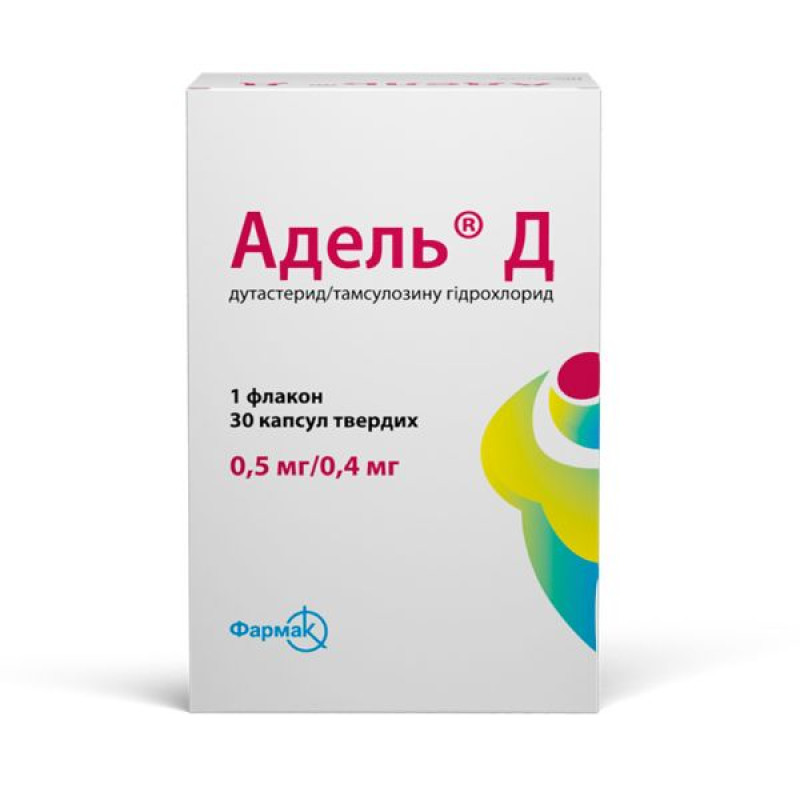
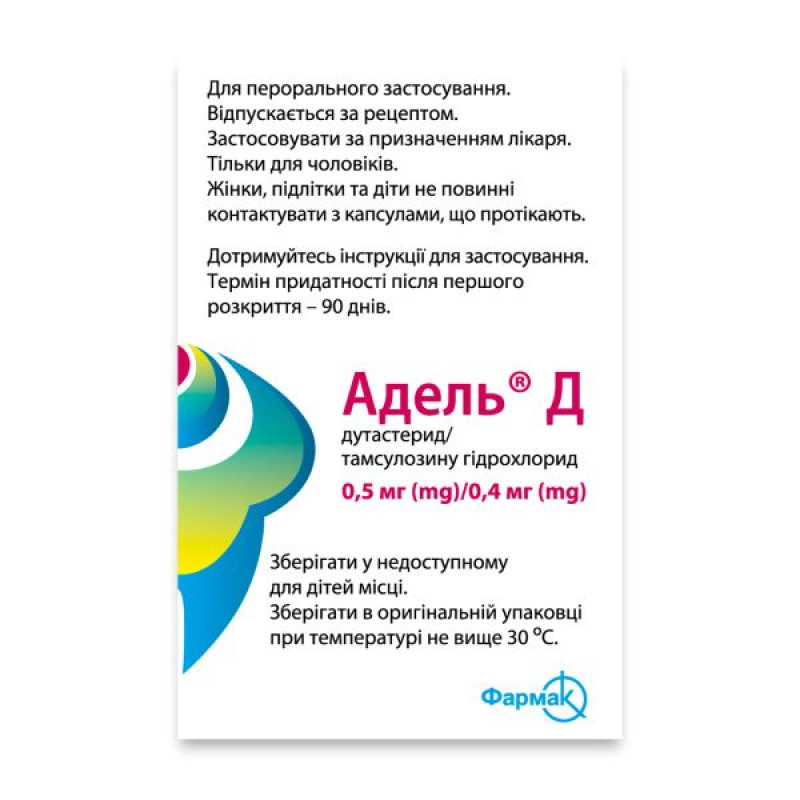
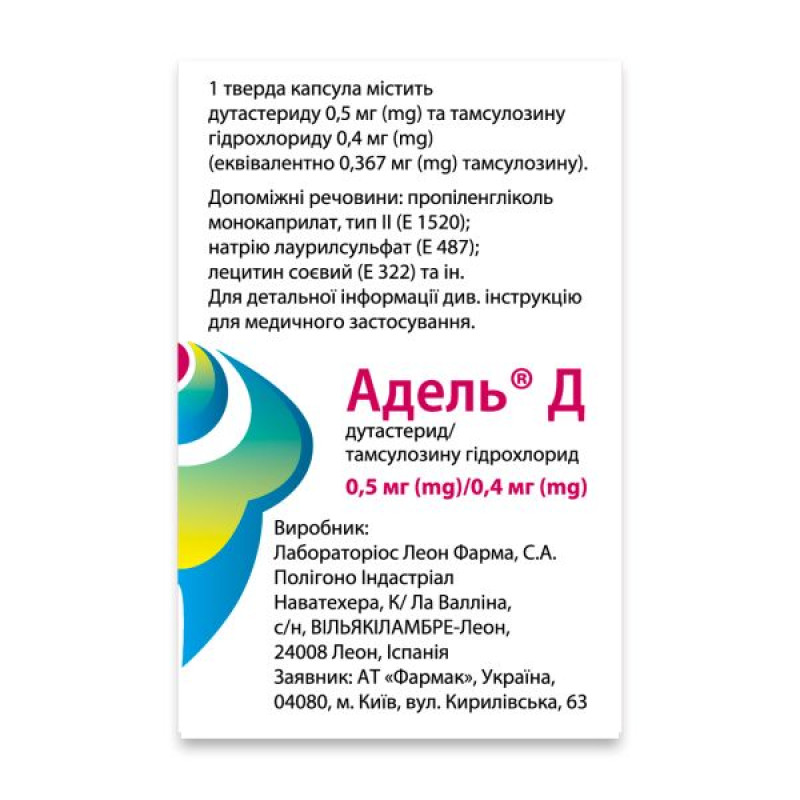
Instructions for use Adel D hard capsules 0.5 mg + 0.4 mg bottle No. 30
Composition
active ingredients: dutasteride, tamsulosin hydrochloride;
1 hard capsule contains dutasteride 0.5 mg and tamsulosin hydrochloride 0.4 mg (equivalent to 0.367 mg tamsulosin);
excipients:
hard capsule shell: gelatin (type B); titanium dioxide (E 171); iron oxide yellow (E 172); iron oxide black (E 172); iron oxide red (E 172);
Contents of the dutasteride soft capsule: propylene glycol monocaprylate (type II), equivalent to 112.65 mg propylene glycol (E 15 20); butylhydroxytoluene (E 321);
soft capsule shell: gelatin (type B); glycerol (E 422); titanium dioxide (E 171); medium chain triglycerides; soya lecithin (E 322);
tamsulosin pellets: methacrylic acid and polymerized ethyl acrylate 1:1 30% dispersion with sodium lauryl sulfate (E 487) and polysorbate 80 (E 433); microcrystalline cellulose (E 460); dibutyl sebacate; colloidal silicon dioxide aqueous (E 551); calcium stearate;
black ink: shellac (E 904), black iron oxide (E 172); propylene glycol (E 1520),
concentrated ammonia solution (E 527), potassium hydroxide (E 525).
Dosage form
The capsules are hard.
Main physicochemical properties: hard gelatin capsule of elongated shape No. OEL approximately 24.2 x 7.7 mm, with a brown body and a beige cap with C001 marking in black ink on the cap.
Capsule contents: oblong soft gelatin capsule (approximately 16.5 x 6.5 mm) of light yellow color, filled with clear liquid and white or almost white tamsulosin granules.
Pharmacotherapeutic group
Drugs used in benign prostatic hyperplasia. α1-adrenoceptor antagonist. ATC code G04CA52.
Pharmacological properties
Pharmacodynamics.
Mechanism of action
Adel® D is a combination of two drugs with complementary mechanisms of action for the relief of symptoms in patients with benign prostatic hyperplasia (BPH): dutasteride, a dual 5-alpha-reductase inhibitor (5-ARI), and tamsulosin hydrochloride, an alpha-1α-adrenoceptor antagonist.
Dutasteride
Dutasteride inhibits 5-ARB type 1 and type 2 isoenzymes, which are responsible for the conversion of testosterone to 5-alpha-dihydrotestosterone, which leads to a decrease in the level of dihydrotestosterone (DHT) in the blood and prostate. DHT is the main androgen responsible for glandular tissue hyperplasia in the prostate gland.
Dutasteride reduces the size of the prostate gland, relieves symptoms, improves urine output, and reduces the risk of acute urinary retention and the need for surgery.
Tamsulosin
Tamsulosin is a selective alpha-1-adrenoceptor antagonist used for the symptomatic treatment of functional symptoms of BPH. It selectively and competitively binds to postsynaptic alpha-1-adrenoceptors (in particular, the alpha-1α subtype - approximately 75% of alpha-1 receptors in the prostate are of the alpha-1α subtype), which are responsible for the contraction of smooth muscle of the prostate and urethra. Tamsulosin therefore reduces the tone of the smooth muscles of the prostate and urethra. As a result, the maximum urine flow rate increases and the obstruction of the urinary tract decreases. In addition, it relieves the symptoms of irritation and obstruction, in which bladder instability and tension of the smooth muscles of the lower urinary tract play a key role.
Effects on DHT/testosterone
The maximum effect of dutasteride, manifested in the form of a decrease in DHT, is dose-dependent and occurs within 1-2 weeks. After one and two weeks of taking dutasteride (0.5 mg/day), the average concentration of DHT in the blood serum decreased by 85% and 90%, respectively; after one and two years they were 94% and 93%, respectively. After discontinuation of treatment, the concentration of DHT in the blood serum, which correlates with clinical effects, returns to baseline values after about 4 months.
The mean increase in serum testosterone levels was 19% after 1 and 2 years. Testosterone concentrations were within normal physiological values.
Alpha-1-adrenergic blockers can lower blood pressure by reducing peripheral resistance.
Clinical efficacy
Studies of the efficacy of the fixed combination of dutasteride-tamsulosin have not been conducted.
The statements below reflect the available information on the concomitant use of dutasteride (0.5 mg/day) and tamsulosin (0.4 mg/day).
The primary efficacy endpoint at 4 years was time to first occurrence of acute urinary retention or BPH-related surgery. After 4 years of treatment, combination therapy significantly reduced the risk of acute urinary retention or BPH-related surgery (by 65.8% [95% CI 54.7% to 74.1%]) compared with tamsulosin monotherapy (p<0.001). Compared with dutasteride monotherapy, the risk reduction was 19.6% (95% CI -10.9% to 41.7%), with no statistically significant difference between the two treatment groups. The incidence of acute urinary retention or surgery related to BPH at 4 years was 4.2% for combination therapy, 11.9% for tamsulosin monotherapy (p < 0.001), and 5.2% for dutasteride monotherapy.
The secondary endpoint was the change from baseline in the International Prostate Symptom Score (IPSS). After 2 years, the combination therapy already showed a statistically significant mean improvement in symptom score of -6.2 points compared to baseline, and the difference compared to monotherapy was significant after 3 months for dutasteride and 9 months for tamsulosin. This improvement in symptoms could be maintained with combination therapy until the end of the 4-year treatment period. After 4 years, the mean improvement in symptom score was -6.3 points with combination therapy, -5.3 points with dutasteride monotherapy (p < 0.001) and -3.8 points with tamsulosin monotherapy (p < 0.001).
After 4 years, the mean increase from baseline in maximal urine output (Qmax) was 2.4 mL/sec for combination therapy, 2.0 mL/sec for dutasteride, and 0.7 mL/sec for tamsulosin. The mean improvement from baseline in IVP (BPH impact index) was -2.2 points for combination therapy, -1.8 points for dutasteride, and -1.2 points for tamsulosin.
Although combination therapy resulted in sustained symptom improvement over the 4 years of the study compared with dutasteride monotherapy, the greatest benefit of combination therapy was observed during the first 12 months of treatment, which may be explained by the known rapid onset of action of alpha-receptor blockers.
Dutasteride monotherapy
Clinical safety
Prostate cancer (especially high-grade tumors)
In a 4-year comparison of placebo and dutasteride (REDUCE study in 8231 men aged 50 to 75 years with a previous negative prostate cancer biopsy and baseline PSA between 2.5 ng/mL and 10.0 ng/mL (men aged 50 to 60 years or 3 ng/mL and 10.0 ng/mL (men aged 60 years and older), 6706 study participants had prostate needle biopsy data, primarily per protocol, i.e. not due to symptoms or clinical suspicion of disease), available for analysis to determine Gleason scores. 1517 study participants were diagnosed with prostate carcinoma. The majority of prostate carcinomas detected by biopsy in both treatment groups were diagnosed as low-grade (Gleason 5-6, 70%).
A higher incidence of prostate carcinoma with Gleason score 8-10 was observed in the dutasteride group (n=29, 0.9%) compared to the placebo group (n=19, 0.6%) (p=0.15). At 1-2 years, the number of patients with Gleason score 8-10 was similar in the dutasteride group (n=17, 0.5%) and the placebo group (n=18, 0.5%). At 3-4 years, more cases of Gleason score 8-10 were diagnosed in the dutasteride group (n=12, 0.5%) compared to the placebo group (n=1, <0.1%) (p=0.0035). Data beyond 4 years are not available. The percentage of study participants diagnosed with Gleason 8-10 cancer was consistent across both study periods (years 1-2 and 3-4) in the dutasteride group (0.5% in each period), whereas in the placebo group the percentage of study participants diagnosed with Gleason 8-10 cancer was lower in years 3-4 than in years 1-2 (<0.1% vs. 0.5%). There was no statistically significant difference in the incidence of Gleason 7-10 cancer between dutasteride and placebo.
After the REDUCE trial, patients were followed for an additional 2 years. Most patients were no longer receiving 5-alpha-reductase inhibitors during this time. In 216 of these patients, a prostate biopsy was performed for clinically suspected disease. During these 2 years, the incidence of prostate cancer was 1.2% in the former dutasteride group and 0.7% in the former placebo group. No cases of Gleason 8-10 tumors were diagnosed during this period.
In the 4-year BPH trial (CombAT), where biopsy was performed non-protocol and all diagnoses of prostate carcinoma were based on biopsy specimens for cause, the incidence of Gleason 8-10 cancer was 0.5% for dutasteride (n=8), 0.7% for tamsulosin (n=11), and 0.3% for combination therapy (n=5).
There is currently no position on a potential causal relationship between dutasteride and high-grade prostate carcinoma, and the clinical significance of the equivocal data is currently unknown.
Several epidemiological studies have not found an increase in prostate cancer mortality with the use of 5-alpha-reductase inhibitors.
In the 2-year clinical trials of dutasteride monotherapy, which achieved a total of 3374 patient-years of exposure to dutasteride, as well as during the 2-year unregistered open-label extension study, 2 cases of breast carcinoma were identified in patients treated with dutasteride and 1 case in a patient treated with placebo. Corresponding observations have also been reported in the postmarketing period. However, in the two 4-year studies CombAT and REDUCE (totaling 17489 patient-years of exposure to dutasteride alone and 5027 patient-years of exposure to dutasteride and tamsulosin in combination), there were no additional cases of breast cancer in either treatment group.
Pharmacokinetics.
Single-dose bioequivalence studies were performed under both fasting and fed conditions. For the tamsulosin component of the dutasteride-tamsulosin combination, a 30% decrease in Cmax was observed after feeding compared to the fasted state. A 30% reduction in food intake had no effect on the AUC of tamsulosin. Food intake does not affect the bioavailability of dutasteride.
Absorption
Dutasteride
After a single oral dose of 0.5 mg dutasteride, the time to peak serum concentration was 1-3 hours. Absolute bioavailability was approximately 60% compared to a 2-hour intravenous infusion.
Tamsulosin
Tamsulosin hydrochloride is absorbed from the gastrointestinal tract and is almost completely bioavailable. Peak plasma concentrations of tamsulosin are reached 6 hours after a single dose taken after a meal.
Tamsulosin hydrochloride has linear absorption kinetics. Steady-state concentrations are reached after approximately 5 days of once-daily dosing. The rate of absorption of tamsulosin hydrochloride is reduced if food has recently been taken. Consistent administration of tamsulosin hydrochloride 30 minutes after the same meal each day may promote uniform absorption.
Plasma levels of tamsulosin show significant interindividual variability after both single and multiple dosing.
Equilibrium state
Dutasteride
Steady-state serum concentrations (Css) of approximately 40 ng/ml are achieved after 6 months of daily dosing with 0.5 mg dutasteride. After 1 month, dutasteride serum levels reach 65% and after 3 months, approximately 90% of steady-state concentrations.
Steady state concentration in semen is also reached after 6 months.
Distribution
Dutasteride
Dutasteride has a large volume of distribution (300-500 L) and high plasma protein binding (> 99.5%; albumin and alpha-1-acid glycoprotein).
After 12 months of treatment, the mean concentration of dutasteride in semen was 3.4 ng/ml (range: 0.4-14 ng/ml), i.e. an average of 11.5% of the serum level.
Tamsulosin
The volume of distribution of tamsulosin hydrochloride is low (approximately 0.2 l/kg). Tamsulosin hydrochloride is highly bound (94% to 99%) to human plasma proteins, primarily alpha-1-acid glycoprotein (AAG).
Metabolism
Dutasteride
Dutasteride is extensively metabolized. It is primarily hydroxylated and dehydrated to inactive metabolites. 4 major and 6 minor metabolites have been identified. In vitro, the drug was hydroxylated by CYP3A4.
Tamsulosin
Tamsulosin hydrochloride is extensively and slowly metabolized in the liver by cytochrome P450 enzymes. In vitro data indicate that CYP3A4 and CYP2D6, as well as some other CYP isoenzymes, are involved to a lesser extent in the metabolism of tamsulosin. However, the main part of it is found in plasma as the parent compound. No metabolite is more active or toxic than the parent compound. Before excretion in the urine, the metabolites of tamsulosin hydrochloride undergo conjugation with glucuronide or sulfate.
Breeding
Dutasteride
5.4% of the administered dose is excreted unchanged in the feces; the remainder is excreted as metabolites. Only traces (less than 0.1% of the dose) of the parent compound can be detected in the urine.
Dutasteride clearance is low. The half-life is 3-5 weeks.
Tamsulosin
After oral administration of tamsulosin modified-release capsules, the elimination half-life after a single dose under fed conditions was approximately 10 hours, or approximately 13 hours from steady state. Approximately 10% of the parent compound is excreted unchanged in the urine.
Kinetics in specific patient groups
Pharmacokinetic studies of dutasteride-tamsulosin in separate groups have not been conducted. The following statements reflect the available information on the individual components.
Liver dysfunction
Dutasteride
The effect of hepatic insufficiency on the pharmacokinetics of dutasteride has not been studied (see section 4.4).
Tamsulosin
No clinically significant changes in the pharmacokinetics of tamsulosin hydrochloride were observed in patients with mild to moderate hepatic impairment (Child-Pugh A or B). The pharmacokinetics of tamsulosin hydrochloride have not been studied in patients with severe hepatic impairment (Child-Pugh C).
Kidney dysfunction
Dutasteride
The effect of renal impairment on the pharmacokinetics of dutasteride has not been studied. Since less than 0.1% of the dose is excreted in the urine, no effect on serum levels is expected.
In patients with mild to moderate (30 < CLcr < 70 mL/min/1.73 m²) or moderate to severe (10 < CLcr < 30 mL/min/1.73 m²) renal impairment, no clinically significant changes in the pharmacokinetics of tamsulosin were observed compared to patients with normal renal function. Patients with end-stage renal disease (CLcr < 10 mL/min/1.73 m²) were not studied.
Elderly patients
Dutasteride
There are no statistically significant differences in pharmacokinetics in patients aged > 50-65 years and > 70 years compared to younger subjects.
Tamsulosin
The data obtained show that in patients aged 55-75 years, the total exposure is approximately 40% higher than in younger men.
Indication
Treatment of moderate to severe symptoms of benign prostatic hyperplasia (BPH).
Reducing the risk of acute urinary retention and the need for surgery in patients with moderate to severe symptoms of BPH.
Contraindication
- History of orthostatic hypotension;
-severe liver failure;
- women, children and adolescents (see sections “Use during pregnancy or breastfeeding” and “Children”);
- hypersensitivity to tamsulosin, dutasteride, other components of the drug or other 5-alpha-reductase inhibitors;
-hypersensitivity to peanuts or soy. Adel® D contains soy lecithin, which may contain traces of soy protein.
Interaction with other medicinal products and other types of interactions
Interaction studies with the combination of dutasteride and tamsulosin have not been conducted. The following statements reflect the available information on the individual components.
Pharmacokinetic interactions
Interactions with the CYP450 enzyme system
Dutasteride
Dutasteride is metabolized by CYP3A4. The decrease in clearance caused by concomitant use of CYP3A4 inhibitors is not considered clinically significant due to the wide therapeutic range. In vitro, the drug is not metabolized by CYP1A2, CYP2A6, CYP2D6, CYP2E1, CYP2C8, CYP2C9, CYP2C19, or CYP2B6. Dutasteride does not inhibit cytochrome P450 enzymes in vitro and does not induce cytochrome P450 enzymes in studies in rats and dogs.
Tamsulosin
Concomitant use of tamsulosin with CYP3A4 or CYP2D6 inhibitors may lead to increased exposure to tamsulosin. Concomitant use with ketoconazole (a potent CYP3A4 inhibitor) resulted in a 2.2- and 2.8-fold increase in Cmax and AUC of tamsulosin, respectively.
Concomitant use with paroxetine (a potent CYP2D6 inhibitor) resulted in an increase in Cmax and AUC of tamsulosin by 1.3 and 1.6 times, respectively.
The effects of concomitant use of both CYP3A4 and CYP2D6 inhibitors in patients treated with tamsulosin have not been clinically evaluated. In this case, a significant increase in tamsulosin exposure is possible.
Interaction with oral anticoagulants
Dutasteride
Dutasteride has not been shown to affect the binding of warfarin, acenocoumarol, or phenprocoumon to plasma proteins in vitro.
Tamsulosin
No interaction studies have been conducted between tamsulosin hydrochloride and warfarin. Tamsulosin did not affect the pharmacokinetics or efficacy of acenocoumarol in healthy volunteers. The effect of acenocoumarol on the pharmacokinetics of tamsulosin has not been studied. There are no interaction studies with phenprocoumon. In patients receiving oral anticoagulants, INR values should be closely monitored for 2-3 months at the start and at the end of treatment with dutasteride-tamsulosin.
Other pharmacokinetic interactions
Dutasteride
No clinically significant pharmacokinetic or pharmacodynamic interactions were observed between dutasteride and tamsulosin, terazosin, warfarin, digoxin, or cholestyramine. Dutasteride did not displace diazepam or phenytoin from plasma proteins in vitro and was not itself displaced.
Tamsulosin
Concomitant administration of tamsulosin hydrochloride and furosemide resulted in a decrease in Cmax and AUC of tamsulosin hydrochloride by 11-12%. These changes are not considered clinically significant and no dose adjustment is required.
In clinical studies, tamsulosin did not affect the pharmacokinetics of atenolol, digoxin, enalapril, nifedipine or theophylline.
Pharmacodynamic interactions
Tamsulosin
In three studies in patients with hypertension controlled with atenolol, enalapril or nifedipine, tamsulosin had no significant effect on blood pressure compared with placebo.
Application features
Before starting treatment with Adel® D, the patient should be examined to exclude other causes of the symptoms.
Due to the risk of adverse reactions to both active substances, Adel® D should only be used after a careful assessment of the benefits and risks for the patient, as well as a thorough analysis of other treatment options (e.g. monotherapy).
Patients with significant residual urine volume and/or severe urinary incontinence should be closely monitored for acute or chronic signs of urinary retention.
Examinations to exclude prostate cancer, including digital rectal examination, should be performed before starting therapy with Adel® D. These examinations should be repeated at regular intervals during therapy.
Results from two long-term clinical trials (the dutasteride REDUCE study and the finasteride PCRT study) in men at high risk of developing prostate cancer showed a higher incidence of prostate carcinoma (Gleason score 8-10) in men treated with a 5-alpha-reductase inhibitor (dutasteride or finasteride) compared to placebo (see section 5.1).
The association between 5-alpha-reductase inhibitors and high-grade prostate cancer is currently unknown. Patients taking Adel® D should be regularly examined for potential signs of prostate cancer, including a PSA test.
Prostate-specific antigen (PSA) changes
Serum PSA levels are an important component in the early detection of prostate cancer. Treatment with the combination of dutasteride and tamsulosin causes a mean decrease in serum PSA levels of approximately 50% after 6 months of treatment (with significant interindividual variation, standard deviation 30%). As a result, PSA levels within the normal range in patients receiving dutasteride and tamsulosin do not rule out prostate carcinoma.
Therefore, a new PSA measurement should be performed after 6 months of treatment with Adel® D, and the result of this measurement should be used as a baseline for future tests. Any confirmed increase in PSA levels compared to the lowest level during treatment with dutasteride-tamsulosin may indicate the presence of prostate carcinoma or poor compliance and should therefore be carefully evaluated, even if these values are still within the normal range for men not taking 5-alpha reductase inhibitors. When interpreting PSA values for a patient taking dutasteride, previous PSA values should be sought for comparison.
PSA levels return to baseline within 6 months after stopping treatment.
The ratio of free to total PSA remains unchanged during dutasteride-tamsulosin therapy. If the physician decides to use the percentage of free PSA as an aid in the detection of prostate carcinoma, then during treatment with Adel® D, no adjustment of the measured value is necessary.
Breast carcinoma
Male breast cancer is very rare in the general population. Rare cases of breast cancer have been reported in men treated with dutasteride in both clinical trials and post-marketing experience. However, two epidemiological studies have shown that patients treated with 5-alpha reductase inhibitors (dutasteride or finasteride) were not at increased risk of developing breast cancer. It is not yet clear whether there is a causal relationship between long-term use of a 5-alpha reductase inhibitor and the occurrence of breast cancer in men.
However, the prescribing physician should advise patients to immediately report any changes in breast tissue (e.g., lumps) or nipple discharge.
Intraoperative atonic iris syndrome
Intraoperative atonic iris syndrome (ISAS) has been reported in some patients undergoing ophthalmic surgery (cataract and glaucoma surgery) treated with alpha-1-adrenergic blockers such as tamsulosin. ISAS is characterized by an atonic iris, progressive intraoperative miosis despite pre-treatment with standard mydriatic agents, and potential iris prolapse in the direction of the phacoemulsification incision. ISAS may increase the risk of ocular complications during and after surgery, and the surgeon should be prepared to adjust surgical techniques accordingly if necessary.
It is not recommended to initiate tamsulosin treatment in patients who are scheduled to undergo eye surgery in the near future. However, it is unknown whether there is a beneficial effect after stopping tamsulosin 1-2 weeks before the procedure. There have also been reports of ISA in patients who stopped taking tamsulosin some time before the procedure.
Hypotension
During treatment with alpha-1-adrenoceptor blockers such as tamsulosin, orthostatic hypotension may develop, which in isolated cases can lead to fainting. Particular caution is required when prescribing the drug to patients who have already experienced hemodynamic hyperreactions during previous therapy with alpha-1-adrenoceptor blockers, as well as to patients receiving antihypertensive therapy. Theoretically, there is a risk of increased hypotensive effects when tamsulosin hydrochloride is used simultaneously with antihypertensive drugs such as anesthetics, phosphodiesterase 5 (PDE5) inhibitors or other alpha-1-adrenoceptor blockers. Therefore, Adel® D is not recommended for use in combination with other alpha-1-adrenoceptor blockers and should be used with caution in combination with PDE5 inhibitors.
Patients who have started treatment with Adel® D should be warned that they should sit or lie down at the first signs of orthostatic hypotension (dizziness) until the symptoms disappear.
Cardiovascular side effects
In two 4-year studies, cases of heart failure (acute or chronic) were observed more often with the combination of dutasteride and alpha-blockers (primarily tamsulosin) than with dutasteride or alpha-blocker monotherapy (incidence 0.1% with dutasteride, 0.2% with alpha-blocker and 0.6% with the combination). However, the overall number of cardiovascular adverse reactions did not differ between the three treatment groups. At present, there is no evidence of a causal relationship between the use of the drugs and the occurrence of heart failure, especially since most patients had underlying diseases such as arterial hypertension or coronary heart disease. In some cases, symptoms of heart failure appeared only after more than one year of therapy.
A meta-analysis of data from a total of n=8,802 patients from 12 randomized placebo- or active-controlled clinical trials found no consistent and statistically significant increase in the relative risk of heart failure (HR 1.05; 95% CI 0.71-1.57), acute myocardial infarction (HR 1.00; 95% CI 0.77-1.30) or cerebrovascular events (HR 1.20; 95% CI 0.88-1.64).
Negative impact on the reproductive system
The simultaneous use of dutasteride and tamsulosin led to an increase in adverse reactions from the reproductive system and mammary glands compared to monotherapy with dutasteride or tamsulosin, especially at the beginning of treatment (i.e. during the first 6-12 months).
Relevant events identified in the 4-year CombAT study were as follows: impotence (combination: 6%, dutasteride: 5%, tamsulosin: 3%), altered (impaired) libido (combination: 5%, dutasteride: 4%, tamsulosin: 2%), ejaculation disorder (combination: 9%, dutasteride: 1%, tamsulosin: 3%).
Reproductive function
A fertility study with dutasteride in 50 volunteers showed, although with marked interindividual variation, a decrease in total sperm count, total sperm volume, and sperm motility, although the mean values remained within normal limits. Sperm concentration and morphology were unchanged. Two subjects demonstrated a 90% decrease in sperm count at 52 weeks, which partially recovered at the 24-week follow-up. The clinical significance of the effects of dutasteride on sperm properties and fertility in individual patients is unknown.
The effect of tamsulosin hydrochloride on sperm count or function has not been studied.
Liver dysfunction
The effect of hepatic insufficiency on the pharmacokinetics of dutasteride has not been studied. Dutasteride is extensively metabolized and has a half-life of 3 to 5 weeks, Adel® D should be used with caution in patients with mild to moderate hepatic impairment (see sections “Method of administration and dosage”, “Contraindications”).
Since there are also no adequate data on the use of tamsulosin in severe liver dysfunction, Adel® D is contraindicated in severe liver disease.
Kidney dysfunction
The effect of renal impairment on the pharmacokinetics of tamsulosin in patients with creatinine clearance <10 ml/min has not been studied. Therefore, Adel® D should be used with caution in these patients. There are no pharmacokinetic data on renal impairment for dutasteride; however, due to the minimal renal excretion of dutasteride, renal impairment is not expected to affect its pharmacokinetics.
CYP3A4 and CYP2D6 inhibitors (see section “Interaction with other medicinal products and other types of interactions”)
Concomitant use of tamsulosin with CYP3A4 inhibitors may increase tamsulosin exposure. In particular, poor CYP2D6 metabolisers receiving concomitant treatment with potent CYP3A4 inhibitors are at risk of significantly increased tamsulosin exposure. Since CYP2D6 polymorphisms are generally unknown outside of clinical trials, Adel® D should generally not be used in combination with potent CYP3A4 inhibitors (e.g. itraconazole, voriconazole, posaconazole, clarithromycin, indinavir, nelfinavir, saquinavir).
Adel® D should be used with caution in combination with moderate CYP3A4 inhibitors (e.g. erythromycin, fluconazole, verapamil, diltiazem). This is especially true when the patient is receiving a strong or moderate CYP2D6 inhibitor (e.g. paroxetine) or a drug that simultaneously inhibits CYP3A4 and CYP2D6 (e.g. amiodarone, cimetidine, imatinib).
Stopping taking Adel® D
When stopping Adel® D, the prostate gland may return to its size prior to the start of treatment. Therefore, patients should be closely monitored for recurrence of symptomatic prostate adenoma.
Skin contact with capsule contents
Since the active substance dutasteride is absorbed through the skin, contact with leaking capsules should be avoided. In case of contact with leaking capsules, the affected area should be washed immediately and thoroughly with soap and water.
Women who are pregnant or planning to become pregnant should not handle crushed or broken Adel® D capsules due to the potential absorption of dutasteride and possible risks to the male fetus (see section “Use during pregnancy or lactation”).
Dutasteride-tamsulosin has not been studied in patients with dysphagia (e.g., esophageal stenosis or neurological disorders associated with esophageal motility disorders). Therefore, caution should be exercised in such patients.
This medicine contains 112.65 mg of propylene glycol in each capsule.
This medicinal product contains less than 1 mmol sodium (23 mg) per hard capsule, i.e. essentially ‘sodium-free’.
Use during pregnancy or breastfeeding
Adel® D is contraindicated in women.
No studies have been conducted on the effects of dutasteride-tamsulosin on pregnancy and lactation.
The following statements reflect the available information about the individual components.
Pregnancy
5-alpha-reductase inhibitors may inhibit the development of external genitalia in male fetuses. Since dutasteride is absorbed through the skin, contact with it should be avoided during pregnancy (especially with leaking capsules). It is not known whether harm can be caused to a male fetus if the mother comes into contact with the semen of a man who has been treated with dutasteride.
Lactation
It is not known whether dutasteride or tamsulosin passes into human breast milk.
Ability to influence reaction speed when driving vehicles or other mechanisms
No studies have been conducted on the effects of dutasteride-tamsulosin on the ability to perform tasks requiring judgment or motor or cognitive abilities. However, patients should be advised that symptoms of orthostatic hypotension (e.g. dizziness) and visual disturbances may occur in some cases with the use of Adel® D, which may impair the ability to drive and use machines.
Method of administration and doses
For oral use.
The recommended dose is 1 capsule (0.5 mg/0.4 mg) per day.
Adel® D should be taken within 30 minutes after a meal and always with a glass of water. It should never be taken on an empty stomach.
It is recommended to take the drug at the same time every day.
Capsules should be swallowed whole, not chewed or otherwise opened, as the contents of the capsule may cause irritation of the oropharyngeal mucosa (see section "Special instructions").
Patients with liver dysfunction
There is no experience in patients with impaired liver function. Adel® D should be used with caution in patients with mild to moderate hepatic impairment (see sections “Special warnings and precautions for use” and “Pharmacological properties”).
Adel® D is contraindicated in patients with severe liver dysfunction.
Patients with renal impairment
There is no experience in patients with renal insufficiency. Therefore, Adel® D
should be used with caution, especially in patients with severe renal impairment (creatinine clearance <10 ml/min) (see section "Pharmacological properties").
Elderly patients
No dose adjustment is required based on age.
Children.
Adel® D is not prescribed for children and adolescents.
Overdose
There are no data on overdose with dutasteride-tamsulosin. The following statements reflect the available information on the individual components.
Dutasteride
In human studies, single daily doses of dutasteride up to 40 mg (equivalent to 80 times the therapeutic dose) have been administered for 7 days without significant safety concerns. In clinical studies, subjects have been administered doses of 5 mg daily for 6 months without additional adverse effects compared to those observed with the recommended dose. There is no specific antidote for dutasteride.
If overdose is suspected, symptomatic treatment should be initiated.
Tamsulosin
Cases of acute overdose with tamsulosin 5 mg have been reported. In these cases, acute hypotension (systolic blood pressure 70 mm Hg), vomiting and diarrhoea were observed. In the event of acute hypotension following tamsulosin overdose, measures should be taken to support cardiovascular function.