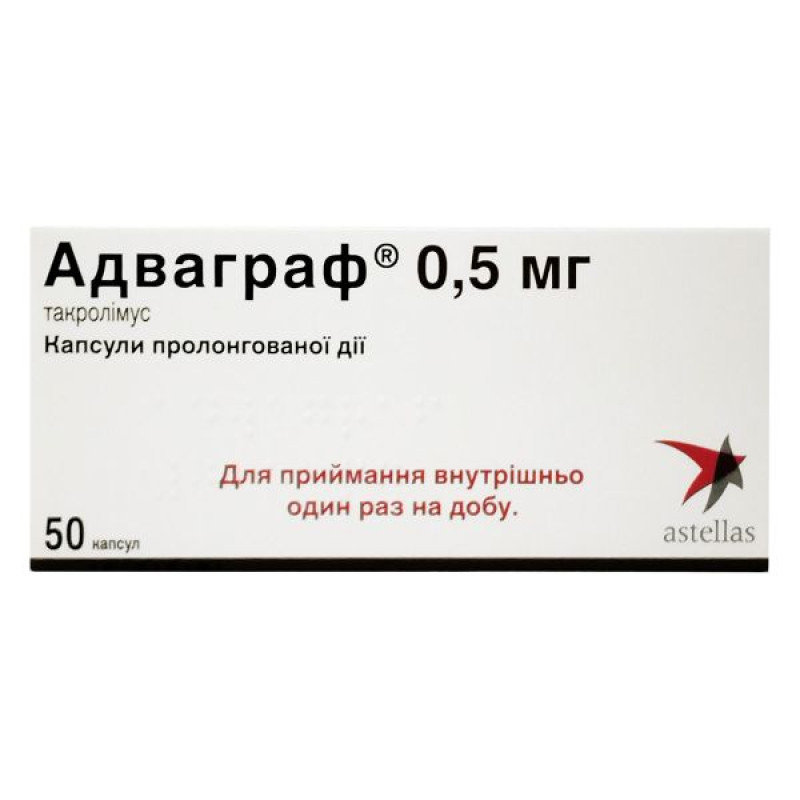
Instructions for Advagraf prolonged-release capsules 5 mg No. 50
Composition
active substance: tacrolimus:
1 capsule contains tacrolimus (as crystalline hydrate) 0.5 mg or 1 mg, or 3 mg, or 5 mg;
excipients: hypromellose, ethylcellulose, lactose monohydrate, magnesium stearate; capsule shell: titanium dioxide (E 171), iron oxide yellow (E 172), iron oxide red (E 172), gelatin, sodium lauryl sulfate; printing ink (Opacode S-1-15013): shellac, lecithin (soy), simethicone, iron oxide red (E 172), hyprolose.
Dosage form
Extended-release capsules.
Main physicochemical properties: 0.5 mg capsules: hard gelatin capsules No. 5, with a red inscription “0.5 mg” on the pale yellow capsule cap, and “647” on the orange capsule body. Capsule contents: white powder;
1 mg capsules: hard gelatin capsules No. 4, with a red inscription “1 mg” on the white capsule cap, and “677” on the orange capsule body. The contents of the capsules are white powder;
3 mg capsules: hard gelatin capsules No. 1, with a red inscription “3 mg” on the orange capsule cap and “637” on the orange capsule body. The contents of the capsules are white powder;
5 mg capsules: hard gelatin capsules No. 0, with a red inscription “5 mg” on the grayish-red capsule cap and “687” on the orange capsule body. The contents of the capsules are white powder.
Pharmacotherapeutic group
Immunosuppressant. Calcineurin inhibitor.
ATX code L04A D02.
Pharmacological properties
Pharmacodynamics.
At the molecular level, the effects and intracellular accumulation of tacrolimus are mediated by binding to a cytosolic protein (FKBP 12). The FKBP 12-tacrolimus complex specifically and competitively inhibits calcineurin, providing a calcium-dependent blockade of T-cell signaling pathways and preventing the transcription of a discrete set of lymphokine genes.
Tacrolimus is a highly potent immunosuppressant. In in vitro and in vivo experiments, tacrolimus clearly reduced the production of cytotoxic lymphocytes, which play a key role in the transplant rejection reaction. Tacrolimus inhibits the production of lymphokines (interleukin-2, -3, γ-interferon), T-cell activation, interleukin-2 receptor expression, and T-helper-dependent B-cell proliferation.
Pharmacokinetics.
Absorption
It has been established that tacrolimus is rapidly absorbed in the gastrointestinal tract in humans. Advagraf (prolonged-release capsules) is a drug in a dosage form that provides prolonged absorption of tacrolimus in the gastrointestinal tract. The average time to reach Cmax is approximately 2 hours. Absorption of tacrolimus is variable (variability of absorption in adult patients is 6–43%). The bioavailability of tacrolimus when taken orally in the form of capsules is on average 20–25%. The bioavailability, as well as the rate and extent of absorption of tacrolimus when taken simultaneously with food, is reduced. The nature of biliary excretion does not affect the absorption of the drug. After reaching the equilibrium concentration of tacrolimus when taking Advagraf, a high correlation is noted between AUC and minimum (C0) levels of tacrolimus in the blood. Therefore, monitoring of minimum (C0) concentrations of tacrolimus in the blood makes it possible to detect systemic exposure to the drug.
Distribution and elimination
The distribution of tacrolimus in humans after intravenous administration is biphasic. In the systemic circulation, tacrolimus binds well to erythrocytes. The ratio of tacrolimus concentrations in whole blood to plasma is 20:1. A significant proportion of plasma tacrolimus (> 98.8%) is bound to plasma proteins (serum albumin, α-1-acid glycoprotein).
Tacrolimus is widely distributed in the body. The steady-state volume of distribution based on plasma concentrations is approximately 1300 l (in healthy volunteers) and based on whole blood concentrations, it averages 47.6 l.
Tacrolimus is a substance with low clearance. In healthy volunteers, the mean total clearance, calculated from whole blood concentrations, is 2.25 l/h. In adult patients after liver, kidney and heart transplantation, the clearance was 4.1 l/h, 6.7 l/h and 3.9 l/h, respectively. Low haematocrit and hypoproteinaemia contribute to an increase in the unbound fraction of tacrolimus, accelerating the clearance of tacrolimus. Corticosteroids used in transplantation may also increase the metabolic rate and accelerate the clearance of tacrolimus.
The elimination half-life of tacrolimus is long and variable. In healthy volunteers, the mean elimination half-life in whole blood is approximately 43 hours.
Metabolism and biotransformation
Tacrolimus is extensively metabolized in the liver, mainly by cytochrome P450-3A4. Tacrolimus metabolism occurs extensively in the intestinal wall. Several metabolites of tacrolimus have been identified. In vitro experiments have shown that only one of the metabolites has immunosuppressive activity close to that of tacrolimus. Other metabolites have weak or no immunosuppressive activity. Only one of the metabolites of tacrolimus has been detected in the systemic circulation at low concentrations. Thus, the pharmacological activity of the drug is practically independent of metabolites.
Following intravenous and oral administration of 14C-labeled tacrolimus, the majority of radioactivity was recovered in the faeces. Approximately 2% of the radioactivity was recovered in the urine. Approximately 1% of tacrolimus was recovered unchanged in the urine and faeces. Thus, tacrolimus was almost completely metabolised before elimination; the main route of elimination was via the bile.
Indication
Prevention and treatment of liver and kidney allograft rejection in adult patients.
Treatment of allograft rejection resistant to standard immunosuppressive regimens in adult patients.
Contraindication
Hypersensitivity to tacrolimus, other macrolides or to any of the excipients.
Interaction with other medicinal products and other types of interactions
Systemically available tacrolimus is metabolised in the liver by CYP3A4. There is also evidence of gastrointestinal metabolism by CYP3A4 in the intestinal wall. Concomitant administration of drugs with established CYP3A4 inhibitory or inducing effects may increase or decrease tacrolimus blood concentrations, respectively.
It is strongly recommended to closely monitor tacrolimus blood levels, as well as QT prolongation (ECG), monitor renal function and other adverse effects, when concomitantly using substances that have the potential to alter CYP3A4 metabolism or otherwise affect tacrolimus blood levels, and, if necessary, interrupt or modify the tacrolimus dose to maintain equivalent tacrolimus exposure (see sections 4.2 and 4.4).
CYP3A4 inhibitors potentially leading to increased tacrolimus blood levels The following substances have been clinically shown to increase tacrolimus blood levels. Strong interactions have been observed with antifungal agents such as ketoconazole, fluconazole, itraconazole and voriconazole, the macrolide antibiotic erythromycin, HIV protease inhibitors (e.g. ritonavir, nelfinavir, saquinavir) or HCV protease inhibitors (e.g. telaprevir, boceprevir). Concomitant use of these substances may necessitate a reduction in tacrolimus doses in almost all patients. A pharmacokinetic study has shown that the increase in tacrolimus blood levels is mainly due to increased bioavailability due to inhibition of gastrointestinal metabolism. The effect on hepatic clearance is less pronounced. Weak interactions have been observed with clotrimazole, clarithromycin, josamycin, nifedipine, nicardipine, diltiazem, verapamil, amiodarone, danazol, ethinyl estradiol, omeprazole, nefazodone, and drugs containing Schisandra extract (Schisandrasphenanthera), known as southern magnolia vine or southern 5-flavor berry.
In in vitro studies, the following substances have been identified as potential inhibitors of tacrolimus metabolism: bromocriptine, cortisone, dapsone, ergotamine, gestodene, lidocaine, mephenytoin, miconazole, midazolam, nilvadipine, norethindrone, quinidine, tamoxifen, (triacetyl) oleandomycin.
Grapefruit juice has been reported to increase blood levels of tacrolimus and should be avoided.
Lansoprazole and ciclosporin have the potential to inhibit CYP3A4-mediated metabolism of tacrolimus and therefore increase tacrolimus blood concentrations.
Other interactions potentially leading to increased tacrolimus blood levels Tacrolimus is highly bound to plasma proteins. Interactions are possible with other active substances known to have high affinity for plasma proteins (e.g. NSAIDs, oral anticoagulants or oral antidiabetics). Other potential interactions that may increase the systemic exposure of tacrolimus include interactions with prokinetic agents (such as metoclopramide and cisapride), as well as with cimetidine and magnesium aluminium hydroxide.
CYP3A4 inducers that potentially lead to decreased blood levels of tacrolimus
Based on clinical experience, it has been established that the following drugs may reduce the concentration of tacrolimus in the blood.
Strong interactions have been observed with rifampicin, phenytoin, and St. John's wort; an increase in the tacrolimus dose may be necessary in almost all patients. Clinically significant interactions have also been observed with phenobarbital. Maintenance doses of corticosteroids reduce tacrolimus blood concentrations.
High doses of prednisolone or methylprednisolone used to treat acute rejection may increase or decrease tacrolimus blood levels. Carbamazepine, metamizole and isoniazid may decrease tacrolimus blood concentrations. Effect of tacrolimus on the metabolism of other medicinal products
The half-life of ciclosporin is prolonged when tacrolimus is administered concomitantly. In addition, a synergistic effect/additive nephrotoxic effect is possible. For these reasons, the combined administration of ciclosporin and tacrolimus is not recommended, and the physician should exercise caution when prescribing tacrolimus to patients who have previously received ciclosporin (see sections 4.2 and 4.4).
For tacrolimus, it has been shown that this drug can cause an increase in phenytoin blood levels.
Since tacrolimus may reduce the therapeutic range of hormonal contraceptives, which usually results in increased hormonal exposure, special attention and caution should be exercised when deciding on contraceptive methods. There is currently insufficient information on the interaction between tacrolimus and statins. Clinical data suggest that the pharmacokinetics of statins are not significantly altered when co-administered with tacrolimus.
Animal studies have shown that tacrolimus can potentially reduce the clearance and increase the half-life of pentobarbital and antipyrine.
Other interactions leading to clinically harmful effects
Concomitant use of tacrolimus with drugs known to be nephrotoxic or neurotoxic may increase these effects (e.g. aminoglycosides, gyrase inhibitors, vancomycin, co-trimoxazole, NSAIDs, ganciclovir or aciclovir). Increased nephrotoxicity has been reported after the use of amphotericin B and ibuprofen in combination with tacrolimus.
Since tacrolimus treatment may be associated with hyperkalaemia or may exacerbate pre-existing hyperkalaemia, increased potassium intake or the use of potassium-sparing diuretics (e.g. amiloride, triamterene or spironolactone) should be avoided (see section 4.4).
Immunosuppressants may affect the response to vaccination, therefore vaccination may be less effective during treatment with tacrolimus. The use of live attenuated vaccines should be avoided (see section 4.4).
Application features
Medication errors have been reported, including accidental, unintentional or uncontrolled substitution of immediate-release or prolonged-release tacrolimus formulations. This may lead to serious adverse reactions, including graft rejection, or other adverse reactions that may be due to either insufficient or excessive exposure to tacrolimus. Patients should receive a single formulation of tacrolimus with the appropriate daily dosing regimen; changes in formulation or regimen should only be made under the close supervision of a transplant specialist (see sections 4.2 and 4.8).
Advagraf is not recommended for use in children due to limited data on safety and/or efficacy in this patient population.
There are no clinical data on the use of Advagraf prolonged-release in adult patients with rejection refractory to therapy with other immunosuppressants.
There are currently no clinical data on the use of Advagraf for the prevention of graft rejection in heart transplantation.
In the initial post-transplant period, the following parameters should be regularly monitored: blood pressure, ECG, neurological and visual status, fasting blood glucose, electrolyte concentrations (especially potassium), liver and kidney function, hematological parameters, coagulation profile, and blood protein levels. In the presence of clinically significant changes, correction of immunosuppressive therapy is necessary.
When concomitantly administered with medicinal products with potential interactions, especially CYP3A4 inhibitors (such as telaprevir, boceprevir, ritonavir, ketoconazole, voriconazole, itraconazole, telithromycin or clarithromycin) or CYP3A4 inducers (such as rifampicin, rifabutin), tacrolimus blood levels should be monitored to maintain adequate tacrolimus exposure.
When using Advagraf, herbal preparations containing St. John's wort (Hypericum perforatum) should be avoided due to the risk of interactions leading to a decrease in tacrolimus blood levels and the therapeutic effect of Advagraf.
The concomitant use of cyclosporine and tacrolimus should be avoided, and tacrolimus should be used with caution in patients who have previously received cyclosporine (see sections “Method of administration and dosage” and “Interaction with other medicinal products and other forms of interaction”). The use of drugs/products containing high amounts of potassium or potassium-sparing diuretics should be avoided (see section “Interaction with other medicinal products and other forms of interaction”).
Concomitant use of tacrolimus with medicinal products known to be nephrotoxic or neurotoxic may increase the risk of nephrotoxic and neurotoxic reactions (see section 4.5).
Immunosuppressants may affect the response to vaccination, vaccination may be less effective during treatment with tacrolimus. Live attenuated vaccines should be avoided.
Gastrointestinal perforations have been reported in patients receiving tacrolimus. Gastrointestinal perforation is a medically important complication that can be life-threatening. Appropriate treatment should be initiated immediately if suspicious symptoms occur.
Tacrolimus blood levels may vary significantly in the presence of diarrhoea; careful monitoring of tacrolimus blood concentrations is necessary if diarrhoea occurs.
Heart disease
Cases of ventricular hypertrophy or septal hypertrophy of the heart, which have been reported as cardiomyopathies, have been rare but have been observed in patients taking Prograf and are therefore possible with Advagraf treatment. In most cases, myocardial hypertrophy was reversible and occurred at tacrolimus blood concentrations exceeding the maximum recommended levels. Other factors that increase the risk of this adverse event include: pre-existing cardiac disease, use of corticosteroids, hypertension, renal and hepatic dysfunction, infections, hypervolemia, edema. Patients at high risk and receiving intensive immunosuppressive therapy should be monitored with echocardiography and ECG before and after transplantation (after 3 months and then after 9-12 months). If abnormalities are detected, consideration should be given to reducing the Advagraf dose or switching to another immunosuppressant.
Tacrolimus may prolong the QT interval and cause torsades de pointes. Caution should be exercised when used in patients with risk factors for QT prolongation, including patients with individual or hereditary QT prolongation, patients with congestive heart failure, bradyarrhythmia, electrolyte abnormalities. Caution should be exercised in patients with known or suspected congenital long QT syndrome or acquired long QT and in patients taking concomitant medicinal products known to prolong the QT interval, including electrolyte abnormalities or known elevations of electrolytes (see section 4.5).
Lymphoproliferative diseases and malignant neoplasms
Patients treated with tacrolimus may develop post-transplant lymphoproliferative disorders (PTLD) associated with Epstein-Barr virus (EBV) (see section 4.8). The risk of post-transplant lymphoproliferative disorders (PTLD) associated with Epstein-Barr virus (EBV) is increased when immunosuppressants with antilymphocyte antibodies (such as basiliximab, daclizumab) are used concomitantly. There is also evidence of an increased risk of lymphoproliferative disorders in patients with negative EBV-VCA (viral capsid antigen). Therefore, serological testing for EBV-VCA should be performed before prescribing Advagraf to this group of patients. Close monitoring of EBV by polymerase chain reaction (PCR) is recommended during treatment. A positive EBV-PCR may persist for months and is not in itself evidence of PLD or lymphoma.
As with other potent immunosuppressive agents, the risk of secondary cancer is unknown (see section 4.8).
As with other immunosuppressive drugs, due to the potential risk of skin malignancies, exposure to sunlight and ultraviolet radiation should be limited, protective clothing should be worn, and sunscreen with a high protection factor should be used.
Patients receiving immunosuppressants, including Advagraf, are at increased risk of developing opportunistic infections (bacterial, fungal, viral and protozoal), such as BK virus nephropathy and JC virus multifocal leukoencephalopathy (PML). These infections are often associated with a high overall immunosuppressive burden and can be serious or fatal, which should be considered by physicians when conducting differential diagnosis in immunocompromised patients with worsening renal function or neurological symptoms.
Posterior reversible encephalopathy syndrome (PRES) has been reported in patients treated with tacrolimus. If patients taking tacrolimus develop symptoms of PRES, such as headache, altered mental status, seizures, and visual disturbances, appropriate diagnostic procedures (e.g. MRI) should be performed. If PRES is diagnosed, systemic tacrolimus should be discontinued immediately, and blood pressure and seizures should be adequately monitored. Most patients recovered fully with appropriate treatment.
Cases of pure red cell aplasia
Cases of pure red cell aplasia (PRCA) have been reported in patients receiving tacrolimus. All patients had risk factors for PRCA, such as parvovirus B19 infection, underlying medical conditions, or concomitant medications associated with PRCA.
Special populations
Patients with severe hepatic impairment may require a dose reduction (see section 4.2). Excipients
Advagraf capsules contain lactose, so the drug should not be used in patients with rare hereditary diseases associated with galactose intolerance, the Lapp lactase deficiency or glucose-galactose malabsorption.
The printing ink used to label Advagraf capsules contains soy lecithin. For patients with hypersensitivity to peanut or soy products, the benefits of using Advagraf should be weighed against the potential risk and severity of hypersensitivity reactions.
Use during pregnancy or breastfeeding
Pregnancy
Human data show that tacrolimus crosses the placenta in women. Limited data in organ transplant recipients show no evidence of an increased risk of adverse effects on the course and outcome of pregnancy with tacrolimus compared with other immunosuppressive drugs. However, cases of spontaneous abortion have been reported. No other relevant epidemiological data are currently available. Tacrolimus should be used in pregnant women only if there is no safer alternative and if the potential benefit to the pregnant woman justifies the potential risk to the foetus. It is recommended that newborns whose mothers have taken tacrolimus during pregnancy be monitored for potential adverse effects (especially renal function). There is a risk of preterm birth (<37 weeks) (incidence 66/123 births, i.e. 53.7%, but the data showed that most newborns had a normal birth weight for their gestational age), and there is also a risk of hyperkalemia in the newborn (incidence 8 out of 111 newborns, i.e. 7.2%), which, however, normalizes on its own.
In studies in rats and rabbits, tacrolimus caused embryo-fetal toxicity at doses associated with maternal toxicity.
Fertility.
In rats, tacrolimus has been shown to have a negative effect on male fertility, with a reduction in sperm count and motility.
Breastfeeding period
Data show that tacrolimus is excreted in human milk. Since adverse effects of tacrolimus on the newborn cannot be excluded, women taking Advagraf should discontinue breast-feeding.
Ability to influence reaction speed when driving vehicles or other mechanisms
Tacrolimus can cause visual and neurological disorders, especially when combined with Advagraf and alcohol.
There are no studies on the effect of tacrolimus (Advagraf) on the ability to drive or operate other machinery.
Method of administration and doses
Advagraf is an oral formulation of tacrolimus administered once daily. Advagraf therapy requires close monitoring by appropriately qualified personnel and equipment. This medicinal product should only be prescribed and changes to the current immunosuppressive regimen should be made by physicians experienced in the management of immunosuppressive therapy in transplant recipients. Accidental, inadvertent or uncontrolled switching between immediate-release and prolonged-release formulations of tacrolimus is dangerous. This may lead to graft rejection or an increased incidence of adverse reactions, including under- or over-immunosuppression, due to clinically significant differences in the systemic exposure of tacrolimus. Patients should be maintained on a single formulation of tacrolimus with an appropriate daily dosing schedule; however, changes in dosage form or regimen should only be made under the close supervision of a transplant specialist (see sections "Special warnings and precautions for use", "Adverse effects"). After switching to any alternative dosage form, it is necessary to monitor the concentration of tacrolimus in the blood and adjust the dose of the drug to maintain systemic exposure to tacrolimus at an adequate level.
Method of administration and doses
The recommended starting doses presented below are indicative.
In renal and hepatic transplant patients, the AUC0-24 of tacrolimus for Advagraf on day 1 was 30% and 50% lower compared to the same dose of immediate-release capsules (Prograf). On day 4, systemic exposure to tacrolimus (measured as trough plasma levels) was similar for the two tacrolimus formulations in renal and hepatic transplant patients. Regular and close monitoring of tacrolimus trough concentrations is recommended during the first 2 weeks after transplantation to ensure adequate tacrolimus exposure during treatment with Advagraf. Since tacrolimus is a substance with low clearance, it may take several days to reach steady-state concentrations after dose adjustments of Advagraf.
To prevent transplant rejection, the state of immunosuppression must be maintained continuously; therefore, the duration of therapy is unlimited.
Prevention of kidney transplant rejection
Oral Advagraf therapy should be initiated at a daily dose of 0.2–0.3 mg/kg/day, administered as a single dose in the morning. The drug should be initiated within 24 hours after transplantation.
The dose of Advagraf should usually be reduced in the post-transplant period. In some cases, concomitant immunosuppressive therapy may be withdrawn, leading to Advagraf monotherapy. Post-transplant changes in the patient's condition may alter the pharmacokinetics of tacrolimus and require further adjustment of the Advagraf dose.
Prevention of liver transplant rejection
Oral Advagraf therapy should be initiated at a daily dose of 0.1–0.2 mg/kg once daily in the morning. Administration should be initiated 12–18 hours after transplantation.
The dose of Advagraf should usually be reduced in the post-transplant period. In some cases, concomitant immunosuppressive therapy may be withdrawn, leading to Advagraf monotherapy. Post-transplant changes in the patient's condition may alter the pharmacokinetics of tacrolimus and require further adjustment of the Advagraf dose.
Switching patients from Prograf treatment to Advagraf
If allotransplant patients who have been receiving Prograf (capsules) at a maintenance dose twice daily need to be switched to Advagraf once daily, the daily dose ratio during the conversion period should be 1:1 (mg:mg). Advagraf should be administered in the morning.
In stable patients switched from Prograf capsules (twice daily) to Advagraf (once daily) in a 1:1 (mg:mg) total daily dose ratio, systemic tacrolimus exposure (AUC 0-24) for Advagraf was approximately 10% lower than for Prograf. The relationship between tacrolimus trough level (C24) and systemic exposure (AUC 0-24) for Advagraf is the same as for Prograf. When switching from Prograf capsules to Advagraf capsules, plasma trough levels should be measured before the switch and for two weeks after the switch. After the switch, tacrolimus trough levels should be monitored and the dose adjusted if necessary to maintain the same systemic exposure. Dose adjustments should be made to maintain tacrolimus systemic exposure at the previous level.
Switching from cyclosporine to tacrolimus
Caution should be exercised when transferring patients from background therapy with ciclosporin to background therapy with tacrolimus (see sections “Special instructions for use” and “Interaction with other medicinal products and other types of interactions”). The simultaneous use of ciclosporin and tacrolimus is not recommended. Advagraf therapy should be initiated after determining the concentration of ciclosporin in the blood plasma and analyzing the patient's clinical condition. The transition should be postponed if the level of ciclosporin in the blood is elevated. In practice, tacrolimus therapy is started 12-24 hours after discontinuation of ciclosporin. After the transition, it is recommended to monitor the level of ciclosporin in the blood, since there may be an effect on the clearance of ciclosporin in the blood.
Treatment of allograft rejection
The following approaches are recommended to control graft rejection: increasing the dose of tacrolimus, increasing corticosteroid therapy, short courses of mono-/polyclonal antibody therapy. If signs of tacrolimus toxicity occur (e.g. severe adverse reactions (see section 4.8), a dose reduction of Advagraf may be necessary.
Treatment of kidney or liver allograft rejection
When switching from other immunosuppressants to Advagraf, treatment should be initiated with the initial oral doses recommended for the prevention of transplant rejection in kidney and liver transplantation, respectively.
Treatment of allograft rejection after heart transplantation
Treatment of allograft rejection after transplantation of other allografts There is no clinical experience with Advagraf in patients after lung, pancreas or intestinal transplantation. Prograf should be administered to patients after lung transplantation at an initial oral dose of 0.10-0.15 mg/kg/day, to patients after pancreas transplantation at an initial oral dose of 0.2 mg/kg/day and to patients after intestinal transplantation at an initial oral dose of 0.3 mg/kg/day.
Therapeutic drug monitoring
Dose selection should be based on clinical assessment of the individual risk of rejection and tolerability of the drug, as well as on monitoring of the therapeutic minimum level of tacrolimus in the blood.
Several methods for determining tacrolimus concentrations in whole blood should be used to select the optimal dose. Comparison of monitoring results published in the literature with monitoring results in a particular clinic should be carried out taking into account the method used to determine tacrolimus concentrations in blood. In modern clinical practice, tacrolimus levels in blood are monitored mainly using immunoassay methods. The correlation between the minimum concentration level (C24) and systemic exposure (AUC0-24) of tacrolimus in blood when using both drugs (Advagraf and Prograf) is almost the same.
In the post-transplant period, tacrolimus trough levels should be monitored. Tacrolimus trough levels should be determined approximately 24 hours after starting Advagraf before the next dose. More frequent tacrolimus trough levels are recommended for the first 2 weeks after transplantation, followed by periodic monitoring during maintenance therapy. Therapeutic tacrolimus trough levels should be monitored particularly closely after switching from Prograf to Advagraf, when adjusting the dose, when changing the immunosuppressive regimen, or when co-administering medicinal products that may alter tacrolimus blood levels (see section 4.5). The frequency of drug level monitoring should be guided by clinical need. As tacrolimus is a substance with low clearance, it may take several days to reach steady-state tacrolimus blood levels after adjusting the dose of Advagraf.
According to clinical studies, in most cases, the treatment of patients is successful with therapeutic trough levels of tacrolimus in the blood not exceeding 20 ng/ml. When interpreting data on the therapeutic trough concentration of tacrolimus in the blood, the clinical condition of the patient must be taken into account. According to available data, in the initial post-transplant period in patients after liver transplantation, the therapeutic level of the drug in the blood is in the range of 5-20 ng/ml, and after kidney or heart transplantation - 10-20 ng/ml. During maintenance immunosuppressive therapy in patients after liver, kidney or heart transplantation, the concentration of the drug in the blood is usually in the range of 5-15 ng/ml.
Special populations
Liver failure
Patients with severe hepatic impairment may require a reduction in the Advagraf dose to maintain tacrolimus trough blood levels within the recommended therapeutic range.
Kidney failure
Since renal function does not affect the pharmacokinetics of tacrolimus, no dose adjustment is necessary. However, due to the nephrotoxic potential of tacrolimus, careful monitoring of renal function (including serum creatinine concentrations, creatinine clearance calculations and urine output monitoring) is recommended.
Race: Black patients may require higher doses of tacrolimus compared to Caucasian patients to achieve similar trough plasma concentrations of tacrolimus. Gender: There is no evidence that male and female patients require different doses of the drug to achieve similar trough plasma concentrations.
Elderly patients
There is no evidence that elderly patients require special doses of the drug.
Method of application.
The recommended oral daily dose of Advagraf is taken once daily in the morning.
Take Advagraf prolonged-release capsules immediately after opening them.