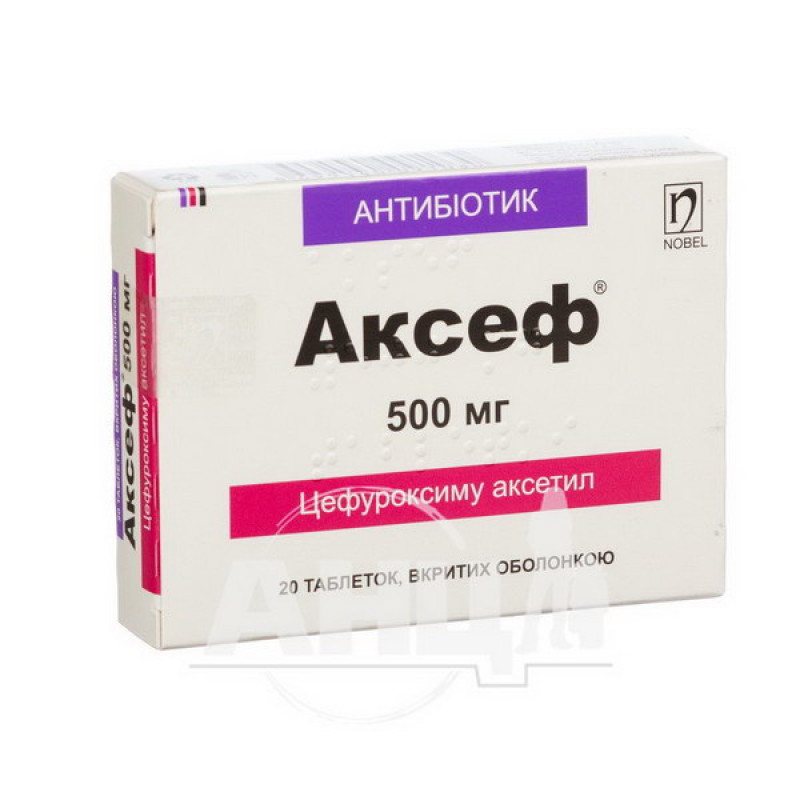
Instructions for Aksef film-coated tablets 500 mg No. 20
Composition
active ingredient: cefuroxime;
1 tablet contains cefuroxime axetil equivalent to cefuroxime 250 mg or 500 mg;
excipients: pregelatinized starch, crospovidone, croscarmellose sodium, sodium lauryl sulfate, magnesium stearate, colloidal anhydrous silicon dioxide, Sepifilm LP 770 coating: hypromellose, microcrystalline cellulose, stearic acid, titanium dioxide (E 171).
Dosage form
Film-coated tablets.
Main physicochemical properties: oblong, film-coated tablets, white in color, with a break line on one side and the NOBEL stamp on the other.
Pharmacotherapeutic group
Antimicrobials for systemic use. Beta-lactam antibiotics.
ATX code J01D C02.
Pharmacological properties
Pharmacodynamics.
Cefuroxime axetil is an oral form of the bactericidal cephalosporin antibiotic cefuroxime, which is resistant to most b-lactamases and exhibits activity against a broad spectrum of gram-positive and gram-negative microorganisms.
The bactericidal effect of cefuroxime is the result of inhibition of the synthesis of the cell membrane of microorganisms.
Acquired antibiotic resistance varies between regions and can change over time, and may vary significantly for individual strains. It is advisable to consult local antibiotic susceptibility data, if available, especially when treating severe infections.
Cefuroxime is generally active against the following microorganisms in vitro:
| Sensitive microorganisms |
Gram-positive aerobes: Staphylococcus aureus (methicillin-susceptible)* Coagulase-negative staphylococcus (methicillin-sensitive) Streptococcus pyogenes Streptococcus agalactiae |
Gram-negative aerobes: Haemophilus influenzae Haemophilus parainfluenzae Moraxella catarrhalis |
Spirochetes: Borrelia burgdorferi |
| Microorganisms whose acquired resistance may be a problem |
Gram-positive aerobes: Streptococcus pneumoniae |
Gram-negative aerobes: Citrobacter freundii Enterobacter aerogenes Enterobacter cloacae Escherichia coli Klebsiella pneumoniae Proteus mirabilis Proteus strains (other than P. vulgaris) Providencia strains |
Gram-positive anaerobes: Peptostreptococcus strains Propionibacterium strains |
Gram-negative anaerobes: Fusobacterium strains Bacteroides strains |
| Resistant microorganisms |
Gram-positive aerobes: Enterococcus faecalis Enterococcus faecium |
Gram-negative aerobes: Acinetobacter strains. Campylobacter strains Morganella morganii Proteus vulgaris Pseudomonas aeruginosa Serratia marcescens |
Gram-negative anaerobes: Bacteroides fragilis |
Others: Chlamydia strains Mycoplasma strains Legionella strains |
*All methicillin-resistant S. aureus are insensitive to cefuroxime.
Pharmacokinetics.
After oral administration of cefuroxime axetil is absorbed in the intestine, hydrolyzed on the intestinal mucosa and enters the bloodstream as cefuroxime.
The optimal level of absorption is observed immediately after food intake. The maximum level of cefuroxime in the blood serum is observed approximately 2-3 hours after taking the drug. The half-life of the drug is approximately 1-1.5 hours. The level of protein binding is 33-55% depending on the method of determination. Cefuroxime is excreted by the kidneys in an unchanged state by tubular secretion and glomerular filtration.
Concomitant use of probenecid increases the area under the mean serum concentration curve by 50%.
Serum cefuroxime levels are reduced by dialysis.
Indication
The drug is indicated for the treatment of the infections listed below in adults and children aged 3 months and older.
acute streptococcal tonsillitis and pharyngitis,
acute bacterial sinusitis,
acute otitis media,
exacerbation of chronic bronchitis caused by pathogens sensitive to cefuroxime axetil,
cystitis,
pyelonephritis,
uncomplicated skin and soft tissue infections,
early manifestations of Lyme disease.
Contraindication
Hypersensitivity to cephalosporin antibiotics, cefuroxime or to any of the excipients. History of severe hypersensitivity reactions (e.g. anaphylactic reactions) to any other type of beta-lactam antibiotic (penicillins, monobactams and carbapenems).
Interaction with other medicinal products and other types of interactions
Drugs that reduce the acidity of gastric juice can reduce the bioavailability of the drug and have the property of eliminating the effect of improved absorption after eating.
Since the ferrocyanide test may give a false-negative result, it is recommended that glucose oxidase or hexokinase methods be used to determine blood and plasma glucose levels in patients treated with cefuroxime axetil. Cefuroxime does not interfere with the alkaline picrate assay for creatinine.
Concomitant use with probenecid results in a significant reduction in the maximum concentration, area under the serum concentration-time curve and half-life of cefuroxime. Therefore, concomitant use with probenecid is not recommended.
Concomitant use with oral anticoagulants may lead to an increase in the INR (international normalized ratio).
Impact on diagnostic tests
Serum cefuroxime levels are reduced by dialysis.
There have been reports of positive Coombs' tests with cephalosporins. This phenomenon may interfere with cross-matching of blood.
Application features
Hypersensitivity reactions
The drug should be administered with extreme caution to patients who have had hypersensitivity reactions to penicillins or other beta-lactam antibiotics, since there is a risk of cross-sensitivity. As with all beta-lactam antimicrobials, serious and rare cases of fatal hypersensitivity reactions have been reported. Hypersensitivity reactions have been reported to progress to Kunis syndrome, an acute allergic coronary arteriospasm that can lead to myocardial infarction (see section 4.8). In the event of severe hypersensitivity reactions, cefuroxime treatment should be discontinued immediately and the patient should receive appropriate emergency medical care.
Before initiating therapy, it is necessary to determine whether the patient has had a previous severe hypersensitivity reaction to cefuroxime, other cephalosporins or other types of beta-lactam drugs. Cefuroxime should be administered with caution to patients with a history of non-severe hypersensitivity reactions to other beta-lactam drugs.
Severe cutaneous adverse reactions (SCARs)
Severe cutaneous adverse reactions, including Stevens-Johnson syndrome (SJS), toxic epidermal necrolysis (TEN) and DRESS syndrome, which can be life-threatening or fatal, have been reported in association with cefuroxime treatment (see section 4.8).
When prescribing the drug, patients should be informed of the signs and symptoms and monitored closely for skin reactions. If signs and symptoms suggestive of these reactions appear, cefuroxime should be discontinued immediately and alternative treatment should be considered. If a patient has developed a serious reaction such as SJS, TEN or DRESS syndrome while taking cefuroxime, treatment with cefuroxime should not be restarted in that patient under any circumstances.
Overgrowth of non-susceptible microorganisms
The use of cefuroxime axetil (as with other antibiotics) may result in overgrowth of Candida. Prolonged treatment may also result in overgrowth of other non-susceptible organisms (e.g. Enterococci, Clostridium difficile), which may necessitate discontinuation of treatment.
Pseudomembranous colitis, which can range from mild to life-threatening, may occur with broad-spectrum antibiotics. It is therefore important to keep this in mind if patients develop severe diarrhoea during or after antibiotic therapy. If diarrhoea is prolonged or severe or if the patient experiences severe cramp-like abdominal pain, treatment should be discontinued immediately and the patient should be carefully evaluated.
Jarisch-Herxheimer reaction
During treatment with cefuroxime axetil for Lyme disease, a Jarisch-Herxheimer reaction has been observed, which is a direct result of the bactericidal action of cefuroxime axetil on the causative organism of Lyme disease, the spirochete Borrelia burgdorferi. Patients should be advised that this is a normal consequence of antibiotic therapy for Lyme disease and resolves without treatment.
When sequential therapy is used, the timing of the transition from parenteral to oral therapy is determined by the severity of the infection, the clinical condition of the patient, and the susceptibility of the pathogen. If there is no clinical improvement within 72 hours, parenteral therapy should be continued. Before starting sequential therapy, the appropriate Summary of Product Characteristics for cefuroxime sodium should be consulted.
Use during pregnancy or breastfeeding
Pregnancy
There are limited data on the use of cefuroxime in pregnant women. Animal studies have not shown any adverse effects of cefuroxime axetil on pregnancy, embryonal and foetal development, parturition or postnatal development. The drug should be administered to pregnant women only if the potential benefit outweighs the potential risk.
Cefuroxime passes into breast milk in small quantities. When using therapeutic doses of the drug, the development of adverse reactions is not expected, but the risk of diarrhea or fungal infection of the mucous membranes cannot be excluded. Therefore, in connection with these reactions, it may be necessary to discontinue breastfeeding. The possibility of a sensitizing effect of the drug should also be taken into account. Cefuroxime is prescribed during breastfeeding only after a doctor has assessed the benefit-risk ratio of its use.
Fertility
There are no data on the effect of cefuroxime sodium on fertility in humans. Animal reproductive studies have not shown any effect of this medicinal product on fertility.
Ability to influence reaction speed when driving vehicles or other mechanisms
Since the drug may cause dizziness, the patient should be warned to drive a car and operate other mechanisms with caution.
Method of administration and doses
Antibiotic susceptibility varies by region and may change over time. Local antibiotic susceptibility data should be consulted if necessary. The usual duration of treatment is 7 days (range 5 to 10 days).
For better absorption, it is recommended to take the drug after meals.
The dosage of the drug for adults and children depending on the infection is given in Tables 1, 2.
Adults and children (≥40 kg) Table 1.
| Indication | Dosage |
| Acute tonsillitis and pharyngitis, acute bacterial sinusitis | 250 mg twice daily |
| Acute otitis media | 500 mg twice daily |
| Exacerbation of chronic bronchitis | 500 mg twice daily |
| Cystitis | 250 mg twice daily |
| Pyelonephritis | 250 mg twice daily |
| Uncomplicated skin and soft tissue infections | 250 mg twice daily |
| Lyme disease | 500 mg twice daily for 14 days (range 10 to 21 days) |
Children (<40 kg) Table 2.
| Indication | Dosage |
| Acute tonsillitis and pharyngitis, acute bacterial sinusitis | 10 mg/kg twice daily to a maximum 125 mg twice daily |
| Children aged 2 years and older with otitis media or, if necessary, for more serious infections | 15 mg/kg twice daily to a maximum of 250 mg twice daily |
| Cystitis | 15 mg/kg twice daily to a maximum of 250 mg twice daily |
| Pyelonephritis | 15 mg/kg twice daily to a maximum 250 mg twice daily for 10-14 days |
| Uncomplicated skin and soft tissue infections | 15 mg/kg twice daily to a maximum of 250 mg twice daily |
| Lyme disease | 15 mg/kg 2 times a day, maximum dose – 250 mg 2 times a day for 14 days (from 10 to 21 days) |
It is recommended to prescribe the drug in suspension form to children.
Cefuroxime acetyl tablets and cefuroxime acetyl granules for suspension are not bioequivalent, so these dosage forms are not interchangeable on a milligram basis.
Cefuroxime is also available as a sodium salt for parenteral use. This allows sequential therapy with a single antibiotic when switching from parenteral to oral administration, if clinically indicated.
The drug is effective for the sequential treatment of exacerbations of chronic bronchitis after previous parenteral administration of cefuroxime sodium.
Sequential therapy
Exacerbation of chronic bronchitis: 750 mg of the drug in the form of injections 2-3 times a day (intravenously or intramuscularly) for 48-72 hours, followed by the use of the drug in the form of tablets of 500 mg 2 times a day orally for 5-10 days. The duration of both parenteral and oral treatment is determined by the severity of the infection and the patient's condition.
Patients with renal insufficiency
Cefuroxime is excreted primarily by the kidneys. In patients with severe renal impairment, a reduced dose of cefuroxime is recommended to compensate for its slower excretion (see table below).
Recommended doses of the drug for renal impairment Table 3.
| Creatinine clearance | T1/2 (hours) | Recommended dosage |
| ≥30 ml/min | 1.4–2.4 | No dose adjustment is required (use standard dose of 125 mg to 500 mg 2 times a day) |
| 10-29 ml/min | 4.6 | Standard individual dose every 24 hours |
| <10 ml/min | 16.8 | Standard individual dose every 48 hours |
| During hemodialysis | 2–4 | One additional standard dose should be administered after each dialysis. |
Patients with hepatic insufficiency
There are no data on the use of this medicinal product in patients with hepatic impairment. Cefuroxime is excreted primarily by the kidneys, therefore, it is expected that existing hepatic impairment will not affect the pharmacokinetics of cefuroxime.
Elderly patients
There are no special precautions for this group of patients. Use normal doses, maximum 1 g per day.
Children.
It is not recommended to prescribe Axef® in tablet form to children under 3 years of age.
It is recommended to prescribe the drug in suspension form to children.
Overdose
Overdose of cephalosporins may cause brain irritation and neurological complications, including encephalopathy, convulsions, and coma. Symptoms of overdose may occur if the dose of the drug has not been appropriately adjusted for patients with impaired renal function.
Serum levels of cefuroxime can be reduced by hemodialysis and peritoneal dialysis.
Side effects
Side effects of cefuroxime axetil are mild and mostly reversible.
Adverse reactions, information about which is given below, are classified by organ system and by frequency of occurrence. By frequency of occurrence, they are divided into the following categories:
very common (≥ 1 in 10), common (≥ 1 in 100 and < 1 in 10), uncommon (≥ 1 in 1,000 and < 1 in 100), rare (≥ 1 in 10,000 and < 1 in 1,000), very rare (< 1 in 10,000).
Infections and infestations
Common: Candida overgrowth.
Not known: Clostridium difficile overgrowth.
From the heart
Unknown: Kunis syndrome.
Blood and lymphatic system disorders
Common: eosinophilia.
Uncommon: positive Coombs test, thrombocytopenia, leukopenia (sometimes profound).
Very rare: hemolytic anemia.
Cephalosporins as a class have the property of being absorbed on the surface of the erythrocyte membrane and interacting with antibodies there, which can lead to a positive Coombs test (impact on blood compatibility) and (very rarely) to hemolytic anemia.
On the part of the immune system
Hypersensitivity reactions, including:
Uncommon: skin rashes.
Rare: urticaria, itching.
Very rare: drug fever, serum sickness, anaphylaxis.
Unknown: Jarisch-Herxheimer reaction.
From the nervous system
Common: headache, dizziness.
From the digestive tract
Common: diarrhea, nausea, abdominal pain.
Uncommon: vomiting.
Rare: pseudomembranous colitis (see section "Special warnings and precautions for use").
Hepatobiliary system
Common: transient increase in liver enzymes (ALT, AST, LDH).
Very rare: jaundice (mainly cholestatic), hepatitis.
Skin and subcutaneous tissue disorders
Very rare: erythema multiforme, Stevens-Johnson syndrome, toxic epidermal necrolysis (exanthematous necrolysis),
Not known: angioedema, drug-induced eosinophilia with systemic symptoms (DRESS syndrome).
Children.
The safety profile of cefuroxime in children is similar to that in adult patients.
Expiration date
3 years
Storage conditions
Store at a temperature not exceeding 25 °C in the original packaging.
Keep out of reach of children.
Packaging
10 tablets in a blister.
1 or 2 blisters in a cardboard box.
Vacation category
According to the recipe.
Producer
NOBEL ILACH SANAI VE TJARET A.Sh.
Location of the manufacturer and address of its place of business.
Sankaklar Quarter, Eski Akcakoca Ave., No. 299, 81100 Duzce, Turkey.