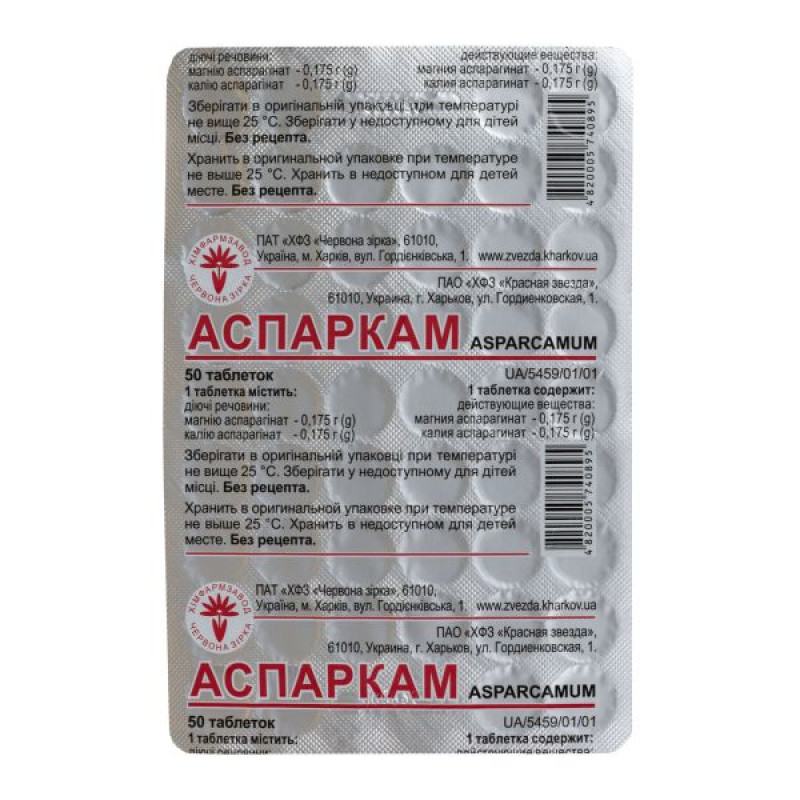
Instructions for Asparkam tablets blister No. 50
Composition
active ingredients: magnesium asparaginate, potassium asparaginate;
1 tablet contains magnesium asparaginate 175 mg (0.175 g) and potassium asparaginate 175 mg (0.175 g);
excipients: corn starch, calcium stearate, talc.
Dosage form
Pills.
Main physicochemical properties: white tablets with a flat surface, a score and a bevel.
Pharmacotherapeutic group
Mineral supplements. Magnesium preparations (various salts in combination). ATX code A12C C30.
Pharmacological properties
Pharmacodynamics
Asparkam belongs to the group of drugs that regulate metabolic processes. The mechanism of action is associated with the property of asparaginates to transport magnesium and potassium ions into the intracellular space and their participation in metabolic processes. Potassium and magnesium ions, as important intracellular cations, are included in the work of a number of enzymes, in the process of binding macromolecules to subcellular elements and in the mechanism of muscle contraction at the molecular level. The ratio of extracellular and intracellular concentrations of potassium, calcium, sodium and magnesium ions affects the contractile ability of the myocardium. Asparaginate, as an endogenous substance, is a carrier of potassium and magnesium ions, has a pronounced affinity for cells, its salts are subject to dissociation only to a small extent. As a result, the ions penetrate into the intracellular space in the form of complex compounds. Magnesium asparaginate and potassium asparaginate improve myocardial metabolism. Insufficient potassium and magnesium in the body increases the risk of developing hypertension, atherosclerotic lesions of the coronary vessels, heart rhythm disturbances, and myocardial pathology.
Pharmacokinetics
Not studied.
Indication
Additional therapy for chronic heart diseases (heart failure, post-infarction period), heart rhythm disorders, especially ventricular arrhythmias. Additional therapy for treatment with digitalis preparations. As a supplement to increase magnesium and potassium intake from food.
Contraindication
Hypersensitivity to the components of the drug; acute and chronic renal failure; Addison's disease; hyperkalemia, hypermagnesemia; atrioventricular block II-III degree; cardiogenic shock (BP < 90 mmHg); oliguria; anuria.
Special safety precautions
The drug should be used with caution in patients with myasthenia gravis; in conditions that may lead to hyperkalemia, such as acute dehydration, widespread tissue damage, in particular, severe burns. In this category of patients, it is recommended to regularly examine the concentration of electrolytes in the blood serum. It should not be prescribed to patients with gastroduodenal ulcers or obstruction.
With prolonged use of the drug, it is necessary to monitor the level of potassium and magnesium in the blood, and regular monitoring of ECG data is also necessary.
Interaction with other medicinal products and other types of interactions
Due to the presence of potassium ions in the composition of the drug, when using Asparkam with potassium-sparing diuretics, ACE inhibitors, beta-blockers, cyclosporine, the risk of developing hyperkalemia increases (control of potassium levels in the blood plasma is necessary) and the inhibitory effect on intestinal peristalsis increases.
The drug inhibits the absorption of oral forms of tetracycline, iron salts and sodium fluoride (a 3-hour interval between doses must be observed).
Asparkam enhances the effect of drugs that stimulate trophic processes in the myocardium; prevents the development of hypokalemia caused by the use of saluretics, corticosteroids, and cardiac glycosides.
Asparkam reduces the cardiotoxic effect of cardiac glycosides.
When used simultaneously with antidepolarizing muscle relaxants, neuromuscular blockade is enhanced, and with anesthetics (ketamine, hexanal, fluorotan) - the central nervous system is depressed.
Asparkam may reduce the effectiveness of neomycin, polymyxin B, tetracycline, and streptomycin.
Ability to influence reaction speed when driving vehicles or other mechanisms
Does not affect.
Use during pregnancy or breastfeeding
There is no data on the use of the drug during pregnancy or breastfeeding.
Method of administration and doses
Asparkam tablets are taken orally. The usual daily dose for adults is
1-2 tablets 3 times a day. The dose can be increased to 3 tablets 3 times a day. Gastric juice can reduce the effectiveness of the drug, so it is recommended to take the tablets after meals.
The duration of treatment is determined by the doctor depending on the nature and course of the disease.
Children
There is no experience with the use of the drug in children, so the drug should not be used in this category of patients.
Overdose
To date, no cases of overdose have been registered. Theoretically, symptoms of hyperkalemia (nausea, vomiting, diarrhea, abdominal pain, metallic taste in the mouth, bradycardia, weakness, disorientation, muscle paralysis, paresthesia of the extremities) and hypermagnesemia (nausea, vomiting, drowsiness, bradycardia, weakness, slurred speech, double vision, redness of the face, thirst, arterial hypotension, hyporeflexia, impaired neuromuscular transmission, respiratory depression, arrhythmia, convulsions, with very high plasma concentrations of magnesium, muscle paralysis, respiratory arrest and cardiac arrest may develop). An electrocardiogram records an increase in the height of the T wave, a decrease in the amplitude of the P wave, and a widening of the QRS complex. Extremely high concentrations of potassium in the blood plasma can lead to death from cardiac depression, arrhythmia, or cardiac arrest.
Treatment: drug withdrawal, symptomatic therapy (intravenous administration of calcium chloride solution at a dose of 100 mg/min), if necessary, hemodialysis.
Adverse reactions
Adverse reactions develop very rarely:
from the digestive tract: nausea, vomiting, diarrhea, abdominal pain, discomfort or burning sensation in the epigastric region, gastrointestinal bleeding, ulcers of the digestive tract mucosa, dry mouth;
from the cardiovascular system: myocardial conduction disorders, decreased blood pressure, AV block;
from the central and peripheral nervous system: paresthesia, hyporeflexia, convulsions;
allergic reactions: hypersensitivity reactions, including itching, facial flushing, rash;
On the part of the respiratory system: possible respiratory depression (due to hypermagnesemia);
others: feeling hot.
Expiration date
3 years.
Do not use after the expiry date stated on the packaging.
Storage conditions
Store in the original packaging at a temperature not exceeding 25°C.
Keep out of reach of children.
Packaging
50 tablets in blisters.
Vacation category
Without a prescription.
Producer
PJSC "Chempharmaceutical Plant "Chervona Zirka".
Location of the manufacturer and its business address
61010, Ukraine, Kharkiv, 1 Hordienkivska St.