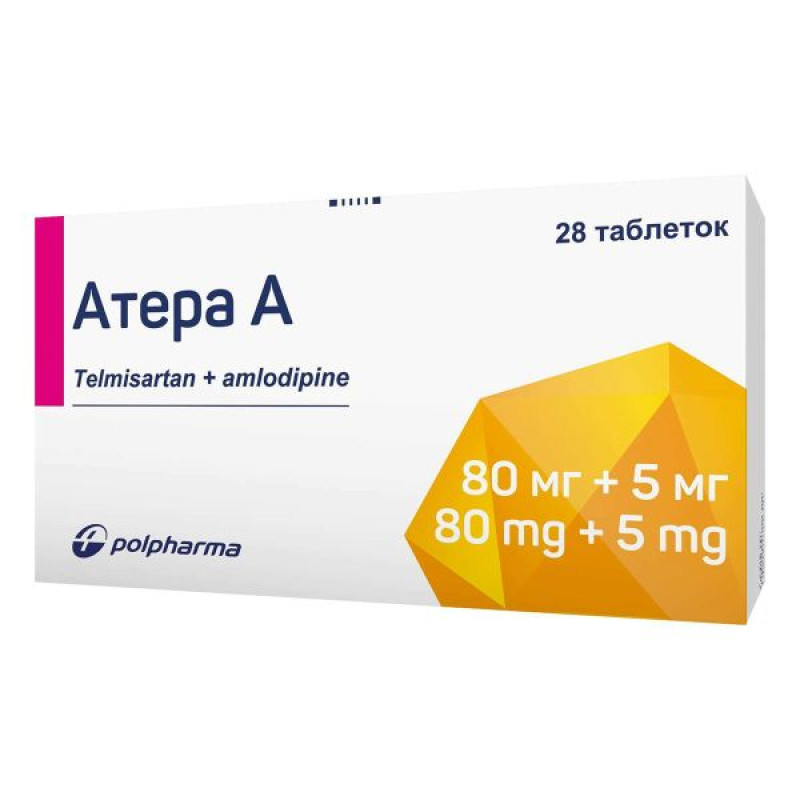
Instructions for Atera A tablets 80 mg + 5 mg No. 28
Composition
active ingredients: telmisartan, amlodipine;
1 tablet contains 40 mg of telmisartan and 5 mg of amlodipine (as amlodipine besylate) or 40 mg of telmisartan and 10 mg of amlodipine (as amlodipine besylate), or 80 mg of telmisartan and 5 mg of amlodipine (as amlodipine besylate), or 80 mg of telmisartan and 10 mg of amlodipine (as amlodipine besylate);
excipients: sodium hydroxide, meglumine, povidone K25, yellow iron oxide (E 172) - only for tablets of 40 mg/10 mg and 80 mg/10 mg, red iron oxide (E 172) - only for tablets of 40 mg/5 mg and 80 mg/5 mg, mannitol (E 421), microcrystalline cellulose, crospovidone, magnesium stearate, pregelatinized starch, corn starch, colloidal anhydrous silicon dioxide.
Dosage form
Pills.
Main physicochemical properties:
Atera A, 40 mg/5 mg tablets: two-layer tablets, oblong, biconvex, white to almost white on one side and pink on the other side, slight inclusions on the pink side are allowed;
Atera A, 40 mg/10 mg tablets: two-layer tablets, oblong, biconvex, white to almost white on one side and yellow on the other side, slight inclusions on the yellow side are allowed;
Atera A, 80 mg/5 mg tablets: two-layer tablets, oblong, biconvex, white to almost white on one side and pink on the other side, slight inclusions on the pink side are allowed;
Atera A, 80 mg/10 mg tablets: two-layer tablets, oblong, biconvex, white to almost white on one side and yellow on the other side, slight inclusions on the yellow side are allowed.
Pharmacotherapeutic group
Angiotensin II receptor blockers, combinations. Telmisartan and amlodipine. ATC code C09D B04.
Pharmacological properties
Pharmacodynamics.
Atera A contains two antihypertensive components with complementary mechanisms of blood pressure control in patients with essential hypertension: an angiotensin II receptor antagonist, telmisartan, and a dihydropyridine calcium channel blocker, amlodipine.
The combination of these substances exhibits an additive antihypertensive effect, lowering blood pressure to a greater extent than each of these components alone.
Taking Atera A once daily provides effective and sustained blood pressure reduction for 24 hours within the therapeutic dose range.
Telmisartan
Telmisartan is a specific and effective orally active angiotensin II receptor (type AT1) antagonist. Telmisartan displaces angiotensin II with very high affinity at the binding site of the AT1 receptor subtype, which is responsible for the known effects of angiotensin II. Telmisartan does not exhibit partial agonist activity at the AT1 receptor. Telmisartan selectively binds the AT1 receptor. Binding is long-lasting. Telmisartan does not exhibit affinity for other receptors, including AT2 and other, less well-studied AT receptors. The functional role of these receptors is unknown, as is the effect of their possible “overstimulation” by angiotensin II, the level of which increases under the influence of telmisartan. Telmisartan reduces the level of aldosterone in the blood plasma. Telmisartan does not inhibit human plasma renin, does not block ion channels. Telmisartan does not inhibit angiotensin-converting enzyme (kininase II), an enzyme that also degrades bradykinin. Therefore, potentiation of bradykinin-mediated adverse reactions should not be expected.
In humans, telmisartan at a dose of 80 mg almost completely inhibits the increase in blood pressure caused by angiotensin II. The blocking effect persists for more than 24 hours and remains significant for up to 48 hours.
After the first dose of telmisartan, antihypertensive activity gradually develops within 3 hours. The maximum reduction in blood pressure is usually achieved 4-8 weeks after the start of treatment and is maintained during long-term therapy.
The antihypertensive effect is sustained for more than 24 hours after dosing, including the last 4 hours before the next dose, as confirmed by ambulatory blood pressure monitoring. The ratio of the pre-dose blood pressure reduction to the maximum blood pressure reduction is more than 80% after 40 mg and 80 mg in placebo-controlled clinical trials. There is an apparent dose-response relationship to the time to recovery of baseline systolic blood pressure. In this regard, data on diastolic blood pressure are inconsistent.
When treatment with telmisartan is abruptly discontinued, blood pressure gradually returns to pre-treatment values within a few days, without the likelihood of withdrawal syndrome.
In clinical trials comparing two antihypertensive drugs, the incidence of dry cough was significantly lower in patients taking telmisartan than in patients treated with angiotensin-converting enzyme (ACE) inhibitors.
The combination of ACE inhibitors and angiotensin II receptor blockers should not be administered concomitantly to patients with diabetic nephropathy due to an increased risk of hyperkalemia, acute kidney injury, and/or hypotension.
Amlodipine
Amlodipine is a calcium influx inhibitor of the dihydropyridine group (slow calcium channel blocker or calcium ion antagonist), which inhibits the transmembrane penetration of calcium ions into the smooth muscles of the heart and blood vessels. The mechanism of antihypertensive action of amlodipine is due to a direct relaxing effect on vascular smooth muscle, which causes a decrease in peripheral vascular resistance and leads to a decrease in blood pressure. Experimental data indicate that amlodipine binds to dihydropyridine and non-dihydropyridine binding sites. Amlodipine is relatively vascular selective, with a greater effect on vascular smooth muscle cells than on cardiac muscle cells.
In patients with hypertension, once-daily dosing provides clinically significant reductions in both supine and standing blood pressure over a 24-hour period. Due to its slow onset of action, amlodipine does not cause acute hypotension.
In hypertensive patients with normal renal function, therapeutic doses of amlodipine resulted in a decrease in renal vascular resistance and an increase in glomerular filtration rate (GFR) and effective renal plasma flow without changes in filtration fraction or proteinuria.
Amlodipine has not been associated with any adverse metabolic effects or changes in plasma lipid levels, so it can be used in patients with asthma, diabetes, and gout.
Patients with heart failure
Clinical studies have shown that amlodipine does not worsen the clinical course of the disease in patients with New York Heart Association (NYHA) class II-IV heart failure, as assessed by exercise tolerance, left ventricular ejection fraction, and a combination of clinical symptoms.
In a long-term placebo-controlled study of amlodipine in patients with NYHA class III-IV heart failure without clinical symptoms or objective signs of ischemic heart disease, on stable doses of ACE inhibitors, digitalis, and diuretics, amlodipine did not show any effect on all-cause mortality from cardiovascular disease. In the same population, amlodipine was associated with more reports of pulmonary edema, despite no significant difference in progression of HF compared with placebo.
Telmisartan/amlodipine
In an eight-week, multicenter, randomized, double-blind, placebo-controlled study in patients with moderate to severe hypertension (mean sitting diastolic blood pressure ≥ 95 mmHg and ≤ 119 mmHg), the combination of telmisartan/amlodipine resulted in a reduction in diastolic and systolic blood pressure and a more rapid achievement of control compared to the respective components when used as monotherapy.
The use of the combination of telmisartan/amlodipine demonstrated dose-dependent reductions in systolic and diastolic blood pressure values in the therapeutic dose range - 21.8/ -16.5 mm Hg (40 mg/5 mg), -22.1/ -18.2 mm Hg (80 mg/5 mg), -24.7/ -20.2 mm Hg (40 mg/10 mg) and 26.4/ -20.1 mm Hg (80 mg/10 mg). Most of the antihypertensive effects were achieved within two weeks of the start of treatment. The obtained mean values of systolic/diastolic blood pressure in the combination therapy containing 5 mg amlodipine were comparable to or slightly higher than in the amlodipine 10 mg group and were associated with significantly lower edema.
In a multicenter, randomized, double-blind, active-controlled study, patients with moderate to severe hypertension inadequately controlled on amlodipine 5 mg were treated with a combination of telmisartan/amlodipine 40 mg/5 mg or 80 mg/5 mg or amlodipine monotherapy 5 mg or 10 mg. After 8 weeks of treatment, each combination was statistically significantly more effective than either dose of amlodipine monotherapy in reducing systolic and diastolic blood pressure with amlodipine 5 mg and 10 mg and with greater control of diastolic blood pressure compared with monotherapy. The incidence of edema was significantly lower with the telmisartan/amlodipine combination at doses of 40 mg/5 mg and 80 mg/5 mg compared with amlodipine at a dose of 10 mg.
In another multicenter, randomized, double-blind, active-controlled study in patients with moderate to severe hypertension inadequately controlled on amlodipine 10 mg, the combination of telmisartan/amlodipine (40 mg/10 mg or 80 mg/10 mg) or amlodipine monotherapy (10 mg) was used. After 8 weeks, the treatment effect of each combination was statistically greater than that of amlodipine monotherapy in reducing systolic and diastolic blood pressure, and increased the rate of normalization of diastolic blood pressure compared with monotherapy. In two corresponding open-label, long-term observational studies conducted for 6 months, the effect of the combination of telmisartan/amlodipine was maintained throughout the study period. In addition, it has been demonstrated that in some patients whose blood pressure was not adequately controlled with the telmisartan/amlodipine combination at a dosage of 40 mg/10 mg, further reduction in blood pressure was achieved by increasing the dose by titration to 80 mg/10 mg.
Pharmacokinetics.
Pharmacokinetics of the fixed combination
The rate and extent of absorption of the drug are equivalent to the bioavailability of telmisartan and amlodipine administered as separate tablets.
Absorption. Telmisartan is rapidly absorbed, although the amounts absorbed vary. The mean absolute bioavailability of telmisartan is approximately 50%. When telmisartan is taken with food, the decrease in the area under the plasma concentration-time curve (AUC0-∞) for telmisartan varies from approximately 6% (40 mg dose) to approximately 19% (160 mg dose). Three hours after administration, plasma concentrations are similar whether telmisartan is taken on an empty stomach or with food.
After oral administration of therapeutic doses, amlodipine is well absorbed with peak blood levels occurring 6-12 hours after administration. Absolute bioavailability is 64% to 80%. Food intake does not affect the bioavailability of amlodipine.
Distribution: Telmisartan is extensively bound to plasma proteins (>99.5%), mainly to albumin and alpha-1 acid glycoprotein. The mean volume of distribution (Vdss) is approximately 500 l.
The volume of distribution of amlodipine is approximately 21 l/kg. In vitro studies have shown that approximately 97.5% of amlodipine circulating in the general circulation is bound to plasma proteins in patients with hypertension.
Biotransformation: Telmisartan is metabolized by conjugation to the glucuronide of the parent compound. The pharmacological activity of the conjugate has not been established.
Amlodipine is extensively (approximately 90%) metabolized in the liver to inactive metabolites.
Elimination. Telmisartan exhibits biexponential pharmacokinetics with a terminal half-life of >20 hours. The maximum plasma concentration (Cmax) and, to a lesser extent, the AUC increase disproportionately with dose. There is no evidence of clinically significant accumulation of telmisartan at the recommended dose. Plasma concentrations were higher in women than in men, without any significant effect on efficacy.
After oral and intravenous administration, telmisartan is almost completely excreted in the feces, mainly as unchanged compound. Cumulative renal excretion is < 1% of the dose. Total plasma clearance (Cltot) is high (approximately 1000 ml/min) compared with hepatic blood flow (approximately 1500 ml/min).
The elimination of amlodipine from plasma is biphasic, with a terminal half-life of approximately 30-50 hours, corresponding to once daily dosing. Steady-state plasma levels are achieved after 7-8 days of continuous dosing. 10% of amlodipine is excreted unchanged in the urine and 60% as amlodipine metabolites.
Linearity/non-linearity. The small decrease in AUC for telmisartan is not expected to result in a decrease in therapeutic efficacy. There is no linear relationship between doses and plasma levels. Cmax and to a lesser extent AUC increase disproportionately at doses above 40 mg. Amlodipine has linear pharmacokinetics.
Special categories of patients
Children (under 18 years of age): There are no pharmacokinetic data in children.
Elderly patients. The pharmacokinetics of telmisartan do not differ in young and elderly patients. The time to reach maximum plasma concentrations of amlodipine is the same in elderly and young patients. In elderly patients, the clearance of amlodipine tends to decrease, resulting in an increase in AUC and half-life of the drug.
Renal impairment. In patients with mild, moderate and severe renal impairment, a doubling of telmisartan plasma concentrations was observed. However, lower plasma concentrations were observed in patients with renal failure undergoing dialysis. Telmisartan is extensively bound to plasma proteins in patients with renal failure and is not removed by dialysis. The elimination half-life is not altered in patients with renal impairment. Renal impairment does not significantly affect the pharmacokinetics of amlodipine.
Hepatic impairment. Pharmacokinetic studies in patients with hepatic impairment have shown an increase in the absolute bioavailability of telmisartan to approximately 100%. The elimination half-life of telmisartan is not altered in patients with hepatic impairment. In patients with hepatic insufficiency, the clearance of amlodipine was reduced, resulting in an increase in AUC of approximately 40-60%.
Indication
Treatment of essential hypertension in adults.
Add-on therapy. Atera A is indicated for adult patients whose blood pressure is not adequately controlled with amlodipine or telmisartan.
Replacement therapy: Adult patients taking telmisartan and amlodipine in separate tablets can instead take Atera A tablets, which contain the same doses of the components.
Contraindication
Hypersensitivity to the active substances, to dihydropyridine derivatives or to any of the excipients of the medicinal product.
Pregnancy or planning a pregnancy (see section "Use during pregnancy or breastfeeding").
Breastfeeding period.
Obstructive biliary disorders and severe hepatic insufficiency.
Shock (including cardiogenic shock).
Left ventricular outflow tract obstruction (e.g., high-grade aortic stenosis).
Hemodynamically unstable heart failure after acute myocardial infarction.
Concomitant use of telmisartan/amlodipine with aliskiren-containing products in patients with diabetes mellitus or renal impairment (GFR < 60 ml/min/1.73 m2).
Children under 18 years of age.
Interaction with other medicinal products and other types of interactions
No interactions between the two components of this fixed dose combination were observed during clinical studies.
Interactions specific to the combination
Interaction studies with other drugs have not been conducted.
Should be considered when used concomitantly
Other antihypertensive drugs. The blood pressure-lowering effect of ATERA A may be enhanced by concomitant use of other antihypertensive drugs.
Medicinal products with blood pressure-lowering potential. Based on the pharmacological properties, it can be expected that some medicinal products may potentiate the hypotensive effects of all antihypertensive medicinal products, including this medicinal product, such as baclofen, amifostine, neuroleptics or antidepressants. In addition, orthostatic hypotension may be potentiated by alcohol.
Corticosteroids (systemic use). Decreased antihypertensive effect.
Interactions related to telmisartan
Concomitant use is not recommended.
Potassium-sparing diuretics or potassium supplements. Angiotensin II receptor antagonists such as telmisartan attenuate diuretic-induced potassium loss. Potassium-sparing diuretics such as spironolactone, eplerenone, triamterene or amiloride, potassium supplements or potassium-containing salt substitutes may lead to significant increases in serum potassium. If concomitant use is indicated because of established hypokalaemia, they should be used with caution and with frequent monitoring of serum potassium.
Lithium: Reversible increases in serum lithium concentrations and toxicity have been reported during concomitant administration of lithium with ACE inhibitors and angiotensin II receptor antagonists, including telmisartan. If the combination is considered necessary, serum lithium levels should be closely monitored during concomitant use.
Other antihypertensive agents acting on the renin-angiotensin-aldosterone system (RAAS): Clinical data have shown that dual blockade of the RAAS through the combined use of ACE inhibitors, angiotensin II receptor blockers or aliskiren is associated with a higher incidence of adverse events such as hypotension, hyperkalaemia and decreased renal function (including acute renal failure) compared with the use of a single RAAS-acting agent.
Non-steroidal anti-inflammatory drugs (NSAIDs). NSAID therapy (including acetylsalicylic acid at anti-inflammatory doses, COX-2 inhibitors and non-selective NSAIDs) may reduce the antihypertensive effect of angiotensin II receptor antagonists. In some patients with compromised renal function (e.g. dehydrated patients or elderly patients with compromised renal function), the concomitant use of angiotensin II receptor antagonists and medicinal products that inhibit cyclooxygenase may lead to additional deterioration of renal function, including possible acute renal failure, which is usually reversible. Therefore, such a combination should be administered with caution, especially in elderly patients. Patients should be adequately hydrated. It is also necessary to ensure that renal function is closely monitored at the beginning of the combination therapy and during treatment.
Ramipril: In one study, concomitant administration of telmisartan and ramipril resulted in a 2.5-fold increase in AUC0-24 and Cmax of ramipril and ramiprilat. The clinical significance of this observation is unknown.
Concomitant use to be considered
Digoxin: Concomitant administration of telmisartan and digoxin resulted in a mean increase in plasma digoxin Cmax (by 49%) and trough concentration (by 20%). Digoxin levels should be monitored at the start of treatment, during dose adjustments and when telmisartan is discontinued to ensure that they remain within the therapeutic range.
Interactions related to amlodipine
Concomitant use requiring caution
CYP3A4 inhibitors. When the CYP3A4 inhibitor erythromycin was co-administered to young patients and diltiazem to elderly patients, the plasma concentration of amlodipine increased by 22% and 50%, respectively. However, the clinical significance of this observation has not been determined. It cannot be excluded that potent CYP3A4 inhibitors (ketoconazole, itraconazole, ritonavir) may increase the plasma concentration of amlodipine to a greater extent than diltiazem. Amlodipine should be used with caution in combination with CYP3A4 inhibitors. However, no adverse reactions consistent with such an interaction have been reported.
CYP3A4 inducers: Plasma concentrations of amlodipine may be altered following concomitant use of known CYP3A4 inducers. Therefore, blood pressure should be monitored and the dose adjusted to take into account the concomitant use of these medicinal products both during and after concomitant treatment, especially with strong CYP3A4 inducers (e.g. rifampicin, St. John's wort (Hypericum perforatum)).
Grapefruit or grapefruit juice. Co-administration of 240 ml of grapefruit juice with a single oral dose of 10 mg amlodipine in 20 healthy volunteers did not show any significant effect on the pharmacokinetics of amlodipine. The concomitant use of amlodipine with grapefruit or grapefruit juice is still not recommended because in some patients the bioavailability of amlodipine may be increased, leading to an increased antihypertensive effect.
Concomitant use to be considered
Tacrolimus: There is a risk of increased blood levels of tacrolimus when co-administered with amlodipine, but the pharmacokinetic mechanism of this interaction is not fully established. To avoid tacrolimus toxicity when amlodipine is used, patients receiving tacrolimus should have their blood levels monitored regularly and their dosage adjusted as necessary.
Cyclosporine: No interaction studies have been conducted with cyclosporine and amlodipine in healthy volunteers or other populations, except in renal transplant patients, where a variable increase in cyclosporine trough concentrations (mean 0%-40%) was observed. In renal transplant patients receiving amlodipine, monitoring of cyclosporine levels should be considered and, if necessary, a reduction in the cyclosporine dose should be considered.
Simvastatin: Concomitant long-term administration of amlodipine with simvastatin 80 mg resulted in an increase in the distribution of simvastatin up to 77% compared to simvastatin alone. Therefore, in patients taking amlodipine, the dose of simvastatin should be limited to 20 mg per day.
Others. Amlodipine has been safely used with digoxin, warfarin, atorvastatin, sildenafil, antacids (aluminum hydroxide, magnesium hydroxide, simethicone), cimetidine, antibiotics, and oral hypoglycemic agents. When amlodipine and sildenafil were combined, each drug had an independent effect on blood pressure reduction.
Application features
Pregnancy: Angiotensin II receptor antagonists (ARBs) should not be initiated during pregnancy. Unless continued ARB therapy is considered essential, patients planning pregnancy should be changed to alternative antihypertensive treatments if they have an established safety profile for use in pregnancy. When pregnancy is diagnosed, ARBs should be stopped immediately, and, if appropriate, alternative therapy should be started (see sections 4.3 and 4.8).
Telmisartan is excreted mainly in the bile. In patients with obstructive biliary disorders or hepatic insufficiency, administration of the drug may lead to a decrease in telmisartan clearance. In addition, as with all calcium antagonists, the half-life of amlodipine is prolonged in patients with impaired hepatic function, and dosage recommendations have not been established.
Patients with obstructive biliary disorders
The drug is contraindicated in patients with obstructive biliary disorders.
Patients with hepatic insufficiency
Patients with mild to moderate hepatic impairment should take Atera A with caution. In severe hepatic impairment, the use of the drug is contraindicated.
Renal vasoconstriction: There is an increased risk of severe hypotension and renal failure when patients with bilateral renal artery stenosis or stenosis of the artery to a single functioning kidney are treated with drugs that affect the RAAS.
Renal failure and kidney transplantation. When taking Atera A tablets, patients with impaired renal function are recommended to periodically monitor the level of potassium and creatinine in the blood serum. There is no experience of using the drug in patients with a recent kidney transplantation. Telmisartan and amlodipine are not removed from the body by dialysis.
Intravascular hypovolemia. Symptomatic hypotension, especially after the first dose, may occur in patients with reduced circulating blood volume and/or sodium levels resulting from excessive diuretic therapy, dietary salt restriction, diarrhea, or vomiting. These conditions should be corrected before taking telmisartan. If hypotension occurs during treatment with the drug, the patient should be placed in the horizontal position and, if necessary, an intravenous infusion of saline solution should be given. After stabilization of blood pressure, treatment can be continued.
Dual blockade of the RAAS. There is evidence that the concomitant use of ACE inhibitors, angiotensin II receptor blockers or aliskiren increases the risk of hypotension, hyperkalemia and decreased renal function (including acute renal failure). Therefore, dual blockade of the RAAS through the combined use of ACE inhibitors, angiotensin II receptor blockers or aliskiren is not recommended.
If concomitant use is considered absolutely necessary, it should only be done under specialist supervision and with frequent and careful monitoring of renal function, electrolytes and blood pressure.
ACE inhibitors and angiotensin II receptor blockers should not be used concomitantly in patients with diabetic nephropathy.
Other conditions requiring stimulation of the RAAS: In patients in whom vascular tone and renal function depend primarily on the activity of the RAAS (e.g., patients with chronic heart failure or underlying renal disease, including renal artery stenosis), the use of drugs that affect this system has been associated with acute hypotension, hyperazotemia, oliguria, and rarely, acute renal failure.
Primary aldosteronism: Patients with primary aldosteronism generally do not respond to antihypertensive drugs that act by inhibiting the RAAS. Therefore, telmisartan is not recommended for them.
Aortic and mitral valve stenosis, obstructive hypertrophic cardiomyopathy. As with other vasodilators, the drug should be used with extreme caution in patients diagnosed with aortic or mitral valve stenosis or obstructive hypertrophic cardiomyopathy. The drug is contraindicated in high-grade aortic stenosis.
Unstable angina, acute myocardial infarction. There are no data on the use of Atera A in unstable angina and during and within one month after myocardial infarction.
Heart failure: In a long-term placebo-controlled study in patients with New York Heart Association (NYHA) class III and IV non-ischemic heart failure, amlodipine was associated with an increased number of reports of pulmonary edema, despite no significant difference in the incidence of worsening heart failure compared to placebo.
Diabetic patients treated with insulin or antidiabetic drugs. Hypoglycemia may occur in such patients when treated with telmisartan. Therefore, glucose levels should be monitored in such patients; dose adjustment of insulin or antidiabetic drugs may be indicated if necessary.
Hyperkalemia. The use of drugs that affect the RAAS can cause hyperkalemia. Hyperkalemia can be fatal in elderly patients, in patients with renal insufficiency, in patients with diabetes mellitus, in patients taking concomitant drugs that can increase blood potassium levels, and/or in patients with intercurrent illnesses.
Before deciding on the concomitant use of drugs that affect the RAAS, the benefit/risk ratio should be assessed.
Diabetes mellitus, renal dysfunction, old age (>70 years).
Combination with one or more drugs that affect the RAAS and/or potassium supplements. Drugs or therapeutic classes of drugs that may induce hyperkalemia include potassium-containing salt substitutes, potassium-sparing diuretics, ACE inhibitors, angiotensin II receptor antagonists, NSAIDs including selective COX-2 inhibitors, heparin, immunosuppressants (cyclosporine or tacrolimus) and trimethoprim.
Concomitant events, including dehydration, acute cardiac decompensation, metabolic acidosis, renal dysfunction, sudden renal deterioration (e.g. infectious diseases), cellular lysis (e.g. acute limb ischemia, rhabdomyolysis, severe trauma).
In this category of patients, careful monitoring of serum potassium levels is recommended.
Other: As with other antihypertensive drugs, excessive blood pressure reduction in patients with ischemic cardiomyopathy or ischemic heart disease may result in myocardial infarction or stroke.
This medicinal product contains less than 1 mmol (23 mg) sodium/dose, i.e. essentially 'sodium-free'.
Use during pregnancy or breastfeeding
Pregnancy
The drug is contraindicated in pregnant women or women planning to become pregnant. If pregnancy is confirmed during the use of the drug Atera A, its use should be immediately discontinued and replaced with another drug approved for use in pregnant women.
Telmisartan
The use of angiotensin II receptor antagonists is contraindicated during pregnancy.
Animal studies with telmisartan have shown reproductive toxicity.
Unless continued therapy with angiotensin II receptor antagonists is considered necessary, patients planning pregnancy should be changed to alternative antihypertensive treatments which have an established safety profile for use in pregnancy. When pregnancy is diagnosed, angiotensin II receptor antagonists should be stopped immediately and alternative therapy should be started.
Treatment with angiotensin II receptor antagonists during the second and third trimesters of pregnancy is known to induce human fetotoxicity (decreased renal function, oligohydramnios, skull ossification retardation) and neonatal toxicity (renal failure, hypotension, hyperkalemia).
Should exposure to angiotensin II receptor antagonists have occurred from the second trimester of pregnancy, ultrasound check of renal function and skull is recommended.
Infants whose mothers have taken angiotensin II receptor antagonists should be closely monitored for hypotension.
Amlodipine
Limited data on use in pregnancy do not indicate that amlodipine or other calcium antagonists have a harmful effect on the health of the fetus. However, there may be a risk of prolonged labor.
Breastfeeding period
Amlodipine is excreted in human milk. The ratio of the dose received by the newborn from the mother is estimated in the interquartile range to be 3-7%, with a maximum of 15%. The effect of amlodipine on the infant is unknown.
Since there is no information on the use of telmisartan during breastfeeding, the use of Atera A is contraindicated during this period, and an alternative therapy with a better established safety profile should be used.
Fertility
There are no controlled clinical studies with the fixed dose combination or the individual components of the drug. Separate reproductive toxicity studies with the combination of telmisartan and amlodipine have not been conducted.
In preclinical studies, no effect of telmisartan on male or female fertility was observed. Similarly, no effect of amlodipine on male or female fertility has been reported.
Reversible biochemical changes in the sperm head have been observed in preclinical and in vitro studies with calcium channel blockers, which may impair fertilization. No clinical significance has been established.
Zd