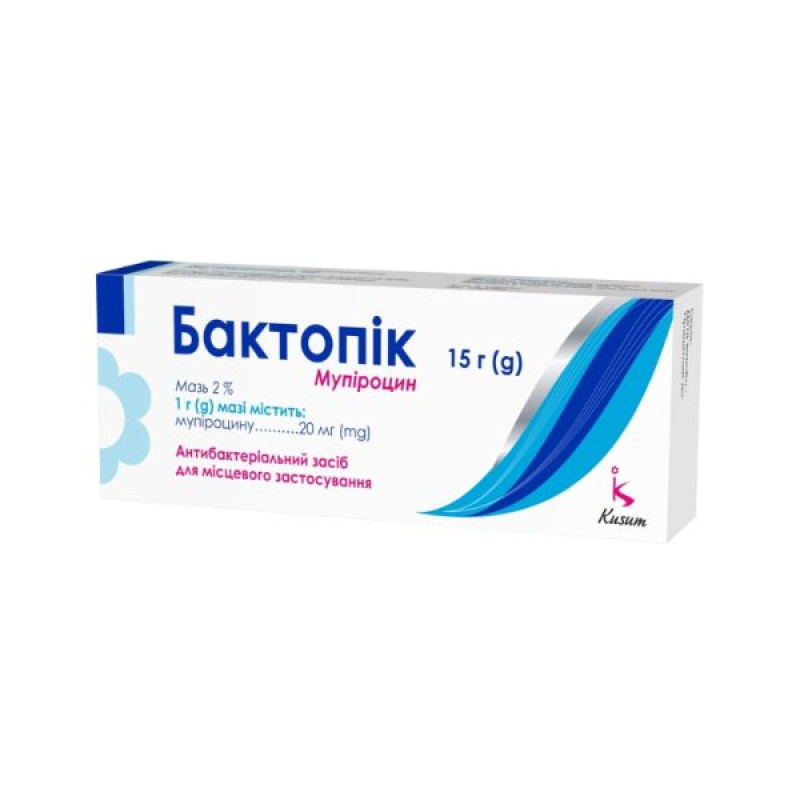
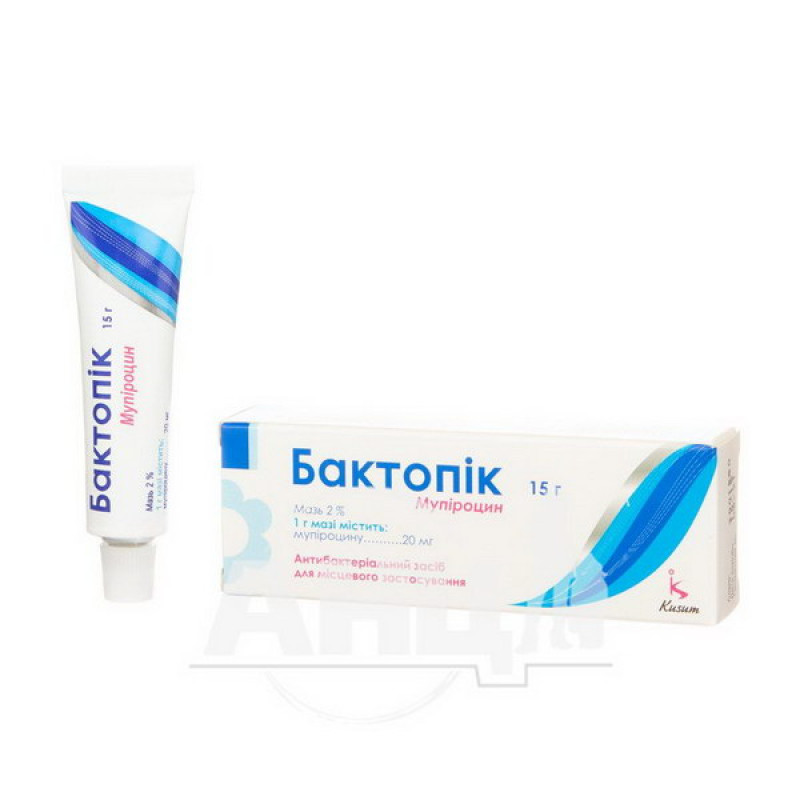
Instructions for use Bactopic ointment 2%, aluminum tube 15 g
Composition
active ingredient: mupirocin;
1 g of ointment contains 20 mg of mupirocin;
excipients: polyethylene glycol 3350, polyethylene glycol 400.
Dosage form
Ointment.
Main physicochemical properties: white to almost white ointment.
Pharmacotherapeutic group
Topical antibiotics. Mupirocin.
ATX code D06A X09.
Pharmacological properties
Pharmacodynamics
Mupirocin is a topical antibacterial agent active against microorganisms that cause most skin infections, including Staphylococcus aureus, including methicillin-resistant strains, other staphylococci, and streptococci. The drug is also active against gram-negative microorganisms such as Escherichia coli and Haemophilus influenzae.
Mupirocin is an antibiotic produced by fermentation of Pseudomonas fluorescens. Mupirocin inhibits isoleucyl transfer RNA synthetase, which leads to the cessation of protein synthesis in the bacterial cell. Mupirocin has bacteriostatic properties when used in minimal inhibitory concentrations, and bactericidal properties when used in higher concentrations, which are achieved with topical application.
Mechanism of resistance development.
The low level of resistance in staphylococci is thought to be caused by point mutations within the ileS gene, which encodes the target enzyme isoleucyl-tRNA synthetase.
The natural resistance of Gram-negative organisms, such as Enterobacteriaceae, may be due to the poor permeability of the outer membrane of the cell wall of Gram-negative bacteria.
Due to its specific mechanism of action and unique chemical structure, there is no cross-resistance of mupirocin with other antibiotics used in clinical practice.
Microbiological sensitivity.
The prevalence of acquired resistance of individual species may vary depending on the geographical region and a certain period of time, therefore it is advisable to take into account information on the prevalence of resistance in a given region, especially when treating severe infections.
| Typically sensitive species |
| Staphylococcus aureus* |
| Streptococcus pyogenes* |
| Streptococcus spp. (β-hemolytic, except S. pyogenes) |
| Species for which acquired resistance is possible |
| Staphylococcus spp., coagulase-negative |
| Naturally resistant microorganisms |
| Corynebacterium spp. |
| Micrococcus spp. |
* Satisfactory activity has been demonstrated in clinical studies.
Pharmacokinetics
When mupirocin ointment is applied topically, systemic absorption is minimal. In addition, absorbed mupirocin is rapidly metabolized to a microbiologically inactive metabolite, monic acid. Penetration of mupirocin into the deeper epidermal and dermal layers of the skin is increased in damaged skin areas and under occlusive dressings.
Elderly patients.
There are no restrictions on the use of mupirocin ointment in elderly patients, except for patients with moderate or severe renal impairment (see section "Special warnings and precautions for use").
Indication
Topical treatment of bacterial skin infections, such as impetigo, folliculitis, furunculosis, caused by microorganisms sensitive to mupirocin.
Contraindication
Hypersensitivity to mupirocin or to any other component of the drug.
This dosage form is not intended for ophthalmic or intranasal use.
Interaction with other medicinal products and other types of interactions
No interactions with other drugs have been identified.
Application features
Hypersensitivity reactions
In the event of hypersensitivity reactions or severe local skin reactions when using the ointment, treatment should be discontinued, the skin area should be washed with water to remove any remaining ointment, and appropriate therapy should be prescribed.
Pseudomembranous colitis
As with other antibacterial drugs, prolonged use of mupirocin may result in overgrowth of non-susceptible organisms.
Pseudomembranous colitis may occur with antibiotic therapy and may range in severity from mild to life-threatening. Therefore, it is important to consider this diagnosis in patients who develop diarrhea during or after antibiotic therapy. Although the likelihood of this occurring with topical mupirocin is lower, if prolonged or severe diarrhea or abdominal cramps occur, treatment should be discontinued immediately and the patient should be evaluated.
Kidney failure
Bactopic ointment should not be applied to open wounds or damaged skin, especially in the presence of moderate or severe renal insufficiency, since absorption of a significant amount of polyethylene glycol excreted by the kidneys is possible.
Bactopic ointment should not be used:
for the treatment of eye diseases; intranasally; in combination with catheters; in the area of central venous catheterization.
Avoid contact with eyes. If this happens, rinse eyes thoroughly with water until all traces of ointment are removed.
Ability to influence reaction speed when driving vehicles or other mechanisms
No adverse reactions that would negatively affect the ability to drive or operate other mechanisms have been identified.
Use during pregnancy or breastfeeding
Pregnancy. Animal studies of mupirocin have not shown any evidence of harmful effects on the fetus. There are no clinical data on the use of mupirocin ointment during pregnancy. Bactopic ointment should be used during pregnancy only if the potential benefit to the mother outweighs the potential risk to the fetus.
Breastfeeding. There is no data on the excretion of mupirocin into breast milk when applied topically. If necessary, it is possible to treat cracked nipples with ointment, but they should be thoroughly washed before feeding the child.
Fertility: There are no data on the effects of mupirocin on human fertility. Animal studies have shown no effect on fertility.
Method of administration and doses
Adults, children and elderly patients
A small amount of ointment should be applied to the affected areas of the skin 2-3 times a day for a period of up to 10 days, depending on the response to treatment.
A bandage can be applied to the area of skin treated with the ointment.
Kidney failure
See the section "Application features".
The drug is intended for external use.
After applying the drug to the skin, wash your hands thoroughly.
Do not mix the ointment with other drugs, because diluting the ointment reduces its antibacterial activity and may lose the stability of mupirocin in the ointment.
The ointment remaining in the tube after the end of treatment must be disposed of.
Children
Used for children from 2 months of age.
Overdose
Symptoms: Experience with symptoms of mupirocin overdose is limited.
Treatment: There is no specific treatment. Symptomatic therapy and appropriate monitoring of the patient's condition are indicated.
Adverse reactions
Immune system disorders: systemic allergic reactions including anaphylaxis, generalized rash, urticaria and angioedema.
Skin and subcutaneous tissue disorders: burning sensation at the site of application of the ointment, eczema, itching, erythema, pain and dryness of the skin at the site of application of the ointment. Skin hypersensitivity reactions: rash, increased exudation, swelling at the site of application of the ointment, contact dermatitis.
From the nervous system: headache, dizziness.
Gastrointestinal: nausea, abdominal pain, ulcerative stomatitis
Expiration date
2 years.
Storage conditions
Store in the original packaging at a temperature not exceeding 25 °C.
Keep out of reach of children.
Packaging
15 g of ointment in an aluminum tube. 1 tube in a cardboard box.
Vacation category
According to the recipe.
Producer
Kusum Healthcare Pvt Ltd
Location of the manufacturer and its business address
SP-289 (A), RIICO Industrial Area, Chopanki, Bhiwadi, Dist. Alwar (Rajasthan), India