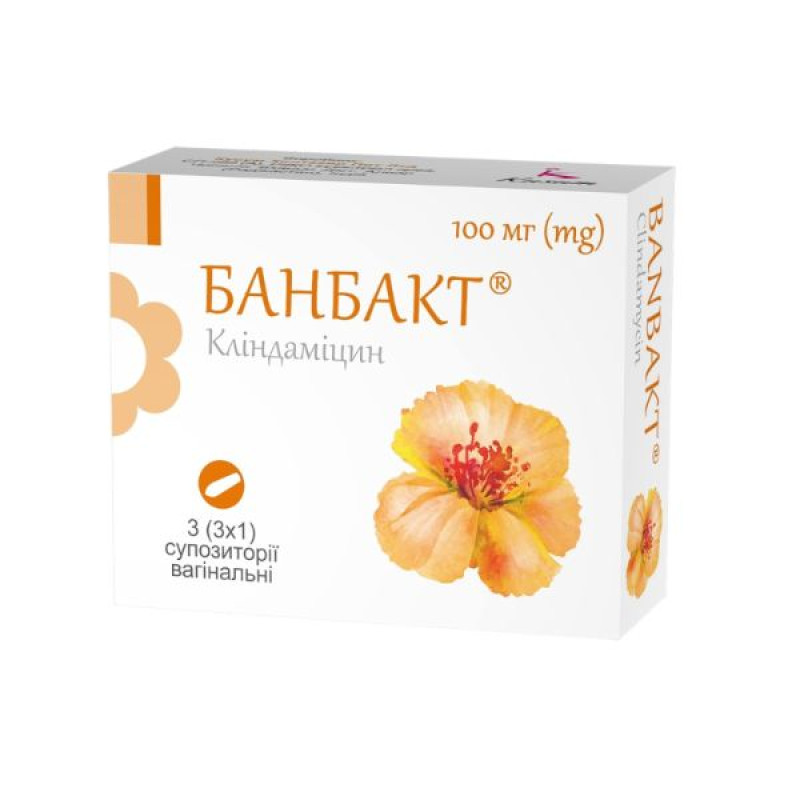
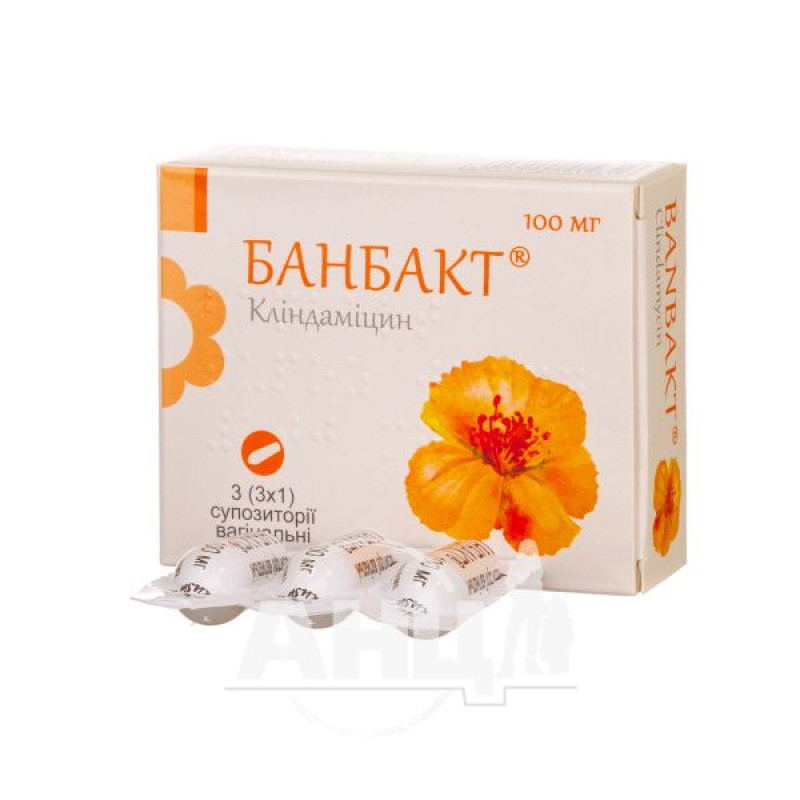
Instructions for Banbact vaginal suppositories 100 mg strip No. 3
Composition
active ingredient: clindamycin;
1 suppository contains clindamycin phosphate equivalent to clindamycin 100 mg; excipient: solid fat.
Dosage form
Vaginal suppositories.
Main physicochemical properties: suppositories from white to light yellow in color, torpedo-shaped.
Pharmacotherapeutic group
Antimicrobial and antiseptic agents used in gynecology, except combined medicinal products containing corticosteroids. Antibiotics. Clindamycin. ATX code G01A A10.
Pharmacological properties
Pharmacodynamics
Mechanism of action. Clindamycin is a lincosamide antibiotic that inhibits bacterial protein synthesis by acting on bacterial ribosomes. The antibiotic binds primarily to the 50S ribosomal subunit and affects the process of protein chain initiation. Although clindamycin phosphate is inactive in vitro, in vivo it is rapidly hydrolyzed to clindamycin, which exhibits antibacterial activity.
Clindamycin, like most protein synthesis inhibitors, has a predominantly bacteriostatic effect, its effectiveness is related to the duration of time when the concentration of the active substance remains above the minimum inhibitory concentration (MIC) of the infectious agent.
Resistance to clindamycin most often arises through modification of the target site of the ribosome, usually by chemical modification of RNA bases or point mutations in RNA, or sometimes in proteins. Cross-resistance has been demonstrated in some organisms in vitro between lincosamides, macrolides, and streptogramins B. Cross-resistance has been demonstrated between clindamycin and lincomycin.
In vitro susceptibility: Clindamycin has been shown to be active in vitro against the following strains of organisms known to be associated with bacterial vaginosis: Bacteroides spp., Gardnerella vaginalis, Mobiluncus spp., Mycoplasma hominis, Peptostreptococcus spp.
Standard methodology for susceptibility testing of potential bacterial vaginosis pathogens, Gardnerella vaginalis and Mobiluncus spp., has not been established. Breakpoints for susceptibility of Gram-negative and Gram-positive anaerobes to clindamycin have been published by EUCAST. Clinical isolates that are susceptible to clindamycin and resistant to erythromycin should also be tested for induced resistance to clindamycin using the D-test. However, the breakpoints are intended to guide systemic antibiotic treatment rather than topical therapy.
Pharmacokinetics
Absorption: The systemic absorption of clindamycin was evaluated following intravaginal administration of 1 clindamycin phosphate suppository once daily (equivalent to 100 mg clindamycin) to 11 healthy female volunteers for 3 days. Approximately 30% (6-70%) of the administered dose was systemically absorbed by day 3 as measured by the area under the concentration-time curve (AUC). Systemic absorption was evaluated following intravenous administration of a subtherapeutic dose of 100 mg clindamycin phosphate as a comparison to the same volunteers administered a vaginal cream containing 100 mg clindamycin phosphate. The mean AUC after 3 days of suppository administration was 3.2 μg h/mL (range 0.42 to 11 μg h/mL). The maximum blood concentration is observed on the 3rd day within 5 hours (range 1 to 10 hours) after application of suppositories and is on average 0.27 μg/ml (range 0.03 to 0.67 μg/ml). For comparison, AUC and maximum concentration (Cmax) after a single intravenous administration were on average 11 μg·h/ml (range 5.1 to 26 μg·h/ml) and 3.7 μg/ml (range 2.4 to 5 μg/ml), respectively. The mean half-life after application of suppositories is 11 hours (range 4 to 35 hours), which is considered to be limited by the rate of absorption. The results of this study showed that the systemic exposure to clindamycin (based on AUC) when administered as a suppository was on average 3-fold lower than after a single intravenous administration of a subtherapeutic dose of 100 mg of clindamycin. The systemic absorption of clindamycin from the suppository was 7-fold higher than when administered as a vaginal cream at the same dose, for which the mean AUC and Cmax values were 0.4 μg h/mL (range 0.13 to 1.16 μg h/mL) and 0.02 μg/mL (range 0.01 to 0.07 μg/mL), respectively. In addition, the recommended daily and total dose of clindamycin in suppositories for intravaginal administration is much lower than that typically used with oral or parenteral clindamycin (when 100 mg of clindamycin is administered daily for 3 days as a suppository, the amount of clindamycin absorbed is approximately 30 mg per day compared with 600–2700 mg per day for 10 days or more with oral or parenteral administration). Overall, the systemic exposure of clindamycin in vaginal suppositories is 2–20 times lower than the therapeutic dose of oral clindamycin hydrochloride and 40–50 times lower than the therapeutic dose of parenteral clindamycin phosphate.
Indication
Treatment of bacterial vaginosis (previous names: haemophilic vaginitis, gardnerella vaginitis, nonspecific vaginitis, corynebacterial vaginitis or anaerobic vaginosis).
Contraindication
Hypersensitivity to the active substance, lincomycin, or to any of the excipients listed in the "Composition" section.
Banbact® is also contraindicated in patients with a history of antibiotic-associated colitis.
Interaction with other medicinal products and other types of interactions
There is no information on the simultaneous use of Banbact® with other vaginal medications.
When administered systemically, clindamycin phosphate exhibits neuromuscular blocking properties that may potentiate and prolong the action of other neuromuscular blocking agents. Therefore, it should be used with caution in patients taking such drugs (see sections 5.2 and 5.3).
The use of latex condoms is not recommended during treatment with clindamycin in the form of vaginal suppositories.
Application features
Before or immediately after starting Banbact®, it may be necessary to conduct laboratory tests for the presence of other infectious agents, including Trichomonas vaginalis, Candida albicans, Chlamydia trachomatis, and gonococci.
The use of Banbact® may lead to overgrowth of microorganisms insensitive to the drug, including yeast.
Symptoms suggestive of pseudomembranous colitis may occur during or after the use of antimicrobial agents (see section 4.8). Cases of pseudomembranous colitis have been reported with nearly all antibacterial agents, including clindamycin; the severity may range from mild to life-threatening. Therefore, this should be considered in patients who develop diarrhea after the use of antibacterial agents. In moderate cases, improvement is observed after discontinuation of the drug.
In case of pseudomembranous diarrhea, clindamycin should be discontinued. Appropriate antibacterial treatment should be prescribed. Drugs that inhibit peristalsis are contraindicated in this case.
It is recommended to prescribe Banbact® with caution to patients with inflammatory bowel diseases, such as Crohn's disease or ulcerative colitis.
As with any vaginal infection, sexual intercourse is not recommended during the use of Banbact® in the form of vaginal suppositories. The base of the vaginal suppositories may weaken the strength of latex condoms and contraceptive diaphragms (see section "Interaction with other medicinal products and other types of interactions"). It is not recommended to use such medicines within 72 hours after treatment with the drug, as their contraceptive efficacy and protective properties against sexually transmitted diseases may be reduced.
During the period of use of the drug Banbact® in the form of vaginal suppositories, the use of other products intended for intravaginal administration (such as tampons, douching agents) is not recommended.
Acute kidney injury
Rare cases of acute kidney injury, including acute renal failure, have been reported. Therefore, monitoring of renal function should be considered in patients receiving long-term clindamycin therapy who have impaired renal function or are taking concomitant nephrotoxic drugs (see Adverse Reactions).
Special precautions for handling and disposal of the drug
Do not use this medicine if the package containing the vaginal suppositories is damaged, opened or not sealed properly.
Use during pregnancy or breastfeeding
Pregnancy
Reproductive toxicity has been demonstrated in animal studies.
The use of Banbact® during the first trimester of pregnancy is not recommended, as there are no adequate well-controlled studies on the use of this drug in pregnant women during this period.
According to clinical studies, the use of clindamycin in a dosage form for vaginal use in women during the second trimester of pregnancy and the systemic use of clindamycin phosphate during the second and third trimesters of pregnancy did not lead to the development of congenital anomalies.
The drug Banbact® can be used in the II and III trimesters of pregnancy only if clearly necessary.
It is not known whether clindamycin is excreted in human milk after vaginal administration. Although administered at much lower doses than systemic clindamycin, approximately 30% (range 6% to 70%) is absorbed into the systemic circulation. Clindamycin has been reported to be present in human breast milk at concentrations of < 0.5 to 3.8 μg/mL following systemic administration. There is a risk of adverse effects on the gastrointestinal flora of the breastfed infant (diarrhea or blood in the stool, or rash) when clindamycin is administered systemically to nursing mothers. The use of Banbact® vaginal suppositories in nursing mothers may be considered if the expected benefit to the mother outweighs the potential risk to the infant.
Fertility
Animal studies have not shown any effect on fertility.
Ability to influence reaction speed when driving vehicles or other mechanisms
The effect of Banbact® on the ability to drive or operate other mechanisms is absent or negligible.
Method of administration and doses
Dosage
The recommended dose is 1 suppository intravaginally before bedtime for 3 consecutive days.
Method of application
The drug Banbact® is used intravaginally.
Entry procedure
Remove the suppository from the blister pack.
Lie on your back and pull your knees to your chest.
Insert the suppository into the vagina using your middle finger as deeply as possible, but so as not to cause discomfort.
Use in elderly patients
The use of Banbact® in the form of vaginal suppositories in patients over 65 years of age has not been studied.
Use in patients with renal impairment
The use of Banbact® in the form of vaginal suppositories in patients with renal impairment has not been studied.
Attention should be paid to official recommendations regarding the appropriate use of antibacterial agents.
Children
The safety and efficacy of Banbact® in the form of vaginal suppositories in children have not been established.
Overdose
No cases of overdose with Banbact® in the form of vaginal suppositories have been reported.
Clindamycin phosphate, contained in the preparation and applied vaginally, can be absorbed in an amount sufficient to develop systemic effects.
In case of overdose, general symptomatic and supportive treatment is indicated, if necessary.
Accidental ingestion of the drug may cause effects similar to those that occur with oral administration of therapeutic doses of clindamycin.
Side effects
The safety of clindamycin vaginal suppositories has been evaluated in clinical trials in non-pregnant patients. The following adverse reactions have been reported: common (≥ 1/100 to < 1/10); uncommon (≥ 1/1000 to < 1/100); not known (frequency cannot be estimated from the available data).
Infections and infestations: common - fungal infections, infections caused by Candida; frequency unknown - clostridial colitis (caused by Clostridioides difficile).
Immune system disorders: frequency unknown - hypersensitivity reactions*; drug-induced eosinophilia with systemic symptoms (DRESS syndrome).
From the nervous system: often - headache.
Gastrointestinal: often - abdominal pain, diarrhea, nausea; infrequently - vomiting; frequency unknown - pseudomembranous colitis**.
Skin and subcutaneous tissue disorders: often - itching (not at the site of application); infrequently - rash.
Musculoskeletal and connective tissue disorders: uncommon – flank pain; frequency unknown – polyarthritis.
Renal and urinary disorders: uncommon - pyelonephritis, dysuria; frequency unknown - acute kidney injury, including acute renal failure (see section "Special warnings and precautions for use").
From the genitals and mammary glands: often - vulvovaginal candidiasis, vulvovaginal pain, vulvovaginal disorders; infrequently - vaginal infections, vaginal discharge, menstrual disorders.
General disorders and administration site conditions: uncommon – application site pain, application site pruritus, local swelling, pain, fever.
*Maculopapular rashes and urticaria have been reported with clindamycin. Of all adverse reactions, generalized skin rashes of mild to moderate severity were the most frequently reported. Cases of acute generalized exanthematous pustulosis, erythema multiforme, some resembling Stevens-Johnson syndrome, have been associated with clindamycin. A few cases of anaphylactoid reactions have been reported. If a hypersensitivity reaction occurs, the drug should be discontinued.
**Pseudomembranous colitis is a phenomenon common to the entire class of antibacterial agents.
Reporting adverse reactions after the registration of a medicinal product is important. This allows monitoring of the benefit/risk ratio when using this medicinal product. Medical and pharmaceutical professionals, as well as patients or their legal representatives, should report all cases of suspected adverse reactions and lack of efficacy of the medicinal product via the Automated Information System for Pharmacovigilance at the link: https://aisf.dec.gov.ua.
Expiration date
2 years.
Storage conditions
Store in the original packaging at a temperature not exceeding 25 °C.
Keep out of reach of children.
Packaging
3 suppositories in a strip. 1 strip in a cardboard box.
Vacation category
According to the recipe.
Producer
Kusum Healthcare Pvt Ltd.
Location of the manufacturer and address of its place of business
SP-289 (A), RIICO Industrial area, Chopanki, Bhiwadi, Dist. Alwar (Rajasthan), India/SP-289 (A), RIICO Industrial area, Chopanki, Bhiwadi, Dist. Alwar (Rajasthan), India.