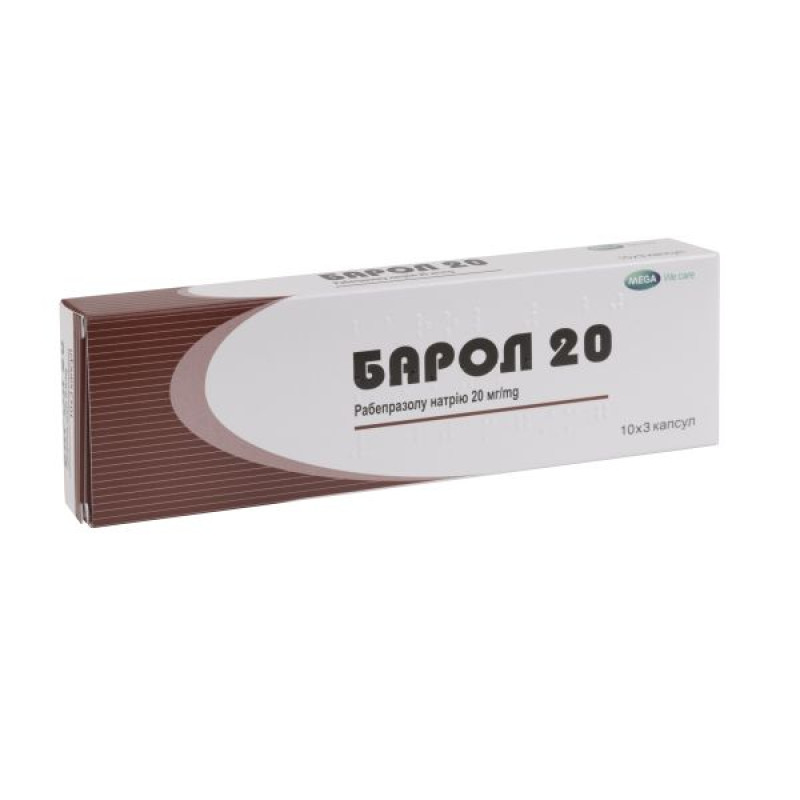
Instructions Barol 20 enteric-coated capsules 20 mg No. 30
Composition
active ingredient: rabeprazole;
1 capsule contains rabeprazole sodium 10 mg or 20 mg (in the form of enteric-coated pellets);
excipients: neutral pellets (No. 16–18) coated with magnesium carbonate; hypromellose; sodium hydroxide; light magnesium carbonate; talc; methacrylate copolymer (type C); macrogol 6000; titanium dioxide (E 171); red iron oxide (E 172); black iron oxide (E 172).
Dosage form
Enteric-coated capsules.
Main physicochemical properties:
10 mg capsules: hard opaque gelatin capsules No. 5, red/white in color, containing spherical or oval brown pellets;
20 mg capsules: hard opaque gelatin capsules No. 3, red/brown in color, containing spherical or oval brown pellets.
Pharmacotherapeutic group
Proton pump inhibitors. ATC code A02B C04.
Pharmacological properties
Pharmacodynamics
Mechanism of action. Rabeprazole sodium belongs to the class of antisecretory compounds, substituted benzimidazoles, does not have anticholinergic properties and is not an antagonist of histamine H2 receptors, but inhibits gastric acid secretion by specific inhibition of the enzyme H+/K+-ATPase on the secretory surface of the gastric parietal cells (acid or proton pump). The effect is dose-dependent and leads to inhibition of both basal and stimulated acid secretion, regardless of the stimulus. Rabeprazole sodium has weak alkaline properties, is rapidly absorbed and concentrated in the parietal cells at all dosages. Rabeprazole sodium is converted to the active sulfenamide form by protonation and, thus, reacts with available cysteine residues of the proton pump.
After oral administration of 20 mg of rabeprazole sodium, the antisecretory effect is observed after 1 hour and reaches a maximum after 2–4 hours. The effect of inhibition of basal function and stimulation of food secretion of acid 23 hours after taking the first dose of rabeprazole sodium was 69 and 82%, respectively, and the duration of this effect reached 48 hours. The effectiveness of rabeprazole sodium in inhibiting acid secretion is somewhat enhanced during daily administration of 1 tablet, but stable inhibition of secretion is achieved 3 days after the start of taking this drug. After stopping taking rabeprazole sodium, secretory activity normalizes within 2–3 days.
Reducing stomach acidity, regardless of any factors, including proton pump inhibitors such as rabeprazole, increases the number of bacteria in the digestive tract. Treatment with proton pump inhibitors increases the risk of gastrointestinal infections such as Salmonella, Campylobacter, and Clostridium difficile.
In the studies, patients received 10 or 20 mg of rabeprazole sodium once daily for 43 months. Serum gastrin concentrations increased during the first 2–8 weeks of therapy, reflecting inhibition of acid secretion. Gastrin concentrations returned to baseline levels, usually within 1–2 weeks after discontinuation of treatment.
Examination of gastric fundus and antrum biopsies from patients treated with rabeprazole or comparator for 8 weeks revealed no histological changes, no significant gastritis, no increased incidence of atrophic gastritis, no intestinal metaplasia, and no spread of H. pylori infection. No significant changes in these assays were observed with long-term treatment for 36 months.
There are currently no data on systemic effects on the central nervous system, cardiovascular and respiratory systems caused by the use of rabeprazole sodium. Oral administration of 20 mg of rabeprazole sodium per day for 2 weeks did not affect thyroid function, carbohydrate metabolism, or blood concentrations of parathyroid hormone, cortisone, estrogen, testosterone, prolactin, cholecystokinin, secretin, glucagon, follicle-stimulating hormone, luteinizing hormone, renin, aldosterone and somatotropic hormone.
Studies in healthy volunteers have shown no clinically significant interactions between rabeprazole and amoxicillin.
Rabeprazole has no negative effect on the plasma levels of amoxicillin and clarithromycin when used concomitantly for the eradication of H. pylori infection in the upper gastrointestinal tract.
Pharmacokinetics
Distribution: In humans, the degree of binding of rabeprazole sodium to blood plasma proteins is approximately 97%.
Metabolism and Excretion: Like other members of the proton pump inhibitor class, rabeprazole is metabolised by the cytochrome P450 (CYP450) hepatic drug metabolism system. In vitro studies with human liver microsomes have shown that rabeprazole sodium is metabolised by CYP450 isoenzymes (CYP2C19 and CYP3A4). At the expected levels in human plasma, rabeprazole does not induce or inhibit CYP3A4. However, the results of in vitro studies cannot always be extrapolated to in vivo situations. These results indicate that an interaction between rabeprazole and ciclosporin is not expected. In humans, the major metabolites present in plasma are the thioester (M1) and the carboxylic acid (M6), while minor metabolites present in low concentrations are the sulfone (M2), dimethylthioester (M4), and mercapturic acid conjugate (M5). Only the dimethyl metabolite (M3) has minor antisecretory activity, but it is not present in plasma.
After a single dose of 20 mg of 14C-labeled rabeprazole sodium, unchanged rabeprazole was not detected in the urine. Approximately 90% of the dose was eliminated in the urine, mainly as two metabolites: the mercapturic acid conjugate (M5) and the carboxylic acid (M6). The remaining portion of the dose was recovered in the feces.
Gender: Since a single dose of 20 mg of rabeprazole sodium is adjusted for body weight and height, gender does not affect pharmacokinetic parameters.
Renal impairment. In patients with end-stage renal disease undergoing maintenance haemodialysis (creatinine clearance < 5 ml/min/1.73 m²), the disposition of rabeprazole sodium was very similar to that in healthy volunteers. Rabeprazole sodium AUC and Cmax in these patients were increased by almost 35% compared to those in healthy volunteers. The mean half-life was 0.82 hours in healthy volunteers, 0.95 hours in haemodialysis patients and 3.6 hours in post-dialysis patients. The clearance of the drug in patients with renal failure undergoing haemodialysis was approximately twice that in healthy volunteers.
Hepatic impairment. After a single dose of 20 mg rabeprazole sodium in patients with moderate chronic liver disease, the AUC was doubled and a 2-3-fold increase in the half-life of rabeprazole was observed compared to that in healthy volunteers. Thus, with daily use of the drug at a dose of 20 mg for 7 days, the AUC should increase by at least 1.5 times, and the changes in peak plasma concentrations should be up to 1.2. The half-life of rabeprazole sodium in patients with liver disease was 12.3 hours compared to 2.1 hours in healthy volunteers. The pharmacodynamic response (pH-metry of gastric contents) in both groups of patients was similar in therapeutic parameters.
Elderly patients. The elimination of rabeprazole sodium is somewhat reduced in elderly patients. After 7 days of rabeprazole sodium 20 mg daily, the AUC in elderly subjects was approximately doubled, Cmax increased by 60%, and the half-life increased by 30% compared to those in young healthy volunteers. However, it should be noted that there was no evidence of accumulation of rabeprazole sodium.
CYP2C19 polymorphism: When rabeprazole sodium was administered at a dose of 20 mg daily for 7 days to patients who are CYP2C19 poor metabolisers, AUC and half-life were approximately 1.9 and 1.6 times higher, respectively, compared to those in extensive metabolisers; however, Cmax was only increased by 40%.
Indication
– Active peptic ulcer of the duodenum;
– active benign gastric ulcer;
– erosive or ulcerative gastroesophageal reflux disease (GERD);
– long-term treatment of gastroesophageal reflux disease (GERD maintenance therapy);
– symptomatic treatment of gastroesophageal reflux disease from moderate to very severe degree (symptomatic treatment of GERD);
– Zollinger-Ellison syndrome;
– in combination with appropriate antibacterial therapeutic regimens for the eradication of Helicobacter pylori in patients with peptic ulcer of the stomach and duodenum.
Contraindication
Hypersensitivity to rabeprazole, substituted benzimidazoles or to any other component of the drug. Concomitant use with atazanavir. Pregnancy or breastfeeding.
Interaction with other medicinal products and other types of interactions
CYP450 system
Rabeprazole sodium is metabolized by the CYP450 hepatic enzyme system, namely CYP2C19 and CYP3A4.
Studies have found that rabeprazole sodium has no pharmacokinetic or clinically significant interactions with warfarin, phenytoin, theophylline, or diazepam, each of which is metabolized by CYP450.
Rabeprazole sodium causes a strong and prolonged decrease in gastric acid production. Thus, rabeprazole may interact with drugs whose absorption depends on the pH of the gastric contents. Simultaneous use of rabeprazole sodium and ketoconazole or itraconazole may lead to a decrease in the concentration of the latter in the blood plasma, and use with digoxin may lead to an increase in the concentration of the latter. Therefore, individual patients who use these drugs together with Barol should be under the supervision of a physician to determine the need for dose adjustment.
Antacids
During clinical trials, patients were given antacids concomitantly with Barol as needed; no interaction with antacids such as aluminum or magnesium hydroxide was observed in a dedicated study.
Atazanavir
Co-administration of atazanavir 300 mg/ritonavir 100 mg with omeprazole (40 mg once daily) or atazanavir 400 mg with lansoprazole (60 mg once daily) in healthy volunteers resulted in a significant decrease in atazanavir exposure. Absorption of atazanavir is pH dependent. Although not studied, similar results are expected with other proton pump inhibitors. Proton pump inhibitors, including rabeprazole, should not be used in combination with atazanavir.
Methotrexate
Adverse reaction reports, published data from population pharmacokinetic studies, and retrospective analyses suggest that concomitant use of methotrexate and proton pump inhibitors (mainly at high doses) may lead to increased serum levels of methotrexate and/or its metabolite hydroxymethotrexate. Although no formal studies have been performed.
Clopidogrel
Concomitant administration of clopidogrel and rabeprazole to healthy volunteers had no clinically significant effect on the concentrations of the active metabolite of clopidogrel. No dose adjustment is required.
Food
Studies have shown that the consumption of a low-fat meal does not affect the absorption of rabeprazole sodium. Taking rabeprazole sodium with a fatty meal may delay absorption by 4 hours or more, but the maximum concentration and extent of absorption remain unchanged.
Cyclosporine
In vitro studies have shown that rabeprazole sodium inhibits the metabolism of cyclosporine. This level of inhibition is similar to that of omeprazole.
Medicinal products not recommended for concomitant use with rabeprazole
| Medicine | Signs of interaction | Mechanism and risk factors |
| Atazanavir sulfate | The therapeutic effect of atazanavir may be reduced | Having an antisecretory effect, rabeprazole increases gastric pH, reduces the solubility of atazanavir sulfate and thereby reduces its concentration in blood plasma. |
Medications that should be prescribed with caution
| Medicine | Signs of interaction | Mechanism and risk factors |
Digoxin Methyldigoxin | Blood levels of digoxin and methyldigoxin may increase | Having an antisecretory effect, rabeprazole can increase gastric pH, which leads to accelerated absorption of digoxin and methyldigoxin. |
Itraconazole Gefitinib | Blood concentrations of itraconazole and gefitinib may decrease | Having an antisecretory effect, rabeprazole is able to increase gastric pH, which leads to inhibition of the absorption of itraconazole and gefitinib. |
| Antacids containing aluminum hydroxide/magnesium hydroxide | Rabeprazole concentrations may be decreased when co-administered with antacids. |
| Tacrolimus | Potentially increased exposure to tacrolimus, especially in transplant patients who are intermediate or poor metabolisers of CYP2C19. |
| Research on neuroendocrine tumors | Serum chromogranin A (CgA) levels are increased due to the decreased gastric acidity caused by PPIs. Elevated CgA levels may cause false-positive results in the diagnosis of neuroendocrine tumors. |
| Secretin stimulation test | Hyperreaction of gastrin secretion in response to the secretin stimulation test, which is falsely indicative of gastrinoma. |
| False positive urine tests for THC | There have been reports of false-positive urine screening tests for tetrahydrocannabinol (THC) in patients taking PPIs. |
Concomitant use is contraindicated.
| Clarithromycin and Amoxicillin | Concomitant use may lead to serious adverse reactions, including potentially fatal arrhythmias. |
Application features
Caution should be exercised when prescribing rabeprazole to patients with known drug hypersensitivity. The risk of cross-hypersensitivity with other proton pump inhibitors or substituted benzimidazoles cannot be excluded.
Use in elderly patients
Symptomatic improvement from treatment with rabeprazole does not exclude the presence of a malignant tumor of the stomach or esophagus, therefore, before prescribing rabeprazole, the presence of a malignant tumor should be excluded.
Patients undergoing long-term treatment (especially those treated for more than 1 year) should be examined regularly.
The risk of cross-hypersensitivity reactions when used with other proton pump inhibitors or substituted benzimidazoles cannot be excluded.
Patients should be warned that Barol capsules should not be chewed or crushed, but should be swallowed whole.
Rabeprazole is not recommended for use in children, as there is no experience with its use in this category of patients.
Blood abnormalities (thrombocytopenia and neutropenia) have been reported. In most cases, no other etiology was found; the blood abnormalities were uncomplicated and resolved after discontinuation of rabeprazole.
Liver enzyme abnormalities have been observed both in clinical trials and during the post-marketing period. In most cases, no other etiology was found; the abnormalities were uncomplicated and resolved after discontinuation of rabeprazole.
In studies in patients with mild or moderate hepatic impairment, no significant difference in the incidence of adverse events was observed when taking rabeprazole compared to controls of the same sex and age. The physician should exercise caution when prescribing rabeprazole in the early stages of therapy in patients with severe hepatic impairment, as there are no clinical data on the use of the drug in this group of patients.
During treatment with rabeprazole, periodic hematological and biochemical testing is recommended.
Concomitant use of atazanavir and rabeprazole is not recommended.
Treatment with proton pump inhibitors, including rabeprazole, increases the risk of gastrointestinal infections such as Salmonella, Campylobacter and Clostridium difficile.
Risk of fractures
Proton pump inhibitors, especially when used at high doses and for long periods (>1 year), increase the risk of hip, wrist, and vertebral fractures, mainly in elderly patients or in patients with other risk factors. Observational studies suggest that proton pump inhibitors increase the overall risk of fractures by 10–40%. The risk may also be increased by other factors. Patients at risk of osteoporosis should receive appropriate treatment and take vitamin D and calcium.
Hypomagnesemia
Severe hypomagnesemia has been reported in patients taking proton pump inhibitors for at least 3 months, and in most cases for a year. Serious manifestations of hypomagnesemia, such as weakness, tetany, delirium, convulsions, dizziness, and ventricular arrhythmias, may occur. In most patients, hypomagnesemia resolved after discontinuation of proton pump inhibitors and magnesium replacement therapy.
With prolonged concomitant treatment with digoxin or drugs that lead to hypomagnesemia (e.g. diuretics), it is necessary to monitor the level of magnesium in the blood of patients before starting and periodically during treatment.
Thyroid function
It is recommended to monitor thyroid function during treatment with rabeprazole.
Features of conducting breath tests
C-urease breath tests may be falsely negative during treatment with proton pump inhibitors such as rabeprazole and antibiotics such as amoxicillin, clarithromycin and metronidazole. Therefore, breath tests for Helicobacter pylori should be performed no earlier than 4 weeks after stopping treatment with these drugs.
Treatment of non-erosive reflux disease is indicated in patients with recurrent reflux symptoms, including heartburn and acid reflux (approximately 2 times a week). Rabeprazole may mask the symptoms of malignancy (e.g. stomach or intestinal cancer) and other gastrointestinal diseases. Therefore, these diseases should be excluded before prescribing Rabeprazole.
If rabeprazole is prescribed to a patient with reflux disease without erosions, the doctor should confirm the effectiveness of the treatment after 2 weeks of use of the drug. If the symptoms do not disappear, there is a possibility that reflux disease is not the cause of their occurrence. In this case, the doctor should use another method of treatment.
If rabeprazole is prescribed for the purpose of eradication of Helicobacter pylori, it is important to pay attention to the contraindications, features of use, clinically significant adverse reactions and other precautions set out in the instructions for medical use of other medicinal products used for the purpose of eradication.
There is some evidence that concomitant use of proton pump inhibitors and methotrexate (mainly at high doses) may increase serum levels of methotrexate and/or its metabolites, which may lead to methotrexate-related toxicity. If high doses of methotrexate are required, discontinuation of proton pump inhibitor treatment should be considered.
Rabeprazole sodium, like all drugs that inhibit gastric acid secretion, may reduce the absorption of vitamin B12 (cyanocobalamin) due to hypo- or achlorhydria. This should be taken into account in patients with reduced body weight or risk factors for reduced absorption of vitamin B12 during long-term treatment, or in the presence of relevant clinical symptoms.
Subacute cutaneous lupus erythematosus.
The use of proton pump inhibitors has been associated with very rare cases of subacute cutaneous lupus erythematosus. If skin lesions, especially in sun-exposed areas, occur, accompanied by arthralgia, the patient should seek medical advice immediately and the physician should consider discontinuing treatment with rabeprazole sodium. The occurrence of subacute cutaneous lupus erythematosus after previous treatment with a proton pump inhibitor is a risk factor for the development of subacute cutaneous lupus erythematosus with the use of other proton pump inhibitors (PPIs).
Kidney dysfunction.
Acute tubulointerstitial nephritis (ATIN) has been reported in patients taking rabeprazole and may occur at any time during rabeprazole therapy (see section 4.8). Acute tubulointerstitial nephritis may progress to renal failure.
If GTIN is suspected, rabeprazole should be discontinued and appropriate treatment should be initiated immediately.
Impact on laboratory test results.
Elevated chromogranin A (CgA) levels may interfere with the detection of neuroendocrine tumors. To avoid this effect, treatment with the drug should be discontinued at least 5 days before chromogranin levels are measured. If chromogranin and gastrin levels have not returned to the control range after the initial measurement, the measurement should be repeated 14 days after discontinuation of PPI treatment.
Use during pregnancy or breastfeeding
Pregnancy: There are no data on the safety of rabeprazole during pregnancy. Animal reproduction studies have not revealed any evidence of impaired fertility or harm to the fetus due to the use of rabeprazole sodium, however, in rats, small amounts of the drug have been observed to cross the placenta.
The use of Barol during pregnancy is contraindicated.
Breastfeeding. It is not known whether rabeprazole sodium is excreted in human milk. No studies have been conducted. Rabeprazole sodium is excreted in the milk of rats.
Therefore, Barol should not be prescribed to women during breastfeeding.
Ability to influence reaction speed when driving vehicles or other mechanisms
Given the pharmacodynamics of rabeprazole sodium and its inherent side effect profile, it can be assumed that Barol should not adversely affect the ability to drive or use machines. However, in case of drowsiness, it is recommended to avoid driving or using machines.
Method of administration and doses
Adults, including elderly patients.
Active duodenal peptic ulcer and active benign gastric ulcer: the recommended dose for these conditions is 20 mg once daily in the morning.
In most patients with active duodenal peptic ulcer, the time required for ulcer healing is up to 4 weeks. However, some patients may require an additional 4 weeks of treatment to recover. In most patients with active benign gastric ulcer, healing occurs within 6 weeks, but some patients who are not responsive to treatment may require an additional 6 weeks of treatment to heal their ulcers.
Erosive or ulcerative gastroesophageal reflux disease: the recommended dose for these diseases is 20 mg once daily for 4–8 weeks.
Long-term treatment of gastroesophageal reflux disease (GERD maintenance therapy): for long-term treatment, maintenance doses of the drug of 10 mg or 20 mg once a day can be used (depending on the effectiveness of the treatment).
Symptomatic treatment of moderate to very severe GERD: in patients without esophagitis, the drug is prescribed at a dose of 10 mg 1 time per day. If after 4 weeks of treatment the symptoms do not disappear, the patient should be further examined. Once the symptoms disappear, further control of symptoms can be achieved using the "as needed" regimen: use 10 mg 1 time per day as needed.
Zollinger-Ellison syndrome: the dose is selected individually.
The recommended initial dose is 60 mg once daily. The dose may be gradually increased to 120 mg daily if clinically necessary. A single dose of up to 100 mg daily may be used. If 120 mg daily is required, the dose should be divided into 2 doses of 60 mg. The duration of treatment depends on the clinical need.
Some patients with Zollinger-Ellison syndrome have been treated with rabeprazole sodium for 1 year.
Eradication of H. pylori: Patients with H. pylori should be treated with appropriate combinations of the drug with antibiotics. It is recommended to administer for 7 days:
For indications requiring only once-daily administration, the tablets should be taken in the morning before a meal. Although neither morning administration nor food has been shown to affect the action of rabeprazole sodium, this mode of administration is more favorable for treatment. The tablets should not be chewed or crushed, but should be swallowed whole.
Renal and hepatic impairment. Patients with renal or hepatic impairment do not require dose adjustment. For the treatment of patients with severe hepatic impairment, see section "Special warnings and precautions for use".
Children
Barol is not used in children, as there is no experience with its use in this category of patients.
Overdose
Experience with intentional or accidental overdose is limited. The maximum dose studied did not exceed 60 mg rabeprazole sodium 2 times a day or 160 mg rabeprazole sodium 1 time a day. Symptoms that occur with overdose are generally minimal, typical of the profile of known adverse events and resolve without the need for further medical intervention. A specific antidote for Barol is unknown. Rabeprazole sodium is highly bound to plasma proteins and is not removed by dialysis. In case of overdose, symptomatic and supportive therapy should be provided.
Adverse reactions
The most frequently reported adverse reactions were headache, diarrhea, abdominal pain, asthenia, flatulence, rash, and dry mouth. The adverse effects observed were mostly minor, moderate, and self-limiting.
Infections and infestations: infections.
From the blood system: anemia, eosinophilia, erythrocytopenia, lymphopenia, neutropenia, leukopenia, thrombocytopenia and leukocytosis.
Immune system disorders: hypersensitivity (including urticaria, facial edema, hypotension and dyspnea, erythema, acute systemic allergic reactions, which usually disappear after discontinuation of treatment).
Metabolic: anorexia, hypomagnesemia, hyponatremia.
On the part of the psyche: insomnia, nervousness, depression, confusion.
From the nervous system: headache, drowsiness, dizziness, weakness in the limbs, numbness of the limbs, hypoesthesia, decreased grip strength, speech disorders, disorientation, delirium, coma.
On the part of the organs of vision: visual disturbances, increased intraocular pressure.
Cardiovascular system: peripheral edema, arterial hypertension, palpitations.
From the respiratory system: cough, pharyngitis, rhinitis, bronchitis, sinusitis, glossitis.
From the digestive tract: diarrhea, vomiting, nausea, abdominal pain, constipation, flatulence, feeling of fullness and heaviness in the stomach, candidiasis, dyspepsia, dry mouth, belching, gastritis, stomatitis, taste disturbance, enteritis, esophagitis, cheilitis, heartburn, hemorrhoids, benign fungicidal polyp, microscopic colitis.
Hepatobiliary system: hepatitis, jaundice, hepatic encephalopathy (in isolated cases, hepatic encephalopathy was observed in patients with cirrhosis of the liver).
Skin and subcutaneous tissue disorders: rash, erythema (acute systemic allergic reactions that usually disappear after discontinuation of treatment), itching, sweating, erythema multiforme, toxic epidermal necrolysis, Stevens-Johnson syndrome, bullous reactions, subacute cutaneous lupus.
Musculoskeletal system: nonspecific pain, back pain, myalgia, leg cramps, arthralgia, fracture of the femoral neck, wrist or spine.
Renal and urinary system disorders: urinary tract infections: interstitial nephritis, tubulointerstitial nephritis (with possible progression to renal failure) - rare.
From the reproductive system: gynecomastia, increased erection.
General disorders: asthenia, flu-like syndrome, malaise, chest pain, chills, fever, thirst, alopecia.
Laboratory indicators: increased levels of liver enzymes (alanine transaminase, aspartate transaminase), lactate dehydrogenase, gamma-glutamyltransferase, alkaline phosphatase, total bilirubin, weight gain, proteinuria, increased levels of total cholesterol, triglycerides, urea nitrogen, increased levels of thyroxine-binding globulin, creatine phosphokinase, uric acid, urine glucose, hyperammonemia.
Caution should be exercised when prescribing rabeprazole to patients with severe hepatic impairment.
Adverse reactions of clinical significance: shock and anaphylactic reactions; pancytopenia, leukopenia, agranulocytosis, hemolytic anemia; fulminant hepatitis, liver dysfunction, jaundice; interstitial pneumonia; toxic epidermal necrolysis, Stevens-Johnson syndrome, erythema multiforme; acute renal failure, interstitial nephritis; hyponatremia; rhabdomyolysis.
Reporting of adverse reactions after the registration of a medicinal product is important. This allows monitoring of the benefit/risk ratio of the medicinal product. Healthcare professionals and pharmacists, as well as patients or their legal representatives, should report all cases of suspected adverse reactions and lack of efficacy of the medicinal product via the Automated Pharmacovigilance Information System at the following link: https://aisf.dec.gov.
Expiration date
2 years.
Storage conditions
Store at a temperature not exceeding 25 °C.
Keep out of reach of children.
Packaging
10 capsules in a strip; 3 strips in a carton.
14 capsules in a strip; 1 strip in a cardboard box.
Vacation category
According to the recipe.
Producer
Inventia Healthcare Ltd., India.
Location of the manufacturer and its business address
F1-F1/1, Ambernath M.I.D.C. Edition; Ambernath (East) 421506, Thane District, Maharashtra, India.
Applicant
Mega Lifesciences (Australia) Pty Ltd.
Applicant's location
60, National Avenue, Pakenham, Victoria 3810, Australia