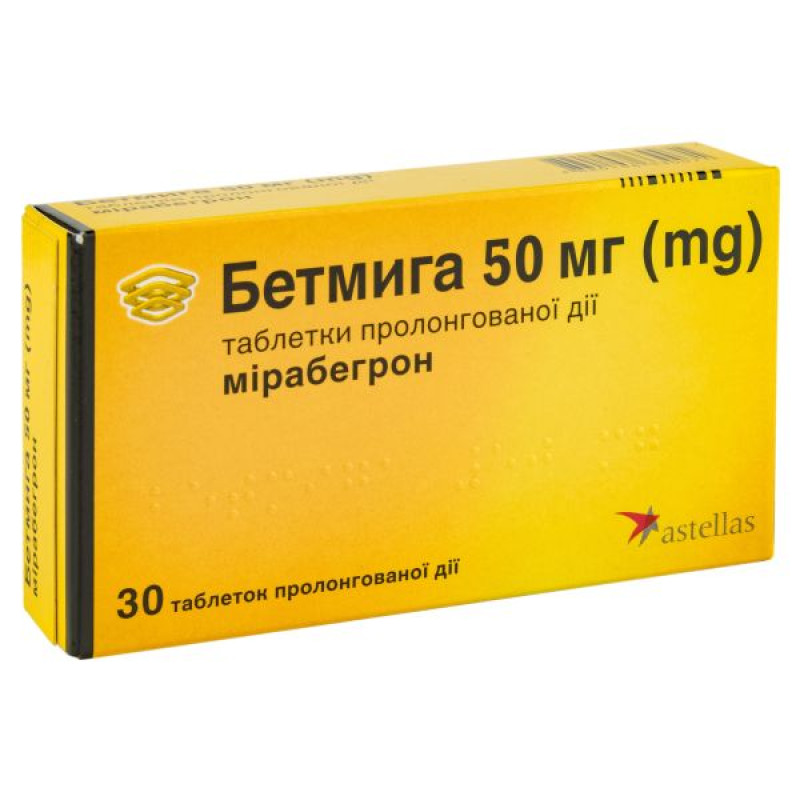
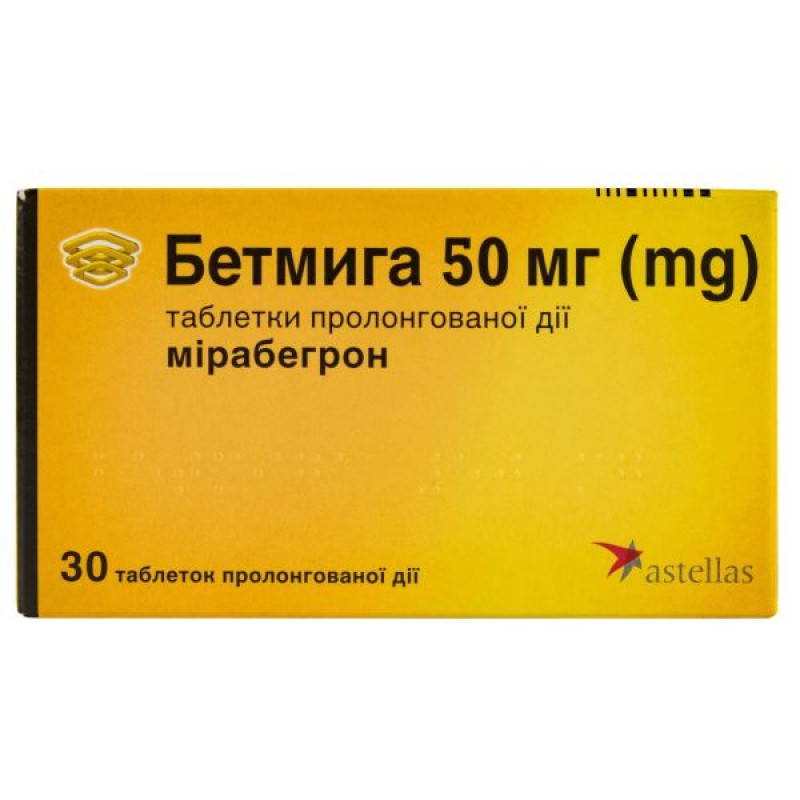
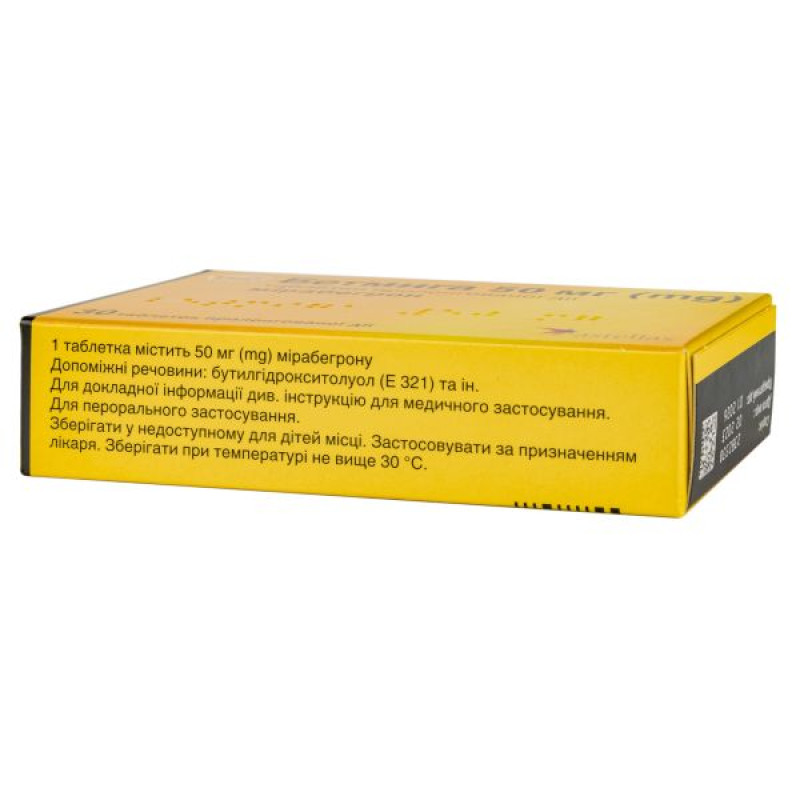
Instructions for Betmiga extended-release tablets 50 mg blister No. 30
Composition
active ingredient: mirabegron;
1 tablet contains 25 mg or 50 mg of mirabegron;
excipients: macrogol 8000, macrogol 2000000, hydroxypropylcellulose, butylhydroxytoluene (E 321), magnesium stearate;
film coating: for 25 mg tablets – Opadry 03F43159 (hypromellose, macrogol 8000, iron oxide yellow (E 172), iron oxide red (E 172)); for 50 mg tablets – Opadry 03F42192 (hypromellose, macrogol 8000, iron oxide yellow (E 172)).
Dosage form
Extended-release tablets.
Main physicochemical properties:
25 mg tablets – oval, biconvex, film-coated tablet, brown in color, engraved with “325” and a graphic image of the Astellas company logo on one side;
50 mg tablets – oval, biconvex, film-coated tablet, yellow in color, engraved with “355” and a graphic image of the Astellas company logo on one side.
Pharmacotherapeutic group
Drugs used in urology. Drugs for the treatment of frequent urination and urinary incontinence. ATX code G04B D12.
Pharmacological properties
Pharmacodynamics
Mechanism of action: Mirabegron is a potent, selective beta-3-adrenergic agonist. Mirabegron relaxes bladder smooth muscle in animals and isolated human tissue, increases cyclic adenosine monophosphatase (cAMP) concentrations in animal bladder tissue, and has a bladder-relaxing effect in a functional animal bladder model.
Mirabegron increases mean voided volume and reduces voiding frequency without bladder muscle contraction outside of voiding without affecting bladder pressure or residual urine in the bladder cavity in an animal model of overactive bladder. In animal bladder models, mirabegron has been shown to reduce voiding frequency. These results indicate that mirabegron improves urinary continence function by stimulating beta-3-adrenergic receptors in bladder muscle.
Sympathetic stimulation of nerve receptors predominates during the retention phase, when urine accumulates in the bladder. Noradrenaline is released from nerve endings, stimulating mainly beta-adrenergic receptors in the bladder muscle tissue, and, accordingly, relaxes the smooth muscles of the bladder. During the urine accumulation phase, the bladder is mainly under the control of the parasympathetic nervous system. Acetylcholine, released in the pelvic nerve endings, stimulates cholinergic M2 and M3 receptors, causing bladder contraction. Activation of the M2 pathway also inhibits beta-3-adrenergic receptors, increasing cAMP. Therefore, stimulation of beta-3-adrenergic receptors does not affect the process of urine accumulation. This was confirmed in models with partial urethral obstruction, where mirabegron reduced the frequency of bladder contractions without bladder muscle contractions outside of voiding without affecting pressure or residual urine in the bladder cavity.
Pharmacokinetics
Absorption.
After oral administration to healthy volunteers, mirabegron is absorbed into the bloodstream and reaches maximum plasma concentrations (Cmax) 3–4 hours after administration. Absolute bioavailability increases from 29% to 35% when the dose is increased from 25 mg to 50 mg. Mean Cmax and AUC values increase more than proportionally over the dose range. In the general male and female population, a 2-fold increase in the dose of mirabegron from 50 mg to 100 mg resulted in an increase in Cmax and AUCtau of approximately 2.9 and 2.6 times, respectively, while a 4-fold increase in the dose of mirabegron from 50 mg to 200 mg induced an increase in Cmax and AUCtau of approximately 8.4 and 6.5 times. Steady-state concentrations are achieved within 7 days (mirabegron administered once daily). After multiple once-daily administration, steady-state plasma concentrations of mirabegron are approximately 2-fold higher than those after a single dose.
Indication
Symptomatic treatment of urinary urgency, frequency and/or incontinence that may occur in adult patients with overactive bladder syndrome (OAB).
Contraindication
Hypersensitivity to the active substance or to any of the excipients. Severe uncontrolled hypertension (systolic blood pressure ≥ 180 mm Hg and/or diastolic blood pressure ≥ 110 mm Hg).
Interaction with other medicinal products and other types of interactions
In vitro study data.
Mirabegron is transported and metabolized by various pathways. Mirabegron is a substrate for cytochrome P450 (CYP) 3A4, CYP2D6, butyrylcholinesterase, uridine diphospho-glucuronosyl transferase (UGT), P-glycoprotein transporter (P-gp), and the organic cation transporters (OCTs) OCT1, OCT2, and OSTZ. Studies of mirabegron using human liver microsomes and recombinant human CYP enzymes have shown that mirabegron is a moderate, time-dependent inhibitor of CYP2D6 and a weak inhibitor of CYP3A. Mirabegron inhibited P-glycoprotein-mediated drug transport at high concentrations.
In vivo study data.
CYP2D6 genetic polymorphism has minimal effect on the mean plasma concentration of mirabegron (see section 5.2).
No interaction of mirabegron with a known CYP2D6 inhibitor is expected or has been studied. No dose adjustment of mirabegron is necessary in patients taking CYP2D6 inhibitors or in patients who are CYP2D6 poor metabolizers.
Drug interactions.
The effect of concomitant medicinal products on the pharmacokinetics of mirabegron and the effect of mirabegron on the pharmacokinetics of other medicinal products have been studied in single and multiple dose studies. Most drug interactions have been studied with mirabegron 100 mg, administered as an oral controlled release tablet (OCAS). The interaction studies of mirabegron with metoprolol and metformin used mirabegron immediate release (IR) formulation at a dose of 160 mg. No clinically significant drug interactions are expected between mirabegron and medicinal products that inhibit, induce, or are substrates or transporters of any of the CYP enzymes, except for the inhibitory effect of mirabegron on the metabolism of CYP2D6 substrates.
Effect on enzyme inhibitors.
In healthy volunteers, mirabegron exposure (AUC) was increased 1.8-fold in the presence of ketoconazole, a strong CYP3A/P-glycoprotein inhibitor. No dose adjustment of Betmiga is required when co-administered with CYP3A and/or P-glycoprotein inhibitors. However, for patients with mild to moderate renal impairment (GFR 30 to 89 mL/min/1.73 m2) or mild hepatic impairment (Child-Pugh Class A) when co-administered with strong CYP3A inhibitors such as itraconazole, ketoconazole, ritonavir, and clarithromycin, the recommended dose is 25 mg once daily without regard to food intake (see section 4.2). When used concomitantly with strong CYP3A inhibitors, Betmiga is not recommended for use in patients with severe renal impairment (GFR 15 to 29 mL/min/1.73 m2) or in patients with moderate hepatic impairment (Child-Pugh class B) (see sections “Method of administration and dosage” and “Special precautions for use”).
Effect on enzyme inducers.
Substances that are CYP3A or P-glycoprotein inducers reduce mirabegron plasma concentrations. No dose adjustment of mirabegron is required when rifampicin or other CYP3A inducers or P-glycoprotein inducers are used at therapeutic doses.
Effect of mirabegron on CYP2D6 substrates.
In healthy volunteers, mirabegron moderately inhibits CYP2D6, the activity of which is restored 15 days after discontinuation of mirabegron. Once-daily administration of mirabegron immediate-release dosage form resulted in a 90% and 229% increase in the Cmax and AUC of metoprolol administered as a single dose, respectively. Once-daily administration of mirabegron resulted in a 79% and 241% increase in the Cmax and AUC of desipramine administered as a single dose.
Caution should be exercised when co-administering mirabegron with medicinal products with a narrow therapeutic index and a strong effect on CYP2D6 metabolism, such as thioridazine, type 1C antiarrhythmics (e.g. flecainide, propafenone) and tricyclic antidepressants (e.g. imipramine, desipramine). Mirabegron should also be used with caution with CYP2D6 substrates, for which individual dose titration is required.
Effect of mirabegron on enzyme transporters.
Mirabegron is a weak inhibitor of P-glycoprotein (P-GP). When taking digoxin in healthy volunteers, mirabegron can increase its Cmax and AUC by 29% and 27%, respectively. For patients who start taking Betmiga and digoxin at the same time, the lowest dose of digoxin should be prescribed. To obtain the desired clinical effect, it is necessary to monitor the concentration of digoxin in the blood and titrate the dose of digoxin. The potential for inhibition of P-glycoprotein by mirabegron should be taken into account when using Betmiga simultaneously with drugs that are sensitive P-GP substrates, such as dabigatran.
Other interactions: No clinically significant interactions of mirabegron were observed when co-administered at therapeutic doses with solifenacin, tamsulosin, warfarin, metformin or combined oral contraceptives containing ethyl estradiol and levonorgestrel. No dose adjustment is required.
The potentiation of the effect of mirabegron when used simultaneously with other drugs may be expressed in an increase in pulse rate.
Application features
The use of Betmiga in patients with end-stage renal failure (GFR <15 mL/min/1.73 m2 or patients requiring hemodialysis) has not been studied, therefore this drug is not recommended for use in this category of patients. There are limited data on the use of Betmiga in patients with severe renal failure (GFR 15 to 29 mL/min/1.73 m2); based on pharmacokinetic studies (see section 5.2), a dose reduction to 25 mg is recommended for these patients. Betmiga is not recommended for use in patients with severe renal failure (GFR 15 to 29 mL/min/1.73 m2) with concomitant use of strong CYP3A inhibitors (see section 5.2).
Liver failure.
The use of Betmiga in patients with severe hepatic impairment (Child-Pugh Class C) has not been studied and is therefore not recommended in this patient population. Betmiga is not recommended in patients with moderate hepatic impairment (Child-Pugh Class B) when co-administered with strong CYP3A inhibitors (“Interaction with other medicinal products and other forms of interaction”).
Arterial hypertension.
Mirabegron may increase blood pressure. Blood pressure should be measured before starting treatment and periodically throughout the course of treatment, especially in patients with arterial hypertension. Data on the use of the drug in patients with stage 2 arterial hypertension (systolic BP ≥ 160 mm Hg or diastolic BP ≥ 100 mm Hg) are limited.
Patients with congenital or acquired QT prolongation.
When using mirabegron at therapeutic doses in clinical studies, no clinically significant prolongation of the QT interval was observed. Since the use of mirabegron in patients taking drugs that can prolong the QT interval or in patients with a history of prolonged QT interval has not been studied, the effect of mirabegron on the condition of these patients is unknown. Caution should be exercised when using mirabegron in this category of patients.
Patients with bladder obstruction and patients taking antimuscarinic drugs for the treatment of overactive bladder syndrome.
Urinary retention has been reported in post-marketing experience with mirabegron in patients with bladder obstruction and in patients taking antimuscarinic medicinal products for the treatment of overactive bladder syndrome. Controlled clinical safety studies in patients with bladder obstruction did not show an increased incidence of urinary retention in patients taking Betmiga, however, Betmiga should be used with caution in patients with clinically significant bladder obstruction. Betmiga should be used with caution in patients taking antimuscarinic medicinal products for the treatment of overactive bladder syndrome.
Use during pregnancy or breastfeeding
There are limited data on the use of mirabegron during pregnancy. Animal studies have shown reproductive toxicity. Betmiga is not recommended for use during pregnancy or in women of childbearing potential not using contraception.
Mirabegron is excreted in breast milk in rodents, and therefore there is a risk that the drug will be excreted in human breast milk. The effects of mirabegron on human milk production or on breast-feeding have not been studied. Mirabegron should not be administered to women who are breast-feeding.
Fertility.
Animal studies have not shown any effects when mirabegron is used at non-therapeutic doses. The effect of mirabegron on human fertility has not been evaluated.
Ability to influence reaction speed when driving vehicles or other mechanisms
Betmiga has no or negligible influence on the ability to drive or use machines.
Method of administration and doses
Adults, including elderly patients.
The recommended dose is 50 mg once daily, regardless of meals.
Renal and hepatic failure
The use of Betmiga in patients with end-stage renal failure (GFR <15 mL/min/1.73 m2 or in patients requiring hemodialysis) or in patients with severe hepatic impairment (Child-Pugh Class C) has not been studied, therefore Betmiga is not recommended for use in these patient categories (see sections “Special warnings and precautions for use”, “Pharmacokinetic properties”).
Table 1 provides recommendations for daily dosing for patients with renal or hepatic impairment in the presence or absence of strong CYP3A inhibitors (see sections 4.4, 4.5, and 5.2).
Table 1
| Renal/hepatic failure | Severity | Strong CYP3A inhibitors(3) |
Without inhibitor | With inhibitor | | Kidney failure (1) | mild | 50 mg | 25 mg |
| medium degree | 50 mg | 25 mg |
| severe | 25 mg | Not recommended |
| Liver failure(2) | mild | 50 mg | 25 mg |
| medium degree | 25 mg | Not recommended |
1 Mild: GFR 60–89 mL/min/1.73 m2; moderate: GFR 30–59 mL/min/1.73 m2; severe: GFR 15–29 mL/min/1.73 m2.
2 Mild: Child-Pugh A; moderate: Child-Pugh B.
3 Strong CYP3A inhibitors, see section “Interaction with other medicinal products and other forms of interaction”.
The tablets should be taken once a day with liquid; the tablet should be swallowed whole; the tablet should not be chewed, divided into parts, or crushed.
Sex
Depending on the article, there is no need to change the dose.
Children
The safety and efficacy of mirabegron in children (under 18 years of age) have not been studied.
Overdose
Mirabegron was administered as a single dose of 400 mg to healthy volunteers, palpitations (in 1 of 6 volunteers) and an increase in heart rate of more than 100 beats per minute (in 3 of 6 volunteers) were noted. With daily administration of mirabegron at a dose of 300 mg per day for 10 days in healthy volunteers, an increase in heart rate and systolic blood pressure was noted.
Treatment of overdose is symptomatic and supportive. In case of overdose, it is recommended to monitor pulse rate, blood pressure and conduct ECG monitoring.
Side effects
Most adverse reactions were mild or moderate in severity.
The most common adverse reactions were tachycardia and urinary tract infection. The incidence of tachycardia was 1.2% and led to discontinuation in 0.1% of patients. The incidence of urinary tract infection was 2.9%. Urinary tract infection did not lead to discontinuation in any patient. Serious adverse reactions included atrial fibrillation (0.2%).
The frequency of adverse reactions is defined as follows: very common (≥ 1/10); common (≥ 1/100 to <1/10); uncommon (≥ 1/1,000 to <1/100); rare (≥ 1/10,000 to <1/1,000); very rare (<1/10,000); frequency unknown (cannot be estimated due to lack of data). Within each group, adverse reactions are presented in order of decreasing seriousness.
Table 2
MedDRA Organ/system class | Often | Infrequently | Rarely | Very rare | Frequency unknown |
| Infections and infestations | Urinary tract infection | Vaginal infections Cystitis | - | - | - |
| Mental disorders | - | - | - | Insomnia* | |
| From the organs of vision | - | - | Eyelid swelling | - | - |
| From the heart | Tachycardia | Feeling of heart palpitations Atrial fibrillation | - | - | - |
| From the vascular system | - | - | - | Hypertensive crisis* | - |
| From the digestive system | Nausea* Constipation* Diarrhea* | Dyspepsia Gastritis | Lip swelling | - | - |
| Skin and subcutaneous tissue disorders | - | Urticaria Rash Macular rash Papular rash Itch | Leukocytoclastic vasculitis Purpura Angioedema* | - | - |
| Musculoskeletal system | - | Joint swelling | - | - | - |
| From the reproductive system and mammary glands | - | Vulvovaginal itching | - | - | - |
| Changes in laboratory test results | - | Increased blood pressure, increased GGT, increased ALT/AST | - | - | - |
| Renal and urinary disorders | - | - | Urinary retention* | - | - |
| From the nervous system | Headache* Dizziness* | - | - | - | - |
*Observed in the post-registration period.
Expiration date
3 years.
Storage conditions
Store at a temperature not exceeding 30 °C.
Keep out of reach of children.
Packaging
10 tablets in a blister. 1 or 3 blisters in a cardboard box.
Vacation category
According to the recipe.
Producer
Astellas Pharma Europe B.V.
Location of the manufacturer and its business address.
Hogemat 2, 7942 JM Meppel, Netherlands.
In case of side effects, please send information to the representative office of Astellas Pharma Europe B.V. at 04050, Kyiv, Pymonenka St., 13, building 7-V, office 41, tel. 044-490-68-25, fax: 044-490-68-26.