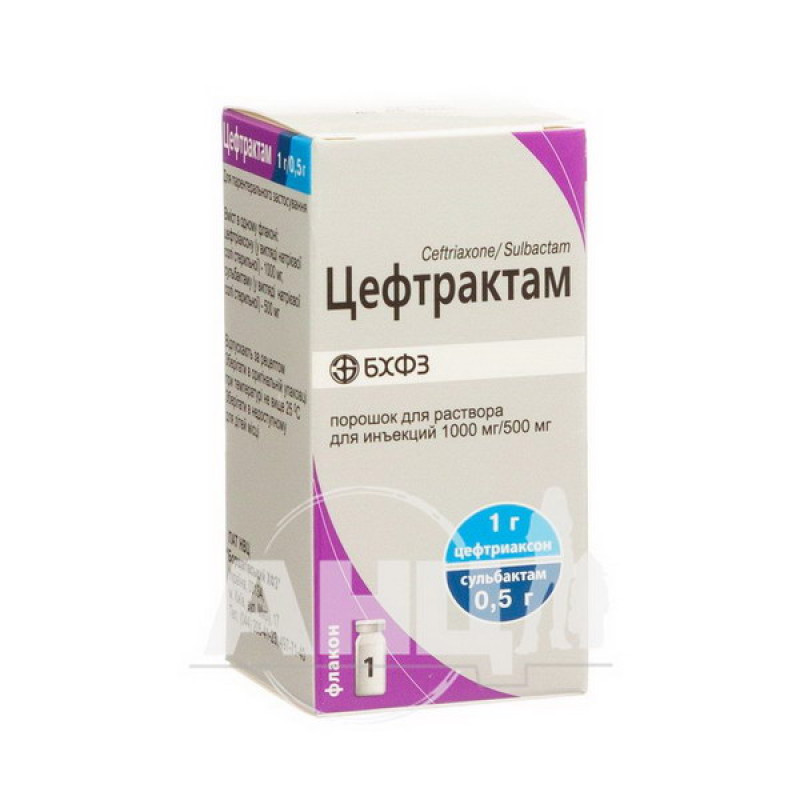
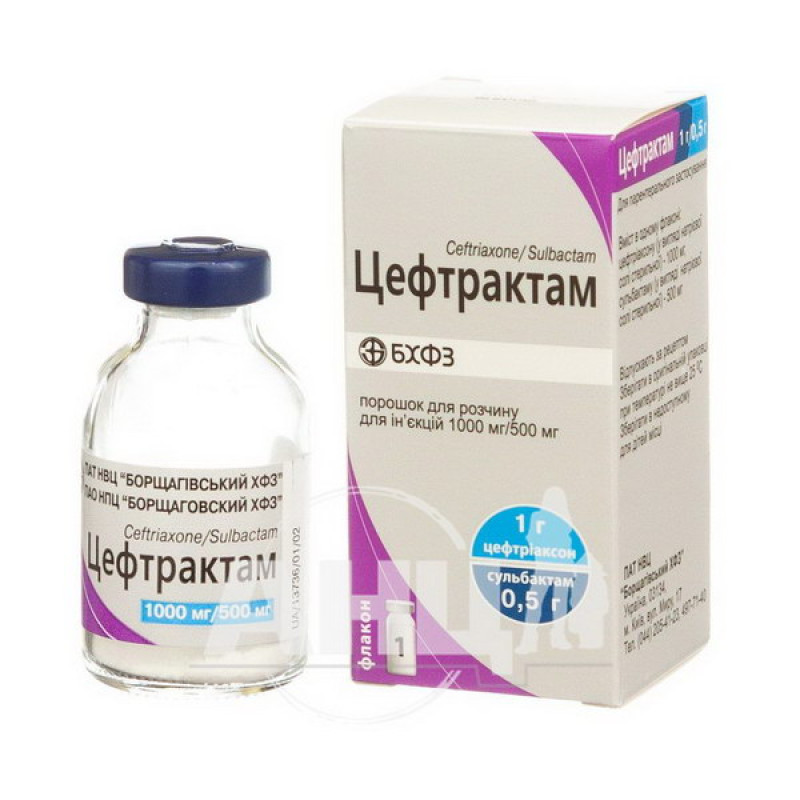
Ceftractam powder for solution for injection is indicated for infectious and inflammatory diseases caused by microorganisms sensitive to the drug:
Lower respiratory tract infections; Acute bacterial otitis media; Skin and soft tissue infections; Kidney and urinary tract infections; Bone and joint infections; Septicemia; Intra-abdominal infections (including peritonitis, biliary tract and gastrointestinal infections); Bacterial meningitis; Gonorrhea; Prevention of infections during surgical interventions.
When prescribing Ceftraktam, official recommendations for antibiotic therapy and recommendations for the prevention of antibiotic resistance must be followed.
Composition
Active ingredients: ceftriaxone, sulbactam;
1 vial contains ceftriaxone (as sterile sodium salt) 500 mg or 1000 mg and sulbactam (as sterile sodium salt) 250 mg or 500 mg, respectively.
Contraindication
Hypersensitivity to ceftriaxone, sulbactam, any cephalosporin antibiotic, lidocaine (intramuscular administration). History of severe hypersensitivity reactions (e.g. anaphylactic reactions) to any other type of beta-lactam antibacterial agent (penicillins, monobactams, carbapenems). History of gastrointestinal disease, especially nonspecific ulcerative colitis, enteritis or colitis associated with the use of antibacterial drugs. Premature newborns up to 41 weeks taking into account the term of intrauterine development (gestational age + calendar age) *. Full-term newborns (up to 28 days of life): with hyperbilirubinemia, jaundice, hypoalbuminemia, acidosis (in these conditions, the binding of bilirubin to blood proteins is reduced) *; if there is a need (or it is expected that there will be a need) for intravenous administration of calcium preparations or calcium-containing solutions due to the risk of formation of ceftriaxone-calcium precipitates in the lungs and kidneys.
* In vitro studies have shown that ceftriaxone may displace bilirubin from its association with serum albumin, leading to a possible risk of bilirubin encephalopathy in such patients.
Before intramuscular administration of ceftriaxone/sulbactam, it is essential to exclude the presence of contraindications to the use of lidocaine if it is used as a solvent (see the section "Special instructions for use", instructions for medical use of lidocaine, especially contraindications).
Ceftriaxone/sulbactam solutions containing lidocaine should never be administered intravenously.
Method of application
Administer intravenously or intramuscularly. Before starting therapy, it is necessary to exclude the patient's hypersensitivity to the antibiotic and to lidocaine (in the case of intramuscular administration) by performing a skin test.
The daily dose for adults and children over 12 years of age is 1.5-3 g of Ceftriaxone (1-2 g in terms of ceftriaxone) once a day (every 24 hours). In severe cases or infections with pathogens that have reduced sensitivity to ceftriaxone, the daily dose of Ceftriaxone can be increased to 6 g (4 g of ceftriaxone).
Application features
Pregnant women
During pregnancy, especially in the first trimester, the drug can be used only if the expected benefit to the woman outweighs the potential risk to the fetus.
Children
The drug is used in pediatric practice.
Drivers
Patients should be careful when driving or operating machinery.
Overdose
Symptoms: There is limited information on cases of overdose. In case of overdose, increased manifestations of adverse reactions are possible.
Side effects
Infections and infestations: possible development of superinfection (secondary fungal infections, including candidiasis, genital mycosis and infections caused by resistant microorganisms). Digestive tract: loose stools / diarrhea, nausea, vomiting, flatulence, stomatitis, glossitis, dysgeusia, gastrointestinal bleeding; pancreatitis (possibly due to obstruction of the biliary tract by precipitates of ceftriaxone calcium salt), pseudomembranous enterocolitis. Hepatobiliary system: pseudocholelithiasis of the gallbladder, precipitation of ceftriaxone calcium salts in the gallbladder with corresponding symptoms in children, reversible cholelithiasis in children; increased activity of hepatic transaminases, alkaline phosphatase in blood plasma, hyperbilirubinemia, kernicterus. Hematopoietic system: eosinophilia, leukopenia, leukocytosis, neutropenia, lymphopenia, thrombocytopenia, thrombocytosis, granulocytopenia, basophilia, anemia, including hemolytic anemia, prolongation / shortening of prothrombin time, coagulopathy, epistaxis, hypoprothrombinemia, agranulocytosis. During long-term treatment, the blood picture should be regularly monitored. Immune system: hypersensitivity reactions, including anaphylactic reactions (including anaphylactic shock), anaphylactoid reactions, serum sickness, Jarisch-Herxheimer reaction. Nervous system: headache, dizziness, tremor, convulsions. Hearing and balance organs: vertigo. Human anatomical models: increased levels of urea and creatinine in the blood, cylindruria, glucosuria, hematuria, oliguria, interstitial nephritis. Skin and subcutaneous tissue: skin rashes, allergic dermatitis, itching, urticaria, edema, including angioedema, rash, erythema multiforme, Stevens-Johnson syndrome, toxic epidermal necrolysis (Lyell's syndrome), DRESS syndrome (drug rash with eosinophilia and systemic symptoms), acute generalized exanthematous pustulosis. Cardiovascular disorders: increase / decrease in blood pressure, palpitations. Respiratory disorders: shortness of breath, bronchospasm.
Interaction
Nonsteroidal anti-inflammatory drugs, antiplatelet agents, vitamin K antagonists (such as warfarin). Increased risk of bleeding. Potentiation of the effect of vitamin K antagonists. Frequent monitoring of the international normalized ratio (INR) and appropriate dose adjustment of vitamin K antagonists are recommended during and after the use of ceftriaxone.
Aminoglycosides: There is conflicting evidence regarding the potential for increased renal toxicity of aminoglycosides when used with cephalosporins. In such cases, aminoglycoside levels and renal function should be closely monitored in clinical practice.
If combined treatment is necessary, they should be administered separately at different sites and not mixed in the same syringe or in the same infusion solution due to physicochemical incompatibility.
Bacteriostatic antibiotics (chloramphenicol, tetracycline). Possible reduction of the bactericidal effect of ceftriaxone.
Storage conditions
In the original packaging at a temperature not exceeding 25 °C.
Keep out of reach of children.
Shelf life - 2 years.