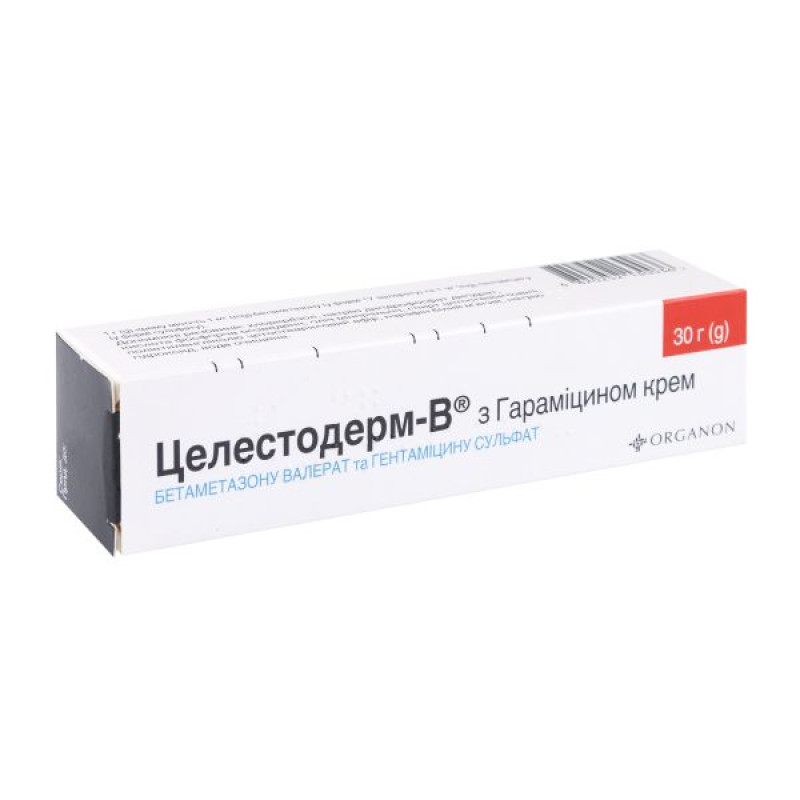
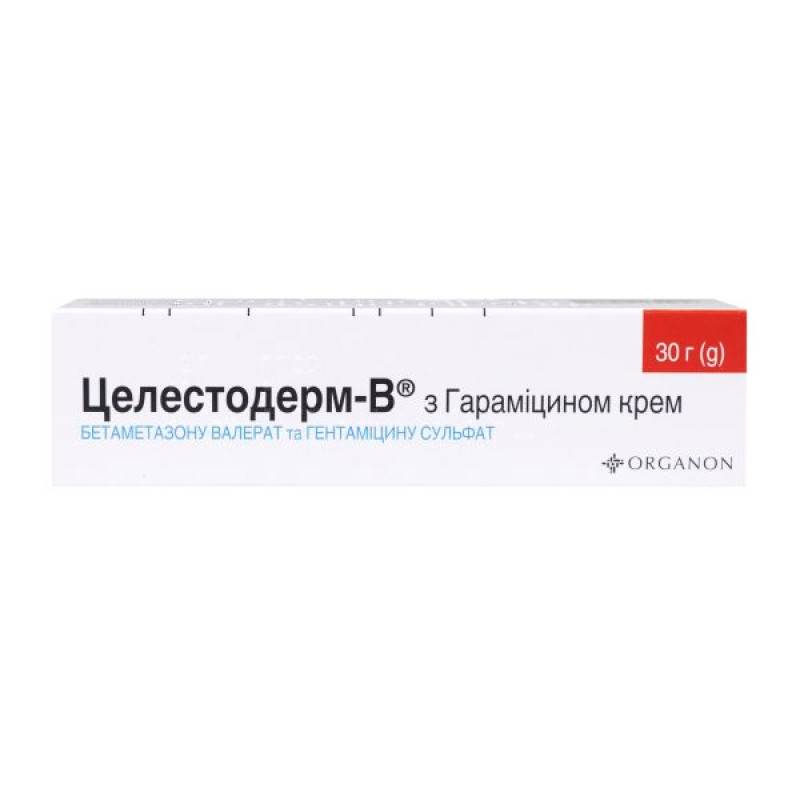
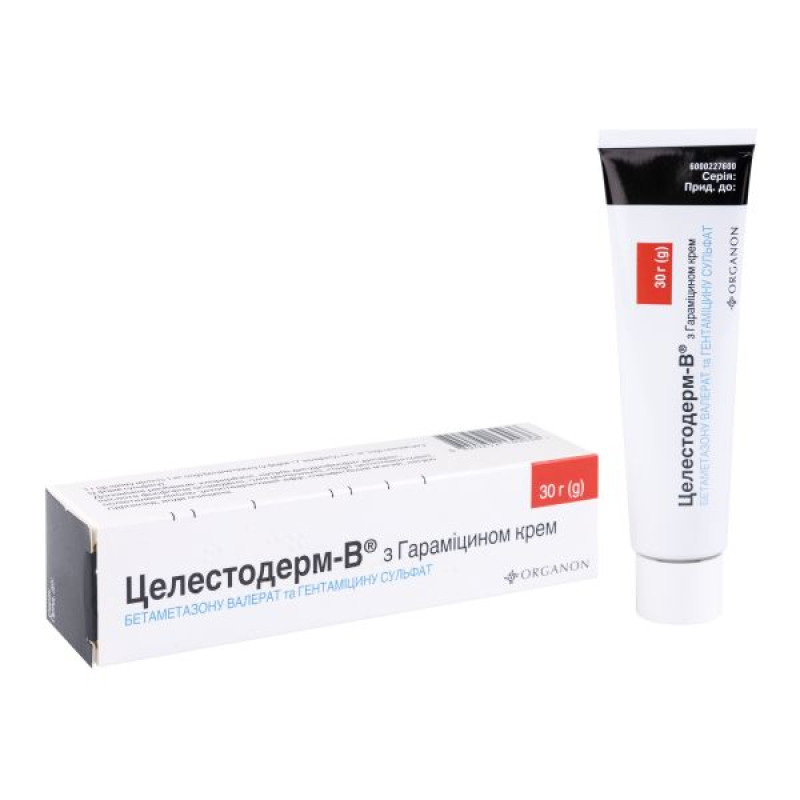
Instructions Celestoderm-B with garamycin cream tube 30 g
Composition
active ingredients: betamethasone, gentamycin;
1 g of cream contains 1 mg of betamethasone (in the form of 17-valerate) and 1 mg of gentamicin (in the form of sulfate);
Excipients: chlorocresol, sodium dihydrogen phosphate dihydrate, diluted phosphoric acid, mineral oil, cetostearyl alcohol, polyethylene glycol cetostearyl ether, white soft paraffin, sodium hydroxide, purified water.
Dosage form
Cream.
Main physicochemical properties: homogeneous white cream without foreign inclusions.
Pharmacotherapeutic group
Corticosteroids for use in dermatology. Corticosteroids, combinations with antibiotics. Betamethasone and antibiotics.
ATX code D07C C01.
Pharmacological properties
Pharmacodynamics.
Celestoderm-B® with Garamycin combines the long-lasting anti-inflammatory, antipruritic and vasoconstrictive effects of betamethasone valerate with the broad spectrum antibacterial activity of gentamicin sulfate. Active against Staphylococcus aureus (coagulase-positive, coagulase-negative and some strains producing penicillinase) and gram-negative bacteria: Pseudomonas aeruginosa, Aerobacter aerogenes, Escherichia coli, Proteus vulgaris and Klebsiella pneumoniae.
Pharmacokinetics.
There are no data on the pharmacokinetics of the drug Celestoderm-B® with Garamycin.
Indication
Dermatoses that are amenable to treatment with glucocorticosteroids, when complicated or suspected of being complicated by a secondary infection caused by microorganisms sensitive to gentamicin: eczema (atopic, infantile, coin-like), anogenital and senile pruritus, contact dermatitis, seborrheic dermatitis, neurodermatitis, intertriginous dermatitis, solar dermatitis, exfoliative dermatitis, stasis dermatitis and psoriasis.
Contraindication
Celestoderm-B® with Garamycin is contraindicated in patients with hypersensitivity to the active substances or to any other component of the drug and in patients with hypersensitivity to other glucocorticoids or aminoglycoside antibiotics.
Celestoderm-B® with Garamycin, cream, is also contraindicated in patients with hypersensitivity to chlorocresol.
Celestoderm-B® with Garamycin, cream, should not be used in the presence of skin diseases caused mainly by viral or bacterial infection.
Celestoderm-B® with Garamycin, cream, should not be used in the first trimester of pregnancy due to the presence of betamethasone valerate in the medicinal product.
Celestoderm-B® with Garamycin, cream, is also contraindicated in the following conditions:
viral infections, including post-vaccination reactions and chickenpox;
skin tuberculosis and syphilis;
viral skin infections (e.g. herpes simplex, herpes zoster);
rosacea and rosacea-like dermatitis;
dermatomycoses;
simultaneous systemic therapy with aminoglycoside antibiotics - as there is a risk of reaching toxic levels in blood plasma;
progressive renal failure;
children's age up to 1 year.
Celestoderm-B® with Garamycin, a cream, is not indicated for application to the ear canal, eyes, or mucous membranes.
Taking into account the possibility of absorption of the active substance, long-term treatment, application to large areas of skin and/or treatment with the use of occlusive dressings should be avoided.
Interaction with other medicinal products and other types of interactions
Celestoderm-B® with Garamycin, cream, should not be used simultaneously with other dermatological drugs for topical use due to possible mutual inactivation.
Gentamicin is incompatible with amphotericin B, heparin, sulfadiazine, and beta-lactam antibiotics (e.g. cephalosporins).
Application features
Any side effects observed with systemic glucocorticoids, including adrenal suppression, may also occur with topical glucocorticoids after systemic absorption, especially in children.
Systemic absorption of topical glucocorticoids generally increases with increasing corticosteroid dosage, duration of treatment, and the size of the body surface area treated. Therefore, patients receiving high doses of potent glucocorticoids such as betamethasone valerate over large areas of the body should be carefully monitored for signs of hypothalamic-pituitary-adrenal (HPA) axis suppression. If suppression occurs, the drug should be discontinued or the frequency of application reduced, or the patient should be switched to a less potent glucocorticoid.
Visual disturbances may occur with systemic and topical corticosteroids (including intranasal, inhaled, and intraocular administration). If symptoms such as blurred vision or other visual disturbances occur, the patient should be evaluated by an ophthalmologist to evaluate possible causes of visual disturbances, which may include cataracts, glaucoma, or rare conditions such as central serous chorioretinopathy, which have been reported following the use of systemic and topical corticosteroids.
Gentamicin-containing drugs, such as Celestoderm-B® with Garamycin, cream, should be chosen with caution for specific therapy. They should only be used if there is no rapid response to antiseptic measures, this response is insufficient, or antiseptic therapy is contraindicated.
Cross-allergic reactions with aminoglycoside antibiotics have been observed.
Gentamicin allergy, which occurred with the topical use of gentamicin-containing drugs (such as creams/ointments), makes it impossible to use gentamicin and other aminoglycosides later, for example in the form of infusions.
Prolonged topical use of antibiotics may sometimes lead to overgrowth of resistant microflora, including fungi. In this case, as well as in the event of skin irritation, sensitization or superinfection, therapy with the drug should be discontinued and appropriate treatment should be prescribed.
Systemic absorption of gentamicin when applied topically may be higher when treating large body surfaces, especially with prolonged use or in the presence of skin lesions. In such cases, undesirable effects associated with systemic absorption of gentamicin may occur. Under such conditions, gentamicin should be used with caution, particularly in children.
Due to the possibility of neuromuscular blockade with systemically absorbed aminoglycosides, the drug should be used with caution in patients with myasthenia gravis, Parkinson's disease, other conditions associated with muscle weakness, and in patients who are concurrently taking other drugs that may cause neuromuscular blockade.
Due to the presence of white soft paraffin and mineral oil in the composition of the medicinal product, the use of Celestoderm-B® cream with Garamycin on the anogenital area may damage the structure of latex condoms and reduce their safety when used during treatment.
Celestoderm-B® with Garamycin, cream, should not be applied to wounds or ulcers on the legs.
Celestoderm-B® with Garamycin, cream, contains cetostearyl alcohol. Cetostearyl alcohol may cause local skin irritation (e.g. contact dermatitis).
Use during pregnancy or breastfeeding
Pregnancy
There are no sufficient data on the use of Celestoderm-B® cream with Garamycin in pregnant women. Animal studies using the active ingredients of Celestoderm-B® cream with Garamycin have shown reproductive toxicity. Celestoderm-B® cream with Garamycin should not be used in the first trimester of pregnancy. The use of Celestoderm-B® cream with Garamycin is possible only in later stages of pregnancy if the expected benefit outweighs the potential risk. Preparations of this group should not be used by pregnant women on large areas, in large quantities or for a long period.
Breast-feeding
There is no information on whether betamethasone passes into breast milk. Other glucocorticoids and gentamicin pass into breast milk. Therefore, Celestoderm-B® with Garamycin, cream, can be used during breastfeeding only if the expected benefit outweighs the potential risk. Preparations of this group should not be applied to large areas, in large quantities or for a long period, and contact of the infant with the skin on which the cream is applied should be avoided.
Ability to influence reaction speed when driving vehicles or other mechanisms
Usually, the drug does not affect the reaction speed when driving or working with other mechanisms.
Method of administration and doses
The cream is applied in a thin layer to the entire affected area of the skin 2 times a day - in the morning and in the evening.
The frequency of application of the drug is determined by the doctor individually, depending on the severity of the disease. In mild cases, it is used once a day, in more severe lesions, more frequent application may be necessary.
The duration of treatment depends on the size and location of the disease, as well as the patient's response to treatment. However, if clinical improvement is not observed within 3–4 weeks, the diagnosis should be reconsidered.
Children.
There are no clinical data on the use of the drug in children, therefore it is undesirable to use it in patients of this age category.
In children receiving topical corticosteroids, adrenal suppression, Cushing's syndrome, growth retardation, insufficient weight gain, and increased intracranial pressure have been reported.
Manifestations of adrenal cortex suppression: low plasma cortisol levels and no response to the adrenal stimulation test with adrenocorticotropic hormone (ACTH) drugs. Increased intracranial pressure is manifested by fontanelle protrusion, headache, and bilateral optic disc edema.
Overdose
Celestoderm-B® with Garamycin, cream, should be used only in recommended doses.
If the patient forgets to apply the cream, it should be done as soon as possible and then continue with the usual dosing regimen.
Symptoms of overdose
With long-term or excessive use of local glucocorticosteroids, suppression of pituitary-adrenal function is possible with the development of secondary adrenal insufficiency and the appearance of symptoms of hypercorticism, including Cushing's disease.
No other manifestations of gentamicin toxicity associated with overdose are expected, as only minimal amounts of gentamicin are absorbed.
Excessive or prolonged topical use of gentamicin may lead to overgrowth of fungi and bacteria insensitive to the antibiotic.
Treatment
The patient should immediately consult a doctor if he accidentally swallows Celestoderm-B® cream with Garamycin, as well as in case of excessive use of the cream or use for a long period of time.
Symptoms of acute hypercorticism are usually reversible. If necessary, correction of electrolyte balance is carried out. In case of chronic toxic effects, gradual withdrawal of glucocorticoids is recommended. In case of overgrowth of resistant microorganisms, it is recommended to discontinue the use of Celestoderm-B® cream with Garamycin and prescribe the necessary therapy.
Side effects
When treated with Celestoderm-B® cream with Garamycin, adverse reactions are observed very rarely and include increased sensitivity, rash, and skin discoloration.
The following adverse reactions have been reported with the use of topical corticosteroids, particularly under occlusive dressings.
| Skin and subcutaneous tissue disorders | Burning, itching, irritation, dry skin, folliculitis, skin pigmentation changes, steroid acne, acne-like eruptions, dilation of small superficial blood vessels, hypertrichosis, rosacea-like (perioral) dermatitis, redness, allergic contact dermatitis, skin maceration, skin atrophy, striae and prickly heat |
| Infections and infestations | Secondary infections |
Celestoderm-B® with Garamycin, cream, is generally well tolerated. In very rare cases, skin irritation may occur, which may be associated with individual hypersensitivity to gentamicin.
Topical gentamicin may prolong wound healing. In addition, topical gentamicin may occasionally cause ototoxicity, vestibular toxicity, and nephrotoxicity, particularly when gentamicin is repeatedly applied to large wounds.
Celestoderm-B® with Garamycin, cream, contains the following excipients: chlorocresol and cetostearyl alcohol. Chlorcresol may cause allergic reactions. Hypersensitivity reactions to these substances have been reported only in rare cases.
In this case, the use of Celestoderm-B® cream with Garamycin should be discontinued.
Blurred vision (see also section 4.4) has been reported with the use of corticosteroids (frequency unknown).
Reporting of suspected adverse reactions
It is important to report suspected adverse reactions after a medicinal product has been authorised. This allows for continued monitoring of the benefit/risk balance of the medicinal product. Healthcare professionals should report all suspected adverse reactions.
Expiration date
3 years.
Storage conditions
Store out of the reach of children at a temperature not exceeding 25 °C.
Packaging
30 g in aluminum tubes. 1 tube in a cardboard box.
Vacation category
According to the recipe.
Producer
Organon Heist bv, Belgium.
Address
Industriepark 30, 2220, Heist-op-den-Berg, Belgium/Industriepark 30, 2220, Heist-op-den-Berg, Belgium.