Pharmacological properties
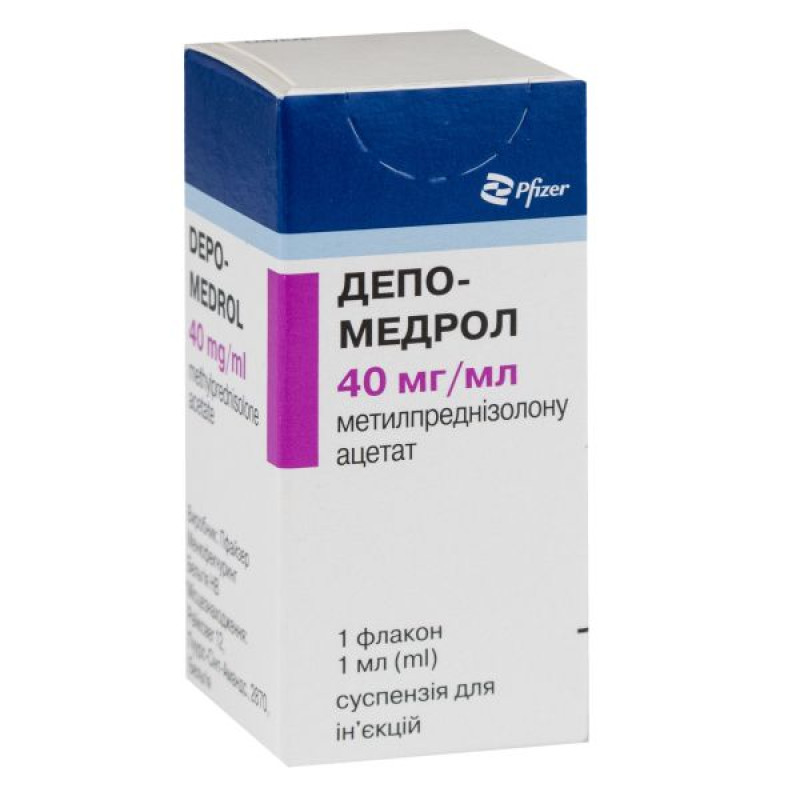
Pharmacodynamics. Depo-Medrol contains a synthetic glucocorticoid, a derivative of 6-methylprednisolone - methylprednisolone acetate.
Natural glucocorticoids (hydrocortisone and cortisone), which also cause fluid and salt retention, are used in replacement therapy in cases of adrenocortical insufficiency. Their synthetic analogues are used in many pathological processes due to their powerful anti-inflammatory properties. Glucocorticoids induce important and diverse metabolic effects and also modify the body's immune response to various stimuli.
Pharmacokinetics. After i / m administration of 40 mg of methylprednisolone acetate, the average plasma C max of 14.8 ng / ml is achieved within 6-8 hours. The drug concentrations in the blood plasma are determined for up to 11-17 days. After intra-articular administration, absorption of Depo-Medrol in the joint is noticeably slower than with i / m administration and lasts for several days.
C max 178.9 nmol/l is reached 2-12 hours after intra-articular administration of a dose of 40 mg.
Methylprednisolone acetate is hydrolyzed by plasma cholinesterase and is metabolized and deactivated primarily in the liver. The main inactive metabolites are 20-β-hydroxymethylprednisolone and 20-β-hydroxy-6-α-methylprednisolone.
Excretion is carried out by the kidneys and with bile.
T½ ranges from 2.4 to 3.5 hours in healthy adults and appears to be independent of the route of administration.
The clearance of methylprednisolone is impaired by concomitant use of troleandomycin, erythromycin, rifampicin, anticonvulsants and theophylline. In case of renal failure, dose adjustment is not required, methylprednisolone is dialyzed.
Corticosteroids readily cross the blood-brain barrier and the placental barrier and into breast milk.
Indication
A. intramuscular injection
When the use of oral agents is not possible, and the potency, dosage form, and route of administration make the drug suitable for the treatment of the pathological condition, intramuscular administration of Depo-Medrol (methylprednisolone acetate) sterile aqueous suspension is indicated for the following conditions.
endocrine disorders
Primary or secondary adrenal insufficiency (the drugs of choice are hydrocortisone or cortisone; if necessary, their synthetic analogues can be used together with mineralocorticoids; for the treatment of children, the combined use of mineralocorticoids is especially important).
Congenital adrenal insufficiency (the drug of choice is hydrocortisone or cortisone, simultaneous use of mineralocorticoids may be necessary, especially when using synthetic analogues).
Before surgery and in case of trauma or serious illness in patients with known adrenal insufficiency or unknown adrenal reserve.
Congenital adrenal hyperplasia, hypercalcemia caused by cancer, non-suppurative thyroiditis.
rheumatological lesions
As an additional remedy for short-term use (to withdraw the patient from an acute condition or in case of exacerbation of the process) in the following diseases: post-traumatic osteoarthritis; synovitis in osteoarthritis, rheumatoid arthritis, including juvenile rheumatoid arthritis (in some cases, low-dose maintenance therapy may be required); acute and subacute bursitis, epicondylitis, acute nonspecific tendosynovitis; acute gouty arthritis; psoriatic arthritis; ankylosing spondylitis.
collagenoses
During exacerbations or in some cases as maintenance therapy for systemic lupus erythematosus, systemic dermatomyositis (polymyositis), acute rheumatic carditis.
dermatological diseases
Pemphigus, severe erythema multiforme (Stevens-Johnson syndrome), exfoliative dermatitis, bullous dermatitis herpetiformis, severe seborrheic dermatitis, severe psoriasis, mycosis fungoides.
allergic conditions
For the control of severe or disabling allergic conditions that are not amenable to conventional treatment: bronchial asthma, contact dermatitis, atopic dermatitis, serum sickness, seasonal or chronic allergic rhinitis, drug allergy, transfusion reactions such as urticaria, angioedema of the larynx (first aid drug - adrenaline).
ophthalmological diseases
Severe acute and chronic allergic and inflammatory processes with damage to the eyes and adjacent organs, such as eye damage caused by Herpes zoster, iritis and iridocyclitis, chorioretinitis, diffuse posterior uveitis and choroiditis, optic neuritis, migratory ophthalmia, inflammation of the anterior segment of the eye, allergic conjunctivitis, allergic marginal corneal ulcer, keratitis.
gastrointestinal disease
To remove the patient from a critical condition with ulcerative colitis, segmental enteritis.
Respiratory diseases
Symptomatic sarcoidosis, berylliosis, fulminant or disseminated pulmonary tuberculosis (used in combination with appropriate anti-tuberculosis chemotherapy), Loeffler syndrome resistant to therapy by other methods, aspiration pneumonitis.
hematological diseases
Acquired (autoimmune) hemolytic anemia, secondary thrombocytopenia in adults, erythroblastopenia (anemia of the red blood cell system), congenital (erythroid) hypoplastic anemia.
Cancer disease
As palliative therapy for leukemia and lymphoma in adults, acute leukemia in children.
For induction of diuresis or treatment of proteinuria in nephrotic syndrome without uremia of idiopathic type or due to systemic lupus erythematosus.
Nervous system
Multiple sclerosis in the exacerbation phase.
Diseases of other organs and systems
Tuberculous meningitis with subarachnoid blockade or with the threat of blockade in combination with appropriate anti-tuberculosis chemotherapy, trichinosis with damage to the nervous system or myocardium.
B. For intrasynovial and soft tissue administration (including periarticular or intrabursal)
Depo-Medrol is indicated as adjunctive therapy for short-term use (to withdraw the patient from an acute condition or during exacerbation of the process) in the following diseases: synovitis in osteoarthritis, rheumatoid arthritis, acute and subacute bursitis, acute gouty arthritis, epicondylitis, acute nonspecific tendosynovitis, post-traumatic osteoarthritis.
B. For introduction into the pathological focus
Depo-Medrol is indicated for injection into the pathological focus in the following diseases: keloid, localized, hypertrophied, infiltrated foci of inflammation (lichen planus, psoriatic plaques, granuloma annulare, lichen simplex chronicus, discoid lupus erythematosus, diabetic necrobiosis lipoidica, alopecia areata).
Depo-Medrol may also be effective in treating cystic formations of the aponeurosis or tendon.
D. For rectal administration
Ulcerative colitis.
Application
Due to the possibility of physical incompatibility, Depo-Medrol (methylprednisolone acetate) sterile aqueous suspension should not be diluted or mixed with other solutions.
Before parenteral administration of the drug, the contents of the vial should be visually inspected to exclude the presence of particles or discoloration.
topical application
This therapy should be used as symptomatic and non-targeted.
1. Rheumatoid arthritis and osteoarthritis
The dose for intra-articular administration depends on the size of the joint, as well as the severity of the patient's condition. In the case of chronic diseases, injections can be repeated at intervals of 1-5 or more weeks, depending on the degree of improvement achieved after the first injection.
General recommendations are given in the table:
Joint size examples of joints Dose, mg
| great | Knee, hip, shoulder | 20-80 |
| average | Ulnar, carpal | 10-40 |
| Small | Metacarpophalangeal, interphalangeal, sternoclavicular, acromioclavicular | 4-10 |
|
Technique. Before performing an intra-articular injection, it is recommended to assess the anatomy of the affected joint. To achieve a full anti-inflammatory effect, it is important that the injection is performed into the synovial cavity. The procedure is performed under sterile conditions, as in lumbar puncture; a 20-24 G needle (put on a dry syringe) is quickly inserted into the synovial cavity.
Procaine infiltration can be done.
To control the needle's entry into the joint cavity, a few drops of intra-articular fluid are aspirated.
When choosing the injection site, which is individual for each joint, the proximity of the synovial cavity to the skin surface (as close as possible) and the location of large vessels and nerves (as far away as possible) are taken into account.
Once the needle is inserted, remove the syringe containing the synovial fluid and replace it with another one containing the required amount of Depo-Medrol. Aspirate some synovial fluid again to ensure that the needle is still in the correct location.
After injection, several movements should be carefully made in the joint to better mix the synovial fluid and suspension.
A sterile gauze bandage is applied to the area.
Sites suitable for intra-articular injection include the knee, ankle, wrist, elbow, shoulder, hip joints and phalanges.
Since it is sometimes difficult to inject into the hip joint, precautions should be taken to avoid injecting into the large vessels in this area.
Anatomically inaccessible joints, such as intervertebral and sacroiliac joints, devoid of a synovial cavity, are considered unsuitable for injection.
The ineffectiveness of therapy is most often due to unsuccessful injection of the drug into the joint cavity.
The effect in case of infiltration into surrounding tissues is insignificant or absent altogether.
If, in the case of precise injection into the synovial cavity (as confirmed by fluid aspiration), there is no effect, repeated injections are not advisable. Local application does not affect the