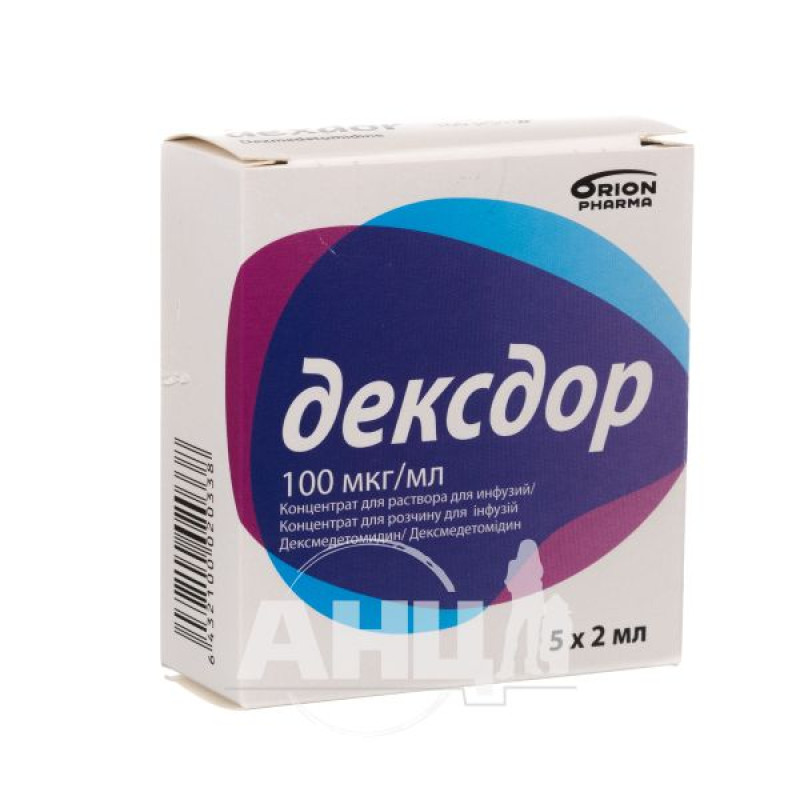
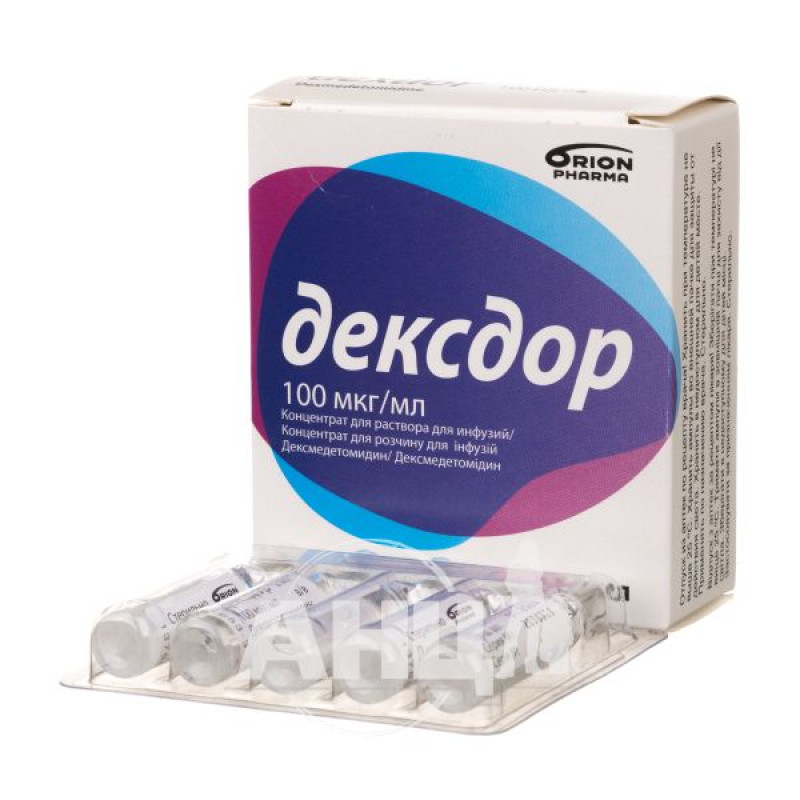
Dexdor concentrate for infusions 100 mcg/ml 2 ml No. 5
Dexdor concentrate for solution for infusion is indicated for sedation in hospital settings (in intensive care units, anesthesiology and resuscitation) of patients who require a level of sedation no deeper than awakening in response to vocal stimulation.
Composition
Active ingredient: dexmedetomidine hydrochloride;
1 ml contains dexmedetomidine hydrochloride 118 mcg, equivalent to 100 mcg of dexmedetomidine;
Excipients: sodium chloride, water for injections.
Contraindication
Hypersensitivity to dexmedetomidine or to any of the excipients of the drug.
Atrioventricular block II-III degree (in the absence of an artificial pacemaker).
Uncontrolled arterial hypotension.
Acute cerebrovascular pathology.
Method of application
Dexdor should be administered by persons experienced in the management of patients requiring intensive care. The drug should only be administered as a diluted intravenous infusion using a controlled infusion device. Ampoules and vials are intended for single patient use only.
Application features
Pregnant women
Dexdor should not be used during pregnancy unless the benefit to the woman outweighs the risk to the fetus/child. Data on the use of dexmedetomidine in pregnant women are limited. The potential risk to humans with regard to reproductive toxicity is unknown. Breastfeeding should be discontinued during treatment.
Children
The safety and efficacy of Dexdor in children aged 0 to 18 years have not been established. Data on use in children are provided in the sections “Pharmacological properties” and “Adverse reactions”, but no dosage recommendations can be made.
Drivers
Given the patient's condition for which the drug is prescribed, it cannot be expected that the patient will be able to drive vehicles or other mechanisms.
Overdose
Several cases of overdose with dexmedetomidine have been reported in clinical and post-marketing studies. According to available data, the administration rate in such cases reached 60 mcg/kg/h for 36 minutes and 30 mcg/kg/h for 15 minutes.
15 minutes in a 20-month-old child and an adult, respectively. The most common adverse reactions resulting from overdose in these cases were bradycardia, hypotension, excessive sedation, drowsiness, and cardiac arrest.
In case of overdose with clinical symptoms, the administration of Dexdor should be reduced or discontinued. The expected effects are mainly cardiovascular and should be stopped according to clinical indications. At high concentrations, the increase in blood pressure may outweigh its decrease. In clinical studies, sinus node arrest was allowed independently or in response to the administration of atropine or glycopyrrolate. In isolated cases of severe overdose, accompanied by cardiac arrest, resuscitation measures were required.
Side effects
The most commonly reported adverse reactions with Dexdor are hypotension, hypertension and bradycardia, occurring in approximately 25%, 15% and 13% of patients, respectively. Hypotension and bradycardia were also the most common serious adverse reactions associated with dexmedetomidine, occurring in 1.7% and 0.9% of randomized patients in the intensive care unit, anesthesiology and intensive care units, respectively.
Interaction
Concomitant use of dexmedetomidine with anesthetics, sedatives, hypnotics, and depressants may lead to an increase in their effects. This assumption has been supported by studies with isoflurane, propofol, alfentanil, and midazolam.
Storage conditions
Store at a temperature not exceeding 25 ° C. Keep out of the reach of children.
Keep the ampoules or vials in the outer carton to protect from light.
Shelf life - 3 years.
There are no reviews for this product.
There are no reviews for this product, be the first to leave your review.
No questions about this product, be the first and ask your question.