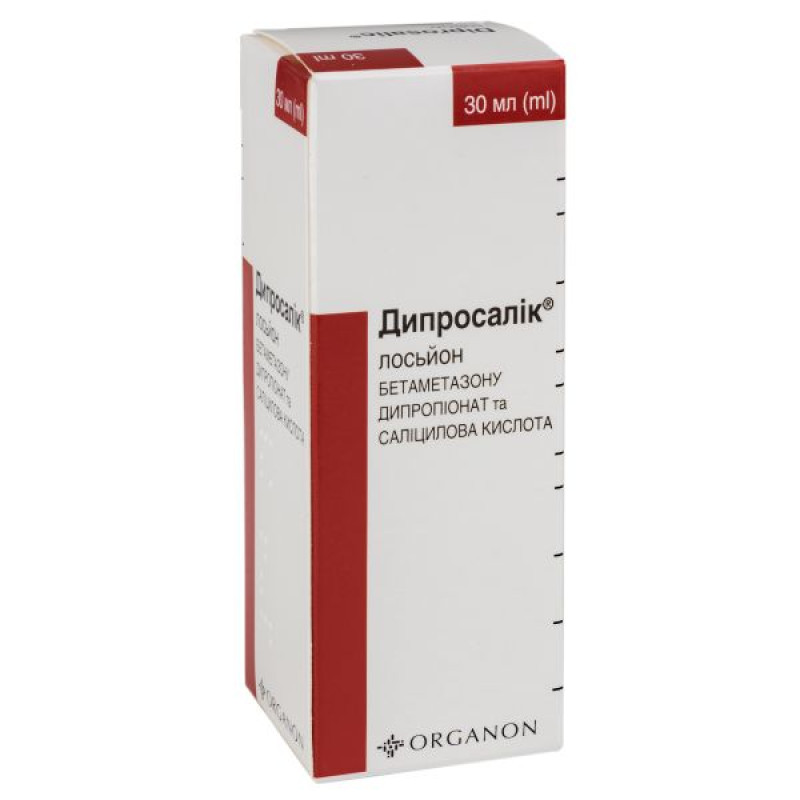
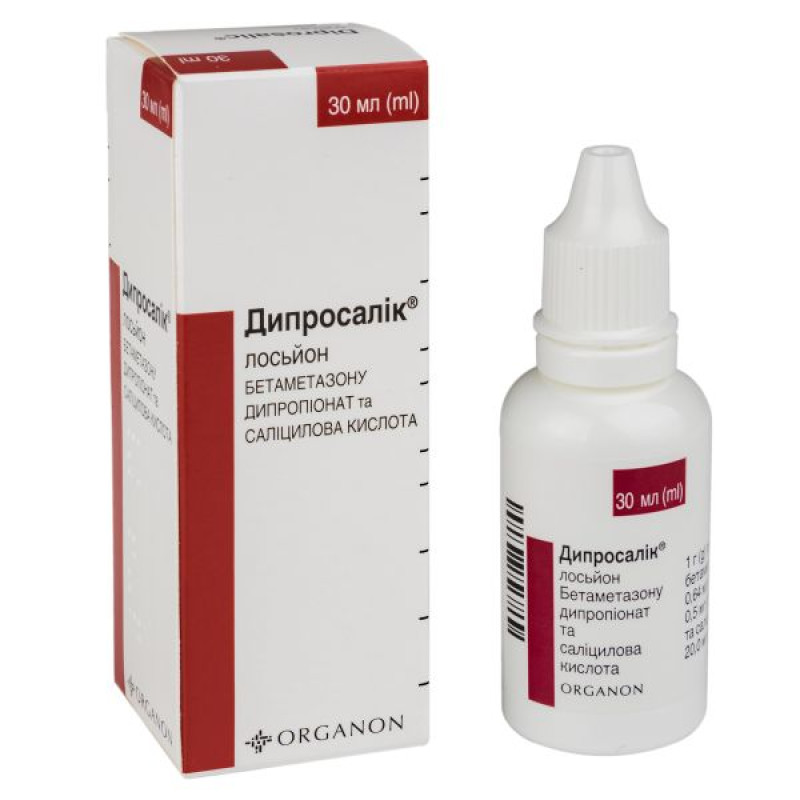
Instructions Diprosalic lotion bottle 30 ml
Composition
active ingredients: betamethasone, salicylic acid;
1 g of lotion contains 0.64 mg of betamethasone dipropionate, equivalent to 0.5 mg of betamethasone, and 20.0 mg of salicylic acid;
Excipients: disodium edetate, hypromellose, sodium hydroxide, isopropyl alcohol, purified water.
Dosage form
Lotion.
Main physicochemical properties: colorless translucent viscous liquid, free from foreign inclusions.
Pharmacotherapeutic group
Corticosteroids for use in dermatology. Active corticosteroids in combination with other drugs. ATX code D07X C01.
Pharmacological properties
Pharmacodynamics
Betamethasone dipropionate
Betamethasone dipropionate is a potent corticosteroid. When applied topically, it has a rapid and long-lasting anti-inflammatory, antipruritic, and vasoconstrictive effect.
Topical corticosteroid treatment is not an etiotropic treatment; if treatment is discontinued, the disease may relapse.
Salicylic acid
Salicylic acid, due to its keratolytic and exfoliating properties, makes the lower layers of the skin more accessible to the action of betamethasone dipropionate and improves its absorption.
Pharmacokinetics
Absorption of betamethasone dipropionate by the body is possible mainly after long-term application to a large area of skin.
Indication
To reduce inflammatory symptoms of psoriasis and seborrhea of the scalp.
Contraindication
The drug is contraindicated in patients with hypersensitivity to the active substances or to any other component of the drug.
The drug is also contraindicated in bacterial and viral infections, such as syphilitic and tuberculous skin lesions; post-vaccination reactions, smallpox, chickenpox, herpes simplex, shingles, perioral dermatitis, perianal itching and genital itching, widespread plaque psoriasis, varicose veins, diaper dermatitis, molluscum contagiosum, dermatomycoses, rosacea, acne, fungal infections.
Interaction with other medicinal products and other types of interactions
There are no known cases of interactions with other medicines.
Topical application of salicylic acid should not be combined with oral administration of drugs containing acetylsalicylic acid and other nonsteroidal anti-inflammatory drugs. Do not use together with benzoyl peroxide and topical retinoids. Salicylic acid may increase the skin permeability of other topical drugs and thereby increase their absorption into the body. In addition, salicylic acid may enhance the undesirable effects of methotrexate and the hypoglycemic effect of oral antidiabetic drugs of sulfonylurea derivatives. If you are taking any other drugs, be sure to inform your doctor.
Application features
Diprosalic® is not intended for use in ophthalmology. Avoid contact with eyes, mucous membranes, wounds and ulcers.
If skin irritation or signs of hypersensitivity occur, treatment should be discontinued and adequate therapy should be selected for the patient.
Any side effects observed with systemic corticosteroids, including adrenal suppression, are also possible with topical glucocorticosteroids, especially in children.
Systemic absorption of topical corticosteroids increases with increasing body surface area treated or when occlusive dressings are used. In such cases or with prolonged use, appropriate precautions should be taken.
Corticosteroids with high potency on large areas of skin should be used with careful and periodic monitoring because they may cause hypothalamic-pituitary-adrenal (HPA) suppression. If suppression develops, the drug should be discontinued, the frequency of application reduced, or the patient switched to a less potent corticosteroid.
The function of the GHNS system is usually restored upon discontinuation of the drug. In some cases, withdrawal symptoms may develop, requiring the addition of a systemic corticosteroid.
When dandruff or keratinization disappears, treatment is continued with corticosteroids only.
It is not recommended to use the drug under occlusive dressings.
If excessive dryness occurs or skin irritation increases, use of the drug should be discontinued.
Topical corticosteroids may cause psoriasis for several reasons, including symptom rebound with subsequent development of tolerance, risk of pustular psoriasis, and local systemic toxicity due to decreased skin barrier function. Patients with impaired liver function are more susceptible to systemic effects. Close patient monitoring is necessary.
Appropriate precautions should be taken to prevent increased absorption when using the product on damaged areas, atrophied skin, large body surfaces, under occlusive dressings or in children (due to a higher body surface area/body weight ratio). When using on large body surfaces, the absorption of salicylic acid should also be considered.
Topical corticosteroids may distort the clinical picture.
Relapse is possible if treatment is interrupted, and the infection may worsen and healing may be delayed.
The drug should not be applied to mucous membranes or areas around the eyes due to the keratolytic effect of salicylic acid.
It is contraindicated to apply the drug to areas with atrophied skin.
Use during pregnancy or breastfeeding
Should not be used in the first trimester of pregnancy.
Since the safety of topical corticosteroids in pregnant women has not been established, their use should be considered only if the expected benefit to the mother clearly outweighs the potential risk to the fetus. These drugs are contraindicated in high doses and for prolonged periods of time.
It is currently unknown whether topical corticosteroids can penetrate into breast milk due to systemic absorption, therefore, when prescribing the drug, a decision should be made to discontinue breastfeeding.
Ability to influence reaction speed when driving vehicles or other mechanisms
Usually the drug does not affect the reaction speed when driving or working with other mechanisms.
Method of administration and doses
A few drops of the lotion are applied to the affected area and rubbed into the skin or scalp with massage movements. The lotion is usually applied 2 times a day - in the morning and in the evening. For some patients, a single daily application may be sufficient to achieve a satisfactory result.
The maximum daily dose should be gradually reduced to the lowest possible dose that allows symptoms to be controlled.
Children.
There are no clinical data on the use of the drug in children, so it is undesirable to use it in patients of this age category.
Because children have a greater surface area to body weight ratio than adults, they are more likely to absorb the drug. Therefore, children are more susceptible to the development of hypothalamic-pituitary-adrenal (HPA) axis suppression due to corticosteroid use and to the development of exogenous corticosteroid effects.
In children receiving topical corticosteroids, adrenal suppression, Cushing's syndrome, growth retardation, insufficient weight gain, and increased intracranial pressure have been reported.
Manifestations of adrenal cortex suppression: low plasma cortisol levels and no response to the adrenal stimulation test with adrenocorticotropic hormone (ACTH) drugs. Increased intracranial pressure is manifested by fontanelle protrusion, headache, and bilateral optic disc edema.
Since corticosteroids may affect growth hormone production in children, it is necessary to monitor the weight and height of pediatric patients.
Overdose
With prolonged or excessive use of topical glucocorticosteroids, suppression of pituitary-adrenal function with the development of secondary adrenal insufficiency and the appearance of symptoms of hypercorticism, including Cushing's disease, is possible. Excessive or prolonged use of topical preparations containing salicylic acid may cause the appearance of symptoms of salicism.
When using large doses of the drug, the keratolytic effect and allergic reactions may increase.
Treatment. Appropriate symptomatic therapy is prescribed. Symptoms of acute hypercorticism are usually reversible. If necessary, correction of electrolyte balance is carried out. In case of chronic toxicity, gradual withdrawal of corticosteroids is recommended.
Treatment of salicism is symptomatic. Measures are taken to more quickly remove salicylates from the body. In case of overgrowth of resistant microorganisms, it is recommended to stop treatment with the drug and prescribe the necessary therapy. Sodium bicarbonate is used orally to alkalize the urine and increase diuresis.
Adverse reactions
The following adverse reactions may occur with the use of topical corticosteroids: burning sensation, itching, irritation, dry skin, tingling skin, skin thickening, skin cracking, feeling of warmth, flaky skin, focal skin peeling, erythema, telangiectasia, folliculitis, hypertrichosis, acneiform eruptions, hypopigmentation, perioral dermatitis and allergic contact dermatitis.
When using the drug on a large area or under an occlusive dressing, especially for a long period, it is necessary to bear in mind the possibility of developing systemic effects of the drug.
Any adverse events that occur with systemic use of glucocorticoids, including adrenal suppression, may also occur with topical use of glucocorticosteroids.
The following adverse reactions may occur more frequently with the use of occlusive dressings: skin maceration, secondary infection, skin atrophy, striae and impetigo.
Stretch marks and dilated blood vessels, mainly on the face, may result from prolonged continuous application of the drug.
Expiration date
1.5 years.
Storage conditions
Store out of the reach of children at a temperature not exceeding 25 °C.
Packaging
30 ml in bottles with a dropper cap. 1 bottle in a cardboard box.
Vacation category
According to the recipe.
Producer
Schering-Plough, France.
Location of the manufacturer and its address of the place of implementation of the activity
2, Rue Louis Pasteur 14200 Herouville Saint-Clair, France/2, Rue Louis Pasteur 14200 Herouville Saint-Clair, France.