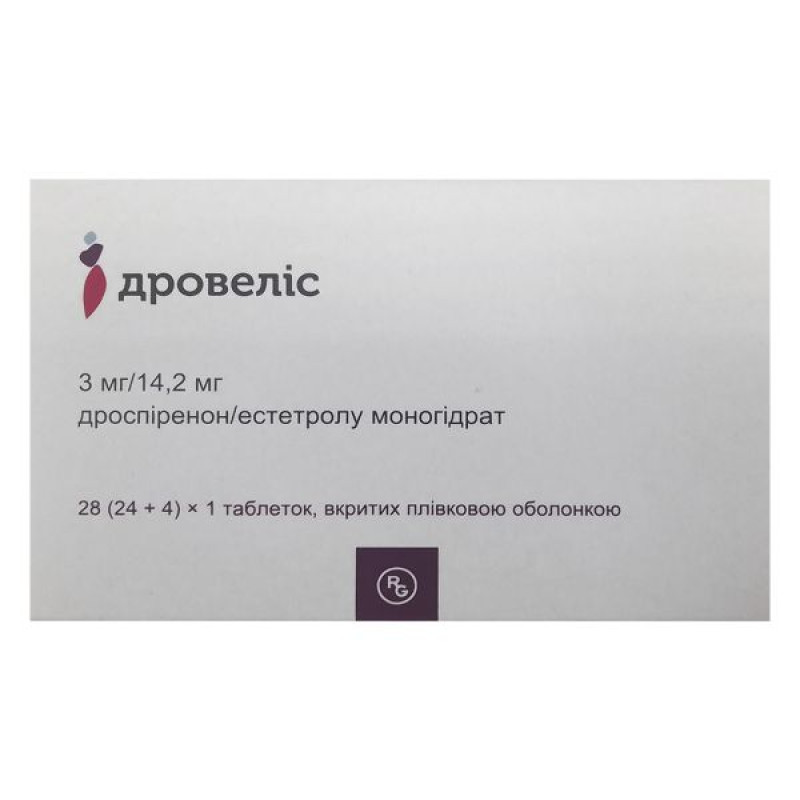
Instructions for Drovelis film-coated tablets 3 mg + 14.2 mg blister No. 28
Composition
active ingredients: drospirenone, estetrol monohydrate;
1 pink active tablet contains 3 mg of drospirenone and estetrol monohydrate in an amount equivalent to 14.2 mg of estetrol;
1 white placebo tablet contains no active ingredients;
excipients:
pink active film-coated tablets:
tablet core: lactose monohydrate, sodium starch glycolate, corn starch, povidone K30, magnesium stearate (E470b);
tablet shell: hypromellose (E464), hydroxypropylcellulose (E463), talc (E553b), hydrogenated cottonseed oil, titanium dioxide (E171), red iron oxide (E172);
white film-coated placebo tablets:
tablet core: lactose monohydrate, corn starch, magnesium stearate (E470b);
tablet shell: hypromellose (E464), hydroxypropylcellulose (E463), talc (E553b), hydrogenated cottonseed oil, titanium dioxide (E171), red iron oxide (E172).
Dosage form
Film-coated tablets.
Active tablets: pink, round, biconvex, film-coated tablets, debossed with a drop logo on one side.
Placebo tablets: white or almost white, round, biconvex, film-coated tablets, debossed with a drop logo on one side.
Pharmacotherapeutic group
Sex hormones and drugs used in genital pathology. Hormonal contraceptives for systemic use. Progestogens and estrogens, fixed combinations.
ATX code G03A A18.
Pharmacological properties
Pharmacodynamics.
Mechanism of action
Drovelis contains the estrogen estetrol and the progestogen drospirenone. Estetrol is an estrogen that is produced by the liver of a human fetus only during pregnancy.
Estetrol exhibits antigonadotropic activity, characterized by a dose-dependent decrease in serum follicle-stimulating hormone (FSH) and luteinizing hormone (LH) levels.
The progestogen drospirenone exhibits progestogenic, antigonadotropic, antiandrogenic, and moderate antimineralocorticoid properties and has no estrogenic, glucocorticoid, or antiglucocorticoid activity. These properties are pharmacologically similar to those of the natural hormone progesterone.
The contraceptive effect of Drovelis is based on the interaction of various factors, the most important of which is the suppression of ovulation.
Clinical efficacy and safety
Two clinical trials were conducted worldwide, one pivotal trial in the EU and Russia and a supportive trial in the US, involving women aged 16 to 50 years for 13 cycles over 1 year.
In a main study conducted in the EU and Russia based on 14,759 cycles, excluding cycles with auxiliary contraception and cycles without sexual activity, the following Pearl indices were established in women aged 18–35 years:
contraceptive failures: 0.26 (upper limit 95%, confidence interval 0.77);
contraceptive failures + patient errors: 0.44 (upper limit 95%, confidence interval 1.03).
A study in the US found higher Pearl indices than those found in the EU and Russian studies. It is known that Pearl indices in US studies are higher than those reported in EU studies, but the reason for this discrepancy is unknown.
In a randomized, open-label study, 97% of women in the Drovelis group resumed ovulation by the end of the next post-treatment cycle.
Endometrial histology after 13 treatment cycles was examined in a subgroup (n = 108) in one clinical trial. No abnormalities were found.
Pediatric population
The European Medicines Agency has deferred the obligation to submit the results of studies with Drovelis for oral contraception in one or more subsets of the paediatric population (see section 4.4 for information on paediatric use).
Pharmacokinetics.
Estetrol
Absorption
Estetrol is rapidly absorbed after administration. After administration of Drovelis, the mean maximum plasma concentration of estetrol is 17.9 ng/ml and is reached 0.5–2 hours after a single dose.
The total exposure of estetrol is not affected by food intake. The Cmax of estetrol is reduced by approximately 50% after food intake.
Distribution
Estetrol does not bind to sex hormone binding globulin (SHBG). Estetrol binds moderately to human plasma proteins (45.5 to 50.4%) and human serum albumin (58.6%) and weakly to human alpha-glycoprotein (11.2%). Estetrol is evenly distributed between erythrocytes and plasma.
In vitro studies have shown that estetrol is a substrate for the transporters P-glycoprotein (P-gp) and breast cancer resistance protein (BCRP). However, concomitant use of drugs that affect P-gp and BCRP activity is unlikely to result in clinically significant drug interactions with estetrol.
After oral administration, estetrol undergoes extensive phase 2 metabolism to form glucuronide and sulfate conjugates. The two major metabolites, estetrol-3-glucuronide and estetrol-16-glucuronide, have negligible estrogenic activity. The predominant isoform of UDP-glucuronyltransferase (UGT) is UGT2B7, which is involved in the biotransformation of estetrol to the direct glucuronide. Estetrol undergoes sulfation, primarily by a specific estrogen sulfotransferase (SULT1E1).
Breeding
The terminal half-life (T1/2) of estetrol was approximately 24 hours under steady-state conditions.
After a single dose of 15 mg of [14C]-estetetrol oral solution, approximately 69% of the total radioactivity was recovered in urine and 21.9% in feces.
Linearity/nonlinearity
When Drovelis is administered at a dose of 1–5 times the dose, plasma estetrol levels do not show any significant deviations from the dose-proportional after a single administration, as well as at steady state.
Equilibrium state
Steady state is reached after 5 days. Cmax of estetrol is approximately 17.9 ng/ml and is reached 0.5–2 hours after dosing. The mean serum concentration is 2.46 ng/ml. Accumulation is very limited: the daily area under the curve (AUC) at steady state is 60% higher than after a single dose.
Drospirenone
Absorption
Drospirenone is rapidly and almost completely absorbed. After taking Drovelis, Cmax is approximately 48.7 ng/ml and is reached approximately 1–3 h after multiple dosing. Bioavailability is 76 to 85%. Total exposure to drospirenone is independent of food intake before/after taking Drovelis tablets.
Distribution
Drospirenone binds to serum albumin and does not bind to GHB or corticosteroid-binding globulin (CBG). Only 3-5% of the total serum concentration of the active substance is represented as free steroid. The mean apparent volume of distribution of drospirenone is 3.7 ± 1.2 l/kg.
Biotransformation
After oral administration, drospirenone is extensively metabolized. The main metabolites in plasma are the acid form of drospirenone, formed by opening the lactone ring, and 4,5-dihydrodrospirenone-3-sulfate, formed by reduction and subsequent sulfation. Drospirenone is also subject to oxidative metabolism catalyzed by cytochrome CYP3A4.
Breeding
After oral administration of Drovelis, serum drospirenone levels decline with a terminal half-life of approximately 34 hours. The metabolic clearance rate of drospirenone in serum is 1.5 ± 0.2 ml/min/kg. Drospirenone is excreted unchanged in trace amounts only. The metabolites of drospirenone are excreted in the feces and urine in an excretion ratio of approximately 1.2 to 1.4. The T1/2 of the metabolite in the urine and feces is approximately 40 hours.
Linearity/nonlinearity
When administered at a dose of 3–15 mg, drospirenone plasma levels do not show any significant deviations from dose proportionality after a single administration, as well as at steady state.
Equilibrium state
Steady state is reached after 10 days. Cmax of drospirenone is approximately 48.7 ng/ml and is reached approximately 1–3 hours after dosing. The mean steady state concentration over the 24-hour dosing period is approximately 22 ng/ml. Accumulation is very limited, with the daily steady state AUC being 80% higher than after a single dose.
Special patient groups
Kidney dysfunction
The effect of renal disease on the pharmacokinetics of estetrol has not been studied. In a study conducted with drospirenone alone at a dose of 3 mg administered orally for 14 days, steady-state serum levels of drospirenone in women with mild renal impairment (creatinine clearance (CLcr) 50–80 mL/min) were comparable to those in women with normal renal function. Serum levels of drospirenone were on average 37% higher in women with moderate renal impairment (CLcr 30–50 mL/min) compared to those in women with normal renal function.
Liver dysfunction
The effect of liver disease on the pharmacokinetics of estetrol has not been studied. In a single-dose study, the oral clearance of drospirenone (CL/F) was reduced by approximately 50% in volunteers with moderate hepatic impairment compared to volunteers with normal hepatic function.
Pediatric population
The pharmacokinetics of estetrol and drospirenone in postmenarcheal children (up to 16 years of age) after administration of Drovelis have not been studied.
Other special population groups
Ethnic groups
No clinically significant differences in the pharmacokinetics of estetrol or drospirenone were observed between Japanese and Caucasian women after a single dose of Drovelis.
Indication
For oral contraception.
Contraindication
- Presence or risk of venous thromboembolism (VTE):
- VTE – current VTE, particularly due to anticoagulant therapy, or history (e.g. deep vein thrombosis (DVT) or pulmonary embolism (PE));
- known hereditary or acquired predisposition to venous thromboembolism, e.g. resistance to activated protein C (including factor V Leiden mutation), antithrombin III deficiency, protein C deficiency, protein S deficiency;
- major surgery with prolonged immobilization (see section "Special instructions for use");
- high risk of venous thromboembolism due to the presence of multiple risk factors (see section "Special warnings and precautions for use").
- Presence or risk of arterial thromboembolism (ATE):
- ATE – presence of ATE currently, in history (e.g. myocardial infarction) or prodromal state (e.g. angina);
- cerebrovascular accident – current stroke, history of stroke, or presence of a prodromal condition (e.g. transient ischemic attack (TIA));
- known hereditary or acquired predisposition to the development of arterial thromboembolism, such as hyperhomocysteinemia and the presence of antiphospholipid antibodies (anticardiolipin antibodies, lupus anticoagulant);
- migraine with focal neurological symptoms in history;
- high risk of arterial thromboembolism due to the presence of multiple risk factors (see section "Special warnings and precautions for use") or due to the presence of one of the following serious risk factors:
- diabetes mellitus with vascular symptoms;
- severe arterial hypertension;
- severe dyslipoproteinemia.
- Current or history of severe liver disease, if liver function tests have not returned to normal.
- Severe renal failure or acute renal failure.
- Presence or history of liver tumors (benign or malignant).
- Known or suspected malignant tumors (e.g., genital or mammary) that are sex hormone-dependent.
- Vaginal bleeding of unknown etiology.
- Hypersensitivity to the active substances or to any of the excipients listed in the "Composition" section.
Interaction with other medicinal products and other types of interactions
Note: The information for the concomitant medicinal product should be consulted for potential interactions.
Pharmacokinetic interactions
The effect of other medicines on Drovelis.
Interactions are possible with drugs that induce microsomal enzymes. This may lead to increased clearance of sex hormones, which in turn may cause breakthrough bleeding and/or loss of contraceptive efficacy.
Therapy
Enzyme induction can be detected after a few days of treatment. Maximum enzyme induction is generally measured after a few weeks. After discontinuation of treatment, enzyme induction can last for about 4 weeks.
Short-term treatment
Women taking enzyme-inducing drugs should temporarily use a barrier method or another method of contraception in addition to the CHC. The barrier method should be used throughout the duration of treatment with the drug and for 28 days after stopping its use. If therapy is started after the last pink active CHC tablets in the pack, the white placebo tablets should not be taken and the next CHC pack should be started immediately after the pink tablets from the previous pack.
Long-term treatment
For women on long-term therapy with active substances that induce liver enzymes, another suitable non-hormonal method of contraception is recommended.
The following interactions have been reported based on published data.
Active substances that increase the clearance of CHCs (enzyme induction), e.g. barbiturates, bosentan, carbamazepine, phenytoin, primidone, rifampicin; medicines used in HIV infection (e.g. ritonavir, nevirapine and efavirenz), also possibly felbamate, griseofulvin, oxcarbazepine, topiramate and medicines containing the herbal remedy St. John's wort (Hypericum perforatum).
Substances with an inconsistent effect on the clearance of CHCs
When used concomitantly with CHCs, a large number of combinations of HIV protease inhibitors and non-nucleoside reverse transcriptase inhibitors, including combinations with hepatitis C virus (HCV) inhibitors, may increase or decrease plasma concentrations of estrogen or progestins. The cumulative effect of such changes may be clinically significant in some cases.
Therefore, the prescribing information for the concomitant HIV/HCV medicinal product should be consulted for potential interactions and any other recommendations. In case of any doubt, women should additionally use a barrier method of contraception during treatment with protease inhibitors or non-nucleoside reverse transcriptase inhibitors.
Active substances that reduce the clearance of CHCs (enzyme inhibitors)
The clinical significance of the potential interaction with enzyme inhibitors remains unknown.
Concomitant use of strong CYP3A4 inhibitors may increase plasma concentrations of estrogen or progestin, or both.
In a multiple-dose study of the combination of drospirenone (3 mg/day)/ethinyl estradiol (0.02 mg/day) and the strong CYP3A4 inhibitor ketoconazole for 10 days, the AUC(0-24 h) of drospirenone and ethinyl estradiol increased 2.7- and 1.4-fold, respectively.
Possible interaction with estetrol
Estetrol is primarily glucuronidated by the enzyme UGT2B7 (see section 5.2). No clinically significant interaction of estetrol with the potent UGT inhibitor valproic acid has been observed.
Effects of Drovelis on other medicinal products
Oral contraceptives can affect the metabolism of other drugs. As a result, the concentrations of active substances in blood plasma and tissues may change - either increase (e.g., cyclosporine) or decrease (e.g., lamotrigine).
Based on in vivo interaction studies in female volunteers using omeprazole, simvastatin or midazolam as marker substrates, it was found that the interaction of drospirenone at a dose of 3 mg with other active substances is unlikely.
According to the results of in vivo interaction studies, it was found that the interaction of estetrol, which is part of the drug Drovelis, with other active substances is unlikely.
Pharmacodynamic interactions
Concomitant use with hepatitis C medicinal products containing ombitasvir/paritaprevir/ritonavir and used with dasabuvir, with or without ribavirin, may increase the risk of ALT elevations in women taking medicinal products containing ethinylestradiol, such as CHCs (see section 4.4). In women taking medicinal products containing estrogens other than ethinylestradiol, ALT elevations were similar to those in women not taking estrogens; however, due to the limited number of women taking these other estrogens, caution should be exercised when used concomitantly with the combination therapy of ombitasvir/paritaprevir/ritonavir and dasabuvir with or without ribavirin, and when used concomitantly with glecaprevir/pibrentasvir or sofosbuvir/velpatasvir/voxilaprevir (see section 4.4).
In patients without renal insufficiency, concomitant use of drospirenone and angiotensin-converting enzyme (ACE) inhibitors or non-steroidal anti-inflammatory drugs (NSAIDs) did not show a significant effect on serum potassium levels. However, concomitant use of Drovelis with aldosterone antagonists or potassium-sparing diuretics has not been studied. In this case, serum potassium should be monitored during the first treatment cycle. See also section "Special warnings and precautions for use".
Pediatric population
Interaction studies have only been conducted in adults.
Application features
The decision to prescribe Drovelis should take into account the individual risk factors of the woman present at the time of prescribing, including risk factors for venous thromboembolism (VTE), as well as the risk of VTE associated with Drovelis compared with other combined hormonal contraceptives (CHCs) (see sections “Contraindications” and “Special Precautions for Use”).
Warning
If any of the conditions or risk factors listed below are present, the appropriateness of using Drovelis should be discussed with the woman before deciding to start taking it.
In case of exacerbation or at the first appearance of any of the above conditions or risk factors, women are advised to consult a doctor and determine the need to stop taking Drovelis. All the data below are based on epidemiological data obtained with the use of CHCs containing ethinylestradiol. Drovelis contains estetrol. Since there are currently no epidemiological data on CHCs containing estetrol, the warnings are considered applicable to Drovelis.
In case of suspected or confirmed ATE or VTE, CHC use should be discontinued. If anticoagulant therapy is initiated, alternative non-hormonal adequate contraception should be provided due to the teratogenic effects of anticoagulants (coumarins).
Circulatory disorders
Risk of VTE
The risk of VTE is increased with the use of any CHC compared to no use. Use of preparations containing low doses of ethinylestradiol (
Some data suggest that the risk of VTE may increase when restarting CHC use after a break of 4 weeks or more.
In women who are not using CHCs and are not pregnant, the incidence of VTE is approximately 2 cases per 10,000 women per year. However, the risk for any individual woman may be much higher depending on the underlying risk factors she has (see below).
Epidemiological studies in women using low doses (
It has been estimated1 that out of 10,000 women using CHCs containing ethinylestradiol and drospirenone, 9–12 will develop a VTE in one year. This compares with around 6 patients2 per 10,000 women using CHCs containing levonorgestrel.
The number of VTE cases per year with low-dose CHCs was lower than would normally be expected during pregnancy or in the postpartum period.
VTE can be fatal in 1–2% of cases.
Thrombosis in other blood vessels, such as the arteries and veins of the liver, kidneys, retina or mesenteric vessels, has been reported extremely rarely in women using CHCs.
1These figures are based on all epidemiological data, taking into account the relative risks associated with the use of different CHCs compared with the use of CHCs containing levonorgestrel.
2On average 5–7 cases per 10,000 women-years based on the calculation of the relative risk of using levonorgestrel-containing CHCs compared to that in women not using CHCs (approximately 2.3–3.6 cases).
Risk factors for developing VTE
The risk of venous thromboembolic complications may be significantly increased in women with additional risk factors when using CHCs, especially in the presence of multiple risk factors (see Table 1).
Drovelis is contraindicated in women with multiple risk factors that place them at high risk of venous thrombosis (see section 4.3). If a woman has more than one risk factor, the increased risk may be greater than the sum of the risks associated with each individual factor, and the overall risk of VTE should be considered. CHCs should not be used if the benefit/risk ratio is unfavourable (see section 4.3).
Table 1
Risk factors for developing VTE
| Risk factor | Note |
Obesity (body mass index (BMI) greater than 30 kg/m2). | The risk increases significantly with increasing BMI. It especially requires attention if women have other risk factors. |
Prolonged immobilization, major surgery, any surgery on the legs or pelvic organs, neurosurgery, or extensive trauma. Note: Temporary immobilization, including air travel lasting more than 4 hours, may also be a risk factor for VTE, especially for women with other risk factors. | In such cases, it is recommended to stop taking the tablets (in the case of elective surgery at least 4 weeks in advance) and not to resume use earlier than 2 weeks after full recovery of motor activity. To avoid unexpected pregnancy, another method of contraception should be used. Antithrombotic therapy should be considered if Drovelis has not been discontinued in advance. |
| A strong family history (VTE in a sibling or parent, especially at a relatively young age, e.g. under 50 years of age). | In case of hereditary predisposition, women are advised to consult a specialist before using any CHC. |
| Other medical conditions associated with VTE | Cancer, systemic lupus erythematosus, hemolytic uremic syndrome, chronic inflammatory bowel disease (Crohn's disease or ulcerative colitis), and sickle cell anemia. |
| Increasing age | Especially over 35 years old. |
There is no consensus on the possible impact of varicose veins and superficial thrombophlebitis on the development or progression of venous thrombosis.
Attention should be paid to the increased risk of thromboembolism during pregnancy, especially during the first 6 weeks after delivery (see section "Use during pregnancy or breastfeeding").
Symptoms of VTE (DVT and PE)
If the following symptoms occur, a woman should seek urgent medical attention and inform the doctor that she is taking CHCs.
Symptoms of DVT may include:
unilateral swelling of the leg and/or foot or an area along a vein on the leg;
pain or increased sensitivity in the leg that may only be felt when standing or walking;
a feeling of heat in the affected leg; redness or discoloration of the skin on the leg.
Symptoms of TELA may include:
sudden shortness of breath of unknown etiology or rapid breathing;
sudden onset of coughing, which may be accompanied by hemoptysis;
sudden chest pain;
fainting or dizziness;
fast or irregular heartbeat.
Some of these symptoms (e.g., shortness of breath, cough) are nonspecific and may be misdiagnosed as more common or less severe conditions (e.g., respiratory tract infections).
Other signs of vascular occlusion may include sudden pain, swelling, and slight blueness of the limb.
In the case of occlusion of the vessels of the eye, the initial symptom may be blurred vision, which is not accompanied by pain, and may progress to loss of vision. Sometimes the loss of vision develops almost instantly.
Risk of developing ATE
Epidemiological studies have shown that the use of any CHC is associated with an increased risk of arterial thromboembolism (myocardial infarction) or cerebrovascular events (e.g. TIA, stroke). Arterial thromboembolic events can be fatal.
The risk of arterial thromboembolic complications or cerebrovascular events is increased in women with risk factors when using CHCs (see Table 2). Drovelis is contraindicated if a woman has one serious or multiple risk factors for ATE that may increase the risk of arterial thrombosis (see section 4.3). If a woman has more than one risk factor, the increased risk may be greater than the sum of the risks associated with each individual factor, so the overall risk of ATE should be considered. CHCs should not be prescribed if the benefit/risk ratio is unfavorable (see section 4.3).
Table 2
Risk factors for developing ATE
| Risk factor | Note |
| Increasing age | Especially over 35 years old. |
| Smoking | Women who wish to use CHCs should be advised to stop smoking. Women over 35 who continue to smoke should be strongly advised to use another method of contraception. |
| Arterial hypertension | |
| Obesity (BMI greater than 30 kg/m2) | The risk increases significantly with increasing BMI. It especially requires attention if women have other risk factors. |
| A strong family history (arterial thromboembolism in a sibling or parent, especially at a relatively young age, e.g. under 50 years of age). | In case of hereditary predisposition, women are advised to consult a specialist before using any CHC. |
| Migraine | An increase in the frequency or severity of migraine during CHC use (which may be a prodromal condition before the development of cerebrovascular events) may be a reason for immediate discontinuation. |
| Other conditions associated with adverse vascular reactions | Diabetes mellitus, hyperhomocysteinemia, heart valve defects, atrial fibrillation, dyslipoproteinemia, and systemic lupus erythematosus. |
Symptoms of ATE
If the following symptoms occur, a woman should seek urgent medical attention and inform the doctor that she is taking CHCs.
Symptoms of a cerebrovascular accident may include:
sudden numbness or weakness of the face, arms, or legs, especially on one side;
sudden gait disturbance, dizziness, loss of balance or coordination;
sudden confusion, impaired speech or understanding;
sudden vision loss in one or both eyes;
sudden severe or prolonged headache with no known cause;
loss of consciousness or fainting with or without seizures.
The temporary nature of the symptoms may indicate a transient ischemic attack (TIA).
Symptoms of myocardial infarction (MI) may include:
pain, discomfort, pressure, heaviness, a feeling of squeezing or fullness in the chest, arm, or behind the breastbone;
discomfort with irradiation to the back, jaw, throat, arm, stomach;
feeling of fullness in the stomach, indigestion or heartburn;
increased sweating, nausea, vomiting, or dizziness;
extreme weakness, restlessness, or shortness of breath;
fast or irregular heartbeat.
Tumors
Some epidemiological studies suggest an increased risk of cervical cancer with long-term use of ethinylestradiol-containing CHCs (> 5 years). However, this statement remains controversial, as it is not yet clear to what extent the results of the studies take into account concomitant risk factors, such as sexual behaviour and other factors, including human papillomavirus (HPV) infection.
High-dose CHCs (50 μg ethinylestradiol) reduce the risk of endometrial and ovarian cancer. It remains to be confirmed whether these findings can also apply to CHCs containing estetrol.
A meta-analysis of 54 epidemiological studies suggests a small increased relative risk (RR 1.24) of breast cancer in women who use CHCs. This increased risk gradually disappears within 10 years after stopping CHC use. Since breast cancer is rare in women under 40 years of age, the increase in the number of breast cancer diagnoses in women who are current or recent users of CHCs is small in relation to the overall risk of breast cancer. There is a trend for breast cancer diagnosed in women who have ever used CHCs to be clinically less severe than in those who have never used CHCs. The increased risk may be due to earlier diagnosis of breast cancer in women who use CHCs, the biological action of CHCs, or a combination of both.
In isolated cases, benign and, even more rarely, malignant liver tumors have been observed in women using CHCs containing ethinylestradiol. In some cases, these tumors have caused life-threatening intra-abdominal bleeding. In the event of complaints of severe epigastric pain, liver enlargement or signs of intra-abdominal bleeding, the possibility of a liver tumor in women taking CHCs should be considered in the differential diagnosis.
In clinical trials in patients treated for hepatitis C virus (HCV) with the medicinal products containing ombitasvir/paritaprevir/ritonavir and dasabuvir, with or without ribavirin, significant increases in ALT levels exceeding 5 times the upper limit of normal were observed. In addition, increases in ALT were observed in patients taking glecaprevir/pibrentasvir or sofosbuvir/velpatasvir/voxilaprevir concomitantly with medicinal products containing ethinylestradiol, such as CHCs. In women taking medicinal products containing estrogens other than ethinylestradiol, ALT elevations were similar to those in women not taking estrogens; however, due to the limited number of women taking these other estrogens, caution should be exercised when co-administered with the combination therapy of ombitasvir/paritaprevir/ritonavir and dasabuvir with or without ribavirin, and when co-administered with glecaprevir/pibrentasvir or sofosbuvir/velpatasvir/voxilaprevir. See also section 4.5.
Other states
The progestogen component of Drovelis is an aldosterone antagonist with potassium-sparing properties. In most cases, an increase in serum potassium is not expected. However, in a clinical study, in some patients with mild to moderate renal impairment and concomitant use of potassium-sparing medicinal products, serum potassium levels increased slightly, but not significantly, when 3 mg of drospirenone was administered for 14 days. Therefore, it is recommended to monitor serum potassium levels during the first cycle of Drovelis in patients with renal insufficiency and to maintain serum potassium levels below the upper limit of normal before starting treatment, especially when potassium-sparing medicinal products are used concomitantly (see section 4.5).
Women with hypertriglyceridemia or a family history of this disorder are at risk of developing pancreatitis when using CHCs.
Although a slight increase in blood pressure has been described in many women taking CHCs, a clinically significant increase in blood pressure is rare. The relationship between CHC use and clinically significant arterial hypertension has not been established. However, if persistent clinically significant arterial hypertension develops during CHC use, the doctor should stop taking the tablets and treat the arterial hypertension. If appropriate, CHC use can be resumed after achieving normotensiveness with antihypertensive therapy.
The following conditions have been reported to occur or worsen during pregnancy and with CHC use, but the relationship to CHC use is not conclusive: jaundice and/or pruritus associated with cholestasis; gallstone formation; porphyria; systemic lupus erythematosus; haemolytic uraemic syndrome; Sydenham's chorea; herpes gestationis; hearing loss associated with otosclerosis.
Exogenous estrogens may induce or exacerbate symptoms of hereditary and acquired angioedema.
Acute or chronic liver function disorders may require discontinuation of CHC use until liver function tests return to normal. In the event of recurrence of cholestatic jaundice previously occurring during pregnancy or previous use of sex hormones, CHC use should be discontinued.
Although CHCs may affect peripheral insulin resistance and glucose tolerance, there is no evidence to suggest that there is a need to change the therapeutic regimen for women with diabetes taking low-dose CHCs (containing 50 mcg ethinylestradiol). However, women with diabetes should