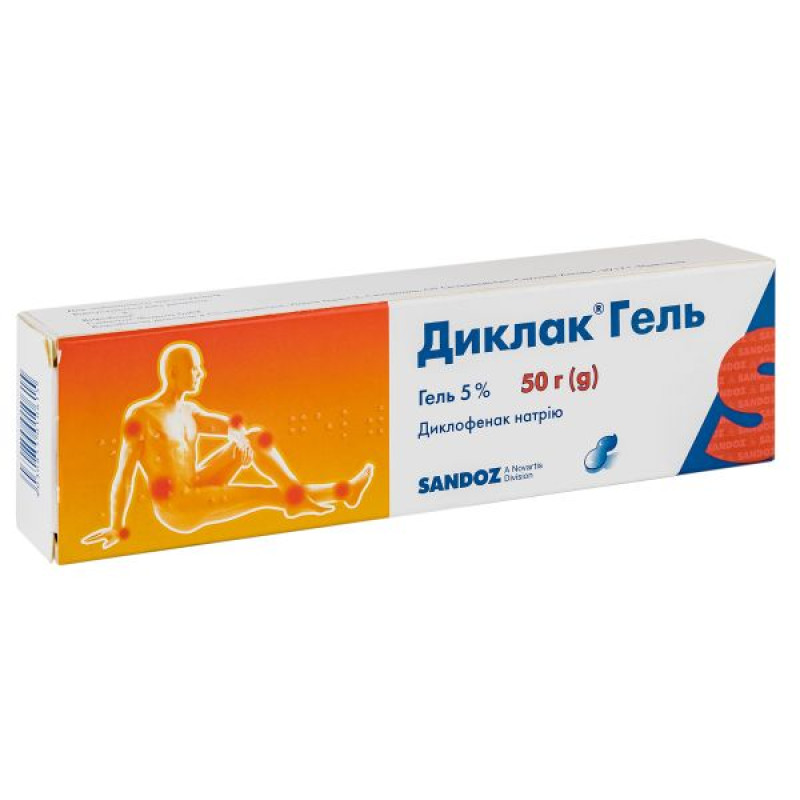
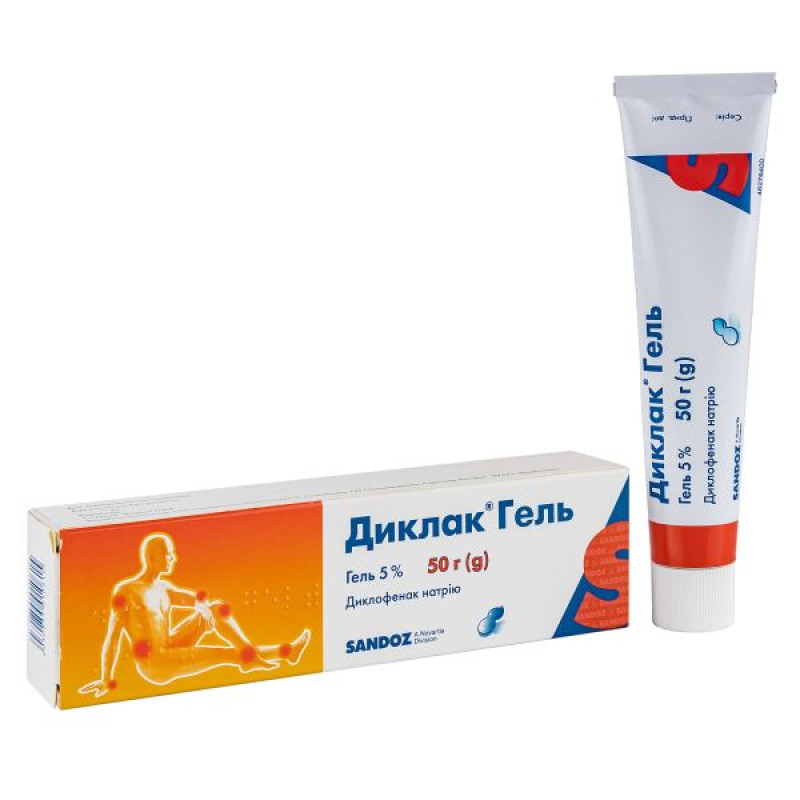
Instructions for Diclac gel 5% tube 50 g
Composition
active ingredient: diclofenac;
1 g of gel contains diclofenac sodium 50 mg;
excipients: isopropyl alcohol, purified water, macrogol-7-glyceryl cocoate, hypromellose, flavoring - "Bouquet" oil WN 4507.
Dosage form
Gel.
Main physicochemical properties: colorless or slightly yellowish transparent gel with a characteristic odor of isopropanol, without air bubbles.
Pharmacotherapeutic group
Topical agents for joint and muscle pain. Nonsteroidal anti-inflammatory drugs for topical use. Diclofenac.
ATX code M02A A15.
Pharmacological properties
Pharmacodynamics
DiklakÒ Gel is a nonsteroidal anti-inflammatory drug for external use from the group of phenylacetic acid derivatives. The drug has pronounced local antirheumatic, analgesic and anti-inflammatory properties, which is due to the inhibition of the synthesis of prostaglandins - mediators of pain and inflammation.
In case of inflammation caused by injuries or rheumatic diseases, DiklakÒ Gel reduces pain, tissue swelling and shortens the period of restoration of functions of damaged joints, ligaments, tendons and muscles.
Pharmacokinetics
Diclofenac sodium is slowly and partially absorbed from the skin surface. The amount of diclofenac absorbed through the skin is proportional to the area of application and depends on both the total dose of the drug applied and the degree of skin hydration. The maximum concentration in the blood plasma is observed after 6-9 hours. After internal use, the maximum concentration in the blood plasma is reached after approximately 1-2 hours. The average retention time of the active substance in the systemic circulation is approximately 9 hours, which is significantly longer compared to 1-2 hours after internal use.
Diclofenac accumulates in the skin, which serves as a reservoir from which the substance is gradually released into the surrounding tissues. From there, diclofenac mainly enters deeper inflamed tissues, such as joints, where it continues to act and is detected in concentrations up to 20 times higher than in blood plasma.
Metabolism and elimination of the drug after application to the skin are similar to those after systemic use. Diclofenac and its metabolites are excreted mainly in the urine. The total systemic plasma clearance of diclofenac is 263 ± 56 ml/min, and the terminal half-life is on average 1-3 hours. Diclofenac is 99% bound to plasma proteins. After rapid metabolism in the liver (hydroxylation and binding to glucuronic acid), two thirds of the substance is excreted by the kidneys and one third - with bile.
In renal or hepatic insufficiency, the metabolism and excretion of diclofenac are not altered.
Indication
Local treatment of pain and inflammation of joints, muscles, ligaments and tendons of rheumatic or traumatic origin.
Contraindication
Hypersensitivity to diclofenac or other non-steroidal anti-inflammatory drugs, to isopropyl alcohol, or to other components of the drug. History of attacks of bronchial asthma, urticaria, acute rhinitis, nasal polyps, angioedema caused by the use of acetylsalicylic acid or other non-steroidal anti-inflammatory drugs. Last trimester of pregnancy.
Interaction with other medicinal products and other types of interactions
Since the systemic absorption of diclofenac following topical application is very low, interactions are unlikely to occur.
Application features
The drug should be used with caution with oral nonsteroidal anti-inflammatory drugs.
The likelihood of developing systemic side effects with topical application of diclofenac is insignificant compared to the use of its oral forms, but it cannot be ruled out when the drug is used on relatively large areas of skin for a long time.
Diclac® Gel is recommended to be applied only to intact skin areas, avoiding contact with inflamed, injured or infected skin. Avoid contact with eyes and mucous membranes. Do not use internally.
If any skin rash appears, treatment with the drug should be discontinued. It is not recommended to use it under an airtight occlusive dressing, but it is allowed to use it under a non-occlusive dressing. In case of sprain, the affected area can be bandaged.
Do not apply to open wounds or infected skin, as well as to areas of skin affected by eczema or mucous membranes.
Diclac® Gel contains isopropyl alcohol, which may cause mild localized skin irritation.
Use during pregnancy or breastfeeding
Clinical experience with diclofenac in pregnant women is limited, therefore, the use of this drug is not recommended during pregnancy or breastfeeding. The drug is contraindicated during the third trimester of pregnancy due to the possibility of developing labor weakness and/or premature closure of the ductus arteriosus. Animal studies have not revealed any harmful effects of diclofenac on pregnancy or embryonic development, childbirth or postnatal development of the child.
If there are good reasons for using Diklak® Gel during breastfeeding, when the expected benefit of the drug, in the opinion of the doctor, outweighs the potential risk, the drug should not be applied to the mammary glands or large areas of skin and should not be used for a long time.
The ability to influence the reaction speed when driving or working with other mechanisms
Does not affect.
Method of administration and doses
Diklak® Gel should be applied 3-4 times a day, gently rubbing into the skin. The amount of the drug used depends on the size of the affected area (for example, 2-4 g of gel, which is the size of a cherry or walnut, is enough to apply to an area of 400-800 cm2).
After applying the drug, hands should be washed, except when this is the area to be treated.
The duration of therapy depends on the nature of the disease and the effectiveness of the treatment.
The drug should not be used for longer than 14 consecutive days.
In case of using the drug not as prescribed by a doctor, it is necessary to seek advice from him if after 7 days of treatment the patient's condition has not improved or has worsened.
Children
There are no dosage recommendations and therapeutic indications for the use of Diclac® Gel in children.
Overdose
Overdose is unlikely due to the low absorption of diclofenac into the systemic bloodstream when applied topically.
In case of accidental ingestion, it should be noted that 1 tube of the drug of 100 g contains the equivalent of 1 g of diclofenac sodium; in this case, the development of systemic adverse reactions is possible.
In case of accidental ingestion, the stomach should be emptied immediately and an adsorbent should be used. Symptomatic treatment is indicated, using therapeutic measures that should be used in case of poisoning with nonsteroidal anti-inflammatory drugs.
Adverse reactions
Diclac® Gel is generally well tolerated. Adverse reactions include mild, transient skin reactions at the application site. In rare cases, allergic reactions may occur.
The assessment of adverse reactions is given by frequency of occurrence: very common (≥ 1/10), common (≥ 1/100, ≤ 1/10), uncommon (≥ 1/1000, ≤ 1/100), rare (≥ 1/10,000, ≤ 1/1000), very rare (< 1/10,000).
Infections and infestations: rare: pustular eruptions.
Skin: uncommon - rash, itching, redness, eczema, exanthema, erythema, burning, the appearance of edema and vesicles, papules, pustules, peeling and dry skin, dermatitis (including contact dermatitis); rare - bullous dermatitis; very rare - photosensitivity reactions, generalized skin rashes, burning sensation of the skin.
On the part of the immune system: very rarely - hypersensitivity reactions (including urticaria), angioedema of the face, shortness of breath.
On the part of the respiratory system: very rarely - bronchial asthma.
Adverse reactions from the digestive system occur very rarely after topical application of preparations containing diclofenac.
When using the gel in high doses or applying it to large areas of skin, the possibility of systemic adverse reactions, as well as hypersensitivity reactions in the form of angioedema and dyspnea, cannot be ruled out.
Expiration date
3 years.
Storage conditions
Store at a temperature not exceeding 25 °C.
Keep out of reach of children.
Packaging
50 g or 100 g of gel in a tube; 1 tube in a cardboard box.
Vacation category
Without a prescription.
Producer
Salutas Pharma GmbH/Salutas Pharma GmbH.
Location of the manufacturer and its business address
Production site in Osterwedingen, Lange Goehren 3, Suelzetal, OT Osterwedingen, Saxony-Anhalt, 39171, Germany/Betriebsstaette Osterweddingen, Lange Goehren 3, Suelzetal, OT Osterweddingen, Sachsen-Anhalt, 39171, Germany.