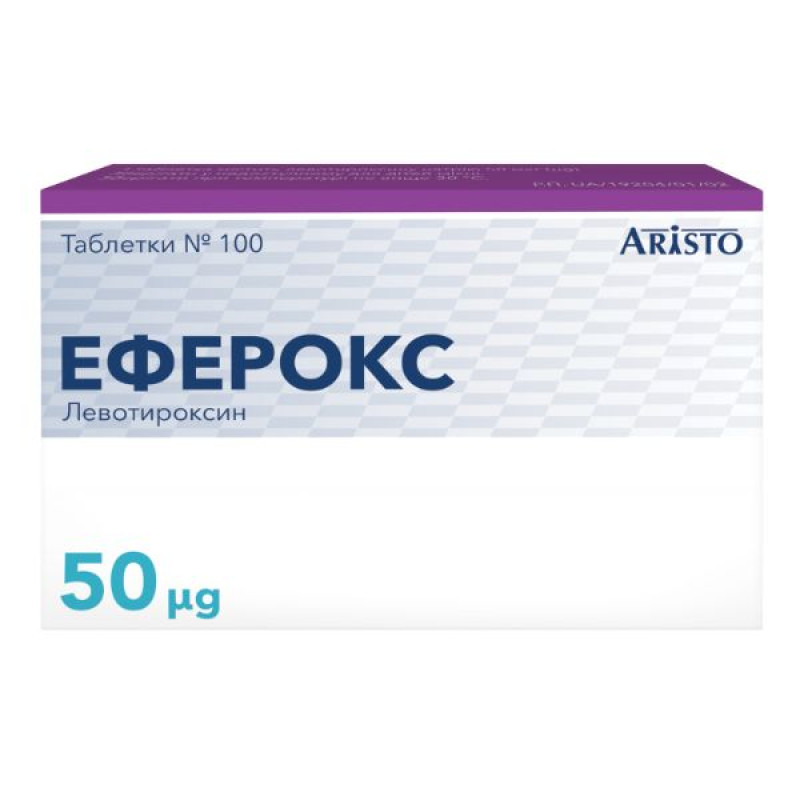
Instructions for Eferox 50 mcg tablets No. 100
Composition
active ingredient: levothyroxine sodium;
1 tablet contains levothyroxine sodium 25 mcg, 50 mcg, 100 mcg;
excipients: microcrystalline cellulose, corn starch, sodium carboxymethyl starch (type A), heavy magnesium oxide, magnesium stearate (vegetable).
Dosage form
Pills.
Main physicochemical properties: white round biconvex tablets, with a break notch (the tablet can be divided by pressing) and with the dosage engraved "25" or "50" or "100".
Pharmacotherapeutic group
Hormone preparations for systemic use (except sex hormones and insulin). Preparations for the treatment of thyroid diseases. Thyroid preparations. Levothyroxine sodium. ATC code H0ZA A01.
Pharmacological properties
Pharmacodynamics.
Synthetic levothyroxine exhibits effects identical to those of the hormone secreted by the thyroid gland. It is converted to TZ (triiodothyronine) in peripheral organs and acts on TZ receptors as an endogenous hormone. There is no difference between the functions of the endogenous hormone and exogenous levothyroxine.
Pharmacokinetics.
After oral administration, levothyroxine is almost completely absorbed in the upper small intestine. Depending on the galenic form of the drug, up to 80% of the dose is absorbed. The time to reach maximum concentration (Tmax) is approximately 5–6 hours.
The clinical effect of the drug is manifested 3–5 days after oral administration. Levothyroxine rapidly binds to specific blood transport proteins (up to 99.97%). The protein binding is not covalent, so the bound hormone in the blood plasma is able to constantly and rapidly exchange with free hormone fractions.
Due to its high level of protein binding, levothyroxine is not amenable to either hemodialysis or hemoperfusion.
The half-life of the drug is 7 days. In hyperthyroidism, this period is reduced to 3–4 days, and in hypothyroidism, it is extended to 9–10 days. The volume of distribution is 10–12 liters.
Approximately 1/3 of the total amount of levothyroxine administered accumulates in the liver, which rapidly interacts with levothyroxine in the blood serum. Thyroid hormones are metabolized mainly in the liver, kidneys, brain and muscles. Metabolites are excreted in the urine and feces. The total metabolic clearance of levothyroxine is approximately 1.2 liters of blood plasma per day.
Indication
Control of hypothyroidism, congenital hypothyroidism in infants, acquired hypothyroidism in children, and juvenile myxedema.
Contraindication
Increased individual sensitivity to any component of the drug.
Thyrotoxicosis that was not treated.
Adrenal insufficiency, adrenal dysfunction that has not been treated.
Interaction with other medicinal products and other types of interactions
Levothyroxine enhances the effect of anticoagulants (warfarin). It may be necessary to reduce the dosage of anticoagulants in case of excess to avoid hypothrombinemia and bleeding.
Blood sugar levels are rising, so the dosage of antidiabetic medications may need to be adjusted.
The response to tricyclic antidepressants (e.g. amitriptyline, imipramine, dosulepin) may be accelerated because levothyroxine increases sensitivity to catecholamines. Concomitant use may cause cardiac arrhythmia.
The effect of sympathomimetic drugs (e.g. adrenaline or phenylephrine) is also enhanced.
Cardiac glycosides: If levothyroxine treatment is initiated in digitalized patients, the dose of digitalis may need to be adjusted. Patients with hypothyroidism may require a gradual increase in digoxin dosage, as they are initially relatively sensitive to it.
Nonsteroidal anti-inflammatory drugs (NSAIDs): Falsely low plasma concentrations have been observed when NSAIDs (phenylbutazone, acetylsalicylic acid) are administered concomitantly with levothyroxine.
Beta-blockers: Levothyroxine (thyroxine) accelerates the metabolism of propranolol, atenolol, and sotalol.
General anesthetics: There have been isolated reports of hypertension and tachycardia when administered concomitantly with ketamine.
Interaction with levothyroxine:
Amiodarone may inhibit the deiodination of thyroxine to triiodothyronine, resulting in reduced concentrations of triiodothyronine. This results in reduced thyroid hormone action.
Anticonvulsants such as carbamazepine and fetonin enhance the metabolism of thyroid hormones and may displace them from plasma proteins.
Starting or stopping anticonvulsants may alter levothyroxine dosage requirements.
The effect of levothyroxine may be reduced with simultaneous use of sertraline.
Absorption of levothyroxine (thyroxine) may be reduced by antacids, calcium salts, cimetidine, oral iron, sucralfate, colestipol, polystyrene sulfonate resin, and cholestyramine (administration should be separated by 4-5 hours).
During concomitant treatment, regular monitoring of thyroid function and clinical observation are recommended. An increase in the dose of thyroid hormones may be necessary.
Caution should also be exercised when PPI treatment ends.
The metabolism of levothyroxine (thyroxine) is accelerated by rifampicin, barbiturates and primidone (may increase the need for levothyroxine (thyroxine) in hypothyroidism).
Imatinib: The plasma concentration of levothyroxine (thyroxine) may be decreased by it.
Beta-blockers may reduce the peripheral conversion of levothyroxine to triiodothyronine.
Lipid-regulating drugs: The drug has been reported to cause both hypothyroidism and hyperthyroidism in patients taking levothyroxine.
Sex hormones: Estrogen, estrogen-containing medicinal products (including hormone replacement therapy), and oral contraceptives may increase dosage requirements in the treatment of hypothyroidism. Conversely, androgens and corticosteroids may reduce serum levothyroxine-binding globulin concentrations.
Anti-obesity medications such as orlistat may reduce the absorption of levothyroxine, which can lead to hypothyroidism (tracking changes in thyroid function).
Effect of drugs that induce cytochrome P-450: Enzyme-inducing drugs such as barbiturates, rifampicin, primidone and products containing St. John's wort (Hypericum perforatum L.) may increase the hepatic clearance of levothyroxine, leading to decreased serum thyroid hormone concentrations. Therefore, patients receiving thyroid replacement therapy may require an increase in the dose of thyroid hormones if these drugs are administered concomitantly.
A number of medications can affect thyroid function test results. This should be taken into account when monitoring a patient receiving levothyroxine.
Biotin may interfere with the results of immunoassays for thyroid function that are based on the biotin/streptavidin interaction, resulting in falsely low or falsely high test results (see section "Special warnings and precautions for use").
Postmarketing cases have been reported suggesting a potential interaction between ritonavir-containing medicinal products and levothyroxine. Thyroid-stimulating hormone (TSH) levels should be monitored in patients treated with levothyroxine, at least for the first month after starting and stopping ritonavir treatment.
Application features
For patients over 50 years of age and those with long-term hypothyroidism, levothyroxine should be introduced very gradually to prevent an uncontrolled increase in metabolic demands.
Patients with panhypopituitarism or other causes of renal insufficiency may respond to levothyroxine treatment. It is recommended that such patients begin corticosteroid therapy before receiving levothyroxine.
Levothyroxine sodium should be used with caution in patients with cardiovascular disorders, including angina pectoris, atherosclerotic heart disease, hypertension, and in the treatment of elderly patients who are more likely to have heart disease of unknown origin.
To reduce the risk of adverse effects of unrecognized overdose, such as atrial fibrillation and fractures associated with low serum levels of thyroid-stimulating hormone (TSH), it is important to monitor serum TSH concentrations in elderly patients and adjust the dose accordingly during long-term use of the drug.
For individuals suspected of having cardiovascular disease or at high risk of having it, it is important to perform an ECG before starting levothyroxine treatment to detect changes that could lead to ischemia. In such cases, levothyroxine should be started at a lower dose, with careful dose escalation to prevent negative ischemia or accelerated infarction.
Special monitoring is required for elderly people and patients who have symptoms of heart failure or signs of myocardial infarction on ECG.
Thyroid hormone therapy may require an increase in the dose of insulin or other antidiabetic drugs (such as metformin). Patients with diabetes mellitus or diabetes insipidus require additional monitoring.
Subclinical hypothyroidism may be associated with bone loss. To reduce the risk of osteoporosis, the dosage of levothyroxine sodium should be adjusted to the lowest possible effective level.
Parents of children receiving thyroid medications should be aware that some hair loss may occur during the first few months of therapy, but this effect is usually temporary and hair grows back.
Hemodynamic monitoring should be performed when levothyroxine treatment is initiated in very low birth weight premature infants, as vascular collapse may occur due to immature adrenal function.
Impact on laboratory test results:
Biotin may interfere with thyroid assays that rely on biotin/streptavidin interaction, resulting in falsely low or falsely high test results. The risk of interference increases with higher doses of biotin.
When interpreting laboratory test results, the possible interaction of biotin should be considered, especially if there is a lack of consistency with the clinical picture.
For patients taking biotin-containing medications, laboratory personnel should be informed of the best time to perform thyroid function tests. Alternative tests that are insensitive to biotin should be used, if available (see Interactions with other medicinal products and other forms of interaction).
Use during pregnancy or breastfeeding
Pregnancy
Information on the safety of levothyroxine treatment during pregnancy is unknown, but any possible risk of fetal malformations should be weighed against the risk of incurable hypothyroidism in the fetus.
Breastfeeding period
Levothyroxine is excreted in breast milk in low concentrations, and the question of whether this could interfere with newborn screening is controversial.
Ability to influence reaction speed when driving vehicles or other mechanisms
Levothyroxine has no or negligible influence on the ability to drive and use machines.
Method of administration and doses
To treat each individual patient depending on their individual needs, the drug is available in tablets containing 25 mcg, 50 mcg, and 100 mcg of levothyroxine sodium.
Dosage information is for guidance only.
The daily dose is determined individually depending on laboratory parameters and the clinical picture of the disease.
Young patients, in the absence of cardiac disease, the target serum levothyroxine (T4) level is 70 to 160 nmol/L or serum thyrotropin level is less than 5 mIU/L. An ECG before therapy is necessary, since ECG changes due to hypothyroidism can be confused with ECG signs of cardiac ischemia. In case of sudden increase in metabolism (due to diarrhea, nervousness, rapid pulse, insomnia, tremor and sometimes anginal pain when there is hidden cardiac ischemia), the dosage should be reduced or canceled for 1-2 days. Then it should be started again at a lower dosage.
Adults
The initial dose is 100 mcg, administered daily, preferably before breakfast or before the first meal of the day. The dosage is increased by 50 mcg at intervals of 3-4 weeks until stable metabolism is achieved. The final daily dose may be 100 to 200 mcg.
Elderly patients
It is used for patients over 50 years of age.
For patients over 50 years of age, it is not recommended to initially exceed 50 mcg daily dosage. Under these conditions, the daily dosage may be increased by 50 mcg at intervals of 3-4 weeks until a stable thyroxine level is achieved. The final daily dosage may range from 50 to 200 mcg.
Patients over 50 years of age who have heart disease
In the presence of heart disease, the recommended dosage is 25 mcg daily or 50 mcg every other day. Under these conditions, the daily dose may be increased by 25 mcg at 4-week intervals until a stable thyroxine level is achieved. The final daily dose may range from 50 to 200 mcg.
For patients 50 years of age and older with or without heart disease, clinical efficacy is a more appropriate dosing criterion than serum levels.
Pediatric patients
The maintenance dose is usually 100 to 150 mcg per m2 of body surface area. The dosage for children depends on their age, body weight and the condition being treated. Regular monitoring of serum TSH levels in children, as in adults, is necessary to ensure that they are receiving the correct dose. Children should be given the total daily dose at least half an hour before the first meal of the day.
Infants with congenital hypothyroidism
For newborns and infants with congenital hypothyroidism, in cases where rapid compensation is required, 10 to 15 mcg per kg of body weight per day is initially recommended for the first 3 months. The dose should be adjusted individually according to clinical manifestations and thyroid hormone and TSH values.
Children with acquired hypothyroidism
For children with acquired hypothyroidism, the recommended initial dose is 12.5-50 mcg/day. The dose should be gradually increased every 2-4 weeks according to clinical manifestations and thyroid hormone and TSH values until the full replacement dose is reached.
Children with juvenile myxedema
The recommended starting dose is 25 mcg daily. The daily dose may be increased by 25 mcg at intervals of 2-4 weeks until mild symptoms of hypothyroidism are seen. The dose should then be tapered slightly.
Children.
The medicine is used from birth (see the section "Method of administration and dosage").
Overdose
In most cases, it is asymptomatic. Signs of overdose may include cough, chest pain (angina), rapid or irregular heartbeat, muscle cramps, headache, restlessness, flushing, increased sweating, diarrhea, tremor, insomnia, and hyperpyrexia. The time to onset of these symptoms may take up to 5 days. Atrial fibrillation may develop. Seizures have been reported in children. Increased toxicity may occur in those with pre-existing cardiovascular disease.
Treatment tactics
Administer oral activated charcoal within 1 hour if an adult has ingested more than 10 mg of the drug or a child has ingested more than 5 mg. If an adult has ingested more than 10 mg of the drug or a child has ingested more than 5 mg, blood should be drawn 6 to 12 hours later to measure free thyroxine levels. The test does not need to be performed immediately and may be delayed until the first business day after the event. Patients with normal thyroxine levels do not require additional monitoring. Those with high levels should be seen by an outpatient 3 to 6 days after ingestion to detect delayed onset hyperthyroidism. Clinical hyperthyroidism should be controlled with beta-blockers, such as propranolol.
Side effects
Adverse reactions usually indicate increased dosage and usually disappear when the dosage is reduced or treatment is discontinued for a few days.
The adverse reactions listed below have been observed during clinical studies and/or post-marketing use of the drug and are based on clinical trial data and are classified according to the Medical Dictionary of Regulatory Activities (MedDRA) system organ class. The frequency categories are defined according to the following convention:
frequency unknown (cannot be estimated from the following data).
| System organ class | Frequency | Adverse reactions |
| On the part of the immune system | frequency unknown | allergic reactions |
| From the endocrine system | frequency unknown | thyrotoxic crisis1 |
| Mental disorders | frequency unknown | anxiety, agitation, insomnia |
| From the nervous system | frequency unknown | tremor |
| From the heart | frequency unknown | Runyon-Heberden disease, arrhythmia, rapid heartbeat, tachycardia |
| From the vascular side | frequency unknown | hyperemia |
| Respiratory, thoracic and mediastinal disorders | frequency unknown | difficulty breathing |
| Gastrointestinal tract | frequency unknown | diarrhea, vomiting |
| Skin and subcutaneous tissue disorders | frequency unknown | hyperhidrosis, rash, itching |
| Musculoskeletal and connective tissue disorders | frequency unknown | arthralgia, muscle spasm, muscle weakness |
| From the reproductive system | frequency unknown | menstrual cycle disorders |
| General disorders and administration site conditions | frequency unknown | headache, fever, malaise, swelling |
| Research | frequency unknown | weight loss |
1Some patients may experience a severe reaction to high levels of thyroid hormone. This is called thyrotoxic crisis with any of the following symptoms: hyperpyrexia, tachycardia, arrhythmia, hypotension, heart failure, jaundice, seizures, and coma.
In pediatric patients, heat intolerance, temporary hair loss, idiopathic intracranial hypertension, craniosynostosis in infants, and premature epiphyseal closure in children are possible.
Reporting of suspected adverse reactions
Reporting of suspected adverse reactions after the authorisation of a medicinal product plays an important role. This allows for continued monitoring of the benefit/risk balance of the medicinal product. Healthcare professionals are asked to report any suspected adverse reactions.
Expiration date
Tablets of 25 mcg and 50 mcg – 24 months, tablets of 100 mcg – 27 months.
Do not use the medicine after the expiry date stated on the packaging.
Storage conditions
Store at a temperature not exceeding 30 °C.
Keep out of reach of children.
Packaging
25 tablets in a blister. 4 blisters in a pack.
Vacation category
According to the recipe.
Producer
Lindopharm GmbH.
Location of the manufacturer and address of its place of business.
Neustrasse 82, 40721 Gilden, Germany.
Applicant
Esparma GmbH, Germany.
Location.
Bielefelder Strasse 1, 39171 Sulzetal, Germany.