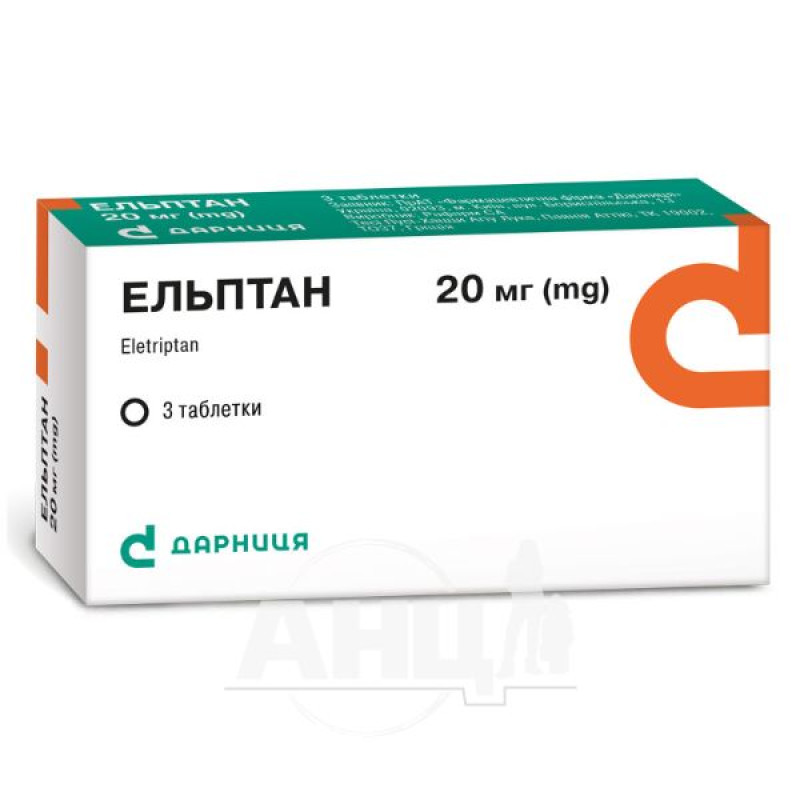
Elptan is an analgesic used to treat migraine. Selective agonists of serotonin 5-HT1 receptors.
Composition
active substance: eletriptan; 1 film-coated tablet contains eletriptan hydrobromide monohydrate 25.17 mg, equivalent to eletriptan 20 mg; excipients: microcrystalline cellulose pH 102, lactose monohydrate (Tablettose 80), croscarmellose sodium, magnesium stearate; film coating: lactose monohydrate, hypromellose, titanium dioxide (E 171), triacetin, sunset yellow FCF aluminum lake (E 110).
Contraindication
Hypersensitivity to the active substance or to any of the excipients of the medicinal product; severe hepatic or renal impairment; moderate or severe hypertension or untreated mild hypertension; confirmed cardiovascular disease, including coronary artery disease (CAD) (angina pectoris, previous myocardial infarction or confirmed asymptomatic ischemia). Patients with coronary artery vasospasm (Prinzmetal's angina), objective or subjective symptoms of CAD; significant arrhythmias or heart failure; peripheral vascular disease; history of cerebrovascular accident (CVA) or transient ischemic attack (TIA); use of ergotamine or ergotamine derivatives (including methysergide) within 24 hours before or after treatment with eletriptan; simultaneous use of other 5-HT1 receptor agonists with eletriptan.
Method of application
The tablets should be swallowed whole with water.
The medication should be used as early as possible after the onset of a migraine headache, but it is also effective at a later stage during a migraine attack.
Eletriptan has not been shown to prevent migraine headaches if used during the aura phase, and therefore this medicine should only be used during the migraine phase of the headache.
The drug should not be used for prophylactic purposes.
Adults (aged 18 to 65).
The recommended starting dose is 40 mg.
If the headache returns within 24 hours: If a migraine headache resolves but then recurs within 24 hours, eletriptan may be re-administered at the same dose that is effective for treating the recurrence. If a second dose is required, it should not be taken within 2 hours of the initial dose.
If no response to treatment is obtained: If the first dose does not reduce the headache within 2 hours, a second dose should not be used to relieve the attack, because the effectiveness of a second dose has not been established in clinical studies.
Clinical trials show that in patients who have failed to relieve a headache attack, treatment for a subsequent attack may still be effective.
If patients taking the drug at a dose of 40 mg do not receive a satisfactory effect (for example, good tolerance, but lack of relief of 2 out of 3 attacks), then a dose of 80 mg may be effective for subsequent migraine attacks. The maximum daily dose should not exceed 80 mg.
Application features
Use during pregnancy or breastfeeding
Pregnancy
There is no clinical experience with eletriptan in pregnant women. Eletriptan should be used during pregnancy only if there is no safer alternative and the expected benefit to the mother outweighs the potential risk to the fetus.
Breast-feeding
Eletriptan is excreted in human milk. Caution should be exercised when considering the use of eletriptan in nursing mothers. The risk to the infant can be minimized by avoiding breastfeeding for 24 hours after taking eletriptan.
Children
The use of eletriptan in patients under 18 years of age is not indicated due to the lack of experience with its use in pediatrics.
Ability to influence reaction speed when driving vehicles or other mechanisms
Eletriptan has a moderate influence on the ability to drive and use machines. Some patients may experience drowsiness or dizziness during migraine or treatment with eletriptan. Caution should be exercised when performing tasks requiring alertness, such as driving a car or operating complex machinery, during migraine attacks and after taking eletriptan.
Adverse reactions
The most common adverse reactions known from clinical trials (5000 patients treated with 20 mg, 40 mg and 80 mg doses) of eletriptan were asthenia, somnolence, nausea and dizziness. A dose-dependent trend in the incidence of adverse events was also observed.
Storage conditions
Store in original packaging at a temperature not exceeding 25°C. Keep out of the reach of children.
Shelf life 3 years.