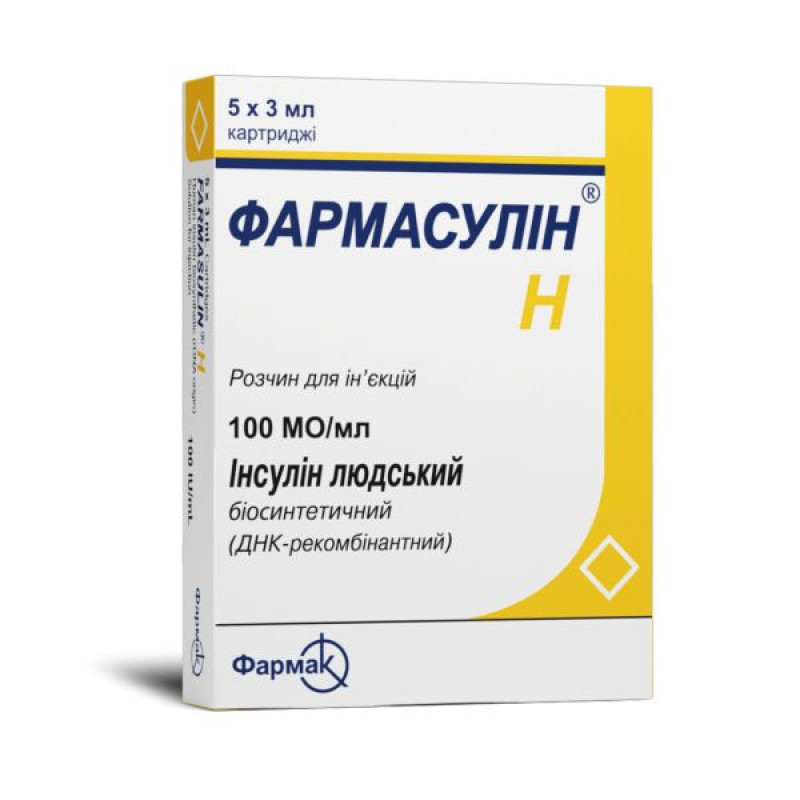
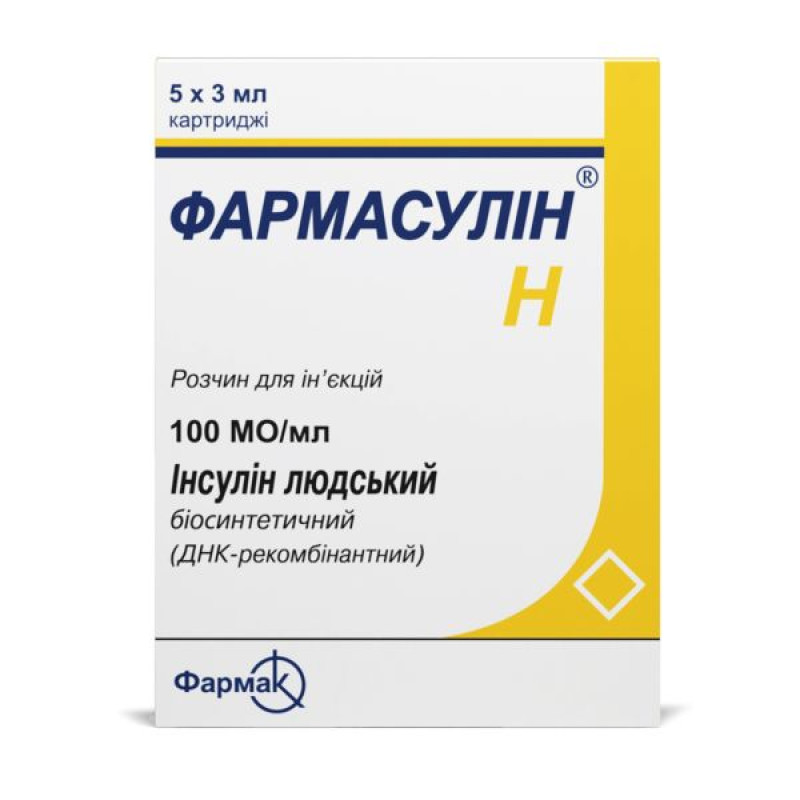
Instructions for Farmasulin H solution for injection 100 IU/ml cartridge 3 ml No. 5
Composition
active ingredient: insulin human;
1 ml of solution contains 100 IU of human biosynthetic insulin (DNA-recombinant);
Excipients: metacresol, glycerin, diluted hydrochloric acid or sodium hydroxide solution, water for injection.
Dosage form
Solution for injection.
Main physicochemical properties: clear colorless liquid.
Pharmacotherapeutic group
Antidiabetic agents. Insulin and analogues. Short-acting insulins and analogues.
ATX code A10A B01.
Pharmacological properties
Pharmacodynamics.
The main action of insulin is to regulate glucose metabolism. In addition, insulin affects several anabolic and anti-catabolic processes in various tissues. In muscle tissue, these effects include increased synthesis of glycogen, fatty acids, glycerol, and protein, as well as increased amino acid uptake and decreased glycogenolysis, gluconeogenesis, ketogenesis, lipolysis, protein catabolism, and amino acid removal.
Pharmacokinetics.
Farmasulin N is a fast-acting insulin.
The drug Farmasulinâ N is a human insulin produced using recombinant DNA technologies.
Insulin pharmacokinetics do not reflect the metabolic activity of the hormone.
The onset of effect of Farmasulinâ H is 30 minutes after administration. The peak of maximum concentration is observed between 1 and 3 hours after injection. Duration is from 5 to 7 hours.
During toxicological studies, no serious harmful effects associated with the use of the drug were detected.
Indication
Treatment of diabetic patients who require insulin as a means of maintaining normal blood sugar levels.
Contraindication
Hypoglycemia, hypersensitivity to Farmasulin H and to any excipients of the drug, except in cases of desensitization therapy.
Interaction with other medicinal products and other types of interactions
Some medications affect glucose metabolism. The physician should be informed of any concomitant treatment used with human insulin.
If it is necessary to use other medications, you should consult a doctor.
Insulin requirements may increase when drugs with hyperglycaemic activity are used, such as oral contraceptives, glucocorticoids, thyroid hormones and growth hormone, danazol, β2-sympathomimetics (e.g. ritodrine, salbutamol, terbutaline), thiazides.
Insulin requirements may be reduced by medicinal products with hypoglycaemic activity, such as oral hypoglycaemic agents, salicylates (e.g. acetylsalicylic acid), sulpha antibiotics, some antidepressants (monoamine oxidase inhibitors), some angiotensin converting enzyme inhibitors (captopril, enalapril), angiotensin II receptor blockers, non-selective β-blockers or alcohol.
Somatostatin analogues (octreotide, lanreotide) can both increase and decrease the need for insulin.
Application features
Any change in type or brand of insulin should be made under close medical supervision. Changes in strength, brand (corresponding to a specific manufacturer), type (rapid-acting, intermediate-acting, slow-acting), type (animal-derived insulin, human insulin, human insulin analogue) and/or method of preparation (recombinant DNA insulin as opposed to animal-derived insulin) may require a change in dosage.
The dosage for patients treated with human insulin may differ from that used for patients treated with animal insulins. If dose adjustments are necessary, these may be made with the first dose or during the first few weeks or months.
In some patients who have had hypoglycaemic reactions after being transferred from animal insulin to human insulin, the early warning symptoms of hypoglycaemia have been less pronounced or different from those previously experienced by these patients with animal insulin. Patients with significant improvement in blood glucose levels (e.g. due to intensification of insulin therapy) may no longer experience some or all of the early warning symptoms of hypoglycaemia and should be advised to do so. The early warning symptoms of hypoglycaemia may also be different or less pronounced in patients with long-standing diabetes and diabetic neuropathy or in patients taking other medicinal products, such as β-blockers, in addition to their current treatment.
Hypoglycemia or hyperglycemic reactions that have not been corrected may lead to loss of consciousness, coma, or death.
Antibodies may be produced during treatment with human insulin, although in lower concentrations than with purified insulin of animal origin.
The need for insulin changes significantly in cases of impaired function of the adrenal glands, pituitary gland, thyroid gland, renal or hepatic failure.
Insulin requirements may also increase during illness or emotional stress.
The need for dose adjustment may arise if the intensity of physical activity or usual diet changes.
Combined use with pioglitazone
Cases of heart failure have been reported with the combined use of pioglitazone with insulin, especially in patients with risk factors for heart failure. This information should be taken into account when prescribing the combination of Farmasulin H with pioglitazone. If this combination is used, the patient should be monitored for signs and symptoms of heart failure, weight gain and edema. Pioglitazone treatment should be discontinued if cardiac symptoms worsen.
Use during pregnancy or breastfeeding
It is important to maintain adequate blood glucose levels in pregnant women who are being treated with insulin (insulin-dependent and gestational diabetes). Insulin requirements usually decrease during the first trimester of pregnancy and then increase during the second and third trimesters. Women with diabetes should inform their doctors if they are pregnant or intend to become pregnant.
Close monitoring of blood glucose levels and overall health is vital for pregnant women with diabetes.
Women with diabetes may need to adjust their insulin doses and/or diet while breastfeeding.
Ability to influence reaction speed when driving vehicles or other mechanisms
Hypoglycemia can negatively affect concentration and reflex reactions, i.e. it is a risk factor in situations that require these qualities, such as driving a car or operating mechanical devices.
Patients should be advised to take precautions before driving to avoid hypoglycaemia exacerbations, particularly if early warning signs of hypoglycaemia are absent or not evident, or if hypoglycaemia exacerbations occur frequently. In such circumstances, they should not drive.
Method of administration and doses
The dose and time of administration are determined by the doctor, taking into account the personal needs of each patient.
Farmasulin® H should be administered subcutaneously or intravenously.
Farmasulin® H can be administered by intramuscular injection, although this method of administration is not recommended.
Subcutaneous injection should be given in the shoulder, thigh, buttocks or abdomen. Injections should be given in different parts of the body so that the same part is not injected more than once a month. Avoid inserting the needle into a blood vessel. Do not rub the injection site after administration. The patient should be given detailed instructions on the injection technique.
1. Instructions for use of the drug.
Cartridges.
The solution for injection in 3 ml cartridges must be used with a pen injector bearing the CE marking in accordance with the recommendations of the pen injector manufacturer.
Preparing the dose.
Farmasulin® H in cartridges does not require resuspension; it should only be used if the solution is clear, colorless, free of visible particles and has the appearance of water.
To load the cartridge into the pen injector, attach the needle, and inject insulin, refer to the pen injector manufacturer's instructions for administering insulin.
The cartridges are not intended for mixing different insulins. Alternatively, separate pen injectors for Farmasulin® H and Farmasulin® H NP should be used to administer the correct dose of each drug.
Empty cartridges cannot be reused.
Vials.
Use an insulin syringe with markings that match the dose of insulin being used. It is important to use a syringe of the same type and brand. Carelessness when using a syringe can lead to incorrect insulin dosing.
Preparing the dose.
1) Before withdrawing insulin from the vial, it is necessary to check the transparency of the solution. If flakes appear, the solution becomes cloudy, a precipitate forms, or deposits of the substance appear on the glass of the vial, the drug must not be used!
Farmasulin® H does not require resuspension; it should only be used if the solution is clear, colorless, free of visible particles and looks like water.
2) Withdraw insulin from the vial by piercing the stopper, previously wiped with alcohol, with a sterile syringe needle. The temperature of the insulin to be injected should be at room temperature.
3) Draw air into the syringe to the mark corresponding to the required dose of insulin, and then release the air into the vial.
4) Turn the syringe and vial upside down and draw up the required dose of insulin.
When performing the injection, the rules of asepsis should be observed. To avoid purulent-inflammatory complications, a disposable syringe should not be reused.
To administer the required dose of each drug, it is necessary to use separate syringes for Farmasulin® H and Farmasulin® H NP.
2. Administration of the drug.
Administer the appropriate dose of insulin according to your doctor's instructions.
Injections should be performed in different places on the body, with the aim of injecting into the same place no more than once a month.
Children
The dosage, administration schedule, and number of injections for children are determined by the doctor based on specific needs and in accordance with each specific case.
Overdose
Symptoms: There is no specific definition for insulin overdose, as blood glucose levels are influenced by complex interactions between serum insulin levels, glucose availability, and other metabolic processes. Hypoglycemia may result from excess insulin given the intensity of carbohydrate intake and level of physical activity.
Symptoms of hypoglycemia include apathy, confusion, palpitations, headache, increased sweating, and vomiting.
Treatment. In cases of mild hypoglycemia, patients are given glucose or other sugar-containing products orally. In cases of moderate hypoglycemia, patients should be treated with intramuscular or subcutaneous glucagon, followed by the administration of carbohydrates with food after adequate recovery of the patient's condition. However, if glucagon is not available or if the patient's body does not respond to its administration, glucose should be administered intravenously. Immediately after regaining consciousness, the patient should be given food. It may be necessary to continue giving the patient carbohydrates and to conduct further monitoring of the blood glucose level, since hypoglycemia may occur even after clinical recovery.
Adverse reactions
Hypoglycemia is the most common side effect of insulin therapy in patients with diabetes. Severe hypoglycemia can lead to loss of consciousness and, in some extreme cases, death. Data on the frequency of hypoglycemia are not available, as hypoglycemia is related to the dose of insulin and to other factors, such as the patient's diet and level of physical activity.
Local allergic reactions may include changes in the injection site, redness, swelling, and itching. They usually last from a few days to a few weeks. In some cases, these reactions are not related to insulin but to other factors, such as irritants in skin cleansers or lack of experience in giving injections.
Systemic allergy is a potentially more serious side effect and is a generalized form of allergy to insulin, including rash on the entire body, shortness of breath, wheezing, decreased blood pressure, increased heart rate and increased sweating. Severe cases of generalized allergy are life-threatening. In some exceptional cases of severe allergy to Farmasulinâ N, appropriate measures should be taken immediately. Insulin replacement or desensitization therapy may be required.
Lipodystrophy may occur at the injection site.
Insulin resistance.
Cases of edema have been reported during insulin therapy, particularly in cases with previously reduced metabolism, which improved with intensive insulin therapy.
Expiration date
2 years.
The shelf life of the drug in cartridges and vials after opening is 28 days at a temperature of 15 ºС to 25 ºС, protected from overheating and sunlight. Cartridges in use should not be kept in the refrigerator.
Do not use the drug after the expiration date indicated on the package.
Storage conditions
Store in the original packaging at a temperature of 2°C to 8°C (in a refrigerator).
Do not freeze. Keep out of reach of children.
Incompatibility
Farmasulin N should not be mixed with insulins from other manufacturers or with insulins of animal origin.
Packaging
3 ml in a cartridge. 5 cartridges in a blister, 1 blister in a pack. 5 ml or 10 ml in a vial. 1 vial in a pack.
Vacation category
According to the recipe.
Producer
PJSC "Farmak".
Location of the manufacturer and its business address
Ukraine, 04080, Kyiv, Frunze St., 74.