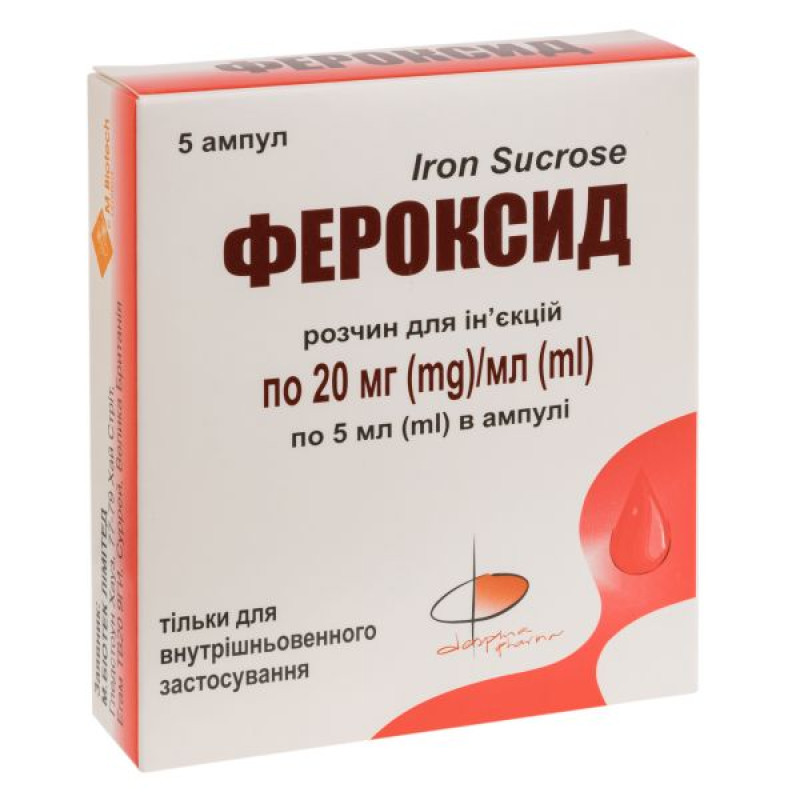
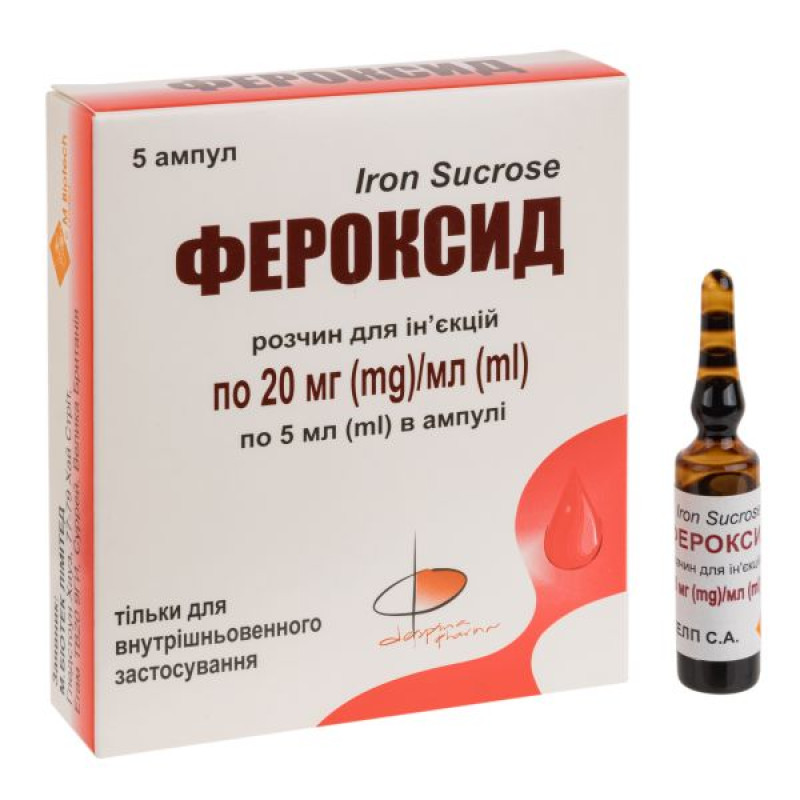
Instructions Feroxide solution for injection 20 mg/ml ampoule 5 ml No. 5
Composition
active ingredient: iron (III) hydroxide sucrose complex;
1 ml of solution contains iron (III) hydroxide sucrose complex equivalent to iron (III) 20 mg;
Excipients: sodium hydroxide, water for injections.
Dosage form
Solution for injection.
Main physicochemical properties: colloidal solution from brown to red-brown in color.
Pharmacotherapeutic group
Antianemic agents. Iron preparations. ATC code B0ZA C.
Pharmacological properties
Pharmacodynamics.
The active component of iron sucrose consists of polynuclear iron (III) hydroxide centers surrounded on the outside by a large number of non-covalently bound sucrose molecules. The average molecular weight of the complex is approximately 43 kDa. The polynuclear iron center has a structure similar to that of the ferritin center, which is a physiological iron-containing protein. The complex is designed so that the absorbed iron is delivered in a controlled manner to the proteins that ensure its transport and storage in the body (transferrin and ferritin, respectively).
After intravenous administration, the multinuclear iron center from the complex is taken up mainly by the reticuloendothelial system of the liver, spleen, and bone marrow. In the second stage, the iron is used for the synthesis of hemoglobin, myoglobin, and other iron-containing enzymes or is stored in the liver as ferritin.
Pharmacokinetics.
Distribution. The ferrokinetics of iron hydroxide sucrose complex labeled with 59Fe and 52Fe were evaluated in 6 patients with anemia and chronic renal failure. During the first 6-8 hours, 52Fe is taken up by the liver, spleen, and bone marrow. Radioactive iron uptake occurs in macrophages of the reticuloendothelial system of the spleen.
After intravenous administration of a single dose of 100 mg of iron to healthy volunteers, peak iron concentrations were observed 10 minutes after administration and reached a mean value of 538 mmol/L. The volume of distribution of the central chamber corresponded well to the volume of blood plasma (approximately 3 liters).
Metabolism: After injection, sucrose is almost completely broken down and the multinuclear iron center is taken up mainly by the reticuloendothelial system of the liver, spleen, and bone marrow.
Within 4 weeks after administration, iron uptake by erythrocytes ranges from 68% to 97%.
Elimination. The average molecular weight of the complex is approximately 43 kDa and is large enough to avoid renal excretion. Renal excretion of iron during the first 4 hours after injection of 100 mg iron was less than 5% of the dose. After 24 hours, total serum iron concentration had decreased to baseline (pre-administration) levels, and renal excretion of sucrose was approximately 75% of the administered dose.
Pharmacokinetics in specific patient groups. It is still unknown whether renal and hepatic insufficiency affect the pharmacological properties of iron (III) hydroxide sucrose complex (see section "Special instructions").
Indication
Iron deficiency in patients who cannot be prescribed oral iron preparations or in case of their ineffectiveness or impossibility of oral administration of iron-containing preparations in the following cases:
intolerance to oral iron preparations;
the presence of inflammatory diseases of the gastrointestinal tract (for example, ulcerative colitis), which may be exacerbated by therapy with oral iron preparations;
iron deficiency states resistant to therapy, in cases where control of these conditions with oral iron preparations is insufficient.
The drug should only be used when the indications are based on appropriate studies. Appropriate laboratory tests include determination of the level of such indicators as hemoglobin, serum ferritin, transferrin saturation.
Contraindication
Known hypersensitivity to the active substance or other components of the drug;
anemia not associated with iron deficiency (e.g. hemolytic anemia, megaloblastic anemia due to vitamin B12 deficiency, impaired erythropoiesis, bone marrow hypoplasia, anemia caused by lead poisoning);
diseases accompanied by iron overload (hemosiderosis, hemochromatosis) or hereditary disorders of iron absorption (for example, sideroachrestic anemia, porphyria cutanea, thalassemia);
First trimester of pregnancy.
Interaction with other medicinal products and other types of interactions
Feroxide is indicated for patients who cannot be prescribed oral iron preparations due to their intolerance, ineffectiveness or the presence of gastrointestinal diseases. Like other iron preparations for parenteral use, Feroxide should not be used simultaneously with iron-containing oral preparations, since the absorption of iron administered orally is reduced. Therefore, treatment with oral iron preparations should be started no earlier than 5 days after the last Feroxide injection.
Application features
Intravenous administration of parenteral iron preparations may lead to immediate-type hypersensitivity reactions (anaphylactoid/anaphylactic reactions), which may be fatal. Therefore, antiallergic treatment should be carried out in a room with appropriate cardiopulmonary resuscitation equipment. Such reactions have been reported even in cases where previous use of parenteral iron preparations was without complications. In patients who have experienced hypersensitivity reactions to other parenteral iron preparations (e.g. iron dextran), Feroxide should be used in case of urgent need, observing all precautions.
Treatment with Feroxide should be prescribed by a doctor only after accurately determining the indication.
Feroxide should only be administered when medical personnel trained in the evaluation and treatment of anaphylactic reactions are available and an area with adequate resuscitation facilities is available. Before each administration, the patient should be questioned about any previous adverse reactions to intravenous iron. There have been reports of hypersensitivity reactions progressing to Kounis syndrome (acute allergic coronary arteriospasm that may lead to myocardial infarction).
Typical symptoms of immediate-type hypersensitivity reactions are: decreased blood pressure, tachycardia (and even anaphylactic shock), respiratory symptoms (including bronchospasm, laryngeal edema and pharyngeal edema), gastrointestinal symptoms (including abdominal cramps, vomiting) or skin symptoms (including urticaria, erythema, pruritus).
Each patient should be observed for adverse reactions at least 30 minutes after each intravenous administration of iron preparations. If allergic reactions or signs of intolerance occur during use, treatment should be discontinued immediately.
For the immediate treatment of acute anaphylactic/anaphylactoid reactions, the first recommended treatment is adrenaline (e.g., 0.3 mg intramuscularly), followed by antihistamines and/or corticosteroids (which have a later onset of action).
High risk of hypersensitivity reactions in patients with existing allergies, including drug intolerance, a history of severe bronchial asthma, eczema and other forms of atopy, as well as in patients with immunological and inflammatory diseases (such as systemic lupus erythematosus, rheumatoid arthritis).
In patients with impaired hepatic function, parenteral iron preparations should be used after careful benefit/risk assessment. Parenteral iron preparations should be avoided in patients with impaired hepatic function when iron overload is a precipitating factor. Careful monitoring of body iron levels is recommended to avoid iron overload.
In patients with elevated ferritin levels, parenteral iron preparations may adversely affect the course of bacterial or viral infections.
Parenteral iron preparations should be used with caution in acute or chronic infections. In patients with chronic infections, the benefit/risk ratio should be assessed. It is recommended that Feroxide be discontinued in patients with bacteremia.
Caution is also required when administering the drug to individuals with low serum iron binding capacity and/or folic acid deficiency.
During the administration of the drug, special attention should be paid to avoiding paravenous leakage. Paravenous leakage can lead to pain, inflammation, tissue necrosis and prolonged brown discoloration of the skin at this site. In the event of paravenous leakage, the drug should be discontinued immediately.
A decrease in blood pressure is commonly observed with the use of intravenous iron preparations. Therefore, the drug should be used with caution. The recommendations for the rate of administration of the drug should be strictly followed to prevent the development of arterial hypotension. A higher incidence of undesirable side effects (especially hypotension) is associated with an increase in the dose or rate of administration of the drug.
Special caution should be exercised when using Feroxide in patients with hepatic insufficiency, decompensated cirrhosis, epidemic hepatitis, Randu-Osler disease, acute infectious kidney diseases, and uncontrolled hyperparathyroidism.
Before use, the ampoules should be inspected for sediment and damage. Only a homogeneous aqueous solution from brown to red-brown in color, which does not contain sediment, can be used. Feroxide should be administered immediately after opening the ampoule.
The patient should inform the doctor if he/she feels worse, fatigue with myalgia or bone pain. Serum phosphate levels should be monitored in patients receiving multiple administrations at higher doses or during long-term treatment, as well as in patients with existing risk factors for hypophosphatemia. In case of persistent hypophosphatemia, treatment with the drug should be reconsidered.
The drug contains less than 1 mmol sodium (23 mg) per ampoule, that is, it is essentially a “sodium-free” drug.
Use during pregnancy or breastfeeding
There are no data on the use of iron (III) hydroxide sucrose complex in pregnant women in the first trimester of pregnancy. Data on the use of iron (III) hydroxide sucrose complex in pregnant women in the second and third trimesters of pregnancy showed no adverse effects on the health of the mother and child.
It is not yet known whether iron(III) hydroxide sucrose complex crosses the placenta. Iron bound to transferrin does not cross the placental barrier. Iron bound to lactoferrin passes into breast milk.
Studies on the effect on iron levels in newborns have not been conducted.
Feroxide is contraindicated for use in the first trimester of pregnancy (see the Contraindications section). The drug may be used in the second and third trimesters of pregnancy only strictly according to indications.
The risk/benefit ratio should be assessed before using the drug during pregnancy, as hypersensitivity reactions may carry a certain risk for the mother and child (see section "Special instructions"). Body weight before pregnancy should be taken into account to calculate the required amount of iron to avoid overdose.
Data on iron excretion in human breast milk after intravenous administration of iron sucrose are limited. In a clinical study, 10 healthy, iron-deficient, breast-feeding women were given 100 mg of iron in the form of a sucrose complex. After four days of treatment, the iron content in breast milk was not increased and did not differ from that in the control group (n = 5). An effect of iron in the mother's breast milk on the newborn/infant cannot be excluded, therefore the risk/benefit ratio should be assessed.
Ability to influence reaction speed when driving vehicles or other mechanisms
There are no relevant studies. The effect on the reaction rate when driving or using other mechanisms is unlikely. However, in case of adverse reactions such as dizziness, confusion after taking the drug, you should refrain from driving or using other mechanisms until the symptoms disappear.
Method of administration and doses
Feroxide should only be administered intravenously. It can be administered by slow injection, intravenous drip infusion, or direct injection into the venous site of the dialysis system.
The product is not intended for intramuscular or subcutaneous administration.
The drug should only be used when the indications are based on appropriate studies. Appropriate laboratory tests include determination of the level of such indicators as hemoglobin, serum ferritin, transferrin saturation.
Patients should be observed for signs and symptoms of hypersensitivity reactions during and after administration of Feroxide. Appropriate emergency treatment should be provided (see section 4.4).
The total cumulative dose of the drug should be calculated for each patient individually and not exceeded. The dose should be calculated taking into account the patient's body weight and hemoglobin level.
In cases where the total required dose exceeds the maximum permitted single dose of 200 mg (for injection) or 500 mg (for infusion), it is recommended to administer the drug in parts.
Dose calculation.
The total cumulative dose of Feroxide, equivalent to the total iron deficiency (mg), should be determined taking into account the hemoglobin (Hb) level and body weight. The dose should be calculated individually according to the total iron deficiency in the patient's body using the Ganzoni formula:
total iron deficiency (mg) = body weight (kg) ´ (normal Hb level (g/l) - patient's Hb level (g/l)) ´ 0.24* + stored iron (mg).
For patients with a body weight of less than 35 kg: normal Hb level is 130 g/l, the amount of deposited iron is 15 mg/kg of body weight.
For patients with a body weight of more than 35 kg: normal Hb level is 150 g/l, the amount of deposited iron is 500 mg.
* Coefficient 0.24 = 0.0034 ´ 0.07 ´ 1000 (iron content in Hb = 0.34%, blood volume = 7% of body weight, coefficient 1000 = conversion of "g" to "mg").
The total volume of Feroxide, which must be entered (in ml) | = Total iron deficiency (mg) 20 mg/ml |
Total cumulative dose of Feroxide (ml) to be administered, taking into account the patient's body weight and Hb level
Table 1
Body weight (kg) | Cumulative therapeutic dose of Feroxide for administration |
| Hb 60 g/l | Hb 75 g/l | Hb 90 g/l | Hb 105 g/l |
| ml | mg Fe | ml | mg Fe | ml | mg Fe | ml | mg Fe |
| 10 | 16 | 320 | 14 | 12 | 240 | 11 | 220 |
| 15 | 24 | 480 | 21 | 420 | 19 | 380 | 16 | 320 |
| 20 | 32 | 640 | 28 | 560 | 25 | 500 | 21 | 420 |
| 25 | 40 | 800 | 35 | 700 | 31 | 620 | 26 | 520 |
| 30 | 48 | 960 | 42 | 840 | 37 | 740 | 32 | 640 |
| 35 | 63 | 1260 | 57 | 1140 | 50 | 1000 | 44 | 880 |
| 40 | 68 | 1360 | 61 | 1220 | 54 | 1080 | 47 | 940 |
| 45 | 74 | 1480 | 66 | 1320 | 57 | 1140 | 49 | 980 |
| 50 | 79 | 1580 | 70 | 1400 | 61 | 1220 | 52 | 1040 |
| 55 | 84 | 1680 | 75 | 1500 | 65 | 1300 | 55 | 1100 |
| 60 | 90 | 1800 | 79 | 1580 | 68 | 1360 | 57 | 1140 |
| 65 | 95 | 1900 | 84 | 1680 | 72 | 1440 | 60 | 1200 |
| 70 | 101 | 2020 | 88 | 1760 | 75 | 1500 | 63 | 1260 |
| 75 | 106 | 2120 | 93 | 1860 | 79 | 1580 | 66 | 1320 |
| 80 | 111 | 2220 | 97 | 1940 | 83 | 1660 | 68 | 1360 |
| 85 | 117 | 2340 | 102 | 2040 | 86 | 1720 | 71 | 1420 |
| 90 | 122 | 2440 | 106 | 2120 | 90 | 1800 | 74 | 1480 |
Required Hb level depending on patient's body weight
Table 2
| Body weight | Required Hb |
| < 35 kg | 130 g/l |
| ≥ 35 kg | 150 g/l |
To convert Hb (mM) to Hb (g/dl), the first indicator must be multiplied by 1.6.
If the required total dose exceeds the maximum permissible single dose of 200 mg (injection) or 500 mg (infusion), then the administration should be carried out in several doses.
Standard dosage.
Adults and elderly patients: 5–10 ml of Feroxide (100–200 mg of iron) 1–3 times a week depending on Hb level. For time of administration and dilution factor, see below.
Children aged 3 years and over: There are only limited data on the use of the drug in children. In case of clinical need, it is recommended to administer no more than 0.15 ml of Feroxide (3 mg iron) per 1 kg of body weight no more than 3 times a week. For the time of administration and dilution factor, see below.
Maximum tolerated single or weekly dose.
Adults and elderly patients
For injections: the maximum tolerated dose is 10 ml of Feroxide (200 mg of iron), no more than 3 times a week, the duration of administration is at least 10 minutes.
For infusion: maximum tolerated dose - no more than 1 time per week:
patients with a body weight of more than 70 kg: 500 mg of iron (25 ml of Feroxide) over at least 3.5 hours;
patients weighing up to 70 kg: 7 mg of iron per kg of body weight for at least 3.5 hours.
The infusion time should be strictly adhered to, even if the patient does not receive the maximum tolerated single dose.
If there is no improvement in hematological parameters (an increase in hemoglobin level of approximately 1 g/L of blood per day or approximately 10–20 g/L 1–2 weeks after the start of treatment), the patient's initial diagnosis should be reviewed and persistent blood loss should be excluded.
Application
Feroxide can only be administered intravenously, by drip infusion, slow injection, or directly into the venous section of a hemodialysis machine.
Feroxide should not be administered intramuscularly or subcutaneously.
If the required total dose exceeds the maximum permissible single dose, the total dose should be divided into several doses.
Intravenous drip.
Feroxide should be administered by drip infusion to reduce the risk of developing arterial hypotension and the danger of the solution entering the perivenous space.
Immediately before administration, Feroxide must be diluted in sterile 0.9% sodium chloride solution, according to the scheme indicated in Table 3, in a ratio of 1:20, for example:
1 ml of Feroxide (20 mg of iron) in a maximum of 20 ml of sterile 0.9% sodium chloride solution.
Table 3
Feroxide dosage (mg iron) | Feroxide dosage (ml) | Maximum volume of sterile 0.9% sodium chloride solution for dilution | Minimum input time |
| 50 mg | 2.5 ml | 50 ml | 8 minutes |
| 100 mg | 5 ml | 100 ml | 15 minutes |
| 200 mg | 10 ml | 200 ml | 30 minutes |
| 300 mg | 15 ml | 300 ml | 1.5 hours |
| 400 mg | 20 ml | 400 ml | 2.5 hours |
| 500 mg | 25 ml | 500 ml | 3.5 hours |
To ensure the stability of the Feroxide solution, dilution in larger than recommended volumes of saline is not permitted.
Intravenous jet injection.
Feroxide can also be administered intravenously by slow infusion as an undiluted solution at a rate of 1 ml per minute (5 ml of Feroxide (100 mg of iron) should be administered over 5 minutes), but the maximum volume of the solution should not exceed 10 ml of Feroxide (200 mg of iron) per injection.
Injection into the venous section of the dialysis system.
Feroxide can be administered directly into the venous section of the dialysis system during a hemodialysis session, strictly following the rules described for intravenous injection.
Dose calculation for replenishing iron levels after blood loss or donation.
The dose of Feroxide required to compensate for iron deficiency should be determined using the following formula:
if the amount of blood lost is known: intravenous administration of 200 mg of iron (10 ml of Feroxide) leads to the same increase in Hb concentration as transfusion of 1 unit of blood (400 ml with an Hb concentration of 150 g/l);
amount of iron to be replaced (mg) = number of units of blood lost ´ 200 or
required volume of Feroxide (ml) = number of units of blood lost ´ 10;
If the Hb level decreases, use the previous formula, but keep in mind that iron stores do not need to be replenished.
The amount of iron to be compensated (mg) = body weight (kg) ´ 0.24 ´ (normal Hb level (g/l) - patient's Hb level) (g/l). For example: body weight = 60 kg, Hb deficiency = 10 g/l Þ the required amount of iron = 150 mg Þ the required volume of Feroxide = 7.5 ml.
Children.
Due to insufficient data, the use of Feroxide is not recommended for the treatment of children under 3 years of age.
Overdose
Overdose may lead to acute iron overload, which may manifest as hemosiderosis. In case of overdose, it is recommended to use symptomatic agents and, if necessary, iron-binding agents (chelates).
Side effects
The most common adverse drug reaction reported is dysgeusia. Common adverse reactions include nausea, hypotension, hypertension, and infusion site pain, which occurred at a frequency of 1 to 2 events per 100 people.
The most important serious adverse reactions associated with the use of the drug include hypersensitivity reactions, which occurred with a frequency of 0.25 events per 100 people during clinical trials. Immediate hypersensitivity reactions (anaphylactoid/anaphylactic reactions) occurred rarely. In general, anaphylactoid/anaphylactic reactions are very serious adverse reactions that can lead to fatal outcomes (see section "Special warnings and precautions for use"). Symptoms include circulatory collapse, hypotension, tachycardia, respiratory symptoms (bronchospasm, laryngeal edema, pharyngeal edema, etc.), gastrointestinal symptoms (abdominal pain, vomiting, etc.), skin symptoms (urticaria, erythema, itching, etc.).
Serious adverse reactions
You should tell your doctor if you experience fatigue, muscle or bone pain (pain in the arms or legs, joints or back). This may be a sign of low phosphorus in the blood, which can cause soft bones (osteomalacia). This condition can sometimes lead to bone fractures. Your doctor may also check your phosphate levels in your blood, especially if you need to take iron supplements over time.
Adverse reactions are classified according to the following frequency: very common (> 1/10), common (> 1/100, < 1/10), uncommon (> 1/1000, < 1/100), rare (> 1/10000, < 1/1000), very rare (1/10000), not known (the available data do not allow an estimate of the frequency, since such events were reported exclusively during post-marketing studies and not in clinical trials).
Infectious and parasitic diseases.
Rare: pneumonia.
From the blood and lymphatic system.
Uncommon: polycythemia1.
From the immune system.
Uncommon: hypersensitivity reactions.
Not known: anaphylactoid reactions, angioedema.
Metabolism and eating disorders.
Rare: iron overload.
From the nervous system.
Common: transient taste disturbance, especially a metallic taste (dysgeusia).
Uncommon: headache, dizziness, burning sensation, paresthesia, hypoesthesia.
Rare: fainting, migraine, drowsiness.
Not known: loss of consciousness, impaired consciousness, confusion, anxiety, tremor.
From the side of the cardiac system.
Common: hypotension and collapse, tachycardia.
Rare: feeling of palpitations.
Not known: bradycardia, Kounis syndrome.
From the vascular system.
Common: hypotension, hypertension.
Uncommon: thrombophlebitis, phlebitis.
Rare: hot flashes.
Not known: circulatory collapse, superficial vein thrombosis.
On the part of the respiratory system, chest organs and mediastinum.
Uncommon: dyspnoea.
Not known: bronchospasm.
On the part of the kidneys and urinary system.
Uncommon: chromaturia.
From the digestive tract.
Common: nausea.
Uncommon: vomiting, abdominal pain, diarrhoea, constipation.
Rare: dry mouth.
On the skin and subcutaneous tissue.
Uncommon: itching, rash.
Not known: urticaria, erythema.
On the part of the musculoskeletal system and connective tissue.
Uncommon: muscle cramps, myalgia, arthralgia, pain in extremity, back pain.
Rare: feeling of discomfort in the extremities, muscle spasms.
Not known: hypotension, hypophosphatemic osteomalacia.
General disorders and administration site reactions.
Uncommon: chills; asthenia; fatigue; pain; reactions, irritation, transudation, skin discoloration to brown, burning sensation, swelling and inflammation at the injection site; peripheral oedema.
Rare: feeling of heat, chest pain, fever, itching at the injection site, hematoma at the injection site.
Very rare: increased sweating, pallor, feeling unwell, swelling.
Laboratory indicators.
Uncommon: increased gamma-glutamyltransferase, increased alanine aminotransferase, increased aspartate aminotransferase, abnormal liver function tests.
Rare: increased serum ferritin1, increased blood creatinine, increased blood lactate dehydrogenase.
1 Possible as a result of iron overdose or overload
Expiration date
3 years.
Do not use the drug after the expiration date indicated on the package.
From a microbiological point of view, the product should be used immediately after opening the ampoule.
After dilution with saline, the physical and chemical stability at room temperature is 12 hours.
Storage conditions
Store in the original packaging at a temperature not exceeding 25 °C.
Do not freeze. Keep out of reach of children.
Incompatibility
Feroxide can only be mixed with sterile 0.9% sodium chloride solution. No other intravenous solutions or therapeutic agents should be added as there is a risk of precipitation and/or other pharmaceutical interactions. Compatibility with polyethylene and polyvinyl chloride containers has not been studied.
Packaging
5 ml in an ampoule, 5 ampoules in a cardboard pack.
Vacation category
According to the recipe.
Producer
HELP S.A.
HELP SA
Location of the manufacturer and address of its place of business.
Pedini, Ioannina, 45500, Greece
Pedini Ioanninon, Ioannina, 45500, Greece
Applicant
M.BIOTECH LIMITED
M.BIOTECH LIMITED
Location of the applicant.
Gladstone House, 77-79 High Street, Egham TV20 9GY, Surrey, United Kingdom
Gladstone House, 77-79 High Street, Egham TW20 9HY, Surrey, United Kingdom