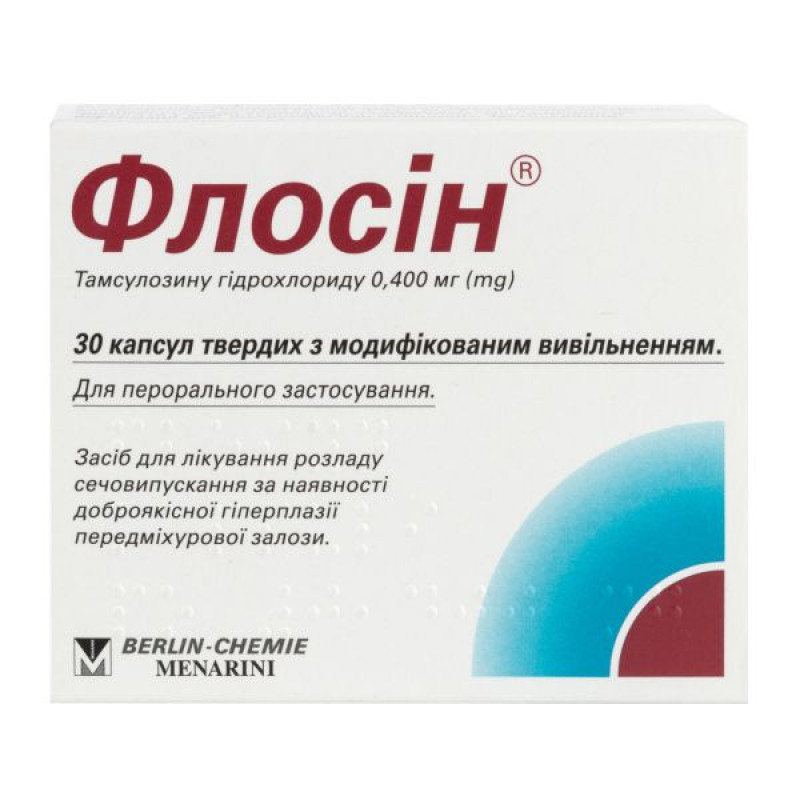
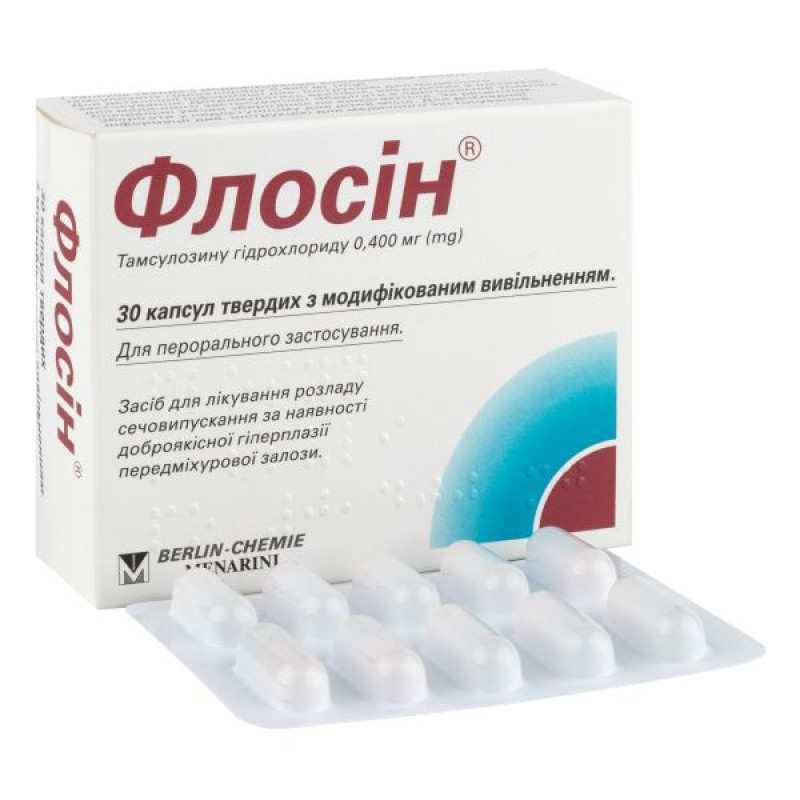
Instructions Flosin hard capsules with modified release 0.4 mg No. 30
Composition
active ingredient: tamsulosin hydrochloride;
1 capsule contains tamsulosin hydrochloride 0.400 mg;
excipients:
Granule core: microcrystalline cellulose, methacrylate copolymer (type A) dispersion 30% (containing polysorbate 80 and sodium lauryl sulfate), triethyl citrate, talc;
Granule shell: methacrylate copolymer (type A) dispersion 30% (containing polysorbate 80 and sodium lauryl sulfate), triethyl citrate, talc;
capsules (shell composition): red iron oxide (E 172), titanium dioxide (E 171), yellow iron oxide (E 172), gelatin;
capsules (cap composition): indigo carmine – FD&C blue No. 2 (E 132), black iron oxide (E 172), titanium dioxide (E 171), yellow iron oxide (E 172), gelatin.
Dosage form
Modified-release hard capsules.
Main physicochemical properties: hard gelatin capsule with an orange body and an olive cap; the capsule is filled with white or almost white granules.
Pharmacotherapeutic group
Drugs used for the treatment of benign prostatic hyperplasia. α1-adrenoceptor antagonists. ATC code G04C A02.
Pharmacological properties
Pharmacodynamics
Mechanism of action
Tamsulosin selectively and competitively binds to postsynaptic α1A-adrenoceptors, in particular to α1A and α1D subtypes. This leads to a decrease in the tone of the smooth muscles of the prostate gland and urinary tract.
Pharmacodynamic effects
Tamsulosin increases the maximum volumetric flow rate of urination. By relaxing the smooth muscles of the prostate gland and urethra, it reduces urinary tract obstruction and thereby facilitates urination.
It also improves reservoir function, which is often impaired due to bladder instability.
These effects on reservoir and voiding function are maintained with long-term treatment. Thus, it significantly reduces the need for surgery or catheterization.
α1-adrenergic receptor antagonists may lower blood pressure by reducing peripheral vascular resistance. No clinically significant reduction in blood pressure was observed in studies with tamsulosin.
Pharmacokinetics
Absorption.
Tamsulosin is absorbed in the intestine and is almost completely bioavailable. In the case of tamsulosin administration immediately after food, its absorption is reduced. In order for tamsulosin to be absorbed approximately equally throughout, it should be administered at the same time after food. Tamsulosin has linear kinetics.
After taking a single dose of tamsulosin on a full stomach, the maximum plasma concentration is reached after approximately 6 hours, and at steady state, which occurs on the 5th day of treatment, the Cmax value is approximately two-thirds higher than the Cmax value after a single dose.
Distribution.
In men, tamsulosin is approximately 99% bound to plasma proteins. The volume of distribution is small (approximately 0.2 l/kg).
Biotransformation.
During the first pass through the liver, tamsulosin is metabolized slowly. In the blood plasma, tamsulosin is present mainly as unchanged active substance. Tamsulosin is metabolized in the liver.
In rats, almost no induction of liver microsomal enzymes was caused by tamsulosin.
None of the metabolites of tamsulosin has a higher activity than the parent compound.
Breeding.
Tamsulosin and its metabolites are excreted mainly in the urine, with approximately 9% of the administered dose being excreted as unchanged active substance. After a single dose of tamsulosin on a full stomach, the elimination half-life is approximately 10 hours and after reaching steady state, approximately 13 hours.
Indication
Treatment of functional disorders of the lower urinary tract in benign prostatic hyperplasia.
Contraindication
Hypersensitivity to the active substance, including drug-induced angioedema, or to any of the excipients of the medicinal product; history of orthostatic hypotension; severe hepatic insufficiency.
Interaction with other medicinal products and other types of interactions
Studies of the interaction of tamsulosin with other drugs have only been conducted in adults.
No drug interactions were observed when tamsulosin hydrochloride was used concomitantly with atenolol, enalapril, or theophylline.
Concomitant use with cimetidine increases, and with furosemide decreases, the concentration of tamsulosin in the blood plasma, but since these levels remain within the normal range, there is no need for special dosage adjustment of tamsulosin.
Concomitant use with strong CYP3A4 inhibitors may lead to an increase in the effect of tamsulosin hydrochloride. Concomitant use with ketoconazole (a known strong CYP3A4 inhibitor) induced an increase in the AUC and Cmax of tamsulosin hydrochloride by a factor of 2.8 and 2.2, respectively.
Tamsulosin hydrochloride should not be used in combination with strong CYP3A4 inhibitors in patients with a CYP2D6 poor metaboliser phenotype.
Tamsulosin hydrochloride should be used with caution in combination with strong and moderate CYP3A4 inhibitors.
When co-administered with paroxetine, a strong CYP2D6 inhibitor, the Cmax and AUC of tamsulosin increase by 1.3 and 1.6 times, respectively, but this increase is not considered clinically significant.
Concomitant use of tamsulosin with other α1-adrenergic blockers may lead to a hypotensive effect.
Application features
Like other α1-adrenoceptor antagonists, tamsulosin may cause in isolated cases a decrease in blood pressure, which can sometimes lead to loss of consciousness. At the first signs of orthostatic hypotension (dizziness, weakness), the patient should sit or lie down until the symptoms disappear.
Treatment with tamsulosin should be preceded by an examination of the patient to exclude any other disease presenting with symptoms similar to those of benign prostatic hyperplasia. A digital rectal examination of the prostate and, if necessary, measurement of prostate-specific antigen (PSA) levels should be performed before treatment and at regular intervals during treatment.
Treatment of patients with severe renal impairment (creatinine clearance < 10 ml/min) requires special caution, as studies in such patients have not been conducted.
Intraoperative atonic iris syndrome (IAAS, a variant of narrow pupil syndrome) has been reported in some patients undergoing cataract and glaucoma surgery who are taking or have taken tamsulosin. IAS may increase procedural complications during and after surgery.
In some cases, tamsulosin should be discontinued 1-2 weeks before cataract and glaucoma surgery, but the appropriateness of stopping tamsulosin treatment has not yet been fully established. ISA has also been reported in patients who stopped tamsulosin well in advance of cataract surgery.
Patients preparing for cataract and glaucoma surgery are not recommended to start tamsulosin therapy.
To avoid ISAR, which can occur during cataract and glaucoma surgery, surgeons and ophthalmologists should determine during the preoperative evaluation whether the patient was taking tamsulosin before surgery or continues to take this medication.
Tamsulosin should not be used in combination with strong CYP3A4 inhibitors in patients with a CYP2D6 poor metaboliser phenotype.
Tamsulosin should be used with caution in combination with strong and moderate CYP3A4 inhibitors (see section “Interaction with other medicinal products and other types of interactions”).
Cases of allergic reactions to tamsulosin have been reported in patients with a history of allergy to sulfonamides. Caution should be exercised when using tamsulosin hydrochloride in patients with a history of allergy to sulfonamides.
Ability to influence reaction speed when driving vehicles or other mechanisms
Studies on the effect of tamsulosin on the ability to drive or use machines have not been conducted. However, patients should be aware that dizziness may occur as a result of taking this medicine.
Use during pregnancy or breastfeeding
Tamsulosin is not indicated for use in women.
Ejaculation disorders have been reported in short- and long-term clinical trials with tamsulosin. Cases of ejaculation disorders, retrograde ejaculation and insufficient ejaculation have been reported in the post-marketing period.
Method of administration and doses
One capsule daily, taken after breakfast or the first meal of the day.
The capsule should be swallowed whole and should not be crushed or chewed, as this prevents the modified release of the active substance.
No dose adjustment is required in patients with impaired renal function. No dose adjustment is required in patients with mild to moderate hepatic insufficiency (see also section "Contraindications").
Children
There are no relevant indications for the use of tamsulosin in children.
The safety and efficacy of tamsulosin in children under 18 years of age have not been established.
Overdose
Symptoms.
Overdose with tamsulosin hydrochloride can potentially cause severe hypotensive effects. Severe hypotensive effects have been observed with varying degrees of overdose.
In case of a sudden decrease in blood pressure due to overdose, supportive therapy should be carried out, aimed at restoring normal cardiovascular function. To normalize blood pressure and heart rate, the patient should be placed in a horizontal position. If this measure does not help, it is recommended to use plasma substitutes and, if necessary, vasoconstrictor drugs. Kidney function should be monitored and supportive therapy should be carried out. Hemodialysis is unlikely to be advisable, since tamsulosin is highly bound to plasma proteins.
Measures to prevent absorption, such as inducing vomiting, will help. In case of significant overdose, gastric lavage should be performed, as well as the use of activated charcoal and an osmotic laxative, such as sodium sulfate.
Adverse reactions
| Organ class/systems | Common (≥1/100, <1/10) | Uncommon (≥1/1000, <1/100) | Rare (≥1/10,000, <1/1,000) | Very rare (≥1/10,000) | Frequency not known (cannot be estimated from available data) |
| Nervous system disorders | dizziness (1.3%) | headache | faint | | |
| Visual impairment | | | | | blurred vision*, visual impairment* |
| Cardiac disorders | | feeling of heartbeat | | | |
| Vascular disorders | | orthostatic hypotension | | | |
| Respiratory, thoracic and mediastinal disorders | | rhinitis | | | nosebleed* |
| Gastrointestinal disorders | | constipation, diarrhea, nausea, vomiting | | | dry mouth* |
| Skin and subcutaneous tissue disorders | | rash, itching, hives | angioedema | Stevens–Johnson syndrome | erythema multiforme*, exfoliative dermatitis* |
| Reproductive and breast disorders | ejaculation disorders, including retrograde ejaculation and ejaculatory failure | | | priapism | |
| General disorders and administration site conditions | | asthenia | | | |
*- observed in the post-registration period.
During post-marketing surveillance, cases of intraoperative atonic iris syndrome (ISAR) have been described during cataract and glaucoma surgery in patients taking tamsulosin (see section "Special warnings and precautions for use").
Post-marketing experience: In addition to the above adverse reactions, cases of atrial fibrillation, arrhythmia, tachycardia and dyspnoea have been reported with tamsulosin. Since worldwide post-marketing experience is the source of the above spontaneous cases, the frequency of reports and the role of tamsulosin in these cases cannot be reliably established.
Reporting of suspected adverse reactions
It is important to report suspected adverse reactions after a medicinal product has been authorised. This allows for continuous monitoring of the benefit/risk balance of the medicinal product. Healthcare professionals are asked to report any suspected adverse reactions.
Expiration date
3 years.
Do not use the drug after the expiration date.
Storage conditions
No special storage conditions are required. Store in the original packaging.
Packaging
10 capsules in a blister; 3 blisters in a cardboard box.
Vacation category
According to the recipe.
Producer
Menarini-Von Heyden GmbH.
Location of the manufacturer and its business address
Leipziger Strasse 7-13, 01097 Dresden, Germany./Leipziger Strasse 7-13, 01097 Dresden, Germany.