GEK-Infusion is indicated for hypovolemia caused by acute blood loss, in cases where the use of crystalloids alone is considered insufficient.
Composition
Active ingredient: hydroxyethyl starch;
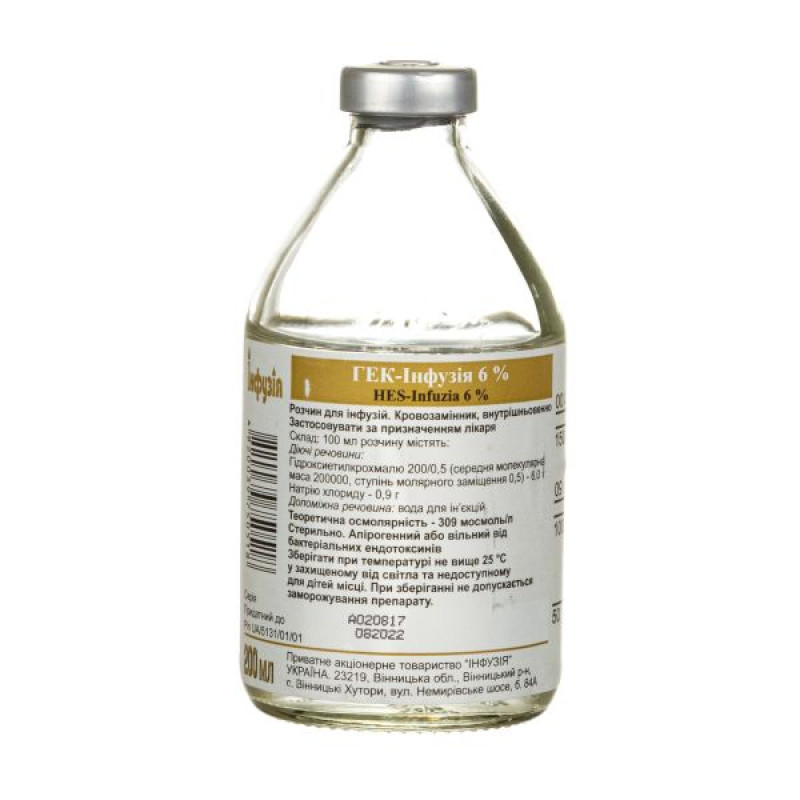
100 ml of solution contain: hydroxyethyl starch 200 / 0.5 (average molecular weight 200,000, degree of molar substitution 0.5) - 6.0 g or 10.0 g, sodium chloride - 0.9 g;
Excipients: water for injections.
Contraindication
Hypersensitivity to the components of the drug; hypervolemia; hyperhydration; hyperchloremia; severe hypernatremia; dehydration, when correction of water and electrolyte balance is required; chronic heart failure; renal failure, patients with renal replacement therapy, severe liver failure; pulmonary edema; intracranial hemorrhages; severe blood clotting disorders; sepsis; burns; critically ill patients due to the risk of kidney damage and death. Contraindicated in patients with transplanted organs.
Method of application
The drug is intended for intravenous drip administration to adults and children from 12 years of age. HEC should be administered in low effective doses for a short period of time. The dose and rate of administration should be set individually depending on the patient's condition, the amount of blood loss and hemodynamic parameters.
The first 10-20 ml of the drug should be administered slowly, carefully monitoring the patient's condition, as the development of anaphylactic reactions is possible.
In the treatment of volume depletion in adults and children from 12 years of age, the maximum daily dose of 6% solution is 33 ml/kg body weight, 10% solution - 20 ml/kg body weight. The maximum infusion rate is up to 20 ml/kg/h, which corresponds to 0.33 ml/kg body weight per minute.
Treatment should be accompanied by continuous monitoring of hemodynamics and should be discontinued immediately after achieving appropriate hemodynamic parameters.
Application features
Pregnant women
The drug is contraindicated in the first trimester of pregnancy, and in the second and third trimesters it should be used only in cases where the expected benefit of treatment for the mother outweighs the possible risk to the fetus.
Children
The drug should be used in children from 12 years of age.
Drivers
There is no data on the effect of the drug on the reaction rate when driving or working with other mechanisms, since the drug should only be used in a hospital setting.
Overdose
Overdose or too rapid administration of the drug may lead to volume overload or hypernatremia, accompanied by peripheral, interstitial or pulmonary edema and acute heart failure. Excessive administration of chloride may lead to hyperchloremic metabolic acidosis.
Treatment: immediate cessation of infusion, use of diuretics.
Side effects
On the part of the immune system: hypersensitivity reactions of varying degrees may occur, in particular anaphylactic reactions (bradycardia, tachycardia, bronchospasm, noncardiac pulmonary edema, urticaria, hypotension, nausea, vomiting). Increased body temperature, chills, edema of the lower extremities, anaphylactic shock, enlargement of the submandibular and parotid salivary glands, mild flu-like symptoms (headache, muscle pain, back pain). On the part of the blood and lymphatic system: a decrease in coagulation factors is possible due to hemodilution as a result of the administration of HEK solutions without parallel administration of blood components. Often, a decrease in hematocrit and plasma protein concentration occurs as a result of hemodilution. Depending on the dose administered, HEK solutions may, due to a decrease in the concentration of coagulation factors, affect blood clotting. Bleeding time and aPTT (Activated Partial Thromboplastin Time) may increase and FVIII/vWFF (Von Willebrand Factor VIII) activity may decrease. Skin and subcutaneous tissue disorders: Itching of the skin, which is difficult to treat and may last for months.
Interaction
When used simultaneously with aminoglycoside antibiotics, the drug may enhance their nephrotoxic effect. To prevent incompatibility, it is not recommended to mix the drug with other drugs. The introduction of hydroxyethyl starch may cause an increase in serum amylase levels.
This effect should not be considered as a violation of pancreatic function, but as a result of the formation of a complex of hydroxyethyl starch with amylase, followed by a delay in its excretion by the kidneys and non-renal pathways.
Storage conditions
Store at a temperature not exceeding 25 °C, protected from light and out of the reach of children.
During storage, the drug must not be frozen.
Shelf life - 5 years.