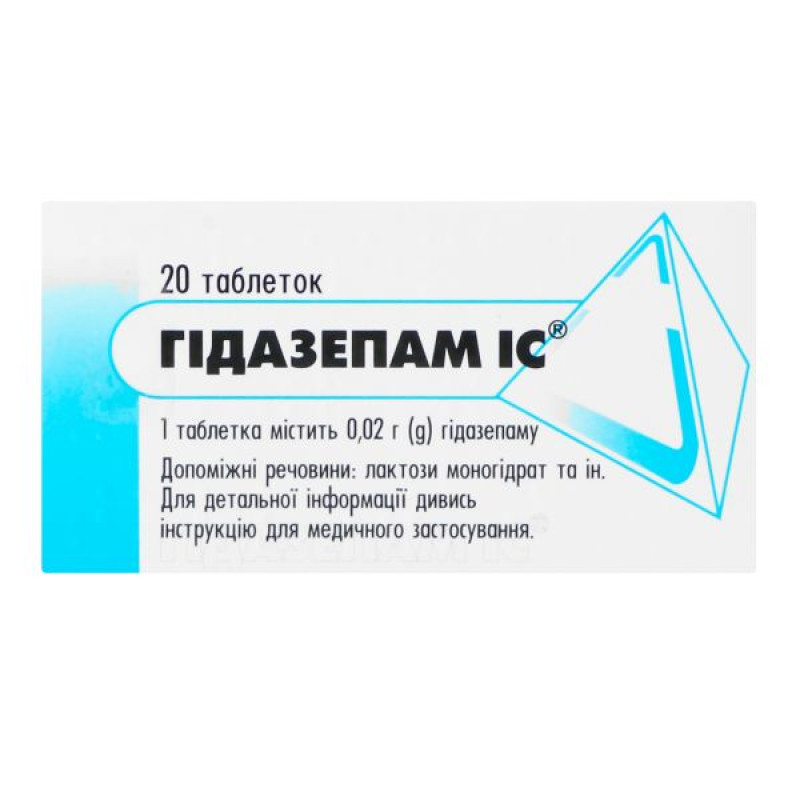
Instructions for use Gidazepam IS tablets 0.02 g blister No. 20
Composition
active ingredient: gidazepam;
1 tablet contains hydazepam 20 mg (0.02 g) or 50 mg (0.05 g);
other ingredients: lactose monohydrate, potato starch, calcium stearate, povidone.
Dosage form
Pills.
Main physicochemical properties: white or white with a cream color, flat-cylindrical tablets, with a bevel; the company's trademark is applied on one surface of the tablet.
Pharmacotherapeutic group
Psycholeptics. Anxiolytics. Benzodiazepine derivatives. ATC code N05B A.
Pharmacological properties
Pharmacodynamics.
Gidazepam belongs to the group of benzodiazepine derivatives. It has an original spectrum of pharmacological activity, combining anxiolytic and activating effects with antidepressant effects with minor side effects and low toxicity. It acts as a daytime tranquilizer and selective anxiolytic. It differs from other benzodiazepines in the presence of a pronounced activating effect, a weakly expressed muscle relaxant effect. In moderate therapeutic doses, it does not have a hypnotic effect and does not accelerate fatigue during operant activity.
In patients with alcoholism during the period of therapeutic remission, mild tranquilizing and anxiolytic effects were observed in the first days of using the drug, psychomotor agitation, anxiety and irritability were significantly reduced. The drug has the greatest effect on the manifestations of the withdrawal syndrome and during the period of remission in patients with alcoholism.
Pharmacokinetics.
When administered orally, gidazepam is rapidly absorbed. After taking single doses, the effect of the drug manifests itself after 30-60 minutes, reaching a maximum within 1-4 hours with subsequent gradual weakening. Gidazepam is distributed most widely in the liver, kidneys and adipose tissue. Bioavailability is quite high. It has been shown that only the dealkylated metabolite is registered in the blood plasma, the unchanged drug is not detected even in trace amounts.
A feature of the pharmacokinetics of hydazepam is the low rate of elimination of its main metabolite after a single dose. The plasma half-life is 86.7 hours, clearance is 3.03 l/h, and the average retention time is 127.32 hours.
The pharmacokinetic characteristics of hydazepam allow it to be used as a tranquilizer with a reduced risk of side effects.
Indication
It is used as a daytime tranquilizer in neurotic, psychopathic asthenia, conditions accompanied by anxiety, fear (including before surgical interventions and painful diagnostic examinations), increased irritability, sleep disturbances, as well as in cases of emotional lability. It is also used to relieve withdrawal syndrome in alcoholism and for maintenance therapy during remission in chronic alcoholism, logoneurosis, migraine.
Contraindication
Hypersensitivity to the components of the drug. Severe myasthenia gravis, significant liver dysfunction (cirrhosis, Botkin's disease) and kidney dysfunction.
Interaction with other medicinal products and other types of interactions
The drug is compatible with other psychotropic, hypnotic and anticonvulsant drugs. Gidazepam potentiates the action of phenamine, 5-hydroxytryptophan, enhances the effect of alcohol, hypnotic drugs, neuroleptics, narcotic analgesics.
Application features
The use of hydazepam should be limited to individuals with open-angle glaucoma, chronic renal failure, and liver failure, as well as alcoholic liver damage.
The drug contains lactose, therefore it should not be administered to patients with rare hereditary forms of galactose intolerance, the Lapp lactase deficiency or glucose-galactose malabsorption syndrome.
Use during pregnancy or breastfeeding
Do not use the drug during pregnancy or breastfeeding.
Ability to influence reaction speed when driving vehicles or other mechanisms
During the treatment period, you should refrain from activities that require increased attention and quick reactions.
Method of administration and doses
The drug is to be used internally.
Take 20-50 mg without chewing up to 3 times a day, if necessary, the dose can be gradually increased to 200 mg/day until a therapeutic effect is obtained. A course dose of 100 mg/day is optimal. The use of higher daily doses (150-200 mg) may be accompanied by increased daytime drowsiness, a feeling of muscle weakness.
As a daytime tranquilizer, Gidazepam IS is recommended for the treatment of conditions with asthenic, depressive, phobic, and hypochondriacal disorders in doses of 60-120 mg/day.
The average daily dose of the drug in the treatment of patients with neurotic, neurosis-like, psychopathic, psychopath-like conditions is 60-200 mg; for migraine - 40-60 mg.
For the relief of alcohol withdrawal, the initial dosage is 50 mg, the average daily dosage is 150 mg. The highest daily dose for alcohol withdrawal is 500 mg.
The duration of the course of therapy ranges from several days to 1-4 months and is determined by the doctor individually, depending on the patient's condition and disease.
The drug can be used in outpatient practice.
The use of the drug is contraindicated in children.
Overdose
Side effects typical of other benzodiazepine tranquilizers may occur, such as drowsiness, lethargy, dizziness, nausea, mild ataxia, allergic reactions. In these cases, the dose of hydazepam should be reduced or discontinued.
Treatment: symptomatic therapy.
Side effects
When using hydazepam in large doses or with increased individual sensitivity, some patients may experience phenomena characteristic of other tranquilizers - benzodiazepine derivatives.
From the nervous system: headache, drowsiness, lethargy, decreased reaction speed, decreased attention and performance, general weakness, dizziness.
Gastrointestinal: nausea.
Cardiovascular system: arterial hypotension.
Musculoskeletal system: muscle weakness.
Skin: rash, itching, skin hyperemia, urticaria.
On the part of the immune system: allergic reactions, including angioedema.
Other: ataxia (a case of ataxia has been reported that coincided with the use of hydazepam).
If adverse reactions occur, the dose should be reduced or the drug should be discontinued.
Expiration date
4 years.
Storage conditions
Store in the original packaging at a temperature not exceeding 25 °C.
Keep out of reach of children.
Packaging
10 tablets in a blister; 1 (for 50 mg dosage) or 2 (for 20 mg dosage) blisters in a pack.
Vacation category
According to the recipe.
Producer
"INTERCHEM" Additional Liability Company.
Address
Ukraine, 65025, Odessa, 21 km. Starokyivska road, 40-A.