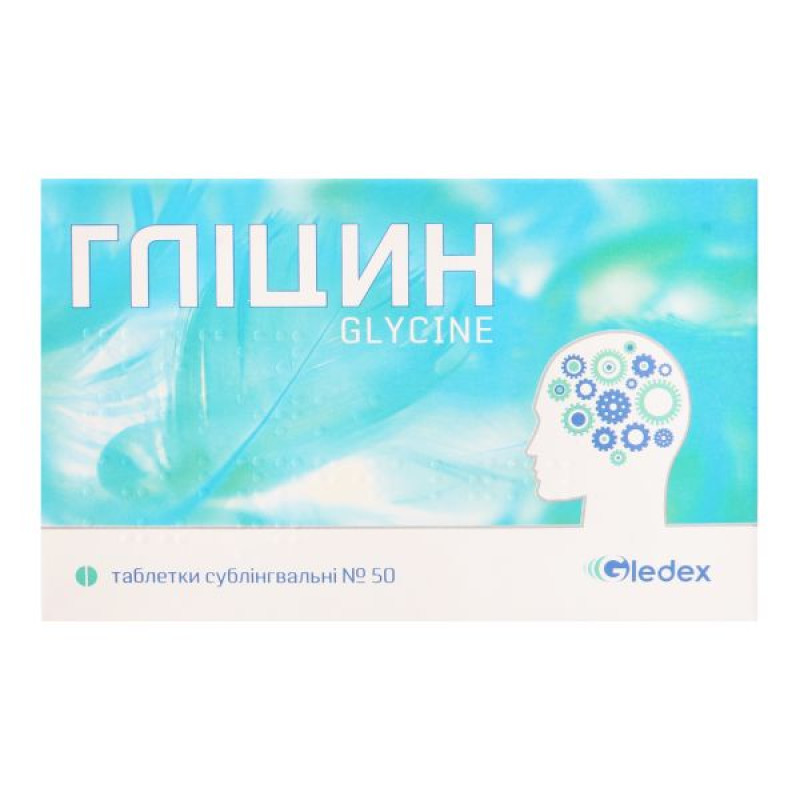
Instructions Glycine sublingual tablets 100 mg No. 50
Composition
active ingredient: Glycine;
1 sublingual tablet contains 100 mg of glycine;
excipients: povidone, montan glycol wax, ammonium methacrylate copolymer (type A), calcium stearate.
Dosage form
Sublingual tablets.
Main physicochemical properties: white tablets with a bevel and a score.
Pharmacotherapeutic group
Drugs that act on the nervous system.
ATX code N07X X.
Pharmacological properties
Pharmacodynamics
Glycine is an essential amino acid. Glycine easily penetrates most biological fluids and tissues of the body, including the brain, is metabolized; its accumulation in tissues does not occur. It is rapidly destroyed in the liver by glycine oxidase to water and carbon dioxide.
Pharmacokinetics
Glycine is a central neurotransmitter that regulates metabolism; normalizes and activates the processes of protective inhibition in the central nervous system. Improves metabolic processes in brain tissues, has an antidepressant and sedative effect. Has glycine and GABA-ergic, alpha1-adrenoblocking, antioxidant, antitoxic effects; regulates the activity of glutamate (NMDA) receptors, thereby reducing psychoemotional stress, aggressiveness and conflict; increases social adaptation, improves mood; facilitates falling asleep and normalizes sleep, increases mental performance, reduces the severity of vegetative-vascular disorders.
L-glycine (glycacol) is involved in the synthesis of the most important substances for the body: nucleic acids, glutathione, bile acids, etc. Glycine is used in the synthesis of porphyrin - the precursor of heme in the hemoglobin molecule, as well as purine bases - the most important elements of nucleic acids. Glycine is part of the structure of glutathione-containing substances, which plays a special role in the anti-radiation protection system.
Glycine participates in detoxification reactions, being included in the composition of hippuric acid, as well as in the synthesis of bile acids (glycocholic acid). In addition, glycine is important for the processes of oxalic acid biosynthesis.
Indication
Decreased mental performance. In stressful situations and psycho-emotional stress (during exams, in conflict situations). Deviant forms of behavior in children and adults.
Functional and organic diseases of the nervous system (neuroses, neurosis-like conditions, vegetative-vascular dystonia, consequences of neuroinfection and craniocerebral trauma, perinatal and other forms of encephalopathy, including alcoholic genesis), which are accompanied by increased excitability, emotional instability, decreased mental performance, and sleep disturbances.
Ischemic stroke and cerebrovascular accident.
As an aid in the treatment of alcoholism.
Contraindication
Individual intolerance to the drug and hypersensitivity to its individual components; arterial hypotension. Children's age up to 3 years.
Special safety measures.
Patients with a tendency to arterial hypotension should monitor blood pressure and, if necessary, adjust the dose of the drug: Glycine is prescribed in lower doses and subject to regular monitoring of blood pressure. If blood pressure indicators are below the normal level, the drug is discontinued.
Interaction with other medicinal products and other types of interactions
Glycine reduces the toxicity of anticonvulsants, antipsychotics, antidepressants, and anticonvulsants. When combined with hypnotics, tranquilizers, and antipsychotics, the inhibitory effect on the central nervous system is enhanced.
Use during pregnancy or breastfeeding
The effect of Glycine on the body during pregnancy or breastfeeding has not been studied in detail, therefore the use of the drug is not recommended.
Ability to influence reaction speed when driving vehicles or other mechanisms
Caution should be exercised when driving or operating machinery, or engaging in potentially hazardous activities.
Method of administration and doses
Glycine is applied transbuccally or sublingually (in tablets in powder form after crushing the tablet).
Children over 3 years of age, adolescents, and adults with reduced mental performance, memory, attention, delayed mental development, psycho-emotional stress, and deviant behavior are prescribed 1 tablet (100 mg) of Glycine 2-3 times a day for 14-30 days.
The maximum daily dose is 300 mg.
Children aged 3 years and older and adults with functional and organic diseases of the nervous system (neuroses, neurosis-like conditions, vegetative-vascular dystonia, consequences of neuroinfection and craniocerebral trauma, perinatal and other forms of encephalopathy) are prescribed 1 tablet 2-3 times a day, the course of treatment is 7-14 days. If necessary, the course of treatment is repeated.
In case of ischemic stroke and cerebral circulation disorders, 1 g of the drug is prescribed transbuccally or sublingually (if necessary, crush the tablet) within the first 3-6 hours from the onset of the stroke, then - for 1-5 days - 1 g per day, then - for 6-30 days - 1-2 tablets 3 times a day.
In the treatment of alcoholism, the drug is prescribed as an adjuvant, 1 tablet 2-3 times a day for 14-30 days. If necessary, the course of treatment is repeated 4-6 times a year.
Children
The drug is used in children aged 3 years and older.
Overdose
There is no information about the clinical manifestations of overdose.
Adverse reactions
In some cases, with individual hypersensitivity, allergic reactions may develop, namely: rhinitis, conjunctivitis, urticaria, throat irritation, weakness.
Expiration date
3 years. Do not use after the expiration date.
Storage conditions
Store in the original packaging out of the reach of children at a temperature not exceeding 25 °C.
Packaging
50 sublingual tablets in a blister. 1 blister in a cardboard box.
Vacation category
Without a prescription.
Producer
LLC "Arpimed".
Location of the manufacturer and its business address
Republic of Armenia, Kotayk region, Abovyan city, 2nd microdistrict, building 19.