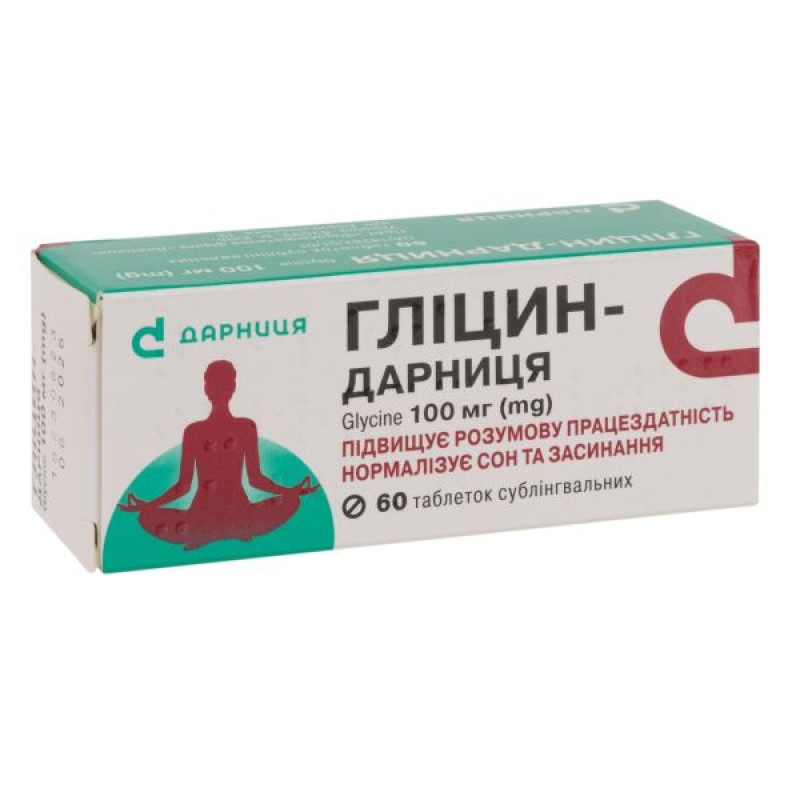
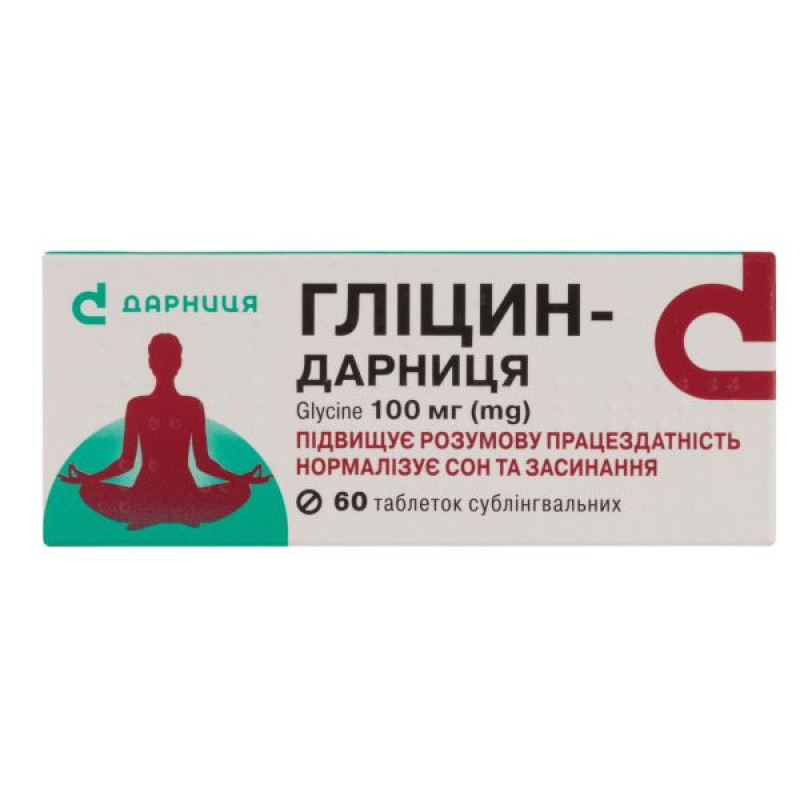
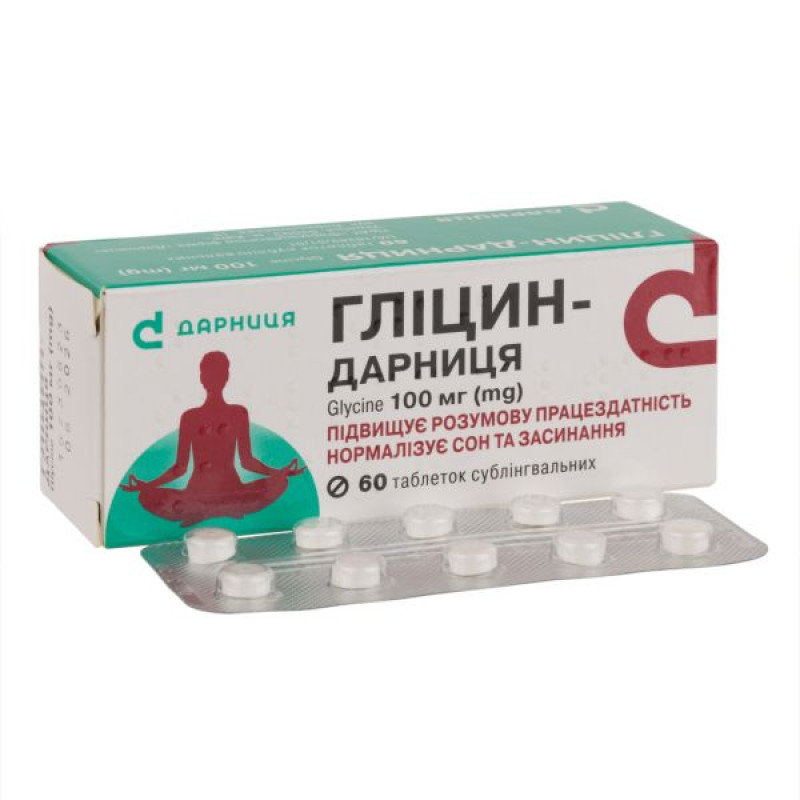
Instructions Glycine sublingual tablets 100 mg No. 60
Composition
active ingredient: glycine;
1 tablet contains glycine (calculated as 100% dry matter) 100 mg;
Excipients: povidone, ammonium methacrylate copolymer dispersion (type A), ammonium methacrylate copolymer dispersion (type B), magnesium stearate.
Dosage form
Sublingual tablets.
Main physicochemical properties: tablets of white or almost white color, flat-cylindrical shape with a bevel and a score.
Pharmacotherapeutic group
Drugs acting on the nervous system. ATX code N07XX.
Pharmacological properties
Pharmacodynamics.
Glycine (aminoacetic acid) has the properties of a metabolic regulator and is a replaceable amino acid (natural metabolite), is a neurotransmitter of inhibitory action and a regulator of metabolic processes in the central nervous system.
The drug has glycine- and GABA-ergic, α-adrenoblocking, antioxidant, antitoxic effects, regulates the activity of glutamate receptors, due to which it is able to:
reduce psycho-emotional stress, aggressiveness, conflict, increase social adaptation;
improve mood;
make it easier to fall asleep and normalize sleep;
increase mental performance;
reduce vegetative-vascular disorders, including during menopause;
reduce the severity of general brain disorders in ischemic stroke and traumatic brain injury;
reduce the toxic effects of alcohol.
The medicine is not habit-forming.
Pharmacokinetics.
Easily penetrates into most biological fluids and tissues of the body, including the brain. Rapidly destroyed in the liver by glycine oxidase to water and carbon dioxide. Glycine does not accumulate in tissues.
Indication
Decreased mental performance.
Stressful situations and psycho-emotional stress (during exams, in conflict situations).
Deviant forms of behavior in children and adults.
Functional and organic diseases of the nervous system (neuroses, neurosis-like conditions, vegetative-vascular dystonia, consequences of neuroinfection, craniocerebral trauma, perinatal and other forms of encephalopathy, including alcoholic genesis), which are accompanied by increased excitability, emotional instability, decreased mental performance, and sleep disturbances.
Ischemic stroke and cerebrovascular accident.
As an aid in the treatment of alcoholism.
Contraindication
Individual intolerance to the drug and hypersensitivity to its individual components; arterial hypotension. Children's age up to 3 years.
Interaction with other medicinal products and other types of interactions
Glycine-Darnitsa reduces the toxicity of anticonvulsants, antipsychotics, antidepressants, and anticonvulsants. When combined with hypnotics, tranquilizers, and antipsychotics, the effect of inhibiting the central nervous system is enhanced.
Application features
In patients with a tendency to arterial hypotension, it is necessary to monitor the level of blood pressure and, if necessary, adjust the dose of the drug. Glycine is prescribed in lower doses and subject to regular monitoring of blood pressure. If it decreases below the normal level, the use of the drug is discontinued.
Use during pregnancy or breastfeeding
The effect of glycine on the body during pregnancy or breastfeeding has not been studied in detail, therefore the use of the drug is not recommended.
Ability to influence reaction speed when driving vehicles or other mechanisms
Caution should be exercised when driving or operating machinery, as well as when engaging in potentially hazardous activities.
Method of administration and doses
The drug is administered transbuccally or sublingually (in tablets or as a powder after crushing the tablet).
Children aged 3 years and older, adolescents, and adults with reduced mental performance, memory, attention, delayed mental development, psycho-emotional stress, and deviant behavior are prescribed 1 tablet (100 mg) of Glycine-Darnitsa 2–3 times a day for 14–30 days.
The maximum daily dose is 300 mg.
Children aged 3 years and older and adults with functional and organic diseases of the nervous system (neuroses, neurosis-like conditions, vegetative-vascular dystonia, consequences of neuroinfection, craniocerebral trauma, perinatal and other forms of encephalopathy, including alcoholic genesis) are prescribed 1 tablet 2–3 times a day, the course of treatment is 7–14 days. If necessary, repeat the course of treatment.
For sleep disorders, 50–100 mg is prescribed 20 minutes before bedtime or immediately before bedtime.
In the treatment of alcoholism, the drug is prescribed as an adjuvant, 1 tablet 2–3 times a day for 14–30 days. If necessary, the course of treatment is repeated 4–6 times a year.
Children.
The medicine is used in children aged 3 years and over.
Overdose
There is no information about the clinical manifestations of overdose.
Side effects
The drug is usually well tolerated. In some cases, with individual hypersensitivity, allergic reactions may develop, including rhinitis, conjunctivitis, rash, itching, urticaria, irritation (itching) in the throat, weakness.
From the gastrointestinal tract, dyspeptic phenomena may develop, including epigastric pain, nausea. From the nervous system, isolated cases of impaired concentration, headache, tension, irritability have been observed.
Expiration date
3 years.
Storage conditions
Store in the original packaging at a temperature not exceeding 25 °C.
Keep out of reach of children.
Packaging
10 tablets in a contour blister pack; 3 or 6 contour blister packs in a pack.
Vacation category
Without a prescription.
Producer
PrJSC "Pharmaceutical Company "Darnitsa".
Address
Ukraine, 02093, Kyiv, Boryspilska St., 13.