Translation of the instructions can be
Griseofulvin tablets 125 mg
Instruction
For medical use of the medicinal product
Composition:
Active ingredient: griseofulvin;
1 tablet contains griseofulvin 125 mg;
excipients: lactose, corn starch, polyethylene glycol, povidone, magnesium stearate.
Dosage form.
Pills.
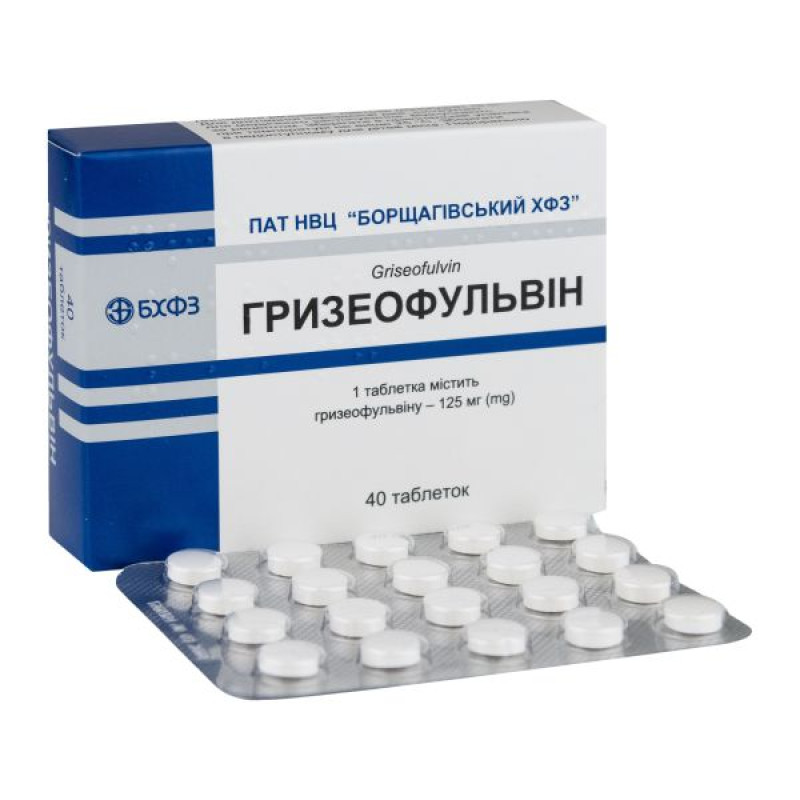
Main physicochemical properties: tablets of white or white with a yellowish tinge, round shape with a biconvex surface. Marbling is allowed on the surface of the tablets.
Pharmacotherapeutic group.
Antifungal drugs for systemic use. ATC code d01b A01.
Pharmacological properties.
Pharmacodynamics.
Griseofulvin is an antibiotic produced by the mold fungus Penicillinum nigricans, a fungistatic agent active against various dermatophytes (Trichophyton, Microsporum, Epidermophyton). The drug inhibits the division of fungal cells in metaphase, disrupting the structure of the mitotic spindle. Griseofulvin accumulates to varying degrees in the cells of the skin, hair, and nails, providing resistance to fungal infection. With the death of the affected keratin, it is replaced by healthy ones.
Pharmacokinetics.
Metabolized in the liver with the formation of the main metabolites: 6-methylgriseofulvin and glucuronide derivative. The half-life is 24 hours. Excreted by the kidneys. Less than 1% is excreted unchanged in the urine, 36% in the feces.
Clinical characteristics.
Indication.
Mycoses of the skin, hair and nails caused by fungi of the genus trichophyton, microsporum, epydermophyton: trichophytosis, favus, microsporia of the scalp and smooth skin, epidermophytosis of the skin (including inguinal epidermophytosis), dermatomycoses of the feet and hands, onychomycoses.
Contraindication.
Hypersensitivity to griseofulvin and other components of the drug; severe leukopenia and systemic blood diseases; severe liver and kidney diseases; porphyria; systemic lupus erythematosus; malignant neoplasms; lactase deficiency, galactosemia, glucose-galactose malabsorption syndrome (the drug contains lactose).
Interaction with other drugs and other types of interactions.
Interaction of griseofulvin with other drugs
Griseofulvin induces cytochrome P450, so it can increase metabolism in the liver and, therefore, weaken the effect of a number of drugs.
Cyclosporine: decreased plasma concentration of cyclosporine; plasma levels should be monitored during treatment with griseofulvin and cyclosporine doses adjusted if necessary.
Methadone: decreased plasma levels of methadone with risk of withdrawal syndrome. Methadone dosing frequency should be increased to 2-3 times daily.
Oral anticoagulants: reduced effect; more frequent monitoring of prothrombin time, international normalized ratio (INR) and dose adjustment of oral anticoagulants is required during treatment with griseofulvin and for 8 days after its discontinuation.
Hormonal contraceptives: reduced contraceptive effectiveness, possible menstrual cycle disorders. For more information, see the section "Special instructions for use".
Estrogens and progestins (non-contraceptive): reduced efficacy due to increased hepatic metabolism. Clinical monitoring of the patient is necessary, and dose adjustment of estrogen or progestin may be necessary during griseofulvin treatment and after its discontinuation.
It is also possible to reduce the effectiveness of oral antidiabetic drugs (control of blood glucose levels with possible dose adjustment of these drugs), theophylline (monitoring of its concentration in the blood with possible dose adjustment).
Interaction of other drugs with griseofulvin
Enzyme inducers (including barbiturates, rifampicin, doxercalciferol, phenylbutazone, primidone, other sedative and hypnotic drugs that induce enzymes) may enhance the metabolism of griseofulvin and reduce its fungistatic activity.
Alcohol: disulfiram-like reactions are possible, manifested by fever, flushing, nausea, vomiting, diarrhea, paresthesia of the extremities. Enhances the effect of ethanol.
Simultaneous use of nicotinamide (vitamin B3), alpha-tocopherol (vitamin E) with griseofulvin increases the concentration of griseofulvin in blood serum and skin.
Impact on laboratory test results
A false-positive result is possible when determining vanillylmandelic acid in urine.
Application features.
Griseofulvin should not be prescribed for prophylactic use, it should not be used to treat mild mycoses, for which the appointment of local antifungal agents is sufficient.
Before starting treatment, it is imperative to identify the type of fungus that caused the disease.
The drug is not effective in candidiasis, bacterial infections, histoplasmosis, actinomycosis, sporotrichosis, chromoblastomycosis, coccidioidomycosis, North American blastomycosis, cryptococcosis (torulosis), lichen, nocardiosis!
Elderly patients are at increased risk of hepatotoxicity (anorexia, nausea, vomiting, fatigue, jaundice, abdominal pain, dark urine, increased activity of hepatic transaminases) due to age-related changes in liver function. Therefore, periodic careful clinical and laboratory monitoring of liver function is necessary.
For better absorption of griseofulvin and to minimize digestive tract disorders, it is advisable to include foods with a high fat content (e.g., milk, ice cream) in the diet. When using the drug, it is recommended to take vitamin supplements: ascorbic acid and B vitamins.
If granulocytopenia develops, treatment with griseofulvin should be discontinued.
Griseofulvin may increase the skin's sensitivity to sunlight, so direct sunlight and artificial ultraviolet radiation should be avoided during treatment.
Griseofulvin can cause serious birth defects in a child when used by women during pregnancy, and also induce chromosomal aberrations in spermatocytes. Since griseofulvin reduces the effectiveness of hormonal contraceptives (oral, parenteral), it is necessary to use additional protective measures (for example, condoms) during treatment. Women should plan pregnancy no earlier than 1 month after the end of the course of treatment; men should not plan future fatherhood during treatment and for 6 months after stopping the drug.
Isolated fatalities have been reported associated with the use of griseofulvin and have been associated with cardiac arrest, spina bifida, multiple birth defects, adrenal insufficiency, primary biliary cirrhosis, systemic lupus erythematosus, and peripheral neuropathy.
During long-term treatment with the drug and/or the use of high doses, it is recommended to regularly monitor the hematopoiesis system, indicators of the functional state of the liver and kidneys.
As with other antibiotics, prolonged treatment with Griseofulvin may lead to increased growth of resistant microflora, in particular fungi, and the development of superinfection, which requires appropriate measures.
To prevent re-infection, it is necessary to disinfect clothes, bedding, underwear, and shoes.
During treatment with griseofulvin, it is necessary to refrain from drinking alcohol!
The drug should not be used in patients with carbohydrate intolerance such as lactase deficiency, galactosemia, glucose-galactose malabsorption syndrome (the drug contains lactose). If you have been told by your doctor that you have an intolerance to some sugars, contact your doctor before taking this medicine.
Use during pregnancy or breastfeeding.
Griseofulvin crosses the placenta. Adequate studies on its safety during pregnancy have not been conducted. Limited data show that griseofulvin has caused serious birth defects when taken by women during pregnancy. The drug is contraindicated during pregnancy. Women of childbearing potential should use effective contraceptive methods during treatment and for 1 month after its discontinuation, and men should use effective contraceptive methods for 6 months after discontinuation of the drug (see section "Special warnings and precautions for use").
It is not known whether griseofulvin passes into breast milk, therefore, if necessary, breastfeeding should be discontinued during treatment.
The ability to influence the reaction speed when driving vehicles or other mechanisms.
The drug may negatively affect the reaction speed when driving or using other mechanisms.
Method of administration and doses.
Take the tablets during or after meals (with 1 teaspoon of vegetable oil).
For microsporia, adults should be prescribed 1 g of griseofulvin per day. It is advisable to divide the daily dose into 2 doses.
The drug should be taken daily until the first negative result of the mycological examination, then at the same dose for 2 weeks every other day and 4 times for the next 2 weeks.
For onychomycosis, trichophytosis, and favus of the scalp, the daily dose of griseofulvin for adults with a body weight of up to 50 kg is 625 mg (5 tablets); for those with a greater weight, an additional 125 mg for every 10 kg should be prescribed.
The treatment period for severe mycoses can last up to 12 months. The course of treatment for lesions of the skin of the body is 2-4 weeks, the scalp - 4-6 weeks, the skin of the feet - 4-8 weeks, fingernails - at least 4 months, toenails - at least 6 months.
The drug should be taken until complete clinical and laboratory recovery.
Children.
The drug should be prescribed to children weighing 25 kg or more at a dose of 10 mg/kg per day, divided into 2 doses.
Overdose.
No cases of griseofulvin overdose have been reported.
Nausea, vomiting, headache, paresthesia, confusion, vertigo, urticaria, porphyria are possible.
Adverse reactions.
Digestive system: dyspepsia, nausea, vomiting, diarrhea, epigastric discomfort/pain, anorexia, changes in taste perception, glossitis.
Skin and subcutaneous tissue: urticaria, skin rashes, including erythematous rashes, photosensitivity reactions; angioedema, erythema nodosum, erythema multiforme, eczema, toxic epidermal necrolysis, Stevens-Johnson syndrome. Alopecia, purpura, acne are possible.
Nervous system and mental disorders: headache, which usually resolves with continued treatment, feeling of fatigue, weakness, dizziness, confusion, sleep disturbances (including drowsiness), irritability, anxiety, agitation, nightmares, depression; peripheral neuropathy (including paresthesias of the extremities), migraine, impaired coordination.
Hematopoietic system: granulocytopenia, leukopenia, neutropenia, thrombocytopenia, anemia, exacerbation of porphyria and systemic lupus erythematosus.
Human anatomical models: dysuria, proteinuria, interstitial nephritis, acute renal failure.
Reproductive system and mammary glands: irregular menstruation, metrorrhagia, erectile dysfunction, miscarriage, unplanned pregnancy.
Hepatobiliary system: possible manifestations of hepatotoxicity, including increased activity of hepatic transaminases, hepatitis, intrahepatic cholestasis.
Cardiovascular system: increased heartbeat, tachycardia, arrhythmia, extrasystole, syncope, cardiomyopathy, hot flashes, vasculitis.
Sense organs: tinnitus, vertigo, conjunctival hemorrhage, conjunctivitis, eye pain.
Respiratory system: shortness of breath, bronchospasm/exacerbation of bronchial asthma, pneumofibrosis.
Other: alcohol intolerance, candidal stomatitis, hyperthermia, chest pain, facial edema; cases of arthropathies, griseofulvin-induced myositis, gout, flu-like syndrome manifested by headache, joint pain, muscle pain, sore throat have been reported.
Serious adverse reactions to griseofulvin are rare and are usually associated with high doses of the drug and/or a long course of treatment.
Expiration date.
4 years.
Storage conditions.
In the original packaging at a temperature not exceeding 25 °C.
Keep out of reach of children.
Packaging.
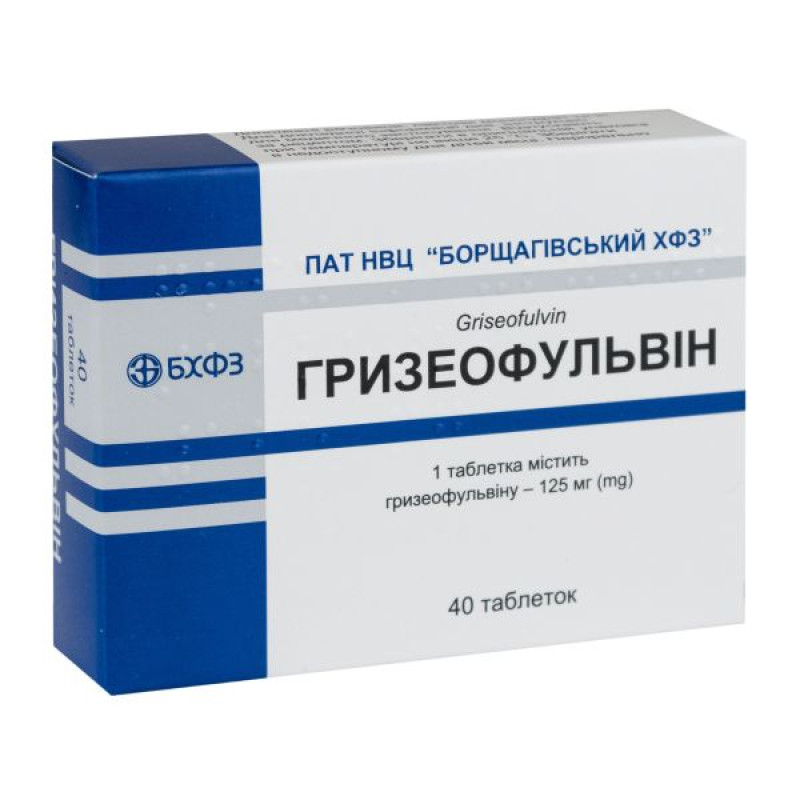
20 tablets in a blister, 2 blisters in a pack.
Vacation category.
According to the recipe.
Producer.
Public Joint Stock Company "Research and Production Center" Borshchagov Chemical and Pharmaceutical Plant ".
Location of the manufacturer and address of the place of business.
Ukraine, 03134, Kyiv, Svit St., 17.