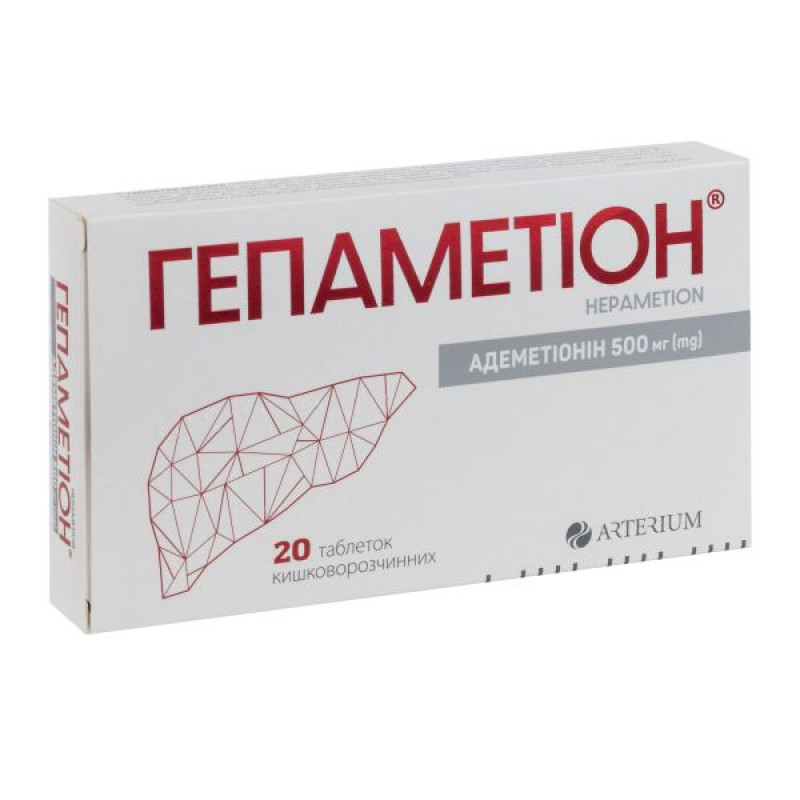
Instructions for use Hepamethion tablets 500 mg No. 20
Composition
active ingredient: ademetionine;
1 tablet contains 949 mg of S-adenosyl-L-methionine 1,4 butanedisulfonate, which corresponds to
500 mg of ademetionine cation;
excipients: microcrystalline cellulose, sodium starch glycolate (type A), colloidal anhydrous silica, magnesium stearate, coating mixture (contains: methacrylate copolymer (type A), talc, titanium dioxide (E 171), colloidal anhydrous silica, sodium bicarbonate, sodium lauryl sulfate, polyethylene glycol (macrogol)).
Dosage form
Enteric-coated tablets.
Main physicochemical properties: film-coated tablets, oval in shape, white to almost white in color.
Pharmacotherapeutic group
Drugs affecting the digestive system and metabolic processes. Amino acids and their derivatives. ATX code A16A A02.
Pharmacological properties
Pharmacodynamics.
Ademethionine, or S-adenosyl-L-methionine, is a derivative of the amino acid methionine. S-adenosyl-L-methionine (ademethionine) is a natural amino acid found in virtually all tissues and body fluids. Ademethionine acts primarily as a coenzyme and methyl group donor in transmethylation reactions, which are essential metabolic processes in humans and animals. The transfer of methyl groups (transmethylation) is also an essential metabolic process in the construction of the phospholipid bilayer in cell membranes and contributes to membrane fluidity. Ademethionine is able to penetrate the blood-brain barrier. The transmethylation process involving ademethionine is key in the formation of neurotransmitters in the central nervous system, including catecholamines (dopamine, noradrenaline, adrenaline), serotonin, melatonin, and histamine.
Ademethionine is also a precursor in the formation of physiological sulfur (thiol) compounds (cysteine, taurine, glutathione, coenzyme A) in transsulfuration reactions. Glutathione, the most powerful antioxidant in the liver, plays an important role in hepatic detoxification. Ademethionine increases hepatic glutathione levels in patients with liver damage of both alcoholic and non-alcoholic genesis. Folic acid (folate) and vitamin B12 are essential co-nutrients in the processes of metabolism and recovery of ademethionine.
Intrahepatic cholestasis
Intrahepatic cholestasis can be a complication of acute and chronic liver diseases and can occur regardless of their etiology. This pathological condition is characterized by a decrease in bile secretion by hepatocytes, which leads to the accumulation in the blood of substances that are usually excreted with bile, including bilirubin, bile salts, and enzymes.
The use of ademetionine allows you to overcome the blocking of metabolism (conversion of methionine to ademetionine) caused by a decrease in the activity of the ademetionine synthetase enzyme. Thus, the physiological mechanisms that prevent the occurrence of cholestasis are restored. Through various experimental studies, it was found that the anticholestatic effect of ademetionine is provided by: 1) restoration of the microfluidity of cytoplasmic membranes through ademetionine-dependent synthesis of membrane phospholipids (reduction of the cholesterol/phospholipid ratio) and 2) overcoming the metabolic blocking of the transsulfuration process and, accordingly, restoration of the synthesis of thiol groups that participate in endogenous detoxification processes.
Pharmacokinetics.
Absorption. In humans, after intravenous administration, the pharmacokinetic profile of ademetionine is biexponential and consists of a phase of rapid, pronounced distribution in tissues and a phase of terminal elimination with a half-life of approximately 1.5 hours. Absorption after intramuscular administration is almost complete (96%), the maximum plasma concentration is reached approximately 45 minutes after administration. After oral administration of enteric-coated ademetionine tablets, the maximum plasma concentration is dose-dependent, is 0.5-1 mg/l and is reached 3-5 hours after taking a single dose of 400 mg to 1000 mg. Plasma concentration decreases to the initial value within 24 hours. Bioavailability after oral administration increases if ademetionine is used between meals. When administered orally, the tablets are absorbed in the intestinal tract and significantly increase the plasma concentration of ademetionine. Animal studies using isotopic methods have confirmed that oral administration of ademetionine stimulates the formation of methylated compounds in the liver. It has also been confirmed that the absorption of ademetionine by the body occurs through typical metabolic pathways characteristic of an endogenous compound (transmethylation, transsulfuration, decarboxylation).
Metabolism. The reactions that produce, utilize, and regenerate ademethionine are called the ademethionine cycle. In the first step of this cycle, ademethionine-dependent methylases use ademethionine as a substrate to produce S-adenosyl-homocysteine, which is then hydrolyzed to homocysteine and adenosine by S-adenosyl-homocysteine hydrolase. Homocysteine, in turn, undergoes reverse transformation to methionine by transfer of a methyl group from 5-methyltetrahydrofolate. Ultimately, methionine can be converted to ademethionine, completing the cycle.
Excretion: In radioisotope studies with oral administration of radiolabeled (methyl 14C) ademetionine in healthy volunteers, urinary excretion of radioactive material was 15.5 ± 1.5% after 48 hours and faecal excretion was 23.5 ± 3.5% after 72 hours, with approximately 60% of the material remaining incorporated in stable pools.
Indication
– Intrahepatic cholestasis in adults, including patients with chronic hepatitis of various etiologies and cirrhosis of the liver;
– intrahepatic cholestasis in pregnant women.
Contraindication
Hypersensitivity to the active substance or to any of the excipients of the drug (see section "Composition").
Genetic defects affecting the methionine cycle and/or causing homocystinuria and/or hyperhomocysteinemia (e.g. cystathionine beta synthase deficiency, vitamin B12 metabolism defect).
Interaction with other medicinal products and other types of interactions
Serotonin syndrome has been reported in a patient taking ademetionine while taking clomipramine. Therefore, although the possibility of an interaction is theoretically possible, caution should be exercised when using ademetionine concomitantly with selective serotonin reuptake inhibitors (SSRIs), tricyclic antidepressants (such as clomipramine), and drugs and herbal remedies containing tryptophan (see section 4.4).
Application features
Ammonia levels should be monitored in patients with pre-cirrhotic or cirrhotic hyperammonemia who are taking ademetionine tablets.
Since vitamin B12 and folic acid (folate) deficiency may lead to decreased ademetionine concentrations, patients at risk (anemia, liver disease, pregnancy, or the possibility of vitamin deficiency due to other diseases or dietary habits such as veganism) should have regular blood tests to check plasma levels of these substances. If deficiency is detected, treatment with vitamin B12 and/or folic acid (folate) is recommended before or during the use of ademetionine. If these studies cannot be performed, patients at risk are recommended to use vitamin B12 and/or folic acid (folate) in accordance with the instructions for medical use of these drugs (see section "Pharmacological properties. Pharmacokinetics. Metabolism").
This drug is not indicated for the treatment of depressive disorders, but may be used to treat intrahepatic cholestasis in patients with depressive disorders. Therefore, the following precautions should be considered for patients receiving antidepressant therapy.
Ademetionine is not recommended for use in patients with bipolar psychosis. There have been reports of patients transitioning from depression to hypomania or mania while treated with ademetionine.
There has been one published report of serotonin syndrome in a patient taking ademetionine while taking clomipramine. Although the possibility of an interaction is theoretically possible, caution should be exercised when ademetionine is used concomitantly with SSRIs, tricyclic antidepressants (such as clomipramine), and drugs and herbal remedies containing tryptophan (see section 4.5).
Patients with depression are generally at risk of suicide or other serious acts and should receive close monitoring and ongoing psychiatric care during treatment with antidepressants to ensure that symptoms of depression are appropriately identified and treated. Patients with a history of suicidal behavior or thoughts, or who demonstrate a significant degree of suicidal ideation, are at increased risk of suicidal thoughts or attempts and should receive careful monitoring during treatment.
There have been reports of transient onset or increased anxiety in patients taking ademetionine. In most cases, discontinuation of therapy was not necessary. Sometimes, anxiety resolved after dose reduction or discontinuation of therapy.
Impact on homocysteine immunoassay
Ademetionine interferes with the immunoassay for homocysteine, which may falsely indicate elevated plasma homocysteine levels in patients taking ademetionine. Therefore, non-immunological methods for determining plasma homocysteine levels are recommended for such patients.
Hepatic impairment: Pharmacokinetic characteristics do not differ between healthy volunteers and patients with chronic liver disease.
Elderly patients.
Clinical studies of ademetionine did not include sufficient numbers of patients aged 65 years and over to determine whether there is a difference in response to treatment compared with younger patients. Based on available clinical experience, no differences in response to treatment have been identified between elderly patients and younger patients. In general, dose selection for elderly patients should be made with caution, usually starting at the lowest recommended dose, taking into account the increased frequency of decreased hepatic, renal, or cardiac function, the presence of concomitant pathological conditions, and the use of other drugs.
Excipients
This medicinal product contains 1.92 mg (0.08 mmol) sodium per tablet, i.e. essentially sodium-free.
Use during pregnancy or breastfeeding
In clinical studies, no adverse reactions were observed in women treated with ademetionine during the third trimester of pregnancy. Ademetionine should be used only if clearly needed during the first two trimesters of pregnancy.
During breastfeeding, ademetionine is used only when the expected benefit from its use outweighs the potential risk to the infant.
Ability to influence reaction speed when driving vehicles or other mechanisms
Some patients may experience dizziness when taking ademetionine. Patients should refrain from driving or operating other machinery until they are certain that ademetionine therapy does not affect their ability to perform these activities.
Method of administration and doses
Treatment can begin with parenteral administration of the drug (use the drug Gepamethion® in the form of a lyophilized powder for injection solution complete with a solvent) with subsequent use of the drug in tablet form or immediately with the use of tablets. The daily dose of tablets can be divided into 2–3 doses.
The tablets should be swallowed whole, without chewing. The tablets of the drug Gepamethion® are coated with a special coating that dissolves only in the intestine, due to which ademetionine is released in the duodenum. For better absorption of the active substance and for the full therapeutic effect, the tablets should be taken between meals.
The Hepamethion® tablet should be removed from the blister immediately before taking it. If the tablets are any color other than white to yellowish (due to a violation of the integrity of the aluminum wrapper), it is recommended to refrain from using them.
Initial therapy
Oral: The recommended dose is 10–25 mg/kg body weight per day. The usual starting dose is 800 mg/day, the total daily dose should not exceed 1600 mg.
Supportive therapy
Administer orally 800–1600 mg/day.
The individual initial and maintenance dose should be determined by the doctor depending on body weight and severity of the disease, as well as taking into account the available dosages of the drug in circulation.
The duration of therapy depends on the severity and course of the disease and is determined by the doctor individually.
Children
The safety and effectiveness of ademetionine in children have not been established.
Overdose
Cases of overdose with ademetionine have been observed rarely. In case of overdose, physicians should contact local poison control centers. In general, patient monitoring and supportive treatment are recommended.
Adverse reactions
Ademetionine was used in clinical trials in approximately 2000 patients. The most commonly reported adverse reactions during treatment with ademetionine were headache, diarrhea, and nausea.
The following adverse reactions have been reported with the following frequencies in clinical trials with ademetionine (n=1922) and in spontaneous reports. Adverse reactions are classified by system organ class (MedDRA) and frequency: very common (≥ 1/10), common (≥ 1/100, < 1/10), uncommon (≥ 1/1000, < 1/100), rare (≥ 1/10000, < 1/1000), very rare (< 1/10000).
Gastrointestinal: common - abdominal pain, diarrhea, nausea; uncommon - dry mouth, dyspepsia, flatulence, gastrointestinal pain, gastrointestinal bleeding, gastrointestinal disorders, vomiting, esophagitis; rare - abdominal bloating.
General disorders and administration site conditions: common: asthenia; uncommon: edema, hyperthermia, chills*, injection site reactions*1, injection site necrosis*1; rare: malaise.
Immune system disorders: Uncommon: hypersensitivity*, anaphylactoid reactions* or anaphylactic reactions (e.g. flushing, dyspnoea, bronchospasm, back pain, chest discomfort, changes in blood pressure (hypotension, hypertension) or pulse rate (tachycardia, bradycardia))*.
Infections and infestations: uncommon – urinary tract infections.
Musculoskeletal and connective tissue disorders: uncommon – arthralgia, muscle cramps.
Psychiatric disorders: common – anxiety, insomnia; uncommon – agitation, confusion.
Respiratory, thoracic and mediastinal disorders: uncommon – laryngeal edema*.
Skin and subcutaneous tissue disorders: common: pruritus; uncommon: hyperhidrosis, angioedema*, allergic skin reactions (e.g. rash, pruritus, urticaria, erythema)*.
Vascular disorders: uncommon – hot flashes, hypotension, phlebitis.
There have been rare reports of suicidal thoughts/behavior in patients with depressive disorders (see section 4.4).
*Adverse reactions from spontaneous reports, which are more commonly known from spontaneous reports or which were not observed in clinical trials, are classified as “uncommon” because the upper limit of the 95% confidence interval for the expected frequency does not exceed 3/X, where X=1922 (total number of volunteers in clinical trials).
1Applies to the injectable form of the drug.
Expiration date
3 years.
Storage conditions
Store in the original packaging at a temperature not exceeding 25 °C.
Packaging
10 tablets in a blister. 2 blisters in a pack.
Vacation category
According to the recipe.
Producer
PJSC "Kyivmedpreparat", Ukraine.
Location of the manufacturer and address of its place of business
Ukraine, 01032, Kyiv, Saksaganskoho St., 139.