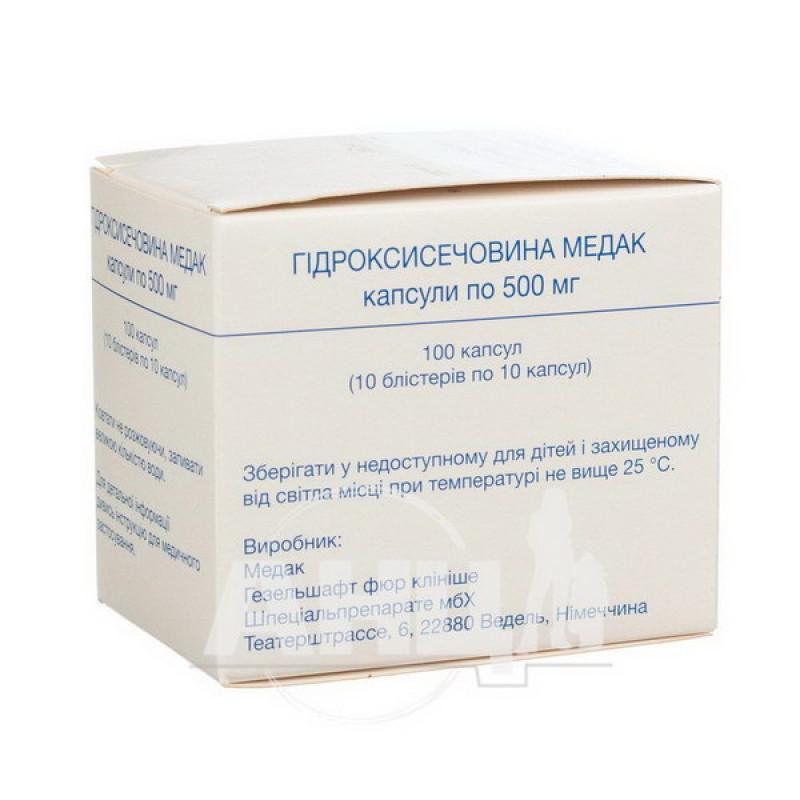
Instructions for use Hydroxyurea Medak capsules 500 mg No. 100
Composition
active ingredient: hydroxycarbamide (hydroxyurea);
1 capsule contains 500 mg of hydroxycarbamide (hydroxyurea);
excipients: lactose monohydrate; calcium citrate; sodium citrate; magnesium stearate;
capsule shell: gelatin, titanium dioxide (E 171).
Dosage form
Capsules.
Main physicochemical properties: opaque white gelatin capsules containing an almost white powder.
Pharmacotherapeutic group
Other antineoplastic agents. ATX code L01X X05.
Pharmacological properties
Pharmacodynamics
The exact mechanism of the drug's antitumor action is not clear, but it is believed to be associated with blocking the ribonucleotide reductase complex, which causes inhibition of DNA synthesis. Cellular resistance is usually due to increased levels of ribonucleotide reductase as a result of gene amplification.
Pharmacokinetics
Pharmacokinetic information is limited. The drug is well absorbed from the gastrointestinal tract, bioavailability is complete. The maximum concentration in the blood serum is reached 0.5-2 hours after administration.
Hydroxycarbamide penetrates the blood-brain barrier.
The metabolism of hydroxycarbamide in humans has not been studied in detail.
Hydroxyurea is partially excreted by the kidneys. The half-life of the drug is 3-4 hours. From 9 to 95% of the drug is excreted from the body in the urine.
Indication
Treatment of patients with chronic myeloid leukemia (CML) in the chronic or progressive stage of the disease.
Treatment of patients with essential thrombocythemia or polycythemia at high risk of thromboembolic complications.
Contraindication
Hypersensitivity to the active substance or to any other component of the drug. If hypersensitivity is detected during treatment, the drug should be discontinued.
Depressed bone marrow function (leukocyte count less than 2.5 ´ 109/l, platelet count less than 100 ´ 109/l) or severe anemia.
Interaction with other medicinal products and other types of interactions
An in vitro study demonstrated the ability of hydroxycarbamide to enhance the cytotoxic effect of ara-C and fluoropyrimidines.
Hydroxyurea may enhance the antiretroviral activity of reverse transcriptase inhibitors such as didanosine and stavudine. Hydroxyurea inhibits HIV DNA synthesis and HIV replication by reducing the number of intracellular deoxynucleotides. Hydroxyurea may also enhance the potential side effects of reverse transcriptase inhibitors such as hepatotoxicity, pancreatitis, and peripheral neuropathy.
Studies have shown that there is analytical interference of hydroxycarbamide with enzymes (urease, uricase, and lactate dehydrogenase) used to determine urea, uric acid, and lactic acid, leading to false-positive results in patients receiving hydroxycarbamide.
Vaccination.
There is an increased risk of serious, fatal infections with concomitant use of live vaccines. Live vaccines are not recommended for immunocompromised patients.
Application features
During treatment with the drug, it is necessary to check blood parameters, as well as kidney and liver function. Experience in treating patients with impaired kidney or liver function is limited. Therefore, treatment of such patients is carried out with caution and under constant supervision, especially at the beginning of treatment.
Hydroxycarbamide can cause bone marrow suppression, most commonly manifested by leukopenia, and (less commonly) thrombocytopenia and anemia.
Complete blood count, including determination of hemoglobin, total leukocyte count, differential platelet count should be performed on a regular basis, and also after establishing an individual optimal dose. The frequency of monitoring is determined individually, but the normal period is weekly. If the leukocyte count in the blood decreases to a level of less than 2.5 ´ 109/l or platelets to a level of less than 100 ´ 109/l, treatment should be discontinued until their content returns to normal.
If you miss a dose, the next dose should be taken after consulting a doctor.
If anemia occurs before or during treatment, red blood cells may be replaced. Transient megaloblastic erythropoiesis is often observed at the beginning of hydroxycarbamide therapy. The morphological change resembles pernicious anemia but is not associated with vitamin B12 or folic acid deficiency.
When using the drug, it is necessary to consume a sufficiently large amount of fluid.
Skin cancer has been reported in patients receiving long-term hydroxyurea therapy. Patients should be advised to protect their skin from sun exposure. In addition, patients should perform self-examination of their skin during and after discontinuation of hydroxyurea therapy and be screened for secondary malignancies at routine check-ups.
Hydroxyurea can induce the development of painful leg ulcers, which are usually difficult to heal and require discontinuation of hydroxyurea treatment. After discontinuation of treatment, the ulcers gradually heal over several weeks.
Cutaneous toxic vasculitis, including vasculitic ulcers and gangrene, has been reported in patients with myeloproliferative disorders treated with hydroxycarbamide. The risk of toxic vasculitis is increased in patients receiving or who have received interferon in the past. The digital localization of these vasculitic ulcers and the progressive clinical course of peripheral vascular insufficiency leading to digital infarction or gangrene are clearly different from the typical skin ulcers commonly described with hydroxycarbamide. Because of the potentially serious clinical consequences of cutaneous vasculitic ulcers in patients with myeloproliferative disorders, hydroxycarbamide should be discontinued and alternative cytoreductive agents should be administered if vasculitic ulcers develop.
Interstitial lung disease, including pulmonary fibrosis, pulmonary infiltration, pneumonitis, and alveolitis/allergic alveolitis, has been reported in patients treated for myeloproliferative neoplasms and may be associated with fatalities. Patients with fever, cough, dyspnea, or other respiratory symptoms should be carefully evaluated, investigated, and treated.
If pulmonary complications occur, immediately discontinue hydroxyurea and initiate corticosteroid treatment.
Hydroxycarbamide may be genotoxic. Men should use reliable contraception during therapy and for 3 months after completion of therapy. They should be informed about the possibility of sperm conservation before starting therapy.
Patients with rare hereditary problems of galactose intolerance, the Lapp lactase deficiency or glucose-galactose malabsorption should not take this medicine.
Elderly patients may be more sensitive to the effects of hydroxyurea and may require a reduced dose.
Hydroxycarbamide should be administered with caution to patients who are receiving or have previously received concomitant radiation or cytotoxic therapy. In these cases, patients are at increased risk of bone marrow depression, gastric irritation and mucositis. In addition, exacerbation of erythema caused by previous or concomitant radiation may occur.
Vaccination Concomitant use of Hydroxyurea medak with a live antiviral vaccine may potentiate the replication of the vaccine virus and/or may increase some of the adverse reactions of the vaccine virus, since normal defense mechanisms may be suppressed by hydroxycarbamide. Vaccination with a live vaccine in patients receiving Hydroxyurea medak may result in serious infection. The patient's humoral immune response to the vaccine may be reduced. The use of live vaccines should be avoided during treatment and for at least 6 months after the end of treatment.
Hydroxyurea medak contains lactose, if the patient has been diagnosed with intolerance to some sugars, you should consult your doctor before taking this medicine.
This medicinal product contains 1 mmol (or 23 mg) sodium per dose. Caution should be exercised when administering this medicinal product to patients on a controlled sodium diet.
Use during pregnancy or breastfeeding
Pregnancy
Hydroxyurea may be a potent mutagenic agent. Animal studies have shown an increased incidence of birth defects. Hydroxyurea should not be used in pregnant women unless the clinical condition of the woman requires treatment with hydroxycarbamide. Hydroxyurea should not be prescribed to pregnant or breastfeeding women unless the benefits outweigh the risks. Women of childbearing potential should use contraceptive precautions before and during treatment with the drug.
If pregnancy occurs during treatment, the patient should be offered genetic counseling. Hydroxycarbamide crosses the placenta.
Breastfeeding period
Since hydroxycarbamide is excreted in breast milk, breastfeeding should be discontinued before starting treatment.
Fertility
Hydroxycarbamide may be genotoxic, therefore genetic counseling is recommended for patients planning to become pregnant after hydroxycarbamide therapy.
Men should use reliable contraception during therapy and for 3 months after completion of therapy. They should be informed about the possibility of sperm conservation before starting treatment.
Ability to influence reaction speed when driving vehicles or other mechanisms
The reaction rate may be impaired during the use of hydroxyurea. This should be taken into account when increased attention is required, for example, when driving vehicles and working with other mechanisms.
Method of administration and doses
Capsules should be swallowed whole, without chewing.
Therapy should be administered by a physician experienced in oncology and hematology. All dosing regimens should be based on the patient's actual or ideal body weight (whichever is lower).
Treatment of chronic myeloid leukemia. Hydroxyurea is usually prescribed at an initial dose of 40 mg/kg body weight per day, taking into account the level of white blood cells in the blood. The dose should be halved (20 mg/kg per day) if the white blood cell level falls below 20 × 109/l. The dosage is then adjusted individually to maintain the white blood cell count at 5-10 × 109/l. The dose of hydroxyurea should be reduced if the white blood cell count is less than 5 × 10⁹/l and should be increased if the white blood cell count is greater than 10 × 109/l.
If the leukocyte count falls below 2.5 × 10⁹/L or the platelet count falls below 100 × 109/L, therapy should be discontinued until blood counts return to normal.
The sufficient period to achieve antineoplastic effect is 6 weeks. In case of disease progression, the drug should be discontinued immediately. If an appropriate therapeutic effect is observed, treatment is continued indefinitely.
Treatment of essential thrombocythemia. The initial dose of hydroxyurea is 15 mg/kg/day, adjusted to maintain a platelet count of 600 × 109/L, while ensuring that the white blood cell count is not lower than 4 × 10⁹/L.
Treatment of polycythemia. Hydroxyurea is initially prescribed at a dose of 15-20 mg/kg/day. The dosage is then adjusted individually to maintain the hematocrit below 45% and platelets below 400 × 109/L. In most patients, this is achieved by continuous administration of hydroxyurea at a dose of 500-1000 mg daily.
If hematocrit and platelet count are successfully controlled, therapy should be continued indefinitely.
Children: Because these conditions are rare in children, the dosage regimen for children has not been studied.
Elderly: Elderly patients may be more sensitive to the effects of hydroxyurea and may require a lower dose.
Patients with renal and hepatic impairment: Insufficient information is available. No dosage regimen recommendations can be made for this patient group.
Children
The safety and efficacy of treatment with the drug in this category of patients have not been established.
Overdose
Patients who used the drug in doses several times higher than the usual recommended doses experienced acute pathologies of the skin and mucous membranes, namely: irritation, purple erythema, swelling of the palms and soles with subsequent peeling of the skin of the hands and feet, intense generalized skin hyperpigmentation, and stomatitis.
Immediate treatment is required, which includes gastric lavage followed by supportive therapy and monitoring of the hematopoietic system.
Side effects
Bone marrow suppression is the dose-limiting toxicity. Gastrointestinal adverse reactions are common but rarely require dose reduction or discontinuation of treatment.
Adverse reactions are divided into the following categories according to frequency of occurrence:
very common (≥ 1/10); common (≥ 1/100 to < 1/10); uncommon (≥ 1/1000 to < 1/100); rare (≥ 1/10,000 to < 1/1000); isolated (< 1/10,000); frequency unknown (cannot be estimated from the available data).
| From the side of the hematopoietic and lymphatic systems | Common: bone marrow depression, leukopenia, megaloblastosis. Uncommon: thrombocytopenia, anemia. |
| On the part of the immune system | Rare: hypersensitivity reactions. |
| Metabolic and nutritional disorders | Uncommon: anorexia. Rare: tumor lysis syndrome. Not known: hyperkalemia. |
| From the psyche | Rare: hallucinations. |
| From the nervous system | Uncommon: peripheral neuropathy1. Rare: neurological disorders including headache, dizziness, disorientation, seizures. |
| Respiratory, thoracic and mediastinal disorders | Rare: acute pulmonary disorders including diffuse pulmonary infiltration, fever, dyspnoea, allergic alveolitis. Rare: pulmonary fibrosis. Not known: Interstitial lung disease |
| Gastrointestinal tract | Common: diarrhea, constipation. Uncommon: pancreatitis1, nausea, vomiting, stomatitis. |
| Hepatobiliary system | Uncommon: hepatotoxicity1, increased liver enzymes and blood bilirubin. |
| Skin and subcutaneous tissue disorders | Common: skin ulcers (especially shin ulcers). Uncommon: maculopapular rash, facial erythema, acral erythema, actinic keratosis, skin cancer (squamous cell carcinoma, basal cell carcinoma). Rare: dermatomyositis-like skin changes, cutaneous and systemic lupus erythematosus, skin hyperpigmentation, skin atrophy, nail pigmentation, nail atrophy, itching, purple papules, desquamation, cutaneous vasculitis, gangrene. |
| Kidney and urinary tract disorders | Uncommon: transient renal tubular dysfunction accompanied by increased blood uric acid, increased blood urea and increased blood creatinine. Uncommon: dysuria. Rare: renal failure. |
| Genital and mammary glands | Very common: azoospermia, oligospermia. |
| General violations | Uncommon: fever on medication, chills, malaise. |
1 Cases of pancreatitis and hepatotoxicity (sometimes fatal), as well as severe peripheral neuropathy, have been reported in HIV-infected patients receiving hydroxycarbamide in combination with antiretroviral drugs, including didanosine in combination with stavudine.
Benign, malignant and unspecified neoplasms (including cysts and polyps).
Patients receiving long-term treatment with hydroxycarbamide for myeloproliferative disorders such as polycythemia vera and thrombocythemia vera may develop secondary leukemia. The extent to which this is related to the underlying disease or to the hydroxycarbamide treatment is currently unknown.
On the part of the hematopoietic and lymphatic systems.
Megaloblastic erythropoiesis may occur during treatment with hydroxycarbamide, which is not responsive to therapy with folic acid or vitamin B12.
Bone marrow suppression resolves with discontinuation of therapy.
The drug may also reduce iron clearance from plasma and reduce the efficiency of iron utilization by erythrocytes, but this does not affect the lifespan of erythrocytes.
Metabolism and eating disorders.
Cases of hyponatremia have been identified during post-marketing surveillance.
From the nervous system.
High doses of the drug may cause moderate drowsiness.
Gastrointestinal disorders.
Severe gastrointestinal disorders (anorexia, nausea, vomiting) caused by the combination of drug intake and radiation can usually be controlled by temporarily stopping the drug.
On the skin and subcutaneous tissue.
Hydroxyurea may increase inflammation of the mucous membranes after irradiation. This may lead to the re-occurrence of erythema and hyperpigmentation in previously irradiated tissues.
Patients who have received radiation therapy in the past may experience exacerbation of post-radiation erythema.
Erythema, skin and nail atrophy, desquamation, purple papules, alopecia, dermatomyositis-like skin changes, actinic keratosis, skin cancer (squamous cell carcinoma, basal cell carcinoma), cutaneous toxic vasculitides including vasculitic ulcers (especially leg ulcers) and gangrene, pruritus, hyperpigmentation of the skin and nails have been reported in isolated cases after many years of daily maintenance therapy with hydroxyurea.
Other effects.
Pain or discomfort due to inflammation of the mucous membranes at the site of irradiation (mucositis) can usually be controlled with local anaesthetics or oral analgesics. If the reaction is severe, treatment with the drug should be temporarily discontinued; if the effect is exceptionally severe, temporary discontinuation of radiotherapy may also be necessary. However, the need to discontinue both forms of treatment has only been observed in rare cases.
Use of the drug in combination with radiation therapy.
Side effects observed with combined treatment with the drug and radiation are similar to those described with monotherapy with the drug: mainly - bone marrow suppression (anemia and leukopenia) and irritation of the stomach walls. In the case of simultaneous use of the drug with radiation therapy, leukopenia was observed in almost all patients. Sometimes (and only in the presence of severe leukopenia) a decrease in the platelet count to values less than 100 ´ 109/l was noted. During treatment with the drug, some side reactions that occur during radiation therapy, such as impaired gastric function and mucositis, may be exacerbated.
Reporting of expected adverse reactions.
Reporting of expected adverse reactions after registration of a medicinal product is of great importance. This allows for continued monitoring of the benefit/risk ratio of the medicinal product. Reports of adverse reactions from healthcare professionals are received in accordance with the current legislation on the circulation of medicinal products in Ukraine.
Expiration date
4 years.
Storage conditions
Store out of the reach of children and protected from light at a temperature not exceeding 25 °C.
Packaging
10 capsules in blisters made of aluminum foil and PVC film; 10 blisters in a cardboard box.
Vacation category
According to the recipe.
Producer
Medak Gesellschaft für Klinike Spetsialpreparate mbH, Germany.
Location of the manufacturer and address of its place of business
Theaterstrasse 6, 22880 Wedel, Germany.