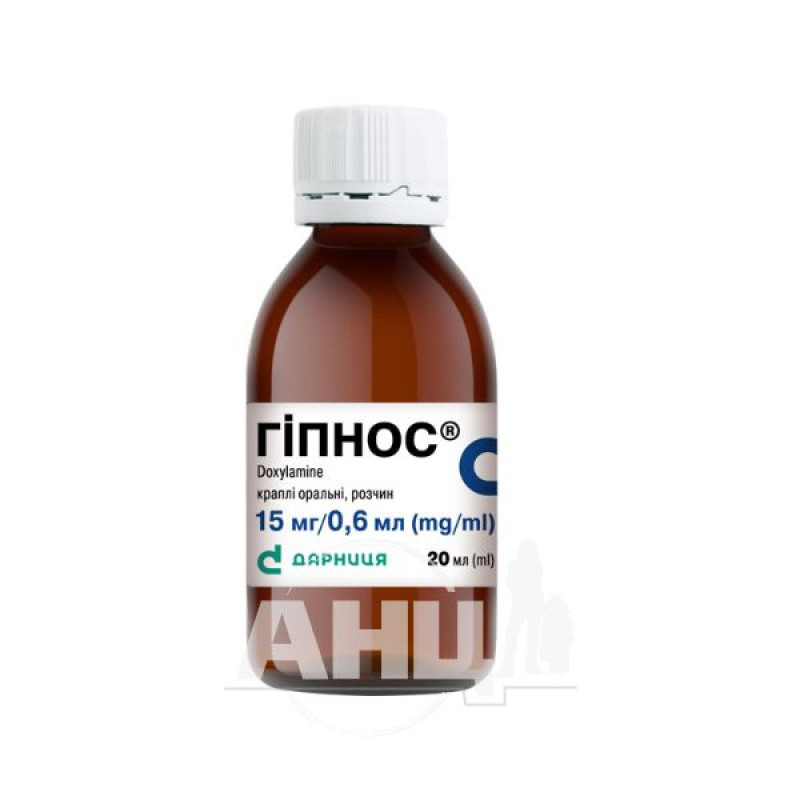
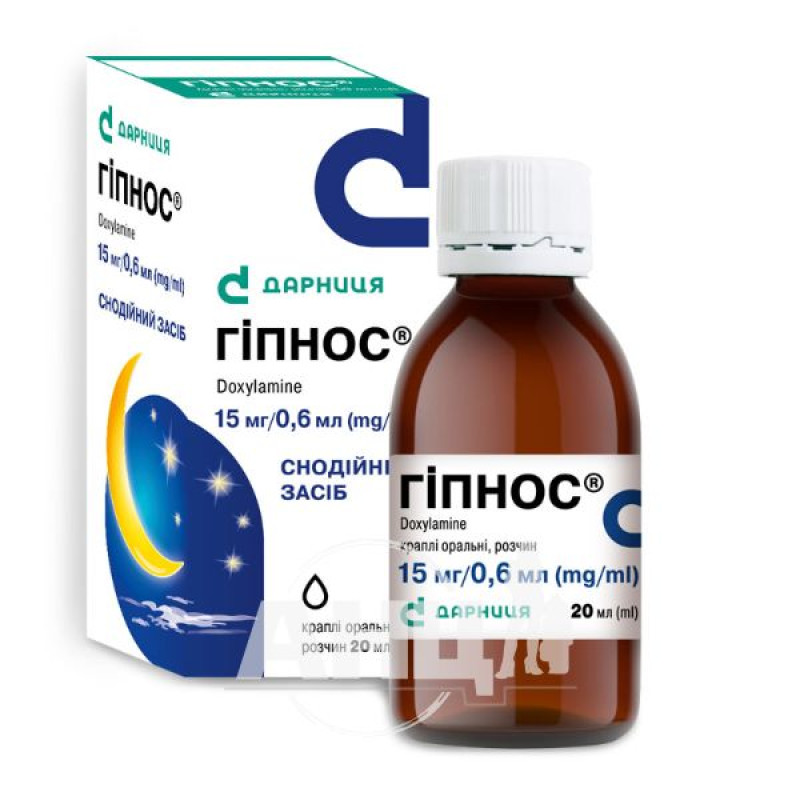
Instructions Hypnos drops 50 ml
Composition
active ingredient: doxylamine;
0.6 ml (13 drops) contains doxylamine succinate 15 mg;
Excipients: ethanol 96%, peppermint oil, purified water.
Dosage form
Oral drops, solution.
Main physicochemical properties: clear colorless liquid with a specific odor.
Pharmacotherapeutic group
Hypnotics and sedatives. Other hypnotics and sedatives. ATX code N05C M.
Antihistamines for systemic use. Doxylamine. ATX code R06A A09.
Pharmacological properties
Pharmacodynamics.
Doxylamine succinate is an ethanolamine class H1-histamine receptor blocker that exhibits sedative and atropine-like effects. It has been shown to reduce the time it takes to fall asleep and improve the duration and quality of sleep.
Pharmacokinetics.
The maximum concentration in blood plasma (Cmax) is reached on average 1 hour (Tmax) after taking doxylamine succinate.
The mean plasma elimination half-life (T½) is on average 10 hours.
Doxylamine succinate is partially metabolized in the liver by demethylation and N-acetylation. The various metabolites formed during the breakdown of the molecule are not quantitatively significant, since 60% of the administered dose is found in the urine as unchanged doxylamine.
Indication
Intermittent insomnia in adults.
Contraindication
Hypersensitivity to doxylamine succinate or to excipients or to other antihistamines.
Acute angle-closure glaucoma in the patient's history or in the family history.
Uretroprostatic disorders with risk of urinary retention.
Interaction with other medicinal products and other types of interactions
Combinations to avoid
Alcohol enhances the sedative effect of most H1 antihistamines. Alcoholic beverages and medications containing ethanol should be avoided.
It is also necessary to avoid the use of a drug with sodium oxybutyrate due to increased central nervous system depression. Impaired reaction speed may lead to danger when driving vehicles and working with other mechanisms.
Combinations to consider
With atropine and atropine-like drugs (imipramine antidepressants, most atropine-like H1-antihistamines, anticholinergic antiparkinsonian drugs, atropine antispasmodics, disopyramide, phenothiazine neuroleptics, and clozapine) due to the occurrence of such adverse reactions as urinary retention, constipation, and dry mouth.
With other sedative drugs (morphine derivatives (painkillers, drugs used for cough treatment and substitution therapy), neuroleptics; barbiturates, benzodiazepines; anxiolytics other than benzodiazepines (meprobamate); other hypnotics, sedative antidepressants (amitriptyline, doxepin, mianserin, mirtazapine, trimipramine); sedative H1-antihistamines; centrally acting antihypertensives; others: baclofen, thalidomide) due to increased depression of the central nervous system. Impaired reaction speed may lead to danger when driving vehicles and working with other mechanisms.
With other hypnotics due to central nervous system depression.
Application features
Insomnia can have various causes that do not necessarily require medication, so it is recommended to consult a doctor before starting to use this medication.
Like all hypnotics or sedatives, doxylamine succinate may exacerbate sleep apnea syndrome (increased number and duration of breathing stops).
The risk of abuse and drug dependence is low. However, cases of abuse resulting in drug dependence have been reported. It is necessary to carefully monitor for signs of abuse or drug dependence. The duration of treatment should not exceed 5 days. The drug is not recommended for use in patients with a history of substance use disorders.
Doxylamine succinate remains in the body for approximately 5 half-lives (see Pharmacokinetics).
The half-life may be significantly longer in the elderly or in those with renal or hepatic impairment. With repeated administration, the drug or its metabolites reach steady state much later and at higher levels. The efficacy and safety of the drug can only be assessed after steady state is achieved.
Dose adjustment may be required (see section "Method of administration and dosage").
Elderly patients with renal or hepatic insufficiency have an increased plasma concentration of the drug and a decreased plasma clearance. It is recommended to reduce the dose of the drug.
To prevent drowsiness during the day, it is necessary to remember that the duration of sleep after taking the medicine should be at least 7 hours.
Important information about excipients
This medicinal product contains 55 vol. % ethanol (ethyl alcohol), which is 135 mg/270 mg/540 mg of ethyl alcohol per dose of the medicinal product (equivalent to 3.28 ml/6.56 ml/13.12 ml of beer or 1.36 ml/2.73 ml/5.46 ml of wine). The medicinal product may be dangerous for people suffering from alcoholism. The ethyl alcohol content should be taken into account by pregnant and breastfeeding women, patients in risk groups, e.g. with liver disease or epilepsy.
Use during pregnancy or breastfeeding
Pregnancy
Based on the available data, doxylamine can be used during pregnancy after consultation with a doctor. If this drug is used at the end of pregnancy, the atropine-like and sedative properties of this molecule should be taken into account when monitoring the newborn.
Breastfeeding period
It is not known whether doxylamine passes into breast milk, therefore it is not recommended to use the drug during breastfeeding.
Ability to influence reaction speed when driving vehicles or other mechanisms
It is necessary to pay attention to the risk of daytime drowsiness, especially when using the drug and alcohol simultaneously (see section "Interaction with other medicinal products and other types of interactions") in people who drive vehicles or work with other mechanisms. In cases of insufficient sleep duration, the risk of impaired reaction speed increases. Therefore, driving a car, working with other mechanisms and other potentially dangerous activities should be avoided at least during the first phase of treatment.
Method of administration and doses
For oral use. Take 15–30 minutes before bedtime.
The recommended dose is 7.5–15 mg (7–13 drops) per day. If necessary, the dose can be increased to 30 mg (26 drops) per day. The drops should be taken with sufficient liquid, approximately ½ glass of water.
Elderly patients and patients with renal or hepatic insufficiency are recommended to reduce the dose.
The duration of the treatment course is 2–5 days.
If insomnia persists for longer than 5 days, you should consult a doctor regarding the appropriateness of further use of the drug.
Children.
The medicine should not be used in children under 18 years of age.
Overdose
The first signs of acute poisoning are drowsiness and signs of anticholinergic effects: agitation, dilated pupils, paralysis of accommodation, dry mouth, flushing of the face and neck, hyperthermia, sinus tachycardia. Delirium, hallucinations and athetotic movements are more common in children, sometimes they are precursors of seizures - rare complications of massive poisoning or even coma. Even if seizures do not occur, acute doxylamine poisoning sometimes causes rhabdomyolysis, which can be complicated by acute renal failure. This muscle disorder is common, requiring systematic screening by measuring creatine phosphokinase activity.
Treatment is symptomatic. Early initiation of treatment is recommended with activated charcoal (50 g for adults, 1 g/kg for children).
Side effects
Anticholinergic effects: constipation, urinary retention, dry mouth, visual disturbances (accommodation disorders, blurred vision, hallucinations, visual defect), palpitations, confusion.
Daytime drowsiness: if this effect develops, the dose should be reduced.
Cases of abuse and drug dependence have been reported.
In addition, H1-antihistamine drugs are known to cause sedation, cognitive impairment, and psychomotor impairment.
Reporting of suspected adverse reactions
Reporting suspected adverse reactions after the marketing authorisation of a medicinal product is an important procedure. It allows for continued monitoring of the benefit-risk balance of the medicinal product in question. Healthcare professionals should report any suspected adverse reactions via the national reporting system.
Expiration date
3 years.
After opening the bottle – 6 months.
Storage conditions
Store in original packaging at a temperature not exceeding 25 ° C. Keep out of the reach of children.
Packaging
5 ml or 20 ml or 50 ml in a dropper bottle; 1 dropper bottle in a pack.
Vacation category
According to the recipe.
Producer
PrJSC "Pharmaceutical Company "Darnitsa".
Location of the manufacturer and address of its place of business.
Ukraine, 02093, Kyiv, Boryspilska St., 13.