shell: quinoline yellow (E 104), titanium dioxide (E 171), methylparaben (E 218), propylparaben (E 219), sodium lauryl sulfate, purified water, gelatin;
cap: FD&C green No. 3, titanium dioxide (E 171), methylparaben (E 218), propylparaben (E 219), sodium lauryl sulfate, purified water, gelatin.
Dosage form
Capsules.
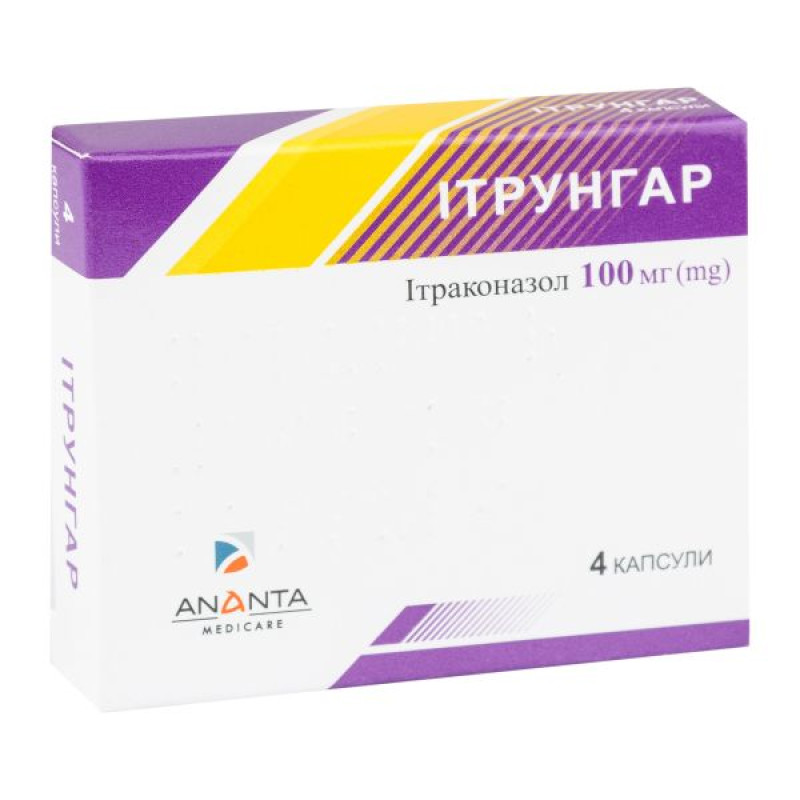
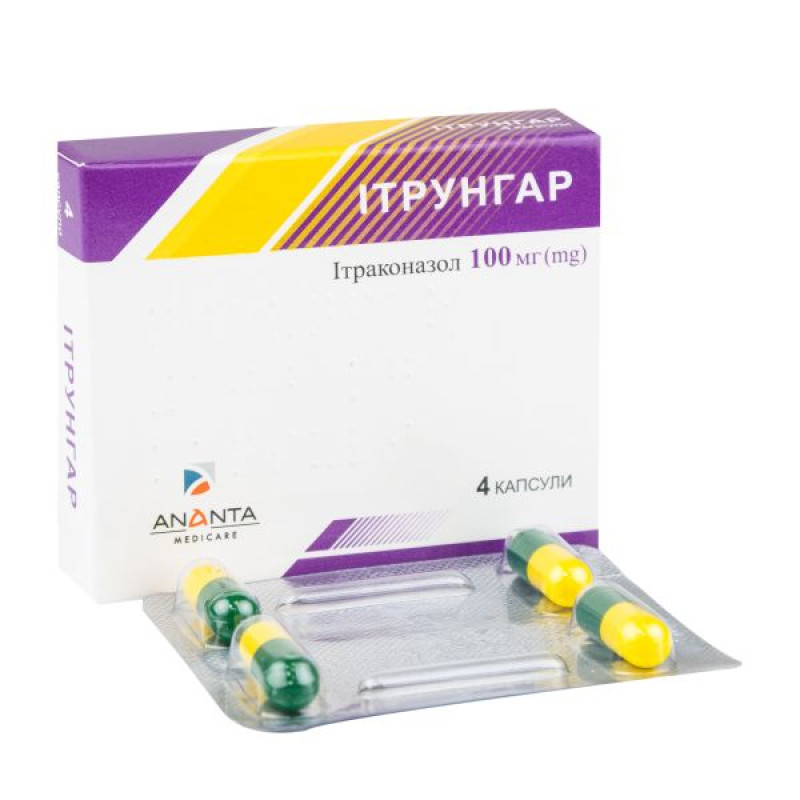
Main physicochemical properties: hard gelatin capsules with a yellow body and a green cap or vice versa (size 0); capsule contents are white to gray pellets.
Pharmacotherapeutic group
Antifungal agents for systemic use. Triazole and tetrazole derivatives. Itraconazole. ATC code J02A C02.
Pharmacological properties
Pharmacodynamics.
Itraconazole is a triazole derivative with a broad spectrum of activity. In vitro studies have shown that itraconazole inhibits the synthesis of ergosterol in fungal cells. Ergosterol is an important component of the fungal cell membrane, and inhibition of its synthesis provides an antifungal effect.
For itraconazole, breakpoints have only been established for Candida spp. In the case of superficial mycotic infections (CLSI M27-A2, breakpoints have not been established according to EUCAST methodology). CLSI breakpoints: susceptible ≤0.125; susceptible dose-dependent 0.25–0.5 and resistant ≥1 μg/ml. Breakpoints have not been established for mycelial fungi.
In vitro studies have shown that itraconazole inhibits the growth of a wide range of fungi pathogenic to humans at concentrations usually ≤1 μg/ml. These include: dermatophytes (Trichophyton spp., Microsporum spp., Epidermophyton floccosum); yeasts (Candida spp., including C. albicans, C. tropicalis, C. parapsilosis and C. krusei, Cryptococcus neoformans, Malassezia spp., Trichosporon spp., Geotrichum spp.), Aspergillus spp.; Histoplasma spp., including H. capsulatum; Paracoccidioides brasiliensis; Sporothrix schenckii; Fonsecaea spp.; Cladosporium spp.; Blastomyces dermatitidis; Coccidiodes immitis; Pseudallescheria boydii; Penicillium marneffei and other species of yeasts and fungi.
Candida krusei, Candida glabrata, and Candida tropicalis are generally the least susceptible Candida species, and some isolates demonstrate resistance to itraconazole in vitro.
The main types of fungi that are not inhibited by itraconazole are zygomycetes (Rhizopus spp., Rhizomucor spp., Mucor spp. and Absidia spp.), Fusarium spp., Scedosporium proliferans and Scopulariopsis spp.
Resistance to azoles develops slowly and is usually the result of multiple genetic mutations. Mechanisms described include overexpression of ERG11, which encodes 14α-demethylase (the target enzyme), point mutations in ERG11 that result in reduced affinity of 14α-demethylase for itraconazole, and/or overexpression of a transporter that results in increased efflux of itraconazole from fungal cells (i.e., removal of itraconazole from its target). Cross-resistance among azoles has been observed within Candida species, but resistance to one member of the class does not necessarily imply resistance to other azoles. Itraconazole-resistant strains of Aspergillus fumigatus have been reported.
Pharmacokinetics.
General pharmacokinetic characteristics.
Peak plasma concentrations of itraconazole are reached within 2 to 5 hours after oral administration. Due to nonlinear pharmacokinetics, itraconazole accumulates in plasma after multiple administration. Steady-state concentrations are generally reached within 15 days with Cmax values of 0.5 μg/ml, 1.1 μg/ml and 2.0 μg/ml after 100 mg once daily, 200 mg once daily and 200 mg twice daily, respectively. The terminal half-life of itraconazole varies from 16 to 28 hours after a single dose and increases to 34–42 hours after multiple doses. After discontinuation of treatment, itraconazole concentrations decline to levels that are almost undetectable in plasma within 7–14 days, depending on the dose and duration of treatment. The mean plasma clearance of itraconazole after intravenous administration is 278 ml/min. Due to saturable hepatic metabolism, clearance of itraconazole decreases at higher doses.
Absorption.
The absorption of itraconazole capsules is reduced in patients with reduced gastric acidity, patients taking drugs that suppress gastric acid secretion (H2-receptor antagonists, proton pump inhibitors), or in patients with achlorhydria caused by certain diseases (see sections "Special instructions for use" and "Interaction with other medicinal products and other types of interaction"). Absorption of itraconazole on an empty stomach in such patients is increased if Itrungar capsules are used with drinks with increased acidity (e.g. non-diet cola). When a single dose of 200 mg of the drug Itrungar on an empty stomach with non-diet cola was used after the use of ranitidine, an H2-receptor antagonist, the absorption of itraconazole was comparable to that after the use of Itrungar capsules alone.
The concentration of itraconazole after administration in the capsule dosage form is lower than after administration of the oral solution at the same dose (see section "Special instructions for use").
Distribution.
Itraconazole is largely bound to plasma proteins (99.8%), albumin being the main binding component (99.6% for the hydroxymetabolite). It also has a high affinity for lipids. Only 0.2% of itraconazole in the blood remains unbound. The apparent volume of distribution of itraconazole is quite large (> 700 l), suggesting its wide distribution in tissues: concentrations in the lungs, kidneys, liver, bones, stomach, spleen and muscles were 2–3 times higher than those in plasma. The accumulation of itraconazole in keratinous tissues, especially in the skin, was 4 times higher than that in plasma. The concentration in cerebrospinal fluid is much lower than in plasma, but efficacy against infections localized in the cerebrospinal fluid has been demonstrated.
Biotransformation.
Itraconazole is extensively metabolized in the liver to a large number of metabolites. In vitro studies indicate that CYP3A4 is the major enzyme involved in the metabolism of itraconazole. The major metabolite is hydroxyitraconazole, which has comparable antifungal activity to itraconazole in vitro. Plasma concentrations of hydroxyitraconazole are approximately 2-fold higher than those of itraconazole.
Breeding.
Approximately 35% of itraconazole is excreted as inactive metabolites in the urine and approximately 54% in the feces within 1 week of a dose of oral solution. Renal excretion of itraconazole and the active metabolite hydroxyitraconazole after intravenous administration is less than 1% of the dose. Fecal excretion of unchanged drug varies from 3 to 18%.
Special categories of patients.
Liver failure.
Itraconazole is primarily metabolized in the liver. A pharmacokinetic study using a single dose of 100 mg itraconazole (1 capsule of 100 mg) was conducted in 6 healthy subjects and 12 cirrhotic subjects. A statistically significant decrease in mean Cmax (47%) and a 2-fold increase in the half-life of itraconazole (37±17 vs. 16±5 hours) were found in cirrhotic subjects compared to healthy subjects. Although total itraconazole concentrations, based on AUC, were comparable in both groups.
There are no data available on the long-term use of itraconazole in patients with cirrhosis.
Kidney failure.
Data on the use of oral itraconazole in patients with renal impairment are limited. A pharmacokinetic study using a single dose of 200 mg itraconazole (4 capsules of 50 mg) was conducted in 3 groups of patients with renal impairment (uremia: n=7, hemodialysis: n=7, chronic ambulatory peritoneal dialysis: n=5). In uremic patients with a mean creatinine clearance of 13 ml/min × 1.73 m2, the AUC-based concentration was slightly lower compared to healthy volunteers. This study did not demonstrate any significant effect of hemodialysis or chronic ambulatory peritoneal dialysis on the pharmacokinetics of itraconazole (Tmax, Cmax, AUC0-8h). Plasma concentration-time profiles showed significant intersubject variability in all 3 groups.
After a single intravenous dose, the mean terminal half-life values in patients with mild (CrCl 50–79 mL/min), moderate (CrCl 20–49 mL/min), and severe (CrCl <20 mL/min) renal impairment were similar to those in healthy volunteers (range 42–49 hours vs. 48 hours in renally impaired patients and healthy volunteers, respectively). Total itraconazole concentrations based on AUC were reduced in patients with moderate and severe renal impairment (by 30% and 40%, respectively) compared to healthy volunteers.
There are no data available on the long-term use of itraconazole in patients with renal impairment. Dialysis has no effect on the half-life or clearance of itraconazole or hydroxyitraconazole.
Data on the use of oral itraconazole in children are limited. Clinical pharmacokinetic studies in children and adolescents aged 5 months to 17 years were conducted with itraconazole capsules, oral solution, and intravenous solution. Individual doses with the capsules and oral solution ranged from 1.5 to 12.5 mg/kg/day, administered once or twice daily. A single intravenous dose of 2.5 mg/kg was administered as an infusion or 2.5 mg/kg as infusions once or twice daily. There was no significant age-related relationship between itraconazole AUC and total clearance, but there was a weak relationship between patient age, volume of distribution, Cmax, and terminal elimination of itraconazole. Apparent clearance and volume of distribution were dependent on patient weight.
Indication
Vulvovaginal candidiasis;
lichen planus;
dermatophytosis caused by itraconazole-sensitive pathogens (Trichophyton spp., Microsporum spp., Epidermophyton floccosum), e.g. tinea pedis, inguinal tinea, tinea corporis, tinea corporis of the hands;
oropharyngeal candidiasis;
onychomycoses caused by dermatophytes and/or yeasts;
histoplasmosis;
systemic mycoses (in cases where first-line antifungal therapy cannot be used or in case of ineffectiveness of treatment with other antifungal drugs, which may be due to the existing pathology, insensitivity of the pathogen or toxicity of the drug):
aspergillosis and candidiasis;
Cryptococcosis (including cryptococcal meningitis): treatment of immunocompromised patients with cryptococcosis and all patients with cryptococcosis of the central nervous system;
maintenance therapy in patients with AIDS to prevent recurrence of an existing fungal infection.
Itrungar is also prescribed for the prevention of fungal infections in patients with prolonged neutropenia in cases where standard therapy is insufficient.
Contraindication
The drug is contraindicated in patients with hypersensitivity to the active substance or to any of the excipients.
Concomitant use of the drug and CYP3A4 substrates is contraindicated (see sections “Interaction with other medicinal products and other types of interactions” and “Special precautions for use”). These include:
Antibacterials for systemic use; antimycobacterials; antimycotic agents for systemic use
Isavuconazole
Anthelmintics; antiprotozoals
Halofantrine
Antihistamines for systemic use
Astemizole
Mizolastine
Terfenadine
Antineoplastic agents
Irinotecan
Venetoclax (in patients with chronic lymphocytic leukemia during the venetoclax initiation and dose titration phase)
Antiplatelet agents
Dabigatran
Ticagrelor
Antiviral agents for systemic use
Ombitasvir/paritaprevir/ritonavir (with or without dasabuvir)
Cardiovascular system (agents acting on the renin-angiotensin system; antihypertensives; beta-blockers; calcium channel blockers; cardiotherapy; diuretics)
Aliskiren
Eplerenone
Quinidine
Bepridil
Finerenone
Ranolazine
Disopyramide
Ivabradine
Sildenafil
(pulmonary hypertension)
Dofetilide
Lercanidipine
Dronedarone
Nisoldipine
Gastrointestinal agents, including antidiarrheals, intestinal anti-inflammatory/anti-infectives; antiemetics and antinausea agents; laxatives; agents used in functional gastrointestinal disorders
Cisapride
Domperidone
Naloxegol
Lipid-regulating drugs
Lovastatin
Lomitapide
Simvastatin
Psychoanaleptics; psycholeptics (e.g. antipsychotics, anxiolytics and hypnotics)
Lurasidone
Pimozide
Sertindole
Midazolam (oral)
Quetiapine
Triazolam
Medications that affect the urinary system
Avanafil
Darifenacin
Solifenacin
(in patients with severe renal insufficiency or moderate to severe hepatic insufficiency)
Dapoxetine
Fesoterodine
(in patients with moderate or severe renal or hepatic impairment)
Vardenafil
(in patients aged 75 years and over)
Other medicines and substances
Colchicine (in patients with renal or hepatic impairment)
Eliglustat (in patients who are CYP2D6 poor metabolizers (PM), CYP2D6 intermediate metabolizers (CM), or extensive metabolizers (EM) taking a strong or moderate CYP2D6 inhibitor)
The drug is contraindicated in patients with ventricular dysfunction, such as congestive heart failure, or a history of congestive heart failure, except for the treatment of life-threatening or other serious infections (see section "Special warnings and precautions for use").
The drug should not be used during pregnancy, except for the treatment of conditions that threaten the life of the mother (see section "Use during pregnancy or breastfeeding").
Women of reproductive age should use reliable contraception during the entire course of treatment with itraconazole, as well as until the end of the menstrual cycle after the end of treatment.
Interaction with other medicinal products and other types of interactions
Itraconazole is primarily metabolized by cytochrome CYP3A4. Other drugs that are metabolized by this pathway or modify CYP3A4 activity may affect the pharmacokinetics of itraconazole. Itraconazole is a potent inhibitor of CYP3A4, a P-glycoprotein inhibitor, and an inhibitor of breast cancer resistance protein (BCRP).
Itraconazole may alter the pharmacokinetics of other substances that share a common metabolic or protein transport pathway.
Examples of drugs that may affect itraconazole plasma concentrations are listed by drug class in Table 1 below.
Examples of drugs whose plasma concentrations may be affected by itraconazole are listed in Table 2 below. Potential changes in safety or efficacy of interacting drugs are not considered. For further information, please refer to the appropriate Summary of Product Characteristics for the drug.
The combinations of itraconazole with the drugs described in Tables 1 and 2 are classified as contraindicated, not recommended or should be used with caution, taking into account the degree of increase in concentration and the safety profile of the interacting drug (see also sections “Contraindications” and “Special Instructions for Use”). The potential for interaction of the listed drugs was assessed based on pharmacokinetic data from human pharmacokinetic studies with itraconazole or other strong CYP3A4 inhibitors (e.g. ketoconazole) and/or in vitro data:
"Contraindicated": Under no circumstances should the drug be used simultaneously with itraconazole and within two weeks after stopping treatment with itraconazole.
"Not recommended": The use of these drugs concomitantly and within 2 weeks of stopping itraconazole treatment should be avoided unless the benefit of treatment outweighs the potential risk of adverse reactions. If concomitant use cannot be avoided, clinical monitoring for signs or symptoms of increased or prolonged effects of the pharmacological effect of the concomitant drug is recommended, and its dose should be reduced or discontinued if necessary. If necessary, it is recommended to measure the plasma concentration of the concomitant drug.
"Use with caution": Close monitoring is recommended when co-administered with itraconazole. During co-administration, it is recommended to closely monitor patients for signs or symptoms of increased or prolonged effects of the pharmacological effect of the co-administered drug and to reduce its dose if necessary. If necessary, it is recommended to measure the plasma concentration of the co-administered drug.
The interactions listed in these tables have been characterized in studies conducted with recommended doses of itraconazole. However, the extent of the interaction may depend on the dose of itraconazole administered. Stronger interactions may occur with higher doses or shorter dosing intervals. Extrapolation of the results to other dosing regimens or other drugs should be done with caution.
After discontinuation of treatment, itraconazole plasma concentrations decline to the limit of quantification within 7–14 days, depending on the dose and duration of treatment. In patients with cirrhosis of the liver or in patients receiving concomitant CYP3A4 inhibitors, the decline in plasma concentrations may be more gradual. This is especially true for drugs whose metabolism is affected by itraconazole (see section 5.2).
Table 1
Drugs that may affect itraconazole plasma concentrations
Drugs (oral single dose unless otherwise specified) within the class
Expected/potential effect on itraconazole levels:
↑ increase
↔ unchanged
↓ decrease
Clinical commentary (for additional information, see above, as well as the sections "Contraindications" and "Peculiarities of use")
Antibacterials for systemic use; antimycobacterials
Isoniazid
Although isoniazid has not been studied directly, it is likely to reduce the concentration of itraconazole.
Not recommended
Rifampicin orally 600 mg once daily
Itraconazole AUC ↓
Not recommended
Rifabutin orally 300 mg once daily
Itraconazole Cmax ↓ 71%, AUC ↓ 74%
Not recommended
Ciprofloxacin orally 500 mg twice daily
Itraconazole Cmax ↑ 53%, AUC ↑ 82%
Use with caution.
Erythromycin 1 g
Use with caution.
Clarithromycin orally 500 mg twice daily
Itraconazole Cmax ↑ 90%, AUC ↑ 92%
Use with caution.
Antiepileptic drugs
Carbamazepine, phenobarbital
Although these drugs have not been studied directly, they are likely to reduce itraconazole concentrations.
Not recommended
Phenytoin orally 300 mg once daily
Itraconazole Cmax ↓ 83%, AUC ↓ 93%
Hydroxyitraconazole Cmax ↓ 84%, AUC ↓ 95%
Not recommended
Antineoplastic agents
Idelalisib
Although idelalisib has not been studied directly, it is likely to increase the concentration of itraconazole.
Use with caution.
Antiviral agents for systemic use
Ombitasvir/paritaprevir/ritonavir (with or without dasabuvir)
Although these drugs have not been studied directly, they are expected to increase itraconazole concentrations.
Although itraconazole has not been studied directly, it may increase the concentrations of these drugs.
Contraindicated
Eletriptan, fentanyl
Although itraconazole has not been studied directly, it may increase the concentrations of these drugs.
Not recommended
Alfentanil, buprenorphine (intravenous [IV] and sublingual), cannabinoids, methadone, sufentanil
Although itraconazole has not been studied directly, it may increase the concentrations of these drugs.
Use with caution.
Oxycodone orally 10 mg,
Oxycodone oral Cmax ↑ 45%, AUC ↑ 2.4-fold
Use with caution.
Oxycodone IV 0.1 mg/kg
Oxycodone IV AUC ↑ 51%
Use with caution.
Antibacterials for systemic use; antimycobacterials; antimycotic agents for systemic use
Isavuconazole
Although itraconazole has not been studied directly, it may increase isavuconazole concentrations.
Contraindicated
Bedaquiline
Although itraconazole has not been studied directly, it may increase bedaquiline concentrations.
Not recommended
Rifabutin orally 300 mg once daily
Rifabutin concentration ↑ (volume unknown)
Not recommended
Clarithromycin orally 500 mg twice daily
Clarithromycin concentration ↑
Use with caution.
Delamanid
Although itraconazole has not been studied directly, it may increase delamanid concentrations.
Use with caution.
Antiepileptic drugs
Carbamazepine
Although itraconazole has not been studied directly, it may increase carbamazepine concentrations.
Not recommended
Anti-inflammatory and antirheumatic drugs
Meloxicam 15 mg
Meloxicam Cmax ↓ 64%, AUC ↓ 37%
Use with caution.
Anthelmintics; antiprotozoals
Halofantrine
Although itraconazole has not been studied directly, it may increase halofantrine concentrations.
Contraindicated
Artemether-lumefantrine, praziquantel
Although itraconazole has not been studied directly, it may increase concentrations of these drugs.
Use with caution.
Quinine 300 mg
Quinine Cmax ↔, AUC ↑ 96%
Use with caution.
Antihistamines for systemic use
Astemizole, mizolastine, terfenadine
Although itraconazole has not been studied directly, it may increase concentrations of these drugs.
Contraindicated
Ebastine 20 mg
Ebastine Cmax ↑ 2.5 times, AUC ↑ 6.2 times
Carabastin Cmax ↔, AUC ↑ 3.1 times
Not recommended
Bilastine, rupatidine
Although itraconazole has not been studied directly, it may increase concentrations of these drugs.
Use with caution.
Antineoplastic agents
Irinotecan
Although itraconazole has not been studied directly, it may increase the concentrations of irinotecan and its active metabolite.
Contraindicated
Venetoclax
Although itraconazole has not been studied directly, it may increase venetoclax concentrations.
Contraindicated in patients with chronic lymphocytic leukemia during initiation and dose titration phase of venetoclax. Otherwise not recommended unless benefits outweigh risks. Refer to venetoclax Summary of Product Characteristics.
Although itraconazole has not been studied directly, it is likely to increase the concentrations of these drugs, with the exception of cabazitaxel and regorafenib. There is no statistically significant change in cabazitaxel exposure, but there is a large variability in the results. The AUC of regorafenib is expected to decrease (based on the active moiety estimate).
Although itraconazole has not been studied directly, it may increase the concentrations of these drugs.
Use with caution.
Indinavir orally 800 mg 3 times a day
Indinavir Cmax ↔, AUC ↑
Use with caution.
Cardiovascular system (agents acting on the renin-angiotensin system; antihypertensives; beta-blockers; calcium channel blockers; cardiotherapy; diuretics)
Although itraconazole has not been directly studied, it is likely to increase the concentration of intranasally administered fluticasone.
Use with caution.
Drugs used for diabetes
Repaglinide 0.25 mg
Repaglinide Cmax ↑ 47%, AUC ↑ 41%
Use with caution.
Saxagliptin
Although itraconazole has not been studied directly, it may increase saxagliptin concentrations.
Use with caution.
Gastrointestinal agents, including antidiarrheals, intestinal anti-inflammatory/anti-infectives; antiemetics and antinausea agents; laxatives; agents used in functional gastrointestinal disorders
Cisapride, naloxegol
Although itraconazole has not been studied directly, it may increase the concentrations of these drugs.
Contraindicated
Domperidone 20 mg
Domperidone Cmax ↑ 2.7 times, AUC ↑ 3.2 times
Contraindicated
Aprepitant, loperamide, netupitant
Although itraconazole has not been studied directly, it may increase the concentrations of these drugs.
Use with caution.
Immunosuppressants
Sirolimus (rapamycin)
Although itraconazole has not been studied directly, it may increase sirolimus concentrations.
Not recommended
Cyclosporine, tacrolimus
Although itraconazole has not been studied directly, it may increase the concentrations of these drugs.
Use with caution.
Tacrolimus IV 0.03 mg/kg once daily
Tacrolimus IV concentration ↑
Use with caution.
Lipid-regulating drugs
Lomitapide
Although itraconazole has not been studied directly, it may increase lomitapide concentrations.