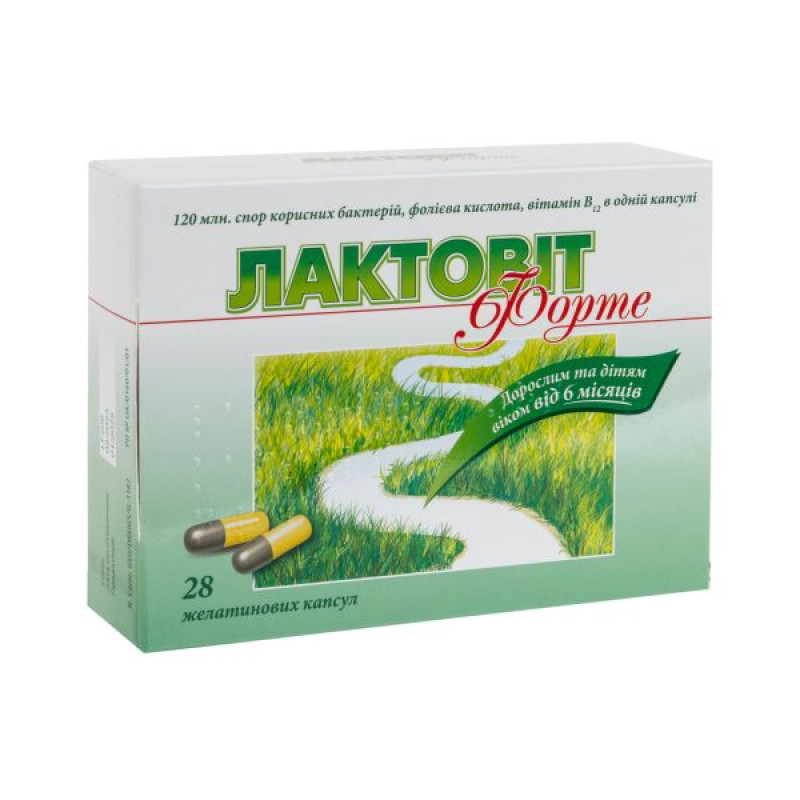
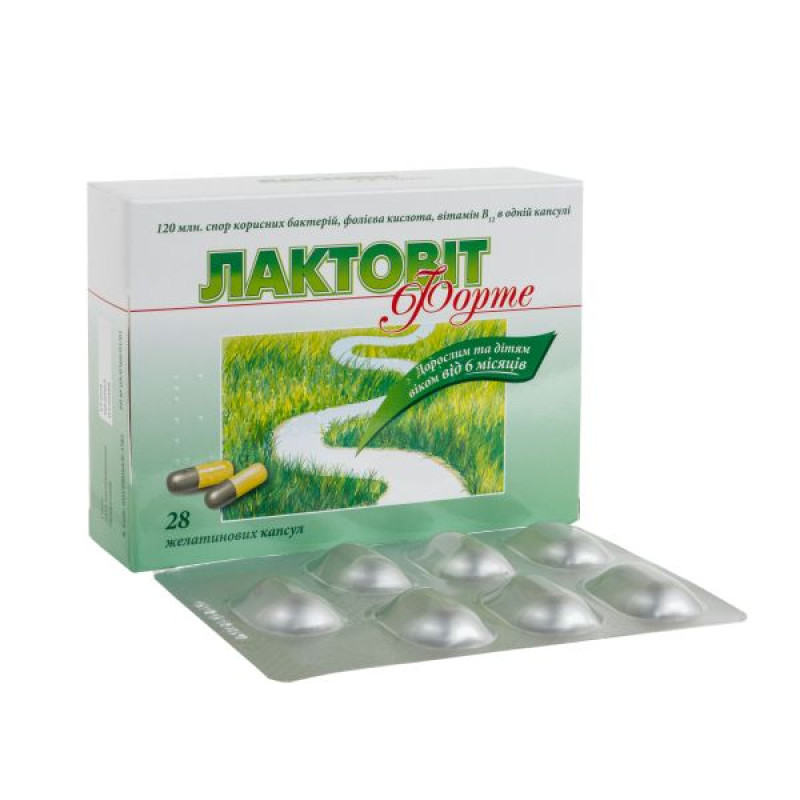
Instructions for Lactovit Forte capsules No. 28
Composition
active ingredients: folic acid, vitamin B12, Lactic Acid Bacillus Bacillus coagulans (Lb.sporogenes));
1 capsule contains folic acid 1.5 mg, vitamin B12 15 mcg, Lactic Acid Bacillus (Bacillus coagulans (Lb.sporogenes)) 120 million spores;
excipients: colloidal anhydrous silicon dioxide, talc, lactose, monohydrate; capsule composition: gelatin, purified water, sodium lauryl sulfate, methylparaben (E 218), propylparaben (E 216), diamond blue (E 133), carmoisine (E 122), tartrazine (E 102), titanium dioxide (E 171).
Dosage form
Capsules.
Main physicochemical properties: hard gelatin capsules with a yellow body and a gray cap, containing crystalline powder with grains of various sizes from light yellow to yellow and/or pink.
Pharmacotherapeutic group
Antidiarrheal microbial drugs. Lactic acid producing bacteria, combinations.
ATX code A07F A51.
Pharmacological properties
Pharmacodynamics
Lactovit Forte is a combination medicine that contains Lactic Acid Bacillus (Bacillus coagulans (Lb.sporogenes)), folic acid, and vitamin B12.
The therapeutic effect of Lactovit Forte is determined by bacteria that produce lactic acid and have antagonistic activity against pathogenic and conditionally pathogenic microorganisms. Bacterial spores are activated in the stomach, then in the duodenum they pass into a living vegetative form and create favorable conditions for the development of beneficial intestinal microflora by producing L(+) lactic acid. Lactobacteria activate the enzymatic breakdown of proteins, fats and complex carbohydrates (also in lactase deficiency in children) and contribute to the processes of restoration of the intestinal mucosa.
Folic acid (vitamin B9) is necessary for normal leuko- and erythropoiesis, the synthesis of amino acids and nucleic acids, purines and pyrimidines.
Vitamin B12 (cyanocobalamin) participates in the metabolism of carbohydrates, proteins, and lipids, in the synthesis of nucleic acids, helps normalize impaired functions of the nervous system, and stimulates erythropoiesis.
Pharmacokinetics
Not researched.
Indication
Lactovit Forte is prescribed for the treatment of adults and children aged 6 months and older who suffer from chronic colitis of various etiologies, including nonspecific ulcerative colitis; in case of somatic diseases complicated by dysbacteriosis resulting from the use of antibiotics, sulfonamide drugs and for other reasons; for the treatment of patients with intestinal disorders who have suffered acute intestinal infections caused by pathogenic and conditionally pathogenic bacteria; also used in obstetric and gynecological practice for nonspecific inflammatory diseases of the genitals and prenatal preparation of pregnant women at risk with impaired purity of vaginal secretions up to III-IV degree.
When conducting maintenance therapy for urticaria, eczema, childhood diathesis, atopic dermatitis.
Contraindication
Hypersensitivity to any of the components of the drug. Erythremia, erythrocytosis, thromboembolism, malignant neoplasms, pernicious anemia, untreated cobalamin deficiency; phenylketonuria; Leber's disease (hereditary optic atrophy).
Interaction with other medicinal products and other types of interactions
Folic acid.
Folic acid absorption is reduced when used simultaneously with analgesics, anticonvulsants, antacids, chloramphenicol, neomycin, polymyxins, antibiotics, sulfonamides, and cytostatics.
When taken together, folic acid reduces the effect of phenytoin, primidone, para-aminosalicylic acid, sulfazoline, hormonal contraceptives for oral use, and chloramphenicol.
Folic acid increases the metabolism of phenytoin.
In patients with folate deficiency, the use of folic acid may reduce the plasma levels of phenobarbital, phenytoin, and primidone and cause an epileptic seizure.
Oral contraceptives, ethanol, sulfasalazine, cycloserine, glutethimide, and methotrexate may affect folate metabolism.
Acetylsalicylic acid may increase the elimination of folic acid. Folates increase the effectiveness of lithium. Nitrous oxide may cause acute folic acid deficiency. Folic acid deficiency may be caused by drugs such as: anti-tuberculosis drugs, folic acid antagonists such as pyrimethamine, triamterene, trimethoprim.
Cannot be used together with mineral acids, alkaline substances, reducing agents, as folic acid is inactivated.
A decrease or change in absorption is possible with the simultaneous use of cholestyramine and folic acid. Therefore, the drug should be taken 1 hour before or 4-6 hours after taking cholestyramine.
Folic acid may reduce the absorption of zinc in the intestines.
Avoid concomitant use with fluorouracil. Antacids containing aluminum or magnesium may reduce the absorption of folic acid, so patients should be advised to take antacids 2 hours after folic acid administration.
Aminoglycosides, salicylates, antiepileptic drugs, colchicine, potassium preparations reduce the absorption of cyanocobalamin, affect its kinetics. When used simultaneously with kanamycin, neomycin, polymyxins, tetracyclines, the absorption of cyanocobalamin decreases.
When used simultaneously with thiamine, the risk of allergic reactions caused by thiamine increases.
Chloramphenicol reduces the hematopoietic response to the drug.
When used simultaneously with cytamene, the effect of cytamene is reduced.
Oral contraceptives reduce the concentration of cyanocobalamin in the blood.
Application features
To preserve the viability of the medicinal product components, it is advisable not to drink Lactovit Forte with hot drinks.
Children over 6 months of age can be given the drug immediately before feeding.
Due to the high antibiotic resistance of lactic acid-producing bacteria, the use of the drug does not interfere with antibiotic therapy.
Lactovit Forte therapy can be prescribed after a course of treatment with bacteriophages.
When using vitamin B12, the clinical picture, as well as laboratory tests in funicular myelosis or pernicious anemia, may lose their specificity.
Patients with neoplasms, except for cases accompanied by megaloblastic anemia and vitamin B12 deficiency, should not use the drug. The drug should not be used in severe or acute forms of cardiac decompensation and angina pectoris.
Excipients.
If you have been told by your doctor that you have an intolerance to some sugars, contact your doctor before taking this medicinal product as it contains lactose.
Tartrazine (E 102), carmoisine (E 122), methylparaben (E 218) and propylparaben (E 216), which are contained in the preparation, may cause allergic reactions (possibly delayed).
Ability to influence reaction speed when driving vehicles or other mechanisms
Caution should be exercised when driving vehicles, as dizziness may sometimes occur when using the drug.
Use during pregnancy or breastfeeding
If there are indications for the use of Lactovit Forte during pregnancy and breastfeeding, take the drug in normal daily doses after consulting a doctor.
Method of administration and doses
For colitis, dysbacteriosis, and intestinal disorders, the drug should be used by adults and children over 6 months of age 2 times a day 40 minutes before meals or immediately before meals/feeding.
For use in children under 2 years of age, open the capsule and dissolve the contents in 10 ml of breast milk or boiled water at room temperature (the water should not be hot) until a suspension is formed; a single dose is 5 ml of suspension.
For children over 2 years of age and adults, the single dose is 1 capsule, the daily dose is 2 capsules.
For adults, the maximum single dose is 2 capsules, the maximum daily dose is 4 capsules.
In obstetric and gynecological practice, Lactovit Forte should be used internally in normal doses.
For prenatal preparation of pregnant women at risk, the drug should be taken orally, 2 capsules once a day for 5-8 days.
Duration of use:
The course of treatment depends on the nature and course of the disease.
in the presence of intestinal disorders, treatment should be carried out for at least 4-6 weeks; in chronic colitis of various etiologies, treatment should be carried out for up to 1.5-2 months; in dysbacteriosis resulting from the use of antibiotics, sulfonamide drugs and for other reasons, treatment should be carried out for 3-4 weeks.
To consolidate the obtained clinical effect, 10-14 days after the end of the course of treatment, in the absence of complete normalization of microflora, maintenance doses of the drug (half the daily dose) are prescribed for 1-1.5 months.
In cases of recurrent diseases, repeated courses of treatment are advisable. In these cases, a repeated examination of the microflora is necessary before prescribing the drug.
Children
It is used to treat children from 6 months of age. For children under 6 years of age, it is advisable to use other dosage forms of the drug (powder for oral suspension).
Overdose
To date, no cases of overdose with Lactovit Forte have been reported. An overdose of folic acid may mask vitamin B12 deficiency. Very high doses of folic acid (15 mg/day) may cause gastrointestinal disorders (nausea, flatulence, bloating, bitter taste in the mouth).
In case of an overdose of cyanocobalamin, pulmonary edema, congestive heart failure, peripheral vascular thrombosis, benign acne are possible. With prolonged use in high doses, liver enzyme activity disorders, pain in the heart area, and hypercoagulation are possible.
When using the drug, side effects may increase.
Treatment: Drug withdrawal, symptomatic therapy.
Adverse reactions
On the part of the digestive tract: dyspepsia, nausea, vomiting, flatulence, abdominal discomfort, loss of appetite, loose stools, diarrhea, bitter taste in the mouth.
On the part of the immune system: hypersensitivity reactions (including anaphylaxis, anaphylactic shock, angioedema, bronchospasm), edema, respiratory disorders, asthma attacks.
From the nervous system: headache, dizziness, nervous excitement, night sleep disorder, convulsions; arterial hypotension.
Cardiac disorders: pain in the heart area, tachycardia, peripheral vascular thrombosis.
On the part of the kidneys and urinary tract: hypertrophy of epithelial cells in the renal tubules and impaired function.
On the part of the blood: hypercoagulation.
Metabolic: disorders of purine metabolism.
General disorders: hot flashes, general weakness, malaise, sweating, hyperthermia, fever.
Expiration date
2 years.
Storage conditions
Store at a temperature not exceeding 25 ºС in the original packaging and out of the reach of children.
Packaging
7 capsules in a blister, 2 blisters in a cardboard box.
Vacation category
Without a prescription.
Producer
Mepro Pharmaceuticals Private Limited.
Location of the manufacturer and its business address.
Fairfax House 15, Falwood Place, London, WC1V 6AY, United Kingdom.