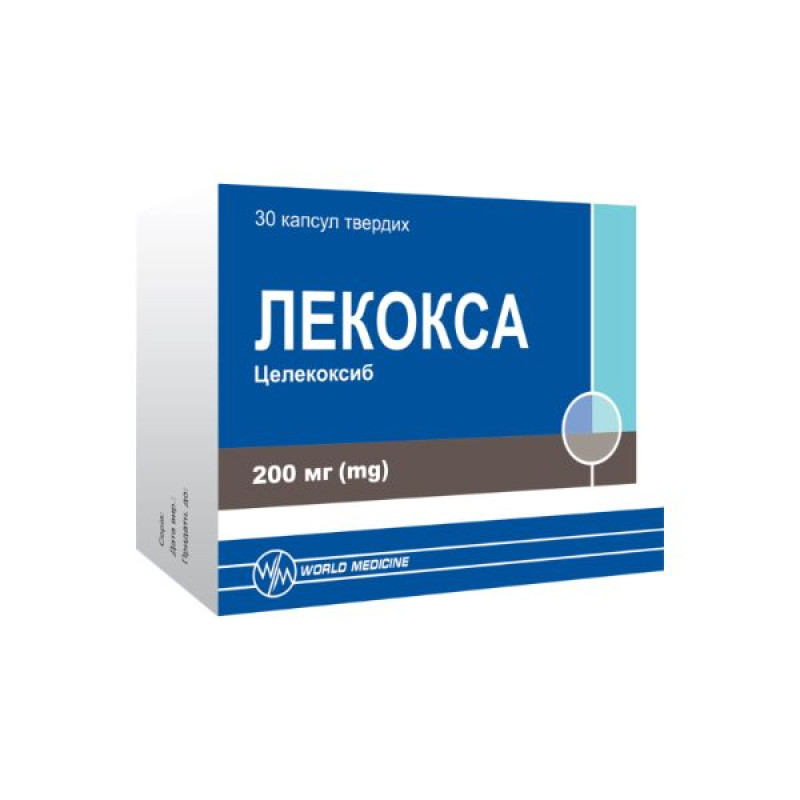
Instructions for Lecox capsules 200 mg No. 30
Composition
active ingredient: celecoxib;
1 hard capsule contains celecoxib 100 mg or 200 mg;
excipients: lactose monohydrate; sodium lauryl sulfate; croscarmellose sodium; povidone; isopropyl alcohol; magnesium stearate;
100 mg capsules: capsule (iron oxide red (E 172), titanium dioxide (E 171), gelatin);
200 mg capsules: capsule (titanium dioxide (E 171), gelatin).
Dosage form
The capsules are hard.
Main physicochemical properties:
100 mg capsules – hard gelatin capsules, size No. 2, opaque, beige cap and body, containing white or almost white powder;
200 mg capsules – hard gelatin capsules, size No. 0, opaque, white cap and body, containing white or almost white powder.
Pharmacotherapeutic group
Anti-inflammatory and antirheumatic agents. Coxibs. ATX code M01A H01.
Pharmacological properties
Pharmacodynamics.
Mechanism of action.
Celecoxib has analgesic, anti-inflammatory and antipyretic properties. Its mechanism of action is thought to be related to inhibition of prostaglandin synthesis, primarily through inhibition of cyclooxygenase-2 (COX-2). Celecoxib is a potent inhibitor of prostaglandin synthesis in vitro. The concentrations of celecoxib achieved during therapy produced effects in vivo.
Prostaglandins increase the sensitivity of afferent nerves and enhance the action of bradykinin, stimulating pain, in animal models. Prostaglandins are mediators of inflammation. Since celecoxib is an inhibitor of prostaglandin synthesis, its mechanism of action may be due to a decrease in prostaglandin levels in peripheral tissues.
Pharmacodynamic properties.
Effect on platelets.
In clinical studies in healthy volunteers, single doses of celecoxib up to 800 mg and multiple doses of celecoxib up to 600 mg twice daily for up to 7 days (which exceeds the recommended therapeutic doses) did not reduce platelet aggregation or prolong clotting time. Due to its lack of effect on platelets, celecoxib cannot be used as a substitute for acetylsalicylic acid for the prevention of cardiovascular diseases. It is unknown whether celecoxib affects platelets in terms of increasing the risk of serious cardiovascular thrombotic adverse reactions associated with the use of celecoxib.
Fluid retention.
Inhibition of prostaglandin E2 (PGE2) synthesis may result in sodium and water retention by increasing reabsorption in the thick ascending limb of the loop of Henle in the renal medulla and possibly in other segments of the distal nephron. PGE2 is thought to inhibit water reabsorption in the collecting tubules by interfering with the action of antidiuretic hormone.
Pharmacokinetics.
Celecoxib exposure increases approximately dose-proportionally after administration of 200 mg twice daily; at higher doses, a less proportional increase is observed. Celecoxib is widely distributed and highly bound to plasma proteins. Celecoxib is metabolized primarily by CYP2C9 with a half-life of approximately 11 hours.
Absorption.
After oral administration, peak plasma levels of celecoxib are reached in approximately 3 hours. When administered in the fasted state at doses up to 200 mg twice daily, both peak plasma levels (Cmax) and area under the pharmacokinetic curve (AUC) are approximately dose-proportional; at higher doses, Cmax and AUC increase sublinearly (see section "Effect of food intake"). Studies of the absolute bioavailability of celecoxib have not been conducted. With repeated administration, steady state is reached on the fifth day or earlier. The pharmacokinetic parameters of celecoxib in a group of healthy volunteers are presented in Table 1.
Table 1
Distribution kinetics of a single dose (200 mg) of celecoxib in healthy volunteers1
| Mean (coefficient of variation, %) values of pharmacokinetic parameters |
| Cmax, ng/ml | Tmax, h | Effective t1/2, h | Vss/F, l | CL/F, l/h |
| 705 (38) | 2.8 (37) | 11.2 (31) | 429 (34) | 27.7 (28) |
| 1 volunteers after celecoxib administration on an empty stomach (n=36, 19–52 years) |
Vss/F – volume of distribution at steady state.
CL/F – plasma clearance.
The impact of food consumption.
When celecoxib was administered with a high-fat meal, Cmax was delayed by approximately 1–2 hours with an increase in total absorption (AUC) of 10% to 20%. When celecoxib was administered in the fasted state at doses above 200 mg, there was a sublinear increase in Cmax and AUC, which is attributed to its low aqueous solubility.
In healthy adult volunteers, the total systemic exposure (AUC) of celecoxib was not different between oral administration of the capsule and dilution of the capsule contents in applesauce. No significant changes in Cmax, time to peak concentration (Tmax), or half-life (t1/2) were observed after administration of the capsule contents with applesauce (see section 4.2).
Distribution.
In healthy volunteers, celecoxib is almost completely bound to plasma proteins (approximately 97%) at the clinical dose range. In vitro studies indicate that celecoxib binds primarily to albumin and to a lesser extent to α1-acid glycoprotein. The apparent volume of distribution at steady state is approximately 400 L, indicating extensive tissue distribution of celecoxib. Celecoxib does not show preferential binding to erythrocytes.
Metabolism.
Celecoxib is primarily metabolized by CYP2C9. Three metabolites have been identified in human plasma: the primary alcohol, the corresponding carboxylic acid, and its glucuronide conjugate. These metabolites have no activity against COX-1 or COX-2.
Excretion.
Celecoxib is eliminated primarily by hepatic metabolism, with only a small amount (less than 3%) of unchanged drug excreted in the urine and feces. Following a single oral dose of radiolabeled celecoxib, approximately 57% of the dose was excreted in the feces and 27% in the urine. The major metabolite in the urine and feces was the carboxylic acid (73% of the dose), with a small amount of the glucuronide also recovered in the urine. The low solubility of celecoxib is thought to prolong absorption, making t1/2 more variable. The effective t1/2 is approximately 11 hours under fasting conditions. Plasma clearance is approximately 500 mL/min.
Certain groups of patients.
Elderly patients.
In elderly patients (aged 65 years and older), steady-state Cmax was 40% higher and AUC was 50% higher compared to younger patients. In elderly women, Cmax and AUC for celecoxib are higher than in elderly men, but this increase is mainly due to the lower body weight of women. In general, no dose adjustment is required in elderly patients. However, in patients weighing less than 50 kg, treatment should be initiated at the lowest recommended dose (see section 4.2).
Children.
In a clinical study, the steady-state pharmacokinetics of celecoxib in an experimental oral suspension formulation were evaluated in 152 patients with juvenile rheumatoid arthritis aged 2 to 17 years and weighing ≥10 kg with single or multiple joint involvement or systemic manifestations of juvenile rheumatoid arthritis. Population pharmacokinetic analysis showed that oral clearance (unadjusted for body weight) of celecoxib increased less than proportionally with increasing body weight, with clearance predicted to be 40% and 24% lower in patients weighing 10 kg and 25 kg, respectively, compared to adult rheumatoid arthritis patients weighing 70 kg.
Administration of celecoxib capsules 50 mg twice daily to patients with juvenile rheumatoid arthritis weighing ≥12 and ≤25 kg and 100 mg capsules to patients with juvenile rheumatoid arthritis weighing >25 kg should provide similar plasma celecoxib concentrations to those observed in a clinical trial that demonstrated non-inferiority of celecoxib to naproxen 7.5 mg/kg twice daily (see Dosage and Administration). Celecoxib has not been studied in patients with juvenile rheumatoid arthritis younger than 2 years of age or weighing <10 kg, nor have studies lasting longer than 24 weeks been conducted.
Patients of different races.
Based on the results of a meta-analysis of pharmacokinetic studies, it was assumed that the AUC of celecoxib in blacks was 40% higher than in whites. The explanation and clinical significance of these results are unknown.
Patients with liver dysfunction.
A pharmacokinetic study in patients with mild (Child-Pugh Class A) and moderate (Child-Pugh Class B) hepatic impairment showed that the AUC of celecoxib at steady state was increased by approximately 40% and 180%, respectively, compared to healthy control subjects. Therefore, the recommended daily dose of celecoxib should be reduced by approximately 50% in patients with moderate hepatic impairment (Child-Pugh Class B).
Patients with renal impairment.
In a cross-sectional study, the AUC of celecoxib in patients with chronic renal failure (glomerular filtration rate 35–60 mL/min) was approximately 40% lower than in patients with normal renal function. There was no significant relationship between glomerular filtration rate and celecoxib clearance.
Drug interaction studies.
In vitro studies indicate that celecoxib is not an inhibitor of cytochrome P450 2C9, 2C19, or 3A4. In vivo studies have shown the following.
When NSAIDs were used with acetylsalicylic acid, the degree of their binding to plasma proteins was reduced, although the clearance of the unbound form of the NSAID did not change. The clinical significance of this interaction is unknown. Clinically significant interactions of NSAIDs with acetylsalicylic acid are listed in the section "Interaction with other medicinal products and other types of interactions"
Lithium preparations.
In a study in healthy volunteers, mean steady-state plasma lithium levels were increased by approximately 17% in patients receiving lithium 450 mg twice daily in combination with celecoxib 200 mg twice daily compared to lithium alone (see Interactions).
Fluconazole.
Concomitant administration of fluconazole 200 mg once daily resulted in a two-fold increase in celecoxib plasma concentrations. This increase is due to inhibition of celecoxib metabolism by fluconazole, which is mediated by the P450 2C9 isoenzyme (see section 4.5).
Other medicines.
In vivo studies have been conducted to investigate the effect of celecoxib on the pharmacokinetics and/or pharmacodynamics of glyburide, ketoconazole, methotrexate (see section 4.5), phenytoin, and tolbutamide, but no clinically significant interactions were identified.
Pharmacogenomics.
In selected patients with genetic polymorphisms (CYP2C9*2 homozygosity and CYP2C9*3 polymorphism), a decrease in CYP2C9 activity has been observed, resulting in a decrease in enzymatic activity. Limited data published in four reports, which included a total of 8 patients homozygous for CYP2C9*3/*3, showed that in these patients systemic levels of celecoxib were 3-7 times higher compared to patients with the CYP2C9*1/*1 and *I/*3 genotypes. The pharmacokinetics of celecoxib in patients with other CYP2C9 polymorphisms, such as *2, *5, *6, *9 and *11, have not been evaluated. The frequency of homozygous *3/*3 genotype is estimated to be 0.3% to 1.0% across ethnic groups (see section 4.2).
A double-blind, randomized, controlled trial (PRECISION; NCT00346216) of comprehensive cardiovascular safety in patients with osteoarthritis (OA) and rheumatoid arthritis (RA) with or at high risk for cardiovascular disease compared celecoxib with naproxen and ibuprofen. Patients were randomized to receive a starting dose of 100 mg celecoxib twice daily, 600 mg ibuprofen three times daily, or 375 mg naproxen twice daily, with the option to increase the dose as needed for pain management.
To assess non-inferiority (80%) by the Antiplatelet Trialists' Collaboration (APTC), a primary composite endpoint was defined, which included cardiovascular death (including bleeding deaths), non-fatal myocardial infarction, and non-fatal stroke. All patients received open-label esomeprazole (20–40 mg) as a gastroprotector. Randomization to treatment groups was stratified by baseline low-dose acetylsalicylic acid use.
An additional 4-month study (PRECISION-ABPM) was conducted to evaluate the effects of the three above-mentioned drugs on blood pressure measured during ambulatory monitoring.
Celecoxib 100 mg twice daily compared with naproxen or ibuprofen at the respective doses met the prespecified criteria for non-inferiority (p < 0.001 for non-inferiority in both comparisons) for the above composite endpoint as defined by the APTC.
In the analysis of the patient population with assigned treatment for 30 months, all-cause mortality was 1.6% in the celecoxib group, 1.8% in the ibuprofen group, and 2.0% in the naproxen group.
Because the increase in the dose of celecoxib to 200 mg twice daily occurred in a relatively small proportion of the total number of patients taking celecoxib (5.8%), the results of the PRECISION study are not suitable for determining the relative cardiovascular safety of celecoxib 200 mg twice daily compared with ibuprofen and naproxen at corresponding doses.
In the additional PRECISION-ABPM study in 444 patients, at month 4, mean daily systolic blood pressure decreased by 0.3 mmHg with celecoxib 100 mg twice daily, whereas mean daily systolic blood pressure increased by 3.7 mmHg and 1.6 mmHg with ibuprofen and naproxen at the same doses. These changes resulted in a statistically and clinically significant difference of 3.9 mmHg (p = 0.0009) between celecoxib and ibuprofen and a statistically insignificant difference of 1.8 mmHg (p = 0.119) between celecoxib and naproxen.
Indication
Symptomatic treatment of osteoarthritis, rheumatoid arthritis and ankylosing spondylitis (see section "Special instructions").
Treatment of acute pain in adult patients (see section "Special instructions").
Treatment of primary dysmenorrhea (see section "Special instructions").
Contraindication
Hypersensitivity (e.g. anaphylactic reactions and serious skin reactions) to celecoxib and/or to any of the other ingredients of the medicinal product (see section 4.4).
History of bronchial asthma, urticaria or other allergic-type reactions after taking acetylsalicylic acid or other NSAIDs. Severe, sometimes fatal, anaphylactic reactions to NSAIDs have been reported in such patients (see section "Special warnings and precautions for use").
History of allergic-type reactions to sulfonamide drugs.
After coronary artery bypass graft surgery (see section "Special precautions for use").
Established ischemic heart disease, peripheral arterial disease, and/or cerebrovascular disease.
Active peptic ulcer or gastrointestinal bleeding.
Estimated creatinine clearance < 30 ml/min.
Congestive heart failure (NYHA class II–IV)
Severe liver dysfunction (plasma albumin < 25 g/l or Child-Pugh score ≥ 10).
Interaction with other medicinal products and other types of interactions
Drugs that affect hemostasis.
The risk of serious bleeding is increased when celecoxib is used with anticoagulants compared to when either agent is used alone. Celecoxib and anticoagulants, such as warfarin, have a synergistic effect on bleeding. Serotonin, which is released by platelets, plays an important role in hemostasis. Case-control and cohort epidemiological studies have shown that the concomitant use of serotonin reuptake inhibitors and NSAIDs increases the risk of bleeding to a greater extent than when NSAIDs are used alone.
Patients should be monitored for bleeding when celecoxib is used concomitantly with anticoagulants (e.g. warfarin), antiplatelet agents (e.g. acetylsalicylic acid), selective serotonin reuptake inhibitors (SSRIs) and serotonin norepinephrine reuptake inhibitors (SNRIs) (see section 4.4).
Acetylsalicylic acid.
Controlled clinical trials have shown that concomitant use of NSAIDs and acetylsalicylic acid at an analgesic dose does not result in any greater therapeutic effect than the use of NSAIDs alone. In a clinical trial, concomitant use of NSAIDs and acetylsalicylic acid was associated with a significantly increased incidence of gastrointestinal adverse reactions compared to the use of NSAIDs alone (see section 4.4).
In two studies involving healthy volunteers and patients with osteoarthritis and chronic heart disease, respectively, it was demonstrated that celecoxib (at a dose of 200–400 mg per day) did not affect the cardioprotective antiplatelet effect of acetylsalicylic acid (at a dose of 100–325 mg).
The concomitant use of celecoxib and acetylsalicylic acid at analgesic doses is generally not recommended due to the increased risk of bleeding (see section 4.4). Celecoxib should not be used in place of low-dose acetylsalicylic acid for the prevention of cardiovascular disease.
Angiotensin-converting enzyme (ACE) inhibitors, angiotensin receptor blockers, and β-blockers.
When used simultaneously with NSAIDs, the hypotensive effect of ACE inhibitors, angiotensin receptor blockers or β-blockers (including propranolol) may be reduced.
Concomitant use of NSAIDs with ACE inhibitors or angiotensin receptor blockers in elderly patients, in patients who are dehydrated (including those treated with diuretics), or in patients with impaired renal function may lead to deterioration of renal function, including acute renal failure. These effects are usually reversible.
When celecoxib is used concomitantly with ACE inhibitors, angiotensin receptor blockers, or β-blockers, blood pressure should be monitored to ensure that the desired blood pressure level is achieved.
When celecoxib is used concomitantly with ACE inhibitors or angiotensin receptor blockers in elderly patients and in those with dehydration or renal impairment, monitoring for signs of renal impairment should be performed (see section 4.4).
Patients should be adequately hydrated when these drugs are used concomitantly. Renal function should be assessed at the beginning of treatment and periodically thereafter.
Diuretics.
Clinical studies and post-marketing surveillance have shown that NSAIDs may reduce the natriuretic effect of loop diuretics (e.g. furosemide) and thiazide diuretics in some patients. This effect is due to the inhibition of prostaglandin synthesis in the kidney by NSAIDs.
Digoxin.
It has been shown that concomitant use of celecoxib with digoxin leads to an increase in plasma digoxin concentrations and a prolongation of its t1/2. In the case of simultaneous use of these drugs, monitoring of plasma digoxin levels should be carried out.
Lithium preparations.
NSAIDs have been shown to increase plasma lithium levels and decrease renal lithium clearance. The mean trough lithium concentration was increased by 15% and renal clearance was decreased by approximately 20%. This effect is thought to be due to the inhibition of prostaglandin synthesis in the kidney by NSAIDs.
When these drugs are used concomitantly, patients should be monitored for signs of lithium toxicity.
Methotrexate.
Concomitant use with NSAIDs increases the toxicity of methotrexate (e.g. neutropenia, thrombocytopenia, renal impairment). Celecoxib does not affect the pharmacokinetics of methotrexate. Patients should be monitored for methotrexate toxicity during concomitant use.
Cyclosporine.
The nephrotoxicity of cyclosporine is increased when used concomitantly with celecoxib. Patients should be monitored for signs of renal dysfunction when these drugs are used concomitantly.
Other NSAIDs, salicylates.
Concomitant use of celecoxib with other NSAIDs or salicylates (e.g. diflunisal and salsalate) increases the risk of gastrointestinal toxicity with little or no increase in efficacy (see section 4.4).
Concomitant use of celecoxib with other NSAIDs or salicylates is not recommended.
Pemetrexed.
Concomitant use of celecoxib and pemetrexed may increase the risk of pemetrexed-related myelosuppression and renal and gastrointestinal toxicity (see pemetrexed Summary of Product Characteristics).
When these drugs are used concomitantly in patients with renal impairment, with creatinine clearance ranging from 45 mL/min to 79 mL/min, monitoring for signs of myelosuppression and renal and gastrointestinal toxicity should be performed.
NSAIDs with a short t1/2 (e.g. diclofenac and indomethacin) should be avoided for 2 days before and after, and on the day of pemetrexed administration.
In the absence of data on the potential interaction between pemetrexed and NSAIDs with a longer t1/2 (e.g. meloxicam and nabumetone), patients taking these NSAIDs should discontinue their use at least 5 days before, on the day of, and for 2 days after pemetrexed administration.
CYP2C9 inhibitors or inducers.
Celecoxib metabolism is mediated primarily by the cytochrome P450 isoenzyme CYP2C9 in the liver. Concomitant use of celecoxib with drugs that are known inhibitors of CYP2C9 (e.g., fluconazole) may increase the exposure and toxicity of celecoxib, while concomitant use with inducers of CYP2C9 (e.g., rifampin) may decrease the efficacy of celecoxib.
When considering the use of celecoxib, the patient's medical history should be assessed. If celecoxib is used concomitantly with inhibitors or inducers of cytochrome CYP2C9, a dose adjustment of celecoxib is warranted (see section 5.2).
CYP2D6 substrates.
In vitro studies indicate that celecoxib, although not a substrate, is an inhibitor of CYP2D6. Therefore, there is a potential for in vivo drug interactions with drugs metabolized by CYP2D6 (e.g., atomoxetine), and celecoxib may increase the exposure and toxicity of these drugs.
When considering the use of celecoxib, the patient's medical history should be assessed. Dosage adjustment may be warranted when celecoxib is used concomitantly with CYP2D6 substrates (see Pharmacokinetics).
Corticosteroids.
Concomitant use of celecoxib with corticosteroids may increase the risk of gastrointestinal ulceration or bleeding. Patients should be monitored for signs of bleeding when these drugs are used concomitantly (see section 4.4).
Application features
Clinical trials of several selective and nonselective COX-2 inhibitors of the NSAID class of drugs of up to 3 years duration have shown an increased risk of serious thrombotic adverse events, including myocardial infarction and stroke, which can be fatal. Based on the available data, it is unclear whether the risk of thrombotic cardiovascular events is similar for all NSAIDs. The relative increase in the incidence of serious thrombotic cardiovascular events compared to baseline, which is associated with the use of NSAIDs, occurs both in patients with known cardiovascular disease and risk factors for it, and in patients without such diseases and factors. However, patients with known cardiovascular disease or risk factors for cardiovascular disease had an even higher absolute incidence of serious thrombotic cardiovascular events due to the increased incidence of these factors and conditions at baseline. Some observational studies have found that this increased risk of serious thrombotic cardiovascular events was evident as early as the first weeks of treatment. The increased risk of thrombotic cardiovascular events was most consistently observed with higher doses of celecoxib.
In the APC (celecoxib Adenoma Prevention) trial, an approximately 3-fold increased risk of the composite endpoint (cardiovascular death, myocardial infarction, or stroke) was observed in the celecoxib 400 mg twice daily and celecoxib 200 mg twice daily treatment groups compared to placebo. This increased risk in both celecoxib treatment groups compared to placebo was primarily due to an increased incidence of myocardial infarction.
A randomized controlled clinical trial, “Prospective Randomized Comprehensive Safety Evaluation of Celecoxib versus Ibuprofen or Naproxen (PRECISION),” was conducted to compare the relative risk of cardiovascular thrombotic events associated with the COX-2 inhibitor celecoxib with that associated with the nonselective NSAIDs naproxen and ibuprofen. Celecoxib was non-inferior to naproxen and ibuprofen (see Pharmacodynamics).
To minimize the potential risk of cardiovascular adverse reactions in patients taking NSAIDs, the lowest effective dose should be used for the shortest possible duration of treatment. Physicians and patients should be closely monitored for the development of such reactions throughout the course of treatment, even in the absence of a history of cardiovascular symptoms. Patients should be informed of the symptoms of serious cardiovascular adverse reactions and the measures to be taken if they occur.
There is no direct evidence that concomitant use of acetylsalicylic acid reduces the increased risk of serious thrombotic cardiovascular events associated with the use of NSAIDs. Concomitant use of acetylsalicylic acid and NSAIDs such as celecoxib increases the risk of serious gastrointestinal reactions (see section "Special warnings and precautions for use", subsection "Gastrointestinal bleeding, ulceration and perforation").
In the CLASS study, the Kaplan-Meier pooled estimates of peripheral edema at 9 months in patients treated with celecoxib 400 mg twice daily (4 and 2 times the recommended doses for OA and RA, respectively), ibuprofen 800 mg three times daily, and diclofenac 75 mg twice daily were 4.5%, 6.9%, and 4.7%, respectively. In the CLASS study, the incidence of hypertension in patients treated with celecoxib, ibuprofen, and diclofenac was 2.4%, 4.2%, and 2.5%, respectively.
Use in coronary artery bypass graft surgery.
Two large controlled clinical trials of COX-2 selective NSAIDs for pain control in the first 10–14 days after coronary artery bypass grafting showed an increased incidence of myocardial infarction and stroke. NSAIDs are contraindicated in coronary artery bypass grafting (see section 4.3).
Use in patients after myocardial infarction.
In an observational study conducted by the Danish National Registry, it was demonstrated that patients who used NSAIDs in the period after myocardial infarction were at increased risk of recurrent infarction, cardiovascular death, and death from any cause, starting from the first week of treatment. In the same cohort, the incidence of death in the first year after myocardial infarction among patients who used NSAIDs was 20 cases per 100 person-years compared with 12 cases per 100 person-years among patients who did not use NSAIDs. Although the absolute number of deaths decreases after the first year after myocardial infarction, analysis of the results of at least four subsequent years of follow-up showed that the increased relative risk of death in patients using NSAIDs persists.
NSAIDs, including celecoxib, cause serious gastrointestinal adverse reactions, including inflammation, bleeding, ulceration, and perforation of the esophagus, stomach, small intestine, and large intestine, which can be fatal. These serious adverse reactions can occur at any time with or without prior symptoms in patients taking celecoxib. Only 1 in 5 patients develop a serious upper gastrointestinal adverse reaction during NSAID treatment with clinical manifestations. Approximately 1% of patients taking celecoxib for 3–6 months and approximately 2–4% of patients taking celecoxib for 1 year have experienced upper gastrointestinal ulcers, serious bleeding, or perforations associated with NSAID use. However, even short-term NSAID therapy is associated with risk.
Risk factors for gastrointestinal bleeding, ulceration, and perforation. Patients with a history of peptic ulcer and/or gastrointestinal bleeding who were taking NSAIDs had a greater than 10-fold increased risk of gastrointestinal bleeding compared with patients without such risk factors. Other factors that increase the risk of gastrointestinal bleeding in patients taking NSAIDs include longer duration of treatment, concomitant use of oral corticosteroids, antiplatelet agents (e.g., acetylsalicylic acid), anticoagulants, or SSRIs, tobacco smoking, alcohol use, advanced age, and poor general health. Most of the fatal gastrointestinal adverse reactions reported since the marketing of celecoxib have occurred in elderly or debilitated patients. In addition, patients with progressive liver disease and/or coagulopathy are at increased risk of developing gastrointestinal bleeding.
In the CLASS study, the incidence of complicated and symptomatic ulcers in all patients at 9 months was 0.78% and in the subgroup of patients taking low-dose acetylsalicylic acid it was 2.19%. In patients aged 65 years and older the incidence was 1.40% at 9 months and 3.06% with concomitant acetylsalicylic acid.
Strategy to minimize gastrointestinal risks in patients taking NSAIDs:
use the lowest effective dose of the drug for the shortest possible period;
avoid using more than one NSAID at the same time;
avoid using the drug in high-risk patients unless the benefit is expected to outweigh the increased risk of bleeding (in such patients, as well as in patients with active gastrointestinal bleeding, the use of alternative drugs instead of NSAIDs should be considered);
Monitor for signs and symptoms of gastrointestinal ulceration and/or bleeding during NSAID therapy;
If a serious gastrointestinal adverse reaction is suspected, immediate investigation and treatment should be initiated and the drug should be discontinued until a serious gastrointestinal adverse reaction has been ruled out;
When concomitantly using low doses of acetylsalicylic acid for the prevention of cardiovascular complications, patients should be monitored more closely for signs of gastrointestinal bleeding (see section "Interaction with other medicinal products and other types of interactions").
Risk of hepatotoxicity.
Elevations of alanine aminotransferase (ALT) or aspartate aminotransferase (AST) (3 times or more the upper limit of normal (ULN)) have been reported in approximately 1% of patients treated with NSAIDs in clinical trials. In addition, rare, sometimes fatal cases of severe hepatic impairment, including fulminant hepatitis, hepatic necrosis and hepatic failure, have been reported.
Elevations in ALT or AST (less than 3 times the upper limit of normal) may occur in approximately 15% of patients taking NSAIDs, including celecoxib.
In controlled clinical trials of celecoxib, the incidence of mild elevations (1.2 to less than 3 times the upper limit of normal) of liver function enzymes was 6% in patients treated with celecoxib.