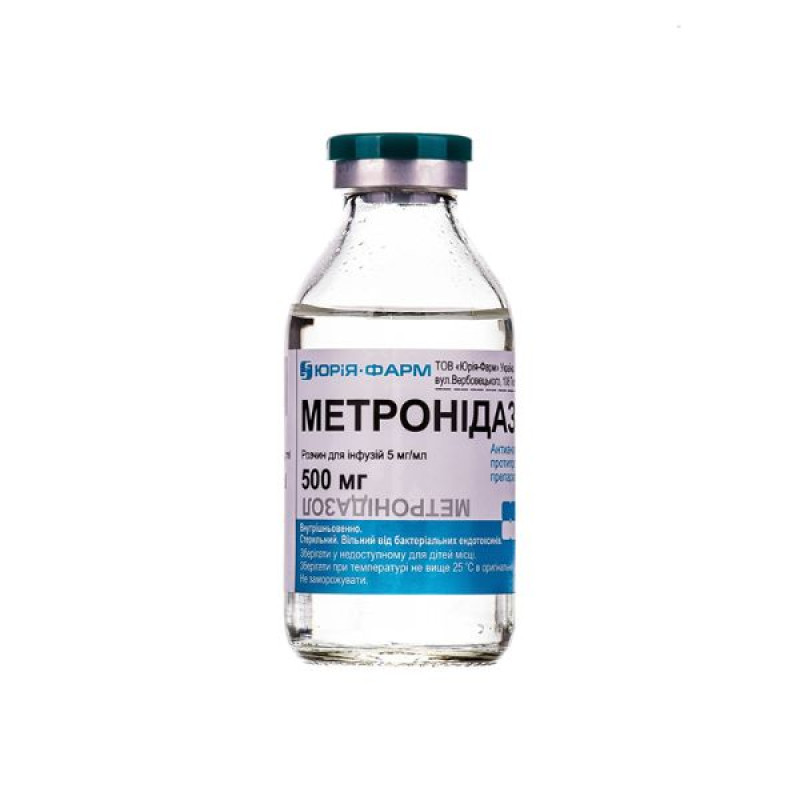
Instructions Metronidazole solution for infusion 5 mg/ml glass bottle 100 ml
Composition
active ingredient: metronidazole;
1 ml of solution contains 5 mg of metronidazole;
Excipients: sodium chloride, disodium edetate, water for injections.
Dosage form
Solution for infusion.
Main physicochemical properties: clear, colorless or slightly yellowish liquid.
Pharmacotherapeutic group
Antimicrobials for systemic use. Imidazole derivatives. ATX code J01X D01.
Pharmacological properties
Pharmacodynamics.
Metronidazole is a stable compound that can penetrate microorganisms. Under anaerobic conditions, metronidazole forms nitroso radicals with microbial pyruvate-ferredoxin oxidoreductase by oxidizing ferredoxin and flavodoxin. Nitrosoradicals form addition products with DNA base pairs, which leads to DNA strand breaks and cell death.
The minimum inhibitory concentration (MIC) established by the European Committee for Antimicrobial Susceptibility Testing, the breakpoints separating susceptible (S) from resistant (R) organisms, are as follows:
Gram-positive anaerobes (S: ≤ 4 mg/ml, R > 4 mg/ml);
Gram-negative anaerobes (S: ≤ 4 mg/ml, R > 4 mg/ml).
List of sensitive and resistant microorganisms
(according to the Central Office for Data Analysis on Resistance to Systemic Antibiotics, Germany, December 2009):
Anaerobes: Bacteroides fragilis, Clostridium difficile0, Clostridium perfringens0⌂, Fusobacterium spp. 0, Peptoniphilus spp. 0, Peptostreptococcus spp. 0, Porphyromonas spp. 0, Prevotella spp., Veillonella spp. 0.
Other microorganisms: Entamoeba histolytica0, Gardnerella vaginalis0, Giardia lamblia0, Trichomonas vaginalis0.
Strains whose acquired susceptibility may be a problem:
Gram-negative aerobes: Helicobacter pylori.
Inherently resistant microorganisms: all obligate aerobes:
Gram-positive microorganisms: Enterococcus spp., Staphylococcus spp., Streptococcus spp.
Gram-negative microorganisms: Enterobacteriaceae, Haemophilus spp.
0 No data were available at the time of publication of these tables. The primary literature provides probable standard reference references and therapeutic recommendations for the susceptibility of the relevant strains.
⌂ Can only be used in patients with penicillin allergy.
Mechanisms of resistance to metronidazole
The mechanisms of metronidazole resistance are currently only partially understood. Metronidazole resistance in H. pylori is caused by mutations in genes encoding
NADPH-nitroreductase. These mutations lead to amino acid substitutions, which render the enzymes inactive. Thus, the activation step of metronidazole with an active nitroso radical does not occur.
Bacteroides strains are resistant to metronidazole due to genes encoding nitroimidazole reductases, which convert nitroimidazoles to aminoimidazoles, thereby inhibiting the formation of antibacterially effective nitroso radicals. There is complete cross-resistance between metronidazole and other nitroimidazole derivatives (tinidazole, ornidazole, nimorazole).
The prevalence of acquired susceptibility of individual strains may vary regionally and over time. Therefore, local data should be used, especially for effective treatment of severe infections. Expert advice should be sought if there is any doubt about the efficacy of metronidazole. Microbiological diagnosis, including identification of the strains of microorganisms and their susceptibility to metronidazole, should be performed, especially in cases of severe infection or treatment failure.
Pharmacokinetics.
Since Metronidazole must be administered intravenously, its bioavailability is 100%.
Distribution
Metronidazole is extensively metabolized in body tissues after administration. Metronidazole is found in most tissues and body fluids, including bile, bone, cerebral abscess, cerebrospinal fluid, liver, saliva, seminal fluid, and vaginal secretions, where concentrations close to those in blood plasma are reached. It also crosses the placenta and is found in breast milk at concentrations equivalent to those in serum. Protein binding is less than 20%, and the apparent volume of distribution is 36 liters.
Biotransformation
Metronidazole is metabolized in the liver by side-chain oxidation and glucuronide formation. Its metabolites include an acid oxidation product, a hydroxyl derivative, and a glucuronide. The major metabolite in serum is the hydroxylated metabolite, and the major metabolite in urine is the acid metabolite.
Breeding
Approximately 80% of the substance is excreted in the urine, of which less than 10% is unchanged. A small amount is excreted by the liver. The half-life is 6-10 hours.
Characteristics in special patient groups
Renal failure delays excretion only to a minor extent.
In severe liver disease, delayed plasma clearance and prolonged serum half-life (up to 30 hours) should be expected.
Indication
Treatment and prevention of infections caused by microorganisms sensitive to metronidazole (mainly anaerobic bacteria).
Metronidazole is active against a wide range of pathogenic microorganisms, especially Bacteroides, Fusobacteria, Clostridia, Eubacteria, anaerobic cocci and Gardnerella vaginalis.
- prevention of postoperative infections caused by anaerobic bacteria, in particular Bacteroides and anaerobic Streptococci species;
- treatment of septicemia, bacteremia, peritonitis, brain abscess, necrotizing pneumonia, osteomyelitis, postpartum sepsis, intrapelvic abscess, pelvic cellulitis and postoperative wound infection - in cases where pathogenic anaerobes have been isolated.
When using metronidazole, national and international guidelines for the appropriate use of antimicrobials should be taken into account.
Contraindication
Hypersensitivity to metronidazole, other nitroimidazole derivatives or to any of the excipients, organic CNS lesions, blood system diseases.
It is not recommended to use the drug in combination with disulfiram or alcohol.
Interaction with other medicinal products and other types of interactions
Patients should be advised not to drink alcohol during treatment with metronidazole and for at least 48 hours after stopping treatment because of the possibility of a disulfiram-like reaction (Antabuse effect). Psychotic reactions have been reported in patients receiving metronidazole and disulfiram concomitantly.
Some potentiation of anticoagulant therapy has been reported when metronidazole is used with oral warfarin-type anticoagulants and an increased risk of hemorrhagic complications due to a decrease in their metabolism in the liver. More frequent monitoring of INR (international normalized ratio) levels is necessary. Adjustment of the oral anticoagulant dose is recommended during metronidazole administration and for 8 days after its discontinuation.
Special concerns regarding the INR (international normalized ratio), many cases of increased activity of oral anticoagulants have been observed in patients treated with antibiotics. Risk factors may include infectious, inflammatory diseases and general health. It is difficult to determine the role of infectious pathology and its treatment in the incidence of INR. However, some types of antibacterial agents require special attention. This applies to fluoroquinolones, macrolides, cyclines, cotrimazole and some cephalosporins.
It is necessary to monitor prothrombin levels. There is no interaction with heparin.
Lithium retention with possible renal damage has been observed in patients treated concomitantly with lithium and metronidazole. Lithium treatment should be limited or discontinued before metronidazole is administered. Patients treated with lithium should have their plasma lithium, creatinine and electrolytes monitored while they are being treated with metronidazole.
Phenytoin and phenobarbital: When phenobarbital or phenytoin is used, metronidazole is metabolized much more rapidly than normal, so the half-life is reduced to approximately 3 hours.
Metronidazole reduces the clearance of 5-fluorouracil and therefore may result in increased toxicity of 5-fluorouracil.
Patients receiving cyclosporine are at risk of increased plasma levels of cyclosporine. If combined use is necessary, careful monitoring of cyclosporine and serum creatinine should be performed.
Metronidazole may increase plasma levels of bisulfan, which may lead to severe bisulfan toxicity.
Amiodarone
QT prolongation and torsade de pointes have been reported with concomitant use of both metronidazole and amiodarone. ECG monitoring of the QT interval may be appropriate when amiodarone is used in combination with metronidazole. Outpatients should be advised to seek medical attention if symptoms suggestive of torsade de pointes occur, such as dizziness, palpitations, or loss of consciousness.
Carbamazepine
Metronidazole may inhibit the metabolism of carbamazepine and consequently increase its plasma concentrations.
Cimetidine
Concomitant use of cimetidine may in some cases reduce the excretion of metronidazole and consequently lead to an increase in its serum concentrations.
Contraceptives
Some antibiotics may, in isolated cases, reduce the effectiveness of oral contraceptives by interfering with bacterial hydrolysis of steroid conjugates in the intestine and thus reducing the reabsorption of unconjugated steroids, resulting in reduced plasma levels of active steroids. This unusual interaction may be seen in women with high levels of biliary excretion of steroid conjugates. Oral contraceptive failure has been reported with various antibiotics, including ampicillin, amoxicillin, tetracyclines, and metronidazole.
Mycophenolate mofetil
Substances that alter the gastrointestinal flora (e.g. antibiotics) may reduce the oral bioavailability of mycophenolic acid preparations. Careful clinical and laboratory monitoring is recommended during therapy with anti-infective agents to detect a decrease in the immunosuppressive effect of mycophenolic acid.
Concomitant use of metronidazole may lead to increased blood concentrations of tacrolimus. The likely mechanism of inhibition of hepatic metabolism of tacrolimus is via CYP 3A4. Tacrolimus blood levels and renal function should be monitored frequently and the dosage adjusted accordingly, especially after the initiation of metronidazole withdrawal in patients stabilized on tacrolimus.
Impact on paraclinical tests
It should be remembered that metronidazole is able to immobilize treponemas, which can lead to a false-positive Nelson test.
Application features
The drug is prescribed with caution to patients with epilepsy and CNS diseases with a reduced seizure threshold.
In patients with severe liver damage, impaired hematopoiesis (including granulocytopenia), metronidazole should be used only if the expected benefit outweighs the potential risk.
Metronidazole has no direct activity against aerobic or facultatively anaerobic bacteria.
Clinical or laboratory monitoring (especially white blood cell count) is recommended and is mandatory if Metronidazole is administered for more than 10 days. Particular attention should be paid to the presence of adverse reactions such as peripheral or central neuropathy (symptoms of which include paresthesia, ataxia, dizziness, seizures).
The duration of treatment with metronidazole or other nitroimidazole-containing drugs should not exceed 10 days. Only in selected cases, in case of urgent need, the treatment period may be extended, accompanied by appropriate clinical and laboratory monitoring. Repeated therapy should be limited to individual cases as much as possible. These restrictions should be strictly observed, since the possible mutagenic activity of metronidazole cannot be excluded, and also because of the increased incidence of certain tumors that has been observed in animal studies.
In the event of severe hypersensitivity reactions (including anaphylactic shock), treatment with Metronidazole should be discontinued immediately and general emergency therapy should be initiated.
Severe persistent diarrhoea occurring during treatment or in the following weeks may be due to pseudomembranous colitis (in many cases caused by Clostridium difficile), see section "Adverse reactions". This intestinal disease caused by antibiotics can be life-threatening and requires immediate appropriate treatment. Drugs that inhibit peristalsis should not be taken.
Metronidazole should be used with caution in patients with active or chronic severe diseases of the peripheral or central nervous system due to the risk of neurological exacerbation.
There is a possibility that gonococcal infection may persist after Trichomonas vaginalis is eradicated.
The elimination half-life of metronidazole is unchanged in the presence of renal insufficiency, so there is no need to reduce the dose of metronidazole. However, such patients retain metabolites of metronidazole. The clinical significance of this is currently unknown.
In patients undergoing hemodialysis, metronidazole and metabolites are effectively removed during an eight-hour dialysis period. Therefore, metronidazole should be re-administered immediately after hemodialysis.
For patients with renal failure undergoing intermittent peritoneal dialysis (IPD) or continuous ambulatory peritoneal dialysis (CAPD), no dose adjustment of Metronidazole is required.
Metronidazole is mainly metabolized by oxidation in the liver. A significant decrease in metronidazole clearance may occur in the presence of hepatic insufficiency. Plasma concentrations of metronidazole may be increased in patients with hepatic encephalopathy. Therefore, metronidazole should be administered with caution to patients with hepatic encephalopathy. The daily dose should be reduced to one third and administered once daily.
Metronidazole has high absorbance values at the wavelength at which nicotinamide adenine dinucleotide (NADH) is determined. Therefore, when measuring NADH by a continuous flow method based on the determination of the end point of reduction of reduced NADH, metronidazole may mask elevated liver enzyme concentrations. Abnormally low liver enzyme concentrations, including zero values, may be observed.
Metronidazole should be used with caution in elderly patients.
Metronidazole is not recommended for patients with porphyria.
Treatment with the drug should be discontinued if ataxia, dizziness or
confusion of consciousness;
Metronidazole affects the results of enzymatic-spectrophotometric determination of aspartate aminotransferase, alanine aminotransferase, lactate dehydrogenase, triglycerides and glucose deoxykinase, reducing their values (possibly to zero).
Patients should be warned that metronidazole may cause darkening of the urine.
The drug can be diluted in 0.9% sodium chloride solution or 5% glucose solution.
Due to the risk of mutagenicity in humans, the use of Metronidazole for longer than usual periods should be carefully considered.
This medicinal product contains 14 mmol (or 322 mg) sodium per 100 ml solution, which should be taken into consideration by patients on a controlled sodium diet.
Use during pregnancy or breastfeeding
The safety of metronidazole during pregnancy has not been well studied. In particular, reports of its use are contradictory. Some studies have shown an increased incidence of malformations. Animal studies have not shown teratogenic effects of metronidazole.
During the first trimester, metronidazole should only be used to treat severe, life-threatening infections when there is no safer alternative. During the second and third trimesters, metronidazole can also be used to treat infections if the expected benefit clearly outweighs the possible risk.
Breastfeeding period
Since metronidazole is excreted in breast milk, breast-feeding should be discontinued during treatment. Breast-feeding should be resumed no earlier than 2-3 days after the end of therapy, since metronidazole has a prolonged half-life.
Ability to influence reaction speed when driving vehicles or other mechanisms
Patients should be warned about the possibility of drowsiness, dizziness, confusion, hallucinations, seizures or temporary visual disturbances, which may impair the ability to drive and use machines.
Method of administration and doses
Metronidazole should be administered only intravenously at a rate of 5 ml/min.
Pre- and postoperative infection prevention: mainly in abdominal (especially colorectal) and gynecological surgery.
Adults
500 mg immediately before surgery, completed approximately 1 hour before surgery. Repeat dose every 8 hours.
Children
Children < 12 years: single dose of 20-30 mg/kg, complete administration approximately 1 hour before surgery.
Neonates with gestational age < 40 weeks: 10 mg/kg body weight once before surgery.
Anaerobic infections. The duration of treatment depends on its effectiveness. In most cases, a seven-day course will be sufficient. If there are clinical indications (e.g., eradication of infection from organs inaccessible for drainage, with a tendency to endogenous contamination with aerobic pathogens from the intestine, oropharynx, or genitals), treatment can be continued.
Treatment of established anaerobic infections
Adults
500 mg every 8 hours.
Children
Children aged 8 weeks to 12 years: the usual daily dose is 20-30 mg/kg/day as a single dose or 7.5 mg/kg every 8 hours. The daily dose may be increased to 40 mg/kg depending on the severity of the infection. The duration of treatment is usually 7 days.
Children < 8 weeks of age: 15 mg/kg/day as a single dose or 7.5 mg/kg every 12 hours. In neonates with a gestational age < 40 weeks, accumulation of metronidazole may occur during the first week of life, so it is advisable to monitor serum metronidazole concentrations after a few days of treatment.
Bacterial vaginosis
Adolescents: 400 mg twice daily for 5-7 days or 2000 mg once.
Urogenital trichomoniasis
Adults and adolescents: 2000 mg once or 200 mg three times a day for 7 days, or 400 mg twice a day for 5-7 days.
Children < 10 years: 40 mg/kg as a single dose or 15-30 mg/kg/day divided into 2-3 doses for 7 days; not to exceed 2000 mg/dose.
Giardiasis
Patients > 10 years of age: 2000 mg once daily for 3 days or 400 mg three times daily for 5 days, or 500 mg twice daily for 7 to 10 days.
Children 7 to 10 years of age: 1000 mg once daily for 3 days.
Children 3 to 7 years of age: 600 to 800 mg once daily for 3 days.
Children 1 to 3 years of age: 500 mg once daily for 3 days.
Alternatively, 15-40 mg/kg/day, divided into 2-3 doses, is prescribed.
Amebiasis
Patients > 10 years of age: 400 to 800 mg 3 times daily for 5-10 days.
Children aged 7 to 10 years: 200 to 400 mg 3 times a day for 5-10 days.
Children aged 3 to 7 years: 100 to 200 mg 4 times a day for 5-10 days.
Children aged 1 to 3 years: 100 to 200 mg 3 times a day for 5-10 days.
Alternatively, 35 to 50 mg/kg per day, divided into 3 doses, is used for 5 to
10 days, do not exceed 2400 mg/day.
Eradication of Helicobacter pylori in paediatric patients. Use as part of combination therapy at 20 mg/kg/day, not to exceed a maximum daily dose of 1000 mg, divided into 2 doses, for 7-14 days. Official recommendations should be consulted before starting treatment.
Elderly people
Caution is recommended in the elderly, especially at high doses.
Children. Apply to children from the first days of life.
Overdose
Single oral doses of metronidazole up to 12 g have been reported in suicide attempts and accidental overdoses. Symptoms have been limited to vomiting, ataxia, and mild disorientation. There is no specific antidote for metronidazole overdose. In cases of suspected overdose, symptomatic and supportive treatment should be given.
Adverse reactions
Adverse effects are mainly associated with prolonged use of high doses.
When planning long-term treatment, the benefits must be weighed against the risk of developing peripheral neuropathy.
The following criteria are used to describe the frequency of undesirable effects: very common: ≥ 1/10; common: ≥ 1/100 - < 1/10; uncommon: ≥ 1/1000 - < 1/100; rare: ≥ 1/10000 - < 1/1000; very rare: < 1/10000; unknown: frequency cannot be estimated from the available data.
Infections and infestations
Very rare: pseudomembranous colitis, which may occur during or after therapy and manifests as severe persistent diarrhea.
Blood and lymphatic system disorders
Very rare: agranulocytosis, neutropenia, thrombocytopenia, pancytopenia.
Not known: leukopenia, aplastic anemia.
Immune system disorders
Uncommon: mild to moderate hypersensitivity reactions, including skin reactions (see Skin and subcutaneous tissue disorders), angioedema and drug fever.
Very rare: severe systemic hypersensitivity reactions: anaphylaxis up to anaphylactic shock; severe skin reactions.
Not known: angioedema, urticaria, fever.
Metabolic disorders, metabolism
Not known: anorexia.
Mental disorders
Uncommon: irritability.
Very rare: psychotic disorders including confusion and hallucinations.
Not known: depressive state.
Neurological disorders
Very rare: encephalopathy (e.g. confusion, fever, headache, hallucinations, paralysis, sensitivity to light, visual and movement disorders, torticollis) and subacute cerebellar syndrome (e.g. ataxia, dysarthria, gait disturbance, nystagmus and tremor), which may disappear after discontinuation of the drug; drowsiness or insomnia, dizziness, convulsions, peripheral neuropathy, manifested as paresthesia, pain, heaviness and tingling in the extremities, headaches.
Not known: peripheral sensory neuropathy, transient epileptiform seizures during intensive and/or prolonged therapy with metronidazole. In most cases, the neuropathy disappeared after discontinuation of treatment or with a reduction in the dose; aseptic meningitis.
Visual impairment
Very rare: visual disturbances such as diplopia and myopia, which are transient in most cases.
Not known: optic neuropathy/neuritis.
Heart disorders
Very rare: ECG changes similar to T wave flattening.
Gastrointestinal tract
Uncommon: vomiting, nausea, diarrhea, glossitis and stomatitis, belching with a bitter taste.
Not known: taste disturbances, oral mucositis, tongue coating, nausea, vomiting; gastrointestinal disorders such as epigastric pain and diarrhoea.
Hepatobiliary system
Very rare: increased liver enzymes (AST, ALT, alkaline phosphatase), cholestatic or mixed hepatitis and hepatocellular liver damage, jaundice and pancreatitis, reversible on discontinuation of the drug; cases of liver failure requiring liver transplantation have been reported in patients treated with metronidazole in combination with other antibiotics.
Changes in the skin and subcutaneous tissue
Uncommon: allergic skin reactions
Very rare: Stevens-Johnson syndrome, toxic epidermal necrolysis, skin rash, pustular rash, itching, redness.
Not known: erythema multiforme.
Musculoskeletal and connective tissue disorders
Very rare: myalgia, joint pain.
From the urinary system
Very rare: dysuria, cystitis, urinary incontinence, darkening of urine (due to a metabolite of metronidazole).
General disorders and administration site conditions
Common: injection site reactions including vein irritation (up to thrombophlebitis) following intravenous administration, pustular rash.
Rare: weakness.
Expiration date
3 years.
Storage conditions
Store out of the reach of children at a temperature not exceeding 25 °C in the original packaging. Do not freeze.
Incompatibility
Metronidazole infusion should not be mixed with cefamandole naphtha, cefoxime sodium, dextrose 10% w/v, in combination with sodium lactate injection, penicillin G potassium (trade name Pfizerpen).
Packaging
100 ml in bottles or containers.
Vacation category
According to the recipe.
Producer
LLC "Yuria-Pharm".
Location of the manufacturer and its business address
Ukraine, 18030, Cherkasy, Verbovetskogo St., 108. Tel.: (044) 281-01-01.