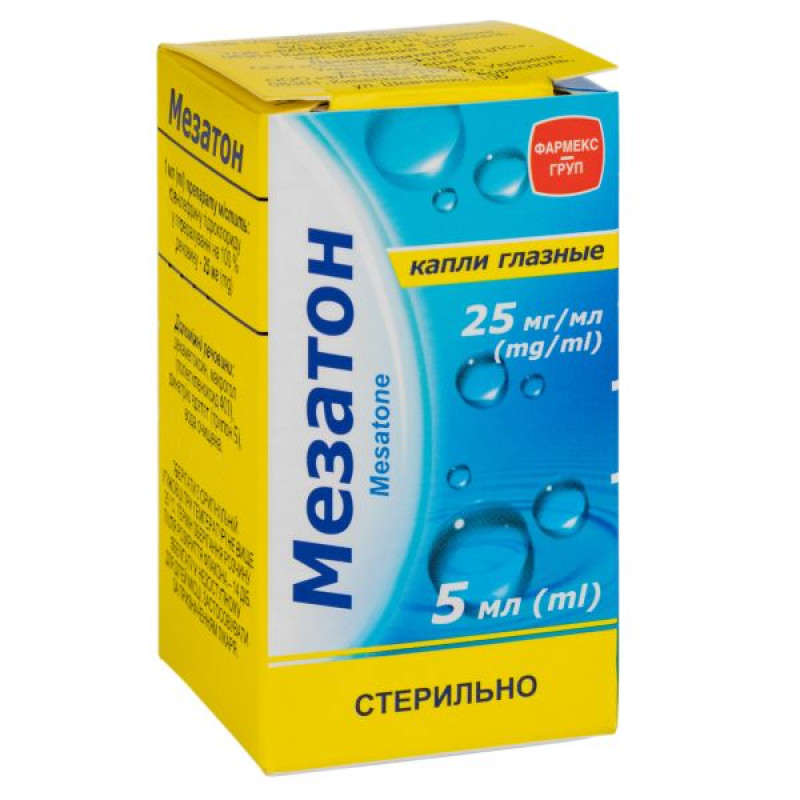
Instructions for use Mezaton eye drops 25 mg/ml bottle with dropper cap 5 ml
Composition
active ingredient: phenylephrine;
1 ml of solution contains phenylephrine hydrochloride in terms of 100% substance – 25 mg;
excipients: decamethoxine, macrogol (polyethylene glycol 400), disodium edetate (trilon B), purified water.
Dosage form
Eye drops.
Main physicochemical properties: transparent colorless or yellowish liquid.
Pharmacotherapeutic group
Eye drops.
Main physicochemical properties: transparent colorless or yellowish liquid.
Pharmacological properties
Pharmacodynamics
Drugs used in ophthalmology. Mydriatic and cycloplegic drugs. ATX code S01F B01.
Pharmacokinetics
The drug has a pronounced stimulating effect on postsynaptic α-adrenoreceptors, while the effect on β-adrenoreceptors of the heart is almost not expressed. The drug exhibits a vasoconstrictor effect similar to the action of noradrenaline, but it has practically no chronotropic and inotropic effect on the heart. The vasopressor effect of the drug is less pronounced than that of noradrenaline, but much longer. When used in usual doses, it does not exhibit a significant stimulating effect on the central nervous system. After instillation, phenylephrine contracts the pupil dilator, thereby causing its expansion, and the smooth muscles of the conjunctival arterioles. There is no effect on the ciliary muscle, so mydriasis occurs without cycloplegia.
Indication
Iridocyclitis, anterior uveitis (for the purpose of treatment and prevention of posterior synechiae and reduction of exudation from the iris).
Diagnostic pupil dilation during ophthalmoscopy and other diagnostic procedures necessary to determine the condition of the posterior segment of the eye).
Performing a provocation test in patients with a narrow anterior chamber angle profile and suspected angle-closure glaucoma.
Differential diagnosis of eyeball injection type.
Pupil dilation during laser interventions on the fundus and vitreoretinal surgery.
"Red eye" syndrome (reduction of hyperemia and irritation of the eye membranes).
Complex therapy of accommodation spasm in school-age children.
Treatment and prevention of asthenopia.
Contraindication
Hypersensitivity to any component of the drug.
Narrow-angle or angle-closure glaucoma.
Significant disorders of the cardiovascular system (heart disease, hypertension, aneurysm, tachycardia), especially in elderly patients.
Insulin-dependent diabetes mellitus.
Thyrotoxicosis.
Hyperthyroidism.
Concomitant use with monoamine oxidase inhibitors (MAOIs) and within 2 weeks after discontinuation of treatment with MAOIs.
Additional pupil dilation during surgery in patients with impaired eyeball integrity or impaired tear secretion.
Concomitant use with tricyclic antidepressants, antihypertensive drugs (including β-blockers).
Congenital deficiency of glucose-6-phosphate dehydrogenase.
Hepatic porphyria.
It is contraindicated to use:
low birth weight newborns; newborns and infants with cardio- or cerebrovascular disorders; elderly patients with severe arteriosclerotic, cardiovascular or cerebrovascular diseases.
Interaction with other medicinal products and other types of interactions
The mydriatic effect of phenylephrine is enhanced by topical atropine and attenuated by topical application of other ophthalmic preparations containing miotics. The drug may inhibit the ability of miotics to reduce intraocular pressure.
The mydriatic effect of phenylephrine is enhanced by topical application of atropine.
Antihypertensive drugs (including β-blockers) are contraindicated for use simultaneously with phenylephrine for topical use, since the reverse effect of many antihypertensive drugs is possible, which can have fatal consequences, arterial hypertension is possible.
MAO inhibitors. Phenylephrine is contraindicated during use of MAO inhibitors and for 2 weeks after discontinuation of MAO inhibitors. Concomitant use with MAO inhibitors within 21 days after discontinuation of their use should be carried out with caution, since the development of systemic adrenergic effects is possible.
Tricyclic antidepressants are contraindicated for use with phenylephrine. The vasopressor effect of adrenergic agents may be potentiated by tricyclic antidepressants (there is a risk of cardiac arrhythmia, including within several days after discontinuation of their use), propranolol, reserpine, guanethidine, methyldopa and m-cholinoblockers.
Inhalation anesthesia. The drug may potentiate cardiovascular depression during inhalation anesthesia. Due to the increased risk of ventricular fibrillation, the drug should be used with caution during general anesthesia with anesthetics such as halothane (fluorothane), which cause increased myocardial sensitivity to sympathomimetics.
Cardiac glycosides or quinidine: Increased risk of arrhythmia.
Before driving or operating machinery, you must wait until your vision has fully recovered.
Ability to influence reaction speed when driving vehicles or other mechanisms
Before driving or operating machinery, you must wait until your vision has fully recovered.
Use during pregnancy or breastfeeding
Not studied. Use is possible if the expected benefit to the mother outweighs the risk to the fetus or child. Breastfeeding should be discontinued during treatment with the drug.
Method of administration and doses
When performing ophthalmoscopy, use a single instillation of a 2.5% solution. As a rule, to achieve mydriasis, it is enough to instill 1 drop of a 2.5% solution of the drug into the conjunctival sac. Maximum mydriasis is achieved after 15–30 minutes and remains at a sufficient level for 1–3 hours. If it is necessary to maintain mydriasis for a long time, repeated instillation is possible after 1 hour.
For diagnostic procedures, a single instillation of a 2.5% solution is used:
as a provocative test in patients with a narrow anterior chamber angle profile and suspected angle-closure glaucoma. If the difference between the intraocular pressure values before instillation and after pupil dilation is from 3 to 5 mm Hg. Art., the provocative test is considered positive; for differential diagnosis of the type of eyeball injection: if 5 minutes after instillation, narrowing of the vessels of the eyeball is noted, the injection is classified as superficial; if redness of the eye persists, the patient must be carefully examined for the presence of iridocyclitis or scleritis, as this indicates dilation of the vessels in the deeper layers of the eye tissues; in iridocyclitis, anterior uveitis, it is used to treat and prevent the development of posterior synechiae; to reduce exudation into the anterior chamber of the eye. For this purpose, 1 drop of the drug is instilled into the conjunctival sac of the affected eye(s) 2–3 times a day.
Complex therapy of accommodation spasm and asthenopia in school-age children. For mild myopia, apply 1 drop of a 2.5% solution of the drug before bedtime on days of high visual load; for moderate myopia, apply 1 drop of a 2.5% solution 3 times a week before bedtime, and in the case of emmetropia (absence of myopia) - daily, regardless of visual load.
For patients with hyperopia who have a tendency to spasm, use a 2.5% solution of the drug in combination with 1 drop of 1% cyclopentolate before bedtime during periods of heavy visual stress, and during normal times use 3 times a week.
Use in elderly patients. No dose adjustment is necessary for elderly patients. Repeated instillations may produce less pronounced mydriasis.
When performing instillations, it is necessary to follow sanitary and hygienic rules, wash your hands with soap, and do not touch the dropper nozzle with your fingers.
Children
In pediatric practice, for diagnostic procedures (ophthalmoscopy, retinography), the drug can be used in children from the first days of life. Use in premature infants is possible with caution after a doctor assesses the risk-benefit ratio: no more than 1 drop in each eye.
Overdose
Even with topical application, manifestations of systemic action of phenylephrine are possible. Most often, this is a significant increase in blood pressure, reflex bradycardia.
Treatment: use of α-adrenergic blockers. In case of reflex bradycardia, atropine should be used (in children - at a dose of 0.01–0.02 mg/kg of body weight).
Adverse reactions
Immune system disorders: hypersensitivity, allergic conjunctivitis.
On the part of the organs of vision: eye pain, in some cases burning sensation (at the beginning of use), reactive hyperemia, blurred vision, irritation, allergic reactions, discomfort, lacrimation, increased intraocular pressure in patients with narrow-angle or angle-closure glaucoma, reactive miosis (the next day after use; repeated instillations may produce less pronounced mydriasis than the day before; the effect is more common in elderly patients). In premature newborns, periorbital pallor is possible.
Cardiovascular system: tachycardia, cardiac arrhythmias, including ventricular, arterial hypertension, reflex bradycardia, coronary artery occlusion, pulmonary embolism, myocardial infarction.
From the side of the central nervous system: headache, agitation, dizziness, tremor, paresthesia, insomnia.
Others: pallor of the face, weakness, shortness of breath, dyspeptic phenomena.
Reporting of suspected adverse reactions. After a medicinal product has been authorised, reporting of suspected adverse reactions is an important procedure. This allows monitoring of the benefit-risk balance of the medicinal product. Healthcare professionals can report all suspected adverse reactions through the national pharmacovigilance system.
Expiration date
2 years. Shelf life of the solution after opening the bottle is 14 days.
Storage conditions
Packaging
5 ml in a bottle with a dropper cap in a pack.
Vacation category
According to the recipe.
Producer
Limited Liability Company "Research Plant "GNTSLS". Limited Liability Company "PHARMEX GROUP".
Location of the manufacturer and its business address
Ukraine, Kharkiv region, Kharkiv city, Vorobyovy street, building 8. Ukraine, 08301, Kyiv region, Boryspil city, Shevchenko street, building 100.