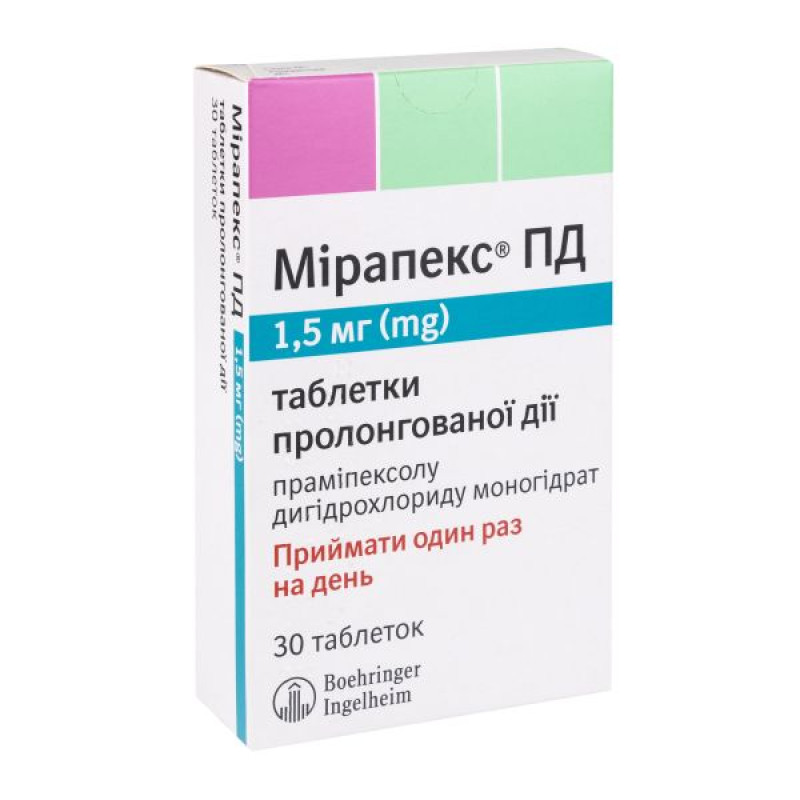
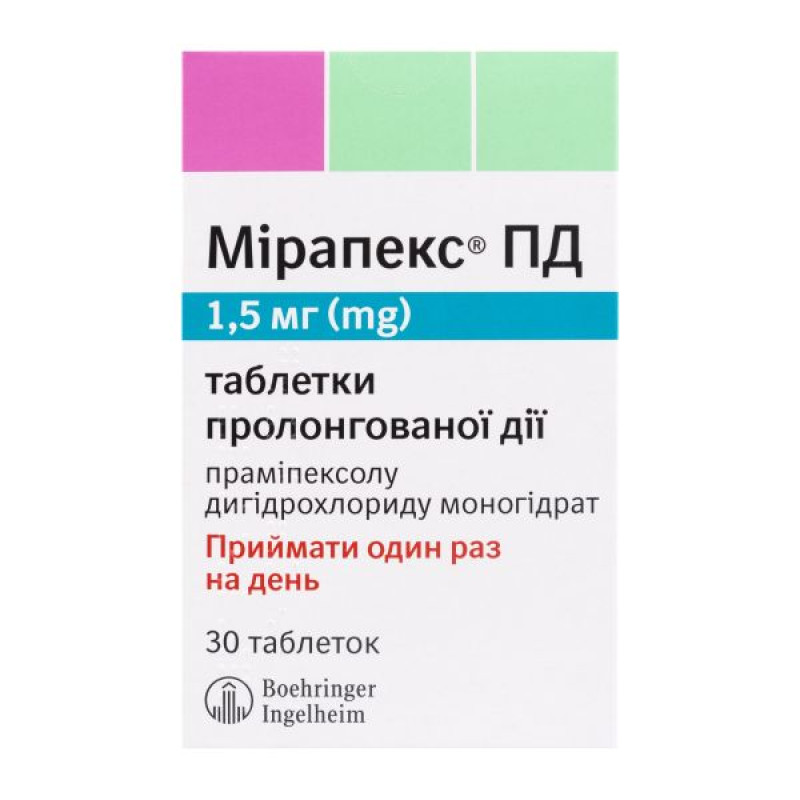
Instructions Mirapex PD prolonged-release tablets 1.5 mg blister No. 30
Composition
active ingredient: pramipexole;
1 extended-release tablet contains:
1.5 mg pramipexole dihydrochloride monohydrate, equivalent to 1.05 mg pramipexole;
excipients: hypromellose 2208, corn starch, carbomer 941, colloidal anhydrous silicon dioxide, magnesium stearate.
Dosage form
Extended-release tablets.
Main physicochemical properties:
For 1.5 mg tablets – white or almost white, oval, biconvex tablets with the company logo “VI” embossed on one side and “P3” on the other side.
Pharmacotherapeutic group
Dopaminergic drugs. Dopamine agonists.
ATX code N04B C05.
Pharmacological properties
Pharmacodynamics
Pramipexole is a dopamine agonist that binds with high selectivity and specificity to the D2 subfamily of dopamine receptors; among these, it has the predominant similarity to D3 receptors, as well as full inherent activity.
Pramipexole alleviates motor dysfunction characteristic of Parkinson's disease by stimulating dopamine receptors in the striatum.
Pharmacokinetics
Pramipexole is completely absorbed after oral administration. Absolute bioavailability exceeds 90%. In a phase I study in which pramipexole immediate-release and prolonged-release tablets were evaluated under fasting conditions, the minimum and maximum plasma concentrations (Cmin, Cmax) and the exposure (area under the pharmacokinetic curve (AUC)) of the same daily dose of MIRAPEX PD prolonged-release tablets administered once daily and MIRAPEX tablets administered three times daily were equivalent.
Taking MIRAPEX PD prolonged-release tablets once daily causes less fluctuation in pramipexole plasma concentrations over 24 hours compared to taking pramipexole immediate-release tablets three times daily. Peak plasma concentrations are reached approximately 6 hours after taking MIRAPEX PD prolonged-release tablets once daily. Steady-state effects are achieved after a maximum of 5 days of continuous dosing.
Co-administration with food generally does not affect the bioavailability of pramipexole. High-fat meals increased the maximum concentration (Cmax) by approximately 24% after a single dose and by approximately 20% after multiple doses, and delayed the time to maximum concentration by approximately 2 hours in healthy volunteers. Co-administration with food had no effect on the overall exposure (AUC). The increase in maximum concentration (Cmax) is not considered clinically relevant.
Body weight does not affect the area under the pharmacokinetic curve (AUC), but has been shown to affect the volume of distribution and therefore the maximum concentration (Cmax). A 30 kg increase in body weight results in a 45% increase in maximum concentration (Cmax). However, in phase III studies in patients with Parkinson's disease, no clinically significant effect of body weight on the therapeutic effect and tolerability of MIRAPEX PD prolonged-release tablets was found. Pramipexole exhibits linear kinetics and little inter-patient variability in plasma levels. In humans, the protein binding of pramipexole is very low (<20%) and the volume of distribution is large (400 l).
Pramipexole is only slightly metabolized in humans.
Renal excretion of unchanged pramipexole is the major route of elimination. Approximately 90% of the 14C-labeled dose is excreted renally, while less than 2% was recovered in the faeces. The total clearance of pramipexole is approximately 500 ml/min and the renal clearance is approximately 400 ml/min. The elimination half-life (t½) varies from 8 hours in young subjects to 12 hours in the elderly.
Indication
MIRAPEX PD is indicated in adults for the treatment of the symptoms of idiopathic Parkinson's disease, both alone (without levodopa) and in combination with levodopa, i.e. throughout the course of the disease. For the treatment of advanced stages when the effect of levodopa is weakening or becoming unstable, and there are fluctuations in the therapeutic effect (dose discontinuation or fluctuations according to the principle of "working - not working").
Contraindication
Hypersensitivity to the components of the drug.
Interaction with other medicinal products and other types of interactions
Binding to blood plasma proteins
The plasma protein binding of pramipexole is very low (< 20%), with little biotransformation observed in men. Therefore, interactions with other medicinal products that affect protein binding or elimination by biotransformation are unlikely. Since anticholinergics are eliminated primarily by biotransformation, the potential for interactions is limited, although interactions with anticholinergics have not been studied. There is no pharmacokinetic interaction with selegiline or levodopa.
Cimetidine reduced the renal clearance of pramipexole by approximately 34%, probably by inhibiting the cationic secretory transport system of the renal tubules. Therefore, medicinal products that are inhibitors of this metabolic pathway of active renal elimination or that are eliminated by this route, such as cimetidine, amantadine, mexiletine, zidovudine, cisplatin, quinine and procainamide, may interact with pramipexole, resulting in a decrease in the clearance of pramipexole. A reduction in the pramipexole dose should be considered when these medicinal products are co-administered with MIRAPEX PD.
Combination with levodopa
If MIRAPEX PD is taken simultaneously with levodopa, it is recommended to reduce the dose of levodopa and the dose of other drugs used in Parkinson's disease should be kept constant when the dose of MIRAPEX PD is increased.
Due to possible additive effects, patients should be advised to exercise caution when taking other sedative medicines or alcohol in combination with pramipexole (see sections 4.5, 4.8 and 4.9).
Antipsychotic medications
Concomitant use of antipsychotic medicinal products and pramipexole should be avoided (see section 4.5), e.g. if antagonistic effects are to be expected.
Application features
When prescribing MIRAPEX PD to patients with Parkinson's disease and renal insufficiency, it is recommended to reduce the dose (see section "Method of administration and dosage").
Hallucinations: Hallucinations are known to be a side effect of dopamine agonist and levodopa treatment. Patients should be informed that they may experience hallucinations (predominantly visual).
Dyskinesia: In advanced Parkinson's disease, dyskinesia may occur during the initial titration of MIRAPEX PD in combination with levodopa treatment. If this occurs, the levodopa dose should be reduced.
Dystonia
Axial dystonia including antecollis, camptocormia and pleurothotonus (Pisa syndrome) have occasionally been reported in patients with Parkinson's disease following initial or gradual dose increases of pramipexole. Although dystonia may be a symptom of Parkinson's disease, symptoms in these patients resolve after dose reduction or discontinuation of pramipexole.
If dystonia occurs, it is necessary to consider revising the treatment regimen with dopaminergic drugs and adjusting the dose of pramipexole.
Sudden onset of sleep or somnolence. Pramipexole has been associated with somnolence and sudden onset of sleep, particularly in patients with Parkinson's disease. Sudden onset of sleep during daytime activity, sometimes occurring without awareness or warning signs, has been reported rarely. Patients should be informed of this. They should be advised to exercise caution when driving or operating machinery during treatment with MIRAPEXIN. Patients who experience somnolence and/or sudden onset of sleep should refrain from driving or operating machinery. In addition, a dose reduction or discontinuation of treatment should be considered. Due to possible additive effects, caution is recommended when patients take other sedative medicines or alcohol in combination with pramipexole (see sections “Interaction with other medicinal products and other types of interactions”, “Ability to influence the speed of reactions when driving vehicles or using other mechanisms” and “Adverse reactions”).
Impulse control disorders. Patients should be monitored closely for the development of impulse control disorders. Patients and caregivers should be made aware that symptoms of impulse control disorders, including pathological gambling, increased libido, hypersexuality, compulsive spending or buying, binge eating and compulsive eating, may occur during treatment with dopamine agonists, including MIRAPEX PD. If such symptoms develop, dose reduction/discontinuation of the drug should be considered.
Mania and delirium: Patients should be monitored closely for the development of mania and delirium. Patients and caregivers should be made aware that mania and delirium can occur in patients receiving pramipexole therapy. If such symptoms develop, dose reduction/discontinuation of the drug should be considered.
Patients with psychotic disorders: Patients with psychotic disorders should only be treated with dopamine agonists if the potential benefits outweigh the risks. The concomitant use of antipsychotic medicinal products and pramipexole should be avoided (see section 4.5).
Ophthalmological observation. Ophthalmological observation is recommended to be carried out at regular intervals or when vision pathologies occur.
Dopamine agonist withdrawal syndrome has been observed with dopamine agonists, including pramipexole (see section 4.8). When discontinuing treatment in patients with Parkinson's disease, the dose of pramipexole should be tapered gradually (see section 4.2). Limited data suggest that patients with impulse control disorders and patients receiving high daily doses and/or high cumulative doses of dopamine agonists may be at increased risk of developing dopamine agonist withdrawal syndrome. Withdrawal symptoms may include apathy, anxiety, depression, fatigue, sweating, pain and lack of response to levodopa. Before reducing the dose and discontinuing pramipexole, patients should be informed of the possible withdrawal symptoms. Patients should be closely monitored during dose reduction and discontinuation of pramipexole. In case of severe and/or persistent symptoms of dopamine agonist withdrawal syndrome, temporary re-administration of pramipexole at the lowest effective dose may be considered.
Severe cardiovascular disease. Caution should be exercised in severe cardiovascular disease. Monitoring of blood pressure is recommended, especially at the beginning of treatment, due to the general risk of orthostatic hypotension associated with dopaminergic therapy.
Neuroleptic malignant syndrome: Symptoms suggestive of neuroleptic malignant syndrome have been reported. In such cases, dopaminergic therapy was discontinued immediately (see section 4.2).
Residues in feces
Some patients have reported the appearance of residues in the feces, which may resemble whole Mirapex PD prolonged-release tablets. If such a report is received from a patient, the physician should review the patient's response to therapy.
Ability to influence reaction speed when driving vehicles or other mechanisms
MIRAPEX PD may have a significant influence on the ability to drive or use machines. Hallucinations or drowsiness may occur.
Patients treated with MIRAPEX PD who experience somnolence and/or sudden sleep onset episodes should be advised to refrain from driving or engaging in activities where impaired alertness may put themselves or others at risk of serious injury or death (e.g. operating machinery) until the recurrence and somnolence have resolved.
Use during pregnancy or breastfeeding
Pregnancy: The effects on pregnancy and lactation have not been studied in humans. MIRAPEX PD should not be used during pregnancy unless clearly necessary, i.e. when the potential benefit justifies the potential risk to the fetus.
Breastfeeding. Since treatment with pramipexole inhibits prolactin secretion in humans, inhibition of lactation is expected. The excretion of pramipexole into human milk has not been studied. In the absence of relevant human data, MIRAPEX PD should not be used during breast-feeding. However, if the use of this drug cannot be avoided, breast-feeding should be discontinued.
Fertility: No studies on the effects on human fertility have been conducted.
Method of administration and doses
MIRAPEX PD extended-release tablets are a dosage form of pramipexole intended for oral administration once daily.
Initial therapy
Doses should be increased gradually, starting at 0.375 mg pramipexole dihydrochloride monohydrate per day, with subsequent increases every 5-7 days. If patients do not experience intolerable adverse reactions, dose titration should be performed to achieve maximum therapeutic effect.
| MIRAPEX PD extended-release tablet dose increase schedule | |
| Week | Daily dose (mg) of pramipexole dihydrochloride monohydrate |
| 1 | 0.375 |
| 2 | 0.75
|
| 3 | 1.5 |
If necessary, the daily dose should be increased at weekly intervals by 0.75 mg to a maximum dose of 4.5 mg pramipexole dihydrochloride monohydrate per day.
However, it should be noted that the likelihood of drowsiness increases when taking doses exceeding 1.5 mg of pramipexole dihydrochloride monohydrate per day (see section "Adverse reactions").
Patients already taking MIRAPEX tablets may be switched to MIRAPEX PD prolonged-release tablets. This is best done at night, maintaining the same daily dose. After switching to MIRAPEX PD prolonged-release tablets, the dose may be adjusted depending on the patient's response to treatment (see section "Pharmacodynamics").
The maximum dose of pramipexole should be in the range of 0.375 mg to a maximum of 4.5 mg pramipexole dihydrochloride monohydrate per day. When increasing the dose in pilot studies, efficacy was observed with a daily dose of 1.5 mg pramipexole dihydrochloride monohydrate. Further dose adjustments should be made taking into account the clinical response and adverse reactions. During clinical studies, approximately 5% of patients were treated with doses not exceeding 1.5 mg pramipexole dihydrochloride monohydrate. In progressive Parkinson's disease, patients may benefit from doses of pramipexole greater than 1.5 mg pramipexole dihydrochloride monohydrate per day if levodopa tapering is planned. It is recommended to reduce the dose of levodopa when increasing the dose of MIRAPEX PD tablets, as well as during maintenance therapy with this drug, depending on the reactions of individual patients (see section "Interaction with other medicinal products and other types of interactions").
Missed pill
If a dose is missed, the MIRAPEX PD extended-release tablet should be taken within 12 hours of the usual time of taking it. If more than 12 hours have passed since the missed dose, the tablet should not be taken and the next dose should be taken the next day at the usual time.
Discontinuation of treatment.
Abrupt discontinuation of dopaminergic therapy may lead to the development of neuroleptic malignant syndrome or dopamine agonist withdrawal syndrome. Therefore, the dose of pramipexole should be reduced gradually, at a rate of 0.75 mg pramipexole dihydrochloride monohydrate per day until the daily dose is reduced to 0.75 mg pramipexole dihydrochloride monohydrate. Thereafter, the dose should be reduced to 0.375 mg pramipexole dihydrochloride monohydrate per day (see section 4.4). Dopamine agonist withdrawal syndrome may occur during gradual dose reduction. Therefore, a temporary increase in dose may be necessary before resuming the dose reduction (see section 4.4).
Dosage for patients with renal insufficiency
The excretion of pramipexole depends on renal function. The following dosage regimen is suggested:
Patients with creatinine clearance above 50 ml/min do not need to reduce the daily dose or frequency of dosing; Patients with creatinine clearance from 30 to 50 ml/min should start treatment with 0.375 mg pramipexole dihydrochloride monohydrate every other day. Before increasing the daily dose, which is carried out after 1 week of treatment, caution should be exercised and a careful assessment of the response to treatment and tolerability of the treatment should be carried out. If necessary, the dose should be increased at weekly intervals by 0.375 mg to a maximum dose of 2.25 mg pramipexole dihydrochloride monohydrate per day; Treatment with MIRAPEX PD prolonged-release tablets is not recommended in patients with creatinine clearance less than 30 ml/min, since there are no data for this category of patients. The possibility of using MIRAPEX PD tablets should be considered.
If renal function deteriorates during maintenance therapy, the above recommendations should be followed.
Dosage for patients with hepatic impairment
No dose adjustment is likely to be necessary for patients with hepatic impairment, as approximately 90% of the absorbed active substance is excreted by the kidneys. However, the potential effect of hepatic impairment on the pharmacokinetics of the drug has not been studied.
Method of application
The tablets should be swallowed whole with water, do not chew, divide or crush. Food intake does not affect the absorption of the drug. MIRAPEX PD should be taken at approximately the same time each day.
Children
The safety and efficacy of MIRAPEX PD in children (under 18 years of age) have not been established. There is no evidence to support the use of MIRAPEX PD in children with Parkinson's disease.
Overdose
There is no clinical experience of significant overdose. Adverse reactions expected to occur may be those associated with the pharmacodynamic profile of a dopamine agonist, including nausea, vomiting, hyperkinesia, hallucinations, anxiety and hypotension. There is no established antidote for dopamine agonist overdose. If there are signs of central nervous system stimulation, a neuroleptic agent may be indicated. Treatment of overdose may require general supportive measures including gastric lavage, intravenous fluids, administration of activated charcoal and monitoring of the electrocardiogram.
Adverse reactions
Expected adverse reactions
An analysis of pooled placebo-controlled trials involving a total of 1,778 patients with Parkinson's disease who took pramipexole and 1,297 patients who took placebo showed that adverse reactions were common in both groups. At least one adverse reaction was reported in 67% of patients taking pramipexole and 54% of patients taking placebo.
Within the system organ class classification, adverse reactions are presented by frequency (number of patients expected to experience the reaction) using the following categories: very common (≥ 1/10); common (≥ 1/100 - < 1/10); uncommon (≥ 1/1000 - < 1/100); rare (< 1/10000); not known (cannot be estimated from the available data).
The most frequently reported adverse drug reactions (≥ 5%) in patients with Parkinson's disease (more frequently with pramipexole than with placebo) were nausea, dyskinesia, hypotension, dizziness, somnolence, insomnia, constipation, hallucinations, headache and fatigue. The incidence of somnolence increases with doses above 1.5 mg pramipexole dihydrochloride monohydrate per day (see section 4.2). The most frequently reported adverse drug reaction with concomitant levodopa use was dyskinesia. Hypotension may occur at the beginning of treatment, especially if pramipexole is titrated too rapidly.
| Organ system class | Very common (≥ 1/10) | Common (≥ 1/100 - <1/10) | Uncommon (≥ 1/1000 - < 1/100) | Uncommon (≥1/10,000 – < 1/1000) | Unknown (cannot be determined based on available data) |
| Infections and infestations | | | pneumonia | | |
| From the endocrine system | | | impaired secretion of antidiuretic hormone1 | | |
| Mental disorders | | insomnia, hallucinations, sleep disturbances, confusion, symptoms of impulse control disorder and compulsive behavior | pathological shopping, pathological gambling, anxiety, hypersexuality, delusions, libido disorders, paranoia, delirium, binge eating1, hyperphagia1 | mania | |
| From the nervous system | drowsiness, dizziness, dyskinesia | headache | sudden sleep onset, amnesia, hyperkinesia, syncope | | |
| From the organs of vision | | visual disturbances, including diplopia, blurred vision, and decreased visual acuity | | | |
| Cardiovascular system | | arterial hypotension | heart failure1 | | |
| Respiratory, thoracic and mediastinal disorders | | | shortness of breath, hiccups | | |
| From the digestive system | nausea | constipation, vomiting | | | |
| Skin and subcutaneous tissue disorders | | hypersensitivity, itching, rash | | | |
| General disorders | | increased fatigue, peripheral edema | | | dopamine agonist withdrawal syndrome (including apathy, anxiety, depression, fatigue, sweating, and pain) |
| Research | | weight loss, including decreased appetite | weight gain | | |
1 This adverse reaction has been observed in the post-marketing period. The frequency category was determined with 95% confidence as uncommon, but may be lower. It is not possible to establish a precise frequency as the adverse reaction was not observed in clinical trials among 2762 patients with Parkinson's disease treated with pramipexole.
Description of selected adverse reactions:
Somnolence: Pramipexole is commonly associated with somnolence and uncommonly with excessive daytime sleepiness and sudden sleep onset episodes (see section 4.4).
Libido disorders: Pramipexole may be uncommonly associated with libido disorders (increased or decreased).
Impulse control disorders: Symptoms of impulse control disorders, including pathological gambling, increased libido, hypersexuality, compulsive spending or buying, binge eating and compulsive eating, may occur during treatment with dopamine agonists, including MIRAPEX PD (see section 4.4).
In a retrospective cross-sectional screening and case-control study of 3090 patients with Parkinson's disease, 13.6% of all patients receiving dopaminergic or non-dopaminergic therapy had symptoms of an impulse control disorder in the previous six months. The symptoms observed included pathological gambling, compulsive shopping, binge eating, and compulsive sexual behavior (hypersexuality). Possible independent risk factors for impulse control disorders included dopaminergic therapy and higher doses of dopaminergic therapy, younger age (≤ 65 years), unmarried status, and a self-reported family history of pathological gambling.
Heart Failure: Heart failure has been observed in patients treated with pramipexole in clinical trials and post-marketing experience. In a pharmacoepidemiological study, pramipexole use was associated with an increased risk of heart failure compared with no use (hazard ratio, 1.86; 95% CI, 1.21-2.85).
Expiration date
3 years.
Storage conditions
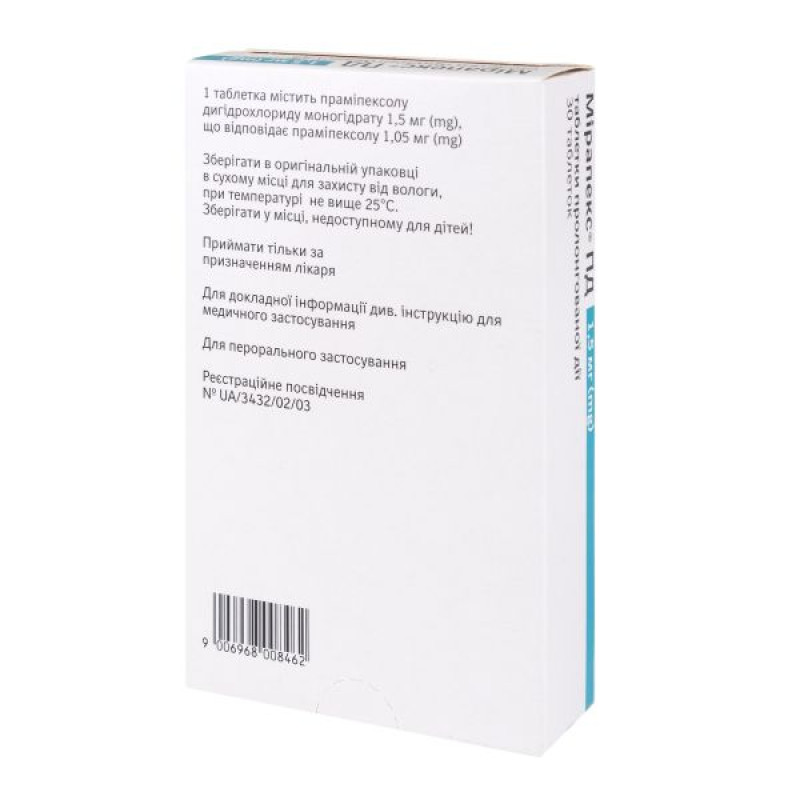
Store in the original packaging in a dry place to protect from moisture, at a temperature not exceeding 25 ° C. Keep out of the reach of children!
Packaging
10 tablets in a blister; 3 blisters in a cardboard box.
Vacation category
According to the recipe.
Producer
Boehringer Ingelheim Pharma GmbH & Co. KG, Germany.
Location of the manufacturer and its business address
Binger Strasse 173, 55216 Ingelheim am Rhein, Germany.