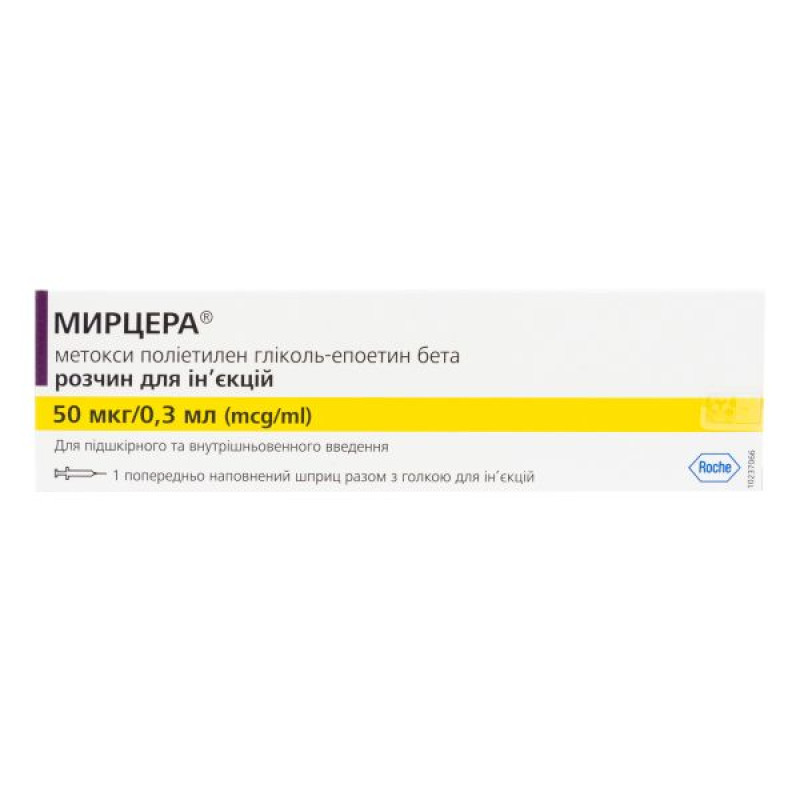
Instructions for Mircera injection solution 50 mcg syringe tube 0.3 ml No. 1
Composition
active ingredient: methoxy polyethylene glycol-epoetin beta;
1 pre-filled syringe with 0.3 ml solution for injection contains 50 mcg or 75 mcg methoxy polyethylene glycol-epoetin beta;
Excipients: L-methionine; sodium sulfate anhydrous; sodium dihydrogen phosphate, monohydrate; mannitol (E 421); poloxamer 188; diluted hydrochloric acid or sodium hydroxide solution (qs to pH 6.2); water for injections.
Dosage form
Solution for injection.
Main physicochemical properties: clear liquid from colorless to slightly yellowish.
Pharmacotherapeutic group
Other antianemic agents. ATX code B03X A03.
Pharmacological properties
Pharmacodynamics
Mircera stimulates erythropoiesis by interacting with erythropoietin receptors on bone marrow progenitor cells. Methoxy polyethylene glycol-epoetin beta, the active substance of Mircera, is a long-acting erythropoietin receptor activator that, unlike erythropoietin, exhibits different activity at the receptor level, characterized by slower binding and faster dissociation from the receptor, reduced specific activity in vitro and increased activity in vivo, and a longer half-life. The average molecular weight of methoxy polyethylene glycol-epoetin beta is approximately 60 kDa, including approximately 30 kDa of protein and carbohydrate moiety.
The dose of the drug indicates the amount of protein in the methoxy polyethylene glycol-epoetin beta molecule without taking into account glycosylation. The protein is synthesized by recombinant DNA technology in Chinese hamster ovary cells and is covalently conjugated to linear polyethylene glycol (PEG).
The natural hormone erythropoietin, the primary growth factor for erythroid development, is produced by the kidneys and released into the vasculature in response to hypoxia. In response to hypoxia, erythropoietin interacts with erythropoietic progenitor cells, leading to increased red blood cell production.
Clinical efficacy
Results from the anaemia correction studies in patients treated with MIRCERA every 2 weeks or every 4 weeks demonstrated that the haemoglobin response rate in the MIRCERA group at the end of the correction period was high and comparable to the comparator groups. The median duration of response was 43 days in the MIRCERA group and 29 days in the comparator group, with haemoglobin increases of 0.2 g/dL/week and 0.3 g/dL/week, respectively, over the first 6 weeks.
To date, 4 randomized controlled trials have been conducted in patients on dialysis who were receiving darbepoetin alfa or epoetin at study entry. At study entry, patients were randomized to receive their previous erythropoietin therapy or to switch to MirceraÒ to achieve stable hemoglobin levels. During the evaluation period (weeks 29-36), the mean and median hemoglobin levels in patients receiving MirceraÒ were virtually identical to baseline hemoglobin levels.
Mircera is not approved for the treatment of patients with chemotherapy-induced anemia.
Pharmacokinetics
The pharmacokinetics of methoxy polyethylene glycol-epoetin beta have been studied in healthy volunteers and in patients with chronic kidney disease and anemia, including patients on/not on dialysis.
Following subcutaneous administration to patients with chronic kidney disease not on dialysis, peak serum concentrations of methoxy polyethylene glycol-epoetin beta were observed 95 hours (mean) after administration. The absolute bioavailability of methoxy polyethylene glycol-epoetin beta following subcutaneous administration was 54%. The terminal half-life was 142 hours in patients with chronic kidney disease not on dialysis.
Following subcutaneous administration to patients with chronic kidney disease on dialysis, peak serum concentrations of methoxy polyethylene glycol-epoetin beta were observed 72 hours (mean) after administration. The absolute bioavailability of methoxy polyethylene glycol-epoetin beta after subcutaneous administration was 62%. The terminal half-life was 139 hours in patients with chronic kidney disease on dialysis.
After intravenous administration to patients with chronic kidney disease on dialysis, the total systemic clearance was 0.494 ml/h/kg. After intravenous administration, the elimination half-life of methoxy polyethylene glycol-epoetin beta was 134 hours.
In a single-dose study following intravenous administration, the pharmacokinetics of methoxy polyethylene glycol-epoetin beta are comparable in patients with severe hepatic impairment and in healthy volunteers (see section 4.2).
Indication
Treatment of symptomatic anemia associated with chronic kidney disease.
Contraindication
Hypersensitivity to methoxy polyethylene glycol-epoetin beta or to any of the excipients of the drug (see section "Excipients"). Uncontrolled arterial hypertension.
Interaction with other medicinal products and other types of interactions
Drug interaction studies with Mircera have not been conducted. There is no evidence that Mircera affects the metabolism of other drugs.
Application features
The safety and efficacy of Mircera therapy in other indications, including anemia in patients with malignant tumors, have not been established.
Caution should be exercised when increasing the dose of Mircera in patients with chronic renal failure, as high cumulative doses of epoetin may be associated with an increased risk of fatal, serious cardiovascular and cerebrovascular events. If the patient has a poor haemoglobin response to epoetin therapy, alternative explanations should be considered (see section 4.2).
Supplemental iron therapy is recommended for all patients with serum ferritin levels less than 100 μg/L or transferrin iron saturation less than 20%. To ensure effective erythropoiesis, iron levels should be determined in all patients before and during treatment.
In the absence of response to treatment with Mircera, it is necessary to initiate a search for causal factors. Iron, folic acid and vitamin B12 deficiencies reduce the effectiveness of therapy with erythropoiesis-stimulating agents, therefore the deficiency of these substances must be corrected. Intercurrent infections, inflammatory processes, injuries, latent blood loss, hemolysis, severe aluminum toxicity, existing blood diseases, bone marrow fibrosis can also lead to a decrease in the effectiveness of therapy with erythropoiesis-stimulating agents. When examining patients, the number of reticulocytes should also be determined. In case of exclusion of the listed conditions and in case of a sudden decrease in hemoglobin levels associated with reticulocytopenia and the detection of antibodies to erythropoietin, it is necessary to conduct a bone marrow study to exclude the diagnosis of pure red cell aplasia. If a diagnosis of pure red cell aplasia is confirmed, treatment with Mircera should be discontinued and patients should not be switched to other agents that stimulate erythropoiesis.
Upon request by the physician, Roche will offer testing or retesting of serum samples in a reference laboratory. This service is free of charge in case of suspected or confirmed pure red cell aplasia mediated by anti-erythropoietin antibodies or unexplained loss of effect during treatment with MirceraÒ (e.g. clinically observed as severe anemia with low reticulocyte count).
Pure red cell aplasia due to antibodies to erythropoietin has been reported with all erythropoiesis-stimulating agents, including Mircera. Antibodies to erythropoietin have been shown to cross-react with all erythropoiesis-stimulating agents. Patients with suspected or confirmed antibodies to erythropoietin should not be switched to Mircera (see section 4.8).
Pure red cell aplasia in patients with hepatitis C virus: If a paradoxical decrease in hemoglobin levels and the development of severe anemia associated with a low reticulocyte count occurs, epoetin therapy should be discontinued and the patient should be tested for antibodies to erythropoietin. Cases of pure red cell aplasia have been reported in patients with hepatitis C who were treated with interferon and ribavirin concomitantly with epoetins. Epoetins are not approved for use in anemia associated with hepatitis C virus.
Severe cutaneous adverse reactions, including Stevens-Johnson syndrome (SJS) and toxic epidermal necrolysis (TEN), which can be life-threatening or fatal, have been reported in association with epoetin treatment (see section 4.8). More severe cases have been observed with long-acting epoetins. Patients should be informed of the symptoms of such reactions when prescribing the drug and should be closely monitored for the development of skin reactions. If signs suggestive of such reactions appear, Mircera® should be discontinued immediately and alternative treatment should be considered. In the event of a severe skin reaction such as SJS or TEN due to Mircera®, treatment with erythropoiesis-stimulating medicinal products should not be re-administered to the patient.
Hemoglobin concentration: In patients with chronic kidney disease, hemoglobin concentration should not exceed the upper limit of normal for the target hemoglobin concentration recommended in the Dosage and Administration section. In clinical trials, an increased risk of fatal events and serious cardiovascular events, including thrombosis or cerebrovascular events, including stroke, has been observed when erythropoiesis-stimulating agents are used to achieve a hemoglobin target above 12 g/dL (7.5 mmol/L) (see Adverse Reactions section).
Controlled clinical trials have not demonstrated a significant benefit from the use of epoetins in increasing hemoglobin concentrations beyond the level necessary to control symptoms of anemia and avoid blood transfusion.
The safety and efficacy of Mircera treatment have not been established in patients with hemoglobinopathies, seizures, bleeding, including a history of recent bleeding requiring blood transfusions, and platelet counts greater than 500 × 109/L. Therefore, Mircera should be used with caution in these patients.
Effect on tumor growth: Mircera, like other erythropoiesis-stimulating agents, is a growth factor that primarily stimulates the production of red blood cells. Erythropoietin receptors can be expressed on the surface of various tumor cells. It is believed that erythropoiesis-stimulating agents, like other growth factors, can stimulate the growth of any type of malignant tumor. In two controlled clinical trials in which epoetins were administered to patients with various tumors, including head and neck cancer and breast cancer, an increase in deaths was observed, the causes of which are unclear.
Misuse of Mircera by healthy individuals may result in excessive increases in hemoglobin levels, which may be associated with life-threatening cardiovascular complications.
In order to improve the tracking of the use of erythropoiesis-stimulating agents, the trade name of these agents should be clearly stated in the patient's medical records.
The medicine contains less than 1 mmol sodium (23 mg) per ml, i.e. essentially sodium-free.
Disposal of unused and expired medicinal products: The release of the medicinal product into the environment should be minimised. The medicinal product should not be disposed of in wastewater or household waste. For disposal, use a so-called “waste collection system” if available.
Ability to influence reaction speed when driving vehicles or other mechanisms
The drug has no or negligible influence on the ability to drive and use machines.
Use during pregnancy or breastfeeding
Pregnancy
There are no data on the use of Mircera in pregnant women.
Animal studies do not indicate direct harmful effects of Mircera on pregnancy, embryonal/fetal development, parturition or postnatal development, but reversible reductions in fetal weight have been observed in association with the use of a class of erythropoiesis-stimulating agents. Mircera should be used with caution in pregnant women.
Breastfeeding period
It is not known whether Mircera is excreted in human milk. In one animal study, methoxy polyethylene glycol-epoetin beta was shown to be excreted in human milk. A decision on whether to continue/discontinue breast-feeding or to continue/discontinue therapy with Mircera should be made taking into account the benefit of breast-feeding to the child and the benefit of Mircera therapy to the woman.
Fertility
Animal studies have not shown any evidence of impaired fertility. The potential risk to humans is unknown.
Method of administration and doses
Treatment with Mircera should be supervised by a physician experienced in the treatment of patients with renal insufficiency.
Mircera can be administered subcutaneously or intravenously. Mircera is administered subcutaneously in the abdomen, upper arm, or thigh. These sites are equally suitable for subcutaneous administration.
Symptoms of anemia and its consequences can vary depending on age, gender, and overall severity of the disease, so a doctor's assessment of the individual course of the disease and the patient's condition is necessary.
The drug can be administered subcutaneously or intravenously to increase hemoglobin to a level not exceeding 12 g/dL (7.45 mmol/L). Subcutaneous administration should be preferred in patients not on hemodialysis to avoid puncture of peripheral veins.
Due to individual variability, it is rare for an individual patient to experience a haemoglobin level higher or lower than the desired haemoglobin level. Haemoglobin variability can be managed by adjusting the dose to a target haemoglobin range of 10 g/dl (6.21 mmol/l) to 12 g/dl (7.45 mmol/l). A sustained increase in haemoglobin above 12 g/dl (7.45 mmol/l) should be avoided; recommendations for appropriate dose adjustment for haemoglobin levels above 12 g/dl (7.45 mmol/l) are provided below.
An increase in hemoglobin levels above 2 g/dL (1.24 mmol/L) over a 4-week period should be avoided. If this occurs, the dose of Mircera should be adjusted.
Patients should be closely monitored to ensure that they receive the lowest approved effective dose of Mircera to adequately control symptoms of anemia while maintaining hemoglobin concentrations below or at 12 g/dL (7.45 mmol/L).
Caution should be exercised when increasing the dose of Mircera in patients with chronic renal failure. If a patient has a poor haemoglobin response to Mircera, alternative explanations should be considered (see section 4.4).
Hemoglobin levels should be monitored every 2 weeks until they stabilize, with subsequent periodic monitoring.
Patients not currently receiving treatment with erythropoiesis-stimulating agents
For patients not on dialysis, the recommended starting dose is 1.2 mcg/kg body weight once monthly subcutaneously to achieve a hemoglobin level above 10 g/dL (6.21 mmol/L).
Alternatively, the recommended starting dose of 0.6 mcg/kg body weight administered subcutaneously or intravenously every 2 weeks may be administered to patients on dialysis and to patients not on dialysis.
If the hemoglobin level increases by less than 1 g/dL (0.621 mmol/L) within one month, the dose of Mircera may be increased by approximately 25% of the previous dose. Further increases of the dose of Mircera by approximately 25% may be made at 1-month intervals until the individual hemoglobin target level is reached.
If the hemoglobin level increases by more than 2 g/dL (1.24 mmol/L) during the first month of treatment or if the hemoglobin level increases to 12 g/dL (7.45 mmol/L), the dose of Mircera should be reduced by approximately 25%. If the hemoglobin level continues to increase, treatment should be interrupted until the hemoglobin level decreases, then Mircera should be resumed at a dose that is approximately 25% lower than the previous dose. After interruption of treatment, a decrease in hemoglobin level of approximately 0.35 g/dL (0.22 mmol/L) per week is expected. Dose adjustment of the drug should not be made more often than once a month.
Patients receiving Mircera every other week and whose hemoglobin level exceeds 10 g/dL (6.21 mmol/L) may be given Mircera once a month at a dose equal to twice the dose administered every other week.
Patients currently receiving treatment with erythropoiesis-stimulating agents
Patients currently receiving erythropoiesis-stimulating agents may be switched to Mircera once monthly intravenously or subcutaneously. The starting dose of Mircera is calculated based on the previous weekly dose of darbepoetin alfa or epoetin administered at the time of the switch (Table 1). The first Mircera administration should be given on the day the previously administered darbepoetin alfa or epoetin would have been due.
Starting doses of Mircera
Weekly dose of darbepoetin alfa (mcg/week) previously used subcutaneously or intravenously | Weekly dose of epoetin (units/week) previously administered subcutaneously or intravenously | Monthly dose (mcg/once a month) of Mircera for subcutaneous or intravenous administration |
| <40 | < 8000 | 120 |
| 40-80 | 8000-16000 | 200 |
| >80 | > 16000 | 360 |
If dose adjustment is required to maintain the target hemoglobin concentration above 10 g/dL (6.21 mmol/L), the monthly dose of the drug may be increased by approximately 25%.
Due to limited experience in patients undergoing peritoneal dialysis, regular monitoring of hemoglobin levels and strict adherence to dose adjustment recommendations are recommended.
Treatment discontinuation
Treatment with Mircera is usually long-term. If necessary, treatment can be stopped at any time.
Missed dose
If a dose of Mircera is missed, it should be administered as soon as possible. Mircera administration should be resumed at the previously used frequency.
Special dosage recommendations
Use in children
Mircera is not recommended for use in children under 18 years of age due to the lack of data on the efficacy and safety of its use in this category of patients.
Elderly patients
In clinical trials, 24% of patients treated with Mircera were
was 65 to 74 years of age, 20% of patients were 75 years of age or older. No dose adjustment is required for elderly patients over 65 years of age.
Patients with hepatic insufficiency
No adjustment of the initial dose and dosing regimen of Mircera is required in patients with hepatic impairment.
Solution storage rules
The pre-filled syringe is ready for use. The sterile pre-filled syringe does not contain preservatives and each pre-filled syringe is for single use only. Only one dose should be administered using the pre-filled syringe. Only clear, colourless to slightly yellow solution, free from visible particles, should be used.
Do not shake.
Before use, the solution should be brought to room temperature. To do this, remove the cardboard box containing Mircera from the refrigerator. Without removing the syringe from the cardboard box to protect the product from light, leave the syringe for 30 minutes to allow the product to reach room temperature.
Failure to bring the product to room temperature may cause discomfort during injection and difficulty in pushing the plunger. Do not warm the syringe in any other way.
Instructions for use of the pre-filled syringe
Remove the Mircera blister pack from the cardboard packaging without opening the protective film. Wash your hands thoroughly with warm water and soap. Remove the protective film from the blister pack, remove the pre-filled syringe and the plastic container with the needle. Holding the container with the needle, remove the cap by making a clockwise rotation as shown in the figure. Holding the pre-filled syringe, remove the rubber tip by bending and pulling it as shown in the figure. Holding the transparent container with the needle, firmly insert the needle into the pre-filled syringe as shown in the figure. For subcutaneous administration of Mircera, choose one of the recommended body areas: the anterior abdominal wall, the anterior surface of the middle thigh or the outer surface of the shoulder. Do not inject the drug into birthmarks, scars, hematomas or areas with swelling, redness, hardening or other changes, as well as areas that may be irritated by a belt or waistband of clothing. Carefully treat the skin at the injection site with a swab moistened with alcohol. Wait until the treated area dries. Carefully holding the pre-filled syringe without pressing on the plunger, carefully remove the container from the needle. Hold the syringe only by its body, as any contact with the clips may lead to premature release of the safety device. Pinch the skin at the injection site with two fingers. Insert the needle into the skin fold at a right angle. Slowly inject all the drug, smoothly pressing on the plunger. Do not stop pressing on the plunger of the pre-filled syringe until you remove the needle from the skin! After injecting the entire dose, remove the needle from the skin without releasing the plunger of the pre-filled syringe, as shown in the figure. After releasing the plunger, the safety device will be released and cover the needle. Press the injection site of Mircera with a cotton swab. If necessary, cover the injection site with a plaster.
Children
Treatment with Mircera is not recommended for children (under 18 years of age) due to the lack of data on the efficacy and safety of the drug.
Overdose
Mircera has a wide therapeutic range. When initiating therapy, the individual response to therapy should be taken into account. Overdose may lead to an increase in the pharmacodynamic effect, i.e. excessive erythropoiesis. In case of excessive increase in hemoglobin levels, Mircera treatment should be temporarily discontinued (see section “Method of administration and dosage”). Phlebotomy may be recommended if clinically indicated.
Adverse reactions
The following criteria are used to describe the frequency of adverse reactions: very common (≥1/10); common (≥1/100 and <1/10); uncommon (≥1/1000 and <1/100); rare (≥1/10,000 and <1/1000); frequency unknown (cannot be estimated from the available data).
Adverse reactions associated with treatment with Mircera
patients with chronic kidney disease.
Adverse reactions that have only been observed during post-marketing use are marked with (*).
Blood and lymphatic system disorders: uncommon: thrombocytopenia*; frequency unknown: pure red cell aplasia*.
Immune system disorders: rare: hypersensitivity reactions; frequency unknown: anaphylactic reaction*.
Nervous system disorders: uncommon: headache; rare: hypertensive encephalopathy.
Cardiovascular system: common: arterial hypertension; uncommon: thrombosis*; rare: hot flashes, pulmonary embolism*.
Skin and subcutaneous tissue disorders: rare: maculopapular rash; frequency unknown: Stevens-Johnson syndrome/toxic epidermal necrolysis*.
Injury, poisoning and procedural complications: uncommon: shunt thrombosis.
Description of selected adverse reactions
Cases of thrombocytopenia have been reported during post-marketing use. In clinical trials, a slight decrease in platelet count within the normal range was reported.
In clinical trials, thrombocytopenia (platelet count <100 × 109/L) was observed in 7% of patients treated with Mircera and 4% of patients treated with other erythropoiesis-stimulating agents. In a post-marketing safety study with long-term treatment of up to 8.4 years, platelet counts <100 × 109/L at baseline were observed in 2.1% of patients in the Mircera group and 2.4% of patients in the other erythropoiesis-stimulating agents group. In this study, platelet counts <100 × 109/L were observed annually in 1.5–3.0% of patients treated with Mircera and 1.6–2.5% of patients treated with other erythropoiesis-stimulating agents.
Stroke was a common adverse reaction in controlled clinical trials with epoetin alfa or darbepoetin alfa. A post-marketing safety study showed a similar incidence of stroke in the MirceraÒ (6.3%) and reference erythropoiesis-stimulating agents (epoetin alfa, darbepoetin alfa, and epoetin beta) groups (7%).
As with other erythropoiesis-stimulating agents, cases of thrombosis, including pulmonary embolism, have been reported during post-marketing use (see section 4.4).
Cases of pure red cell aplasia mediated by the development of neutralizing antibodies to erythropoietin have been reported, the frequency of which is unknown. If a diagnosis of pure red cell aplasia is made, treatment with Mircera should be discontinued. Patients should not be switched to other recombinant erythropoietins (see section 4.4).
Expiration date
3 years.
Storage conditions
Keep out of reach of children. Store at 2 to 8°C in the original package in order to protect from light. Do not freeze.
The product can be removed from the refrigerator and stored once at room temperature (not above 30°C). The product should be used within this period, which should not exceed 1 month.
Packaging
50 mcg/0.3 ml in a pre-filled syringe. 1 pre-filled syringe together with an injection needle in a cardboard box.
Vacation category
According to the recipe.
Producer
Roche Diagnostics GmbH.
Location of the manufacturer and its business address
Sandhoferstrasse 116, 68305 Mannheim, Germany.