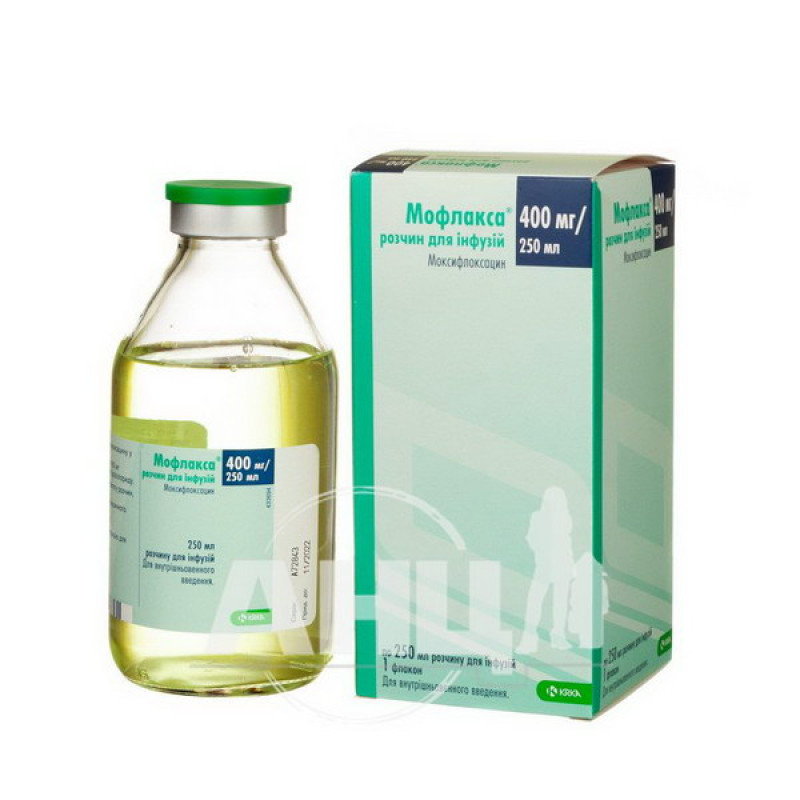
Moflax ® infusion solution is used for the following indications:
community-acquired pneumonia; complicated infectious diseases of the skin and subcutaneous tissues.
Moxifloxacin should only be used when other antibacterial drugs that are usually recommended for the initial treatment of these infections are inappropriate.
Composition
The active substance is moxifloxacin (1 ml of solution for infusion contains 1.6 mg of moxifloxacin in the form of moxifloxacin hydrochloride; 1 bottle (250 ml) contains 400 mg of moxifloxacin in the form of moxifloxacin hydrochloride).
Excipients: sodium chloride, sodium lactate solution, water for injections.
Contraindication
hypersensitivity to moxifloxacin, other quinolone antibiotics or to any of the excipients; pregnancy and breastfeeding; patient's age up to 18 years; history of tendon diseases/pathologies associated with the use of quinolones; during preclinical and clinical studies, changes in electrophysiological parameters of cardiac activity were observed after the administration of moxifloxacin, manifested by prolongation of the QT interval; for this reason, moxifloxacin is contraindicated in patients with: congenital or acquired prolongation of the QT interval; electrolyte imbalance, especially in the case of uncorrected hypokalemia; clinically significant bradycardia; clinically significant heart failure with reduced left ventricular ejection fraction; symptomatic arrhythmias in history; moxifloxacin can be used simultaneously with drugs that prolong the QT interval; Due to insufficient clinical experience, moxifloxacin is contraindicated in patients with impaired liver function and an increase in transaminase levels of five times or more.
Method of application
Dosage
The recommended dosage regimen is 400 mg of moxifloxacin as an infusion once daily.
Initial intravenous therapy may be continued with oral moxifloxacin tablets 400 mg if clinically indicated.
In clinical trials, most patients were switched to oral moxifloxacin within 4 days (communicable disease pneumonia) or 6 days (complicated skin and subcutaneous tissue infections). The recommended total duration of intravenous and oral treatment is 7-14 days for community-acquired pneumonia and 7-21 days for complicated skin and subcutaneous tissue infections.
Method of use
The drug should be administered as a continuous infusion lasting at least 60 minutes.
If indicated, the infusion solution can be administered through a T-shaped catheter together with compatible infusion solutions.
Application features
Drivers
Studies on the effects of moxifloxacin on the ability to drive and use machines have not been conducted. However, fluoroquinolones, including moxifloxacin, may affect the speed of reactions when driving or operating other mechanisms, causing reactions from the central nervous system (e.g. dizziness, acute temporary loss of vision) or acute short-term loss of consciousness (fainting). Patients are advised to check their reaction to moxifloxacin before driving or operating complex mechanisms.
Overdose
No specific measures are recommended after accidental overdose. In case of overdose, symptomatic treatment is carried out. Since QT interval prolongation is possible, ECG monitoring is required. Simultaneous use of activated charcoal with a dose of moxifloxacin 400 mg administered orally or intravenously will reduce the systemic bioavailability of the drug by more than 80% or 20%, respectively. Administration of activated charcoal at the initial stage of absorption may be effective in preventing excessive increase in systemic exposure to moxifloxacin in case of overdose after taking the drug.
Side effects
The following are the adverse reactions observed during clinical trials with moxifloxacin at a dose of 400 mg per day (intravenous therapy only, stepwise (intravenous/oral) therapy and oral), and their frequency.
All adverse reactions, except nausea and diarrhea, were observed with a frequency of less than 3%.
Infections and infestations: common (≥ 1/100, <1/10) - superinfections associated with resistant bacteria or fungi, such as oral and vaginal candidiasis.
From the nervous system: often (≥ 1/100, <1/10) - headache, dizziness.
Cardiac disorders: often (≥ 1/100, <1/10) - prolongation of the QT interval in patients with hypokalemia.
Gastrointestinal: often (≥ 1/100, <1/10) - nausea, vomiting, pain in the gastrointestinal tract and abdominal cavity, diarrhea.
Hepatobiliary disorders: often (≥ 1/100, <1/10) - increased transaminase levels.
Interaction
The drug is incompatible with the following solutions:
sodium chloride solutions 10% (100 mg/ml) and 20% (200 mg/ml); sodium bicarbonate solutions 4.2% (42 mg/ml) and 8.4% (84 mg/ml).
Storage conditions
Keep out of the reach of children. This medicinal product does not require any special temperature storage conditions.
Shelf life - 3 years.