Pharmacological properties
Pharmacodynamics. Cysteinyl leukotrienes (LC4, LTD4, LTE4) are potent inflammatory eicosanoids secreted by various cells, including mast cells and eosinophils. These important pro-asthmatic mediators bind to cysteinyl leukotriene receptors (CYSLT) present in the human airways (including smooth muscle myocytes and macrophages) and other pro-inflammatory cells (including eosinophils and some myeloid stem cells). CYSLT are implicated in the pathophysiology of BA and allergic rhinitis. In BA, leukotriene-mediated effects include bronchospasm, sputum production, vascular permeability, and increased eosinophils. In allergic rhinitis, CYSLT is released from the nasal mucosa during both phases (early and late) after allergen exposure and is manifested by the symptoms of allergic rhinitis. Intranasal testing with CysLT demonstrated increased nasal airway resistance and symptoms of nasal obstruction.
Montelukast is an active compound that binds with high selectivity and chemical affinity to CysLT 1 receptors. Montelukast causes significant blockade of airway cysteinyl leukotriene receptors, as evidenced by its ability to inhibit bronchoconstriction induced by inhaled LTD 4 in patients with bronchial asthma. Even a low dose of 5 mg causes significant blockade of LTD 4-induced bronchoconstriction. Montelukast causes bronchodilation within 2 hours after oral administration; this effect was additive to the bronchodilation induced by agonists and β-blockers.
Treatment with montelukast suppresses both early and late-stage bronchospasm by reducing the response to antigens. Montelukast reduces peripheral blood eosinophils in adults and children, significantly reduces airway eosinophils (sputum analysis), and improves clinical control of asthma.
Pharmacokinetics
Absorption. After oral administration, montelukast is rapidly and almost completely absorbed. In adults, when taking film-coated tablets at a dose of 10 mg on an empty stomach, C max in blood plasma is achieved after 3 hours. After taking the drug in the form of chewable tablets at a dose of 5 mg on an empty stomach, C max is achieved after 2 hours. The average bioavailability for chewable tablets is 73% and decreased to 63% when taken with food. The average bioavailability for film-coated tablets is 64%. Taking a regular meal does not affect C max in blood plasma and bioavailability of film-coated tablets.
Distribution: Montelukast is more than 99% bound to plasma proteins. The steady-state volume of distribution of montelukast averages 8-11 L. In studies of radiolabeled montelukast, passage across the blood-brain barrier was minimal. In all other tissues, radiolabeled material concentrations were also minimal 24 hours after dosing.
Metabolism: Montelukast is extensively metabolized. In studies involving adults and children receiving therapeutic doses of the drug, steady-state plasma concentrations of montelukast metabolites were not determined.
In vitro studies using human liver microsomes have shown that cytochromes P450 3A4, 2A6, and 2C9 are involved in the metabolism of montelukast. Further in vitro studies using human liver microsomes have shown that at therapeutic concentrations, montelukast does not inhibit cytochromes P450 3A4, 2C9, 1A2, 2A6, 2C19, and 2D6. The contribution of metabolites to the therapeutic effects of montelukast is minimal.
Elimination: The plasma clearance of montelukast in healthy adult volunteers averages 45 mL/min. Following an oral dose of radiolabeled montelukast, 86% of the dose is excreted in the feces within 5 days and less than 0.2% in the urine. This, together with the oral bioavailability of montelukast, indicates that its metabolites are almost entirely excreted in the bile.
Pharmacokinetics in different patient groups. No dose adjustment is required for the elderly or patients with mild to moderate hepatic impairment. There are no data on the pharmacokinetics of montelukast in patients with severe hepatic impairment (Child-Pugh score greater than 9).
Studies in patients with renal impairment have not been conducted. Since montelukast and its metabolites are excreted in the bile, dose adjustment is not considered necessary for patients with renal impairment.
At high doses (20 and 60 times the recommended adult dose), montelukast has been shown to decrease plasma theophylline concentrations. This effect was not seen at the recommended dose of 10 mg once daily.
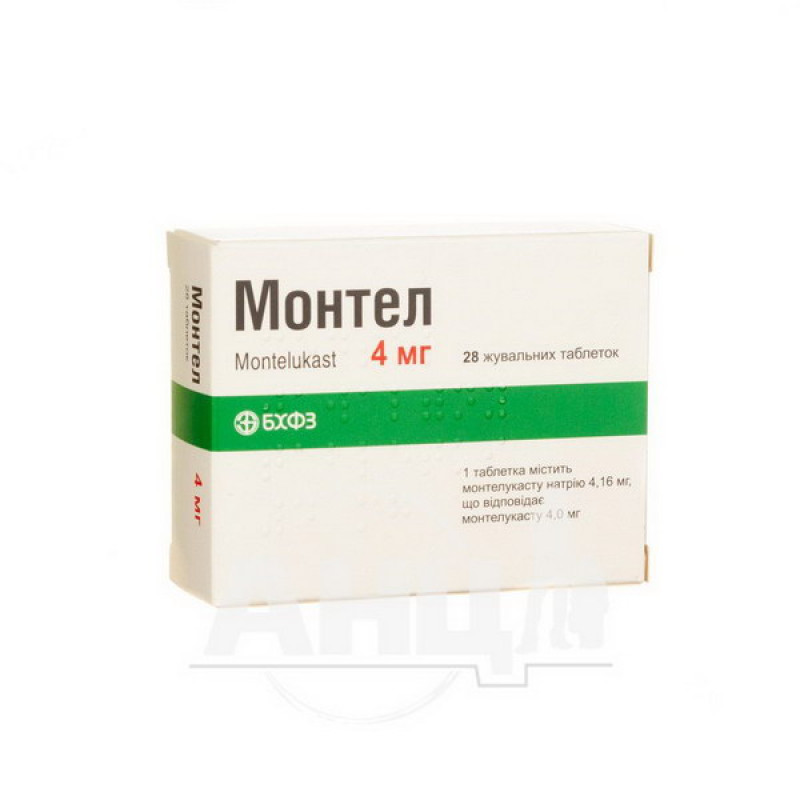
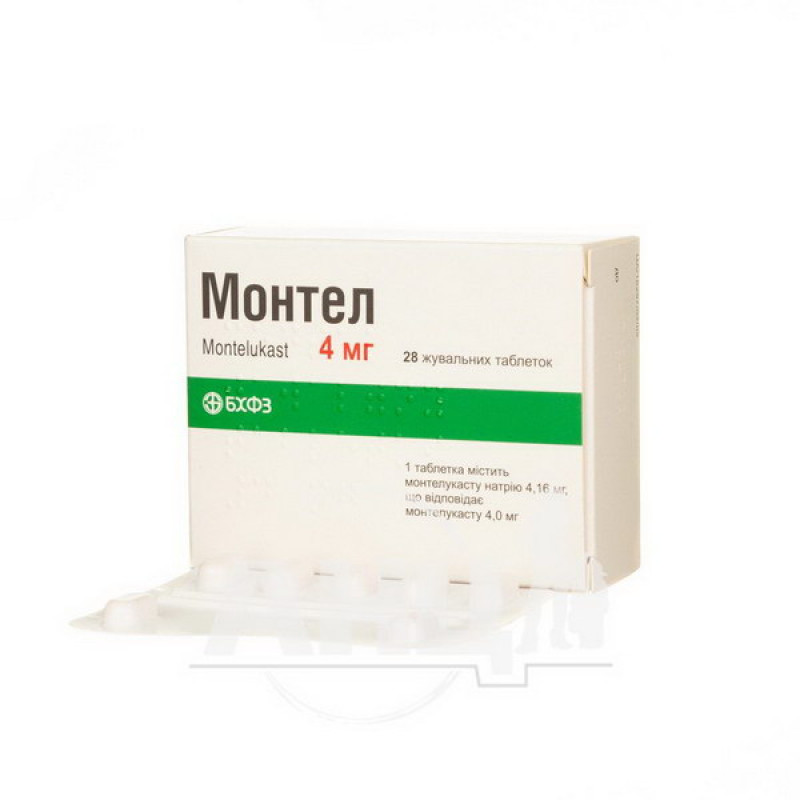
Pharmacokinetic studies have shown that the concentration profiles of the 4 mg chewable tablets in children aged 2-5 years are similar to those of the 10 mg film-coated tablets in adults, and that of the 5 mg tablets in children aged 6-14 years are similar to those of the 10 mg film-coated tablets in adults. The 4 mg chewable tablets should be used in children aged 2-5 years.
Indication
Symptomatic treatment of seasonal allergic rhinitis in patients with bronchial asthma.
Prevention of asthma, the dominant component of which is exercise-induced bronchospasm.
Relief of symptoms of seasonal and perennial allergic rhinitis.
Chewable tablets 5 mg (children aged 6-14 years); chewable tablets 4 mg (children aged 2-5 years):
additional treatment of persistent mild to moderate asthma, inadequately controlled with inhaled corticosteroids, and in cases of inadequate clinical control of asthma symptoms with short-acting β-adrenergic agonists used as needed; as an alternative to treatment with low-dose inhaled corticosteroids in patients with persistent mild asthma, who have no recent history of severe asthma attacks requiring oral corticosteroids, and who are intolerant to inhaled corticosteroids; prevention of asthma, the dominant component of which is exercise-induced bronchospasm; relief of symptoms of seasonal and perennial allergic rhinitis.
Application
Film-coated tablets, 10 mg, the drug is taken orally, regardless of meals.
Adults and children over 15 years of age for the treatment of asthma or asthma in combination with seasonal allergic rhinitis should take 1 tablet (10 mg) once a day (in the evening).
To relieve the symptoms of allergic rhinitis, the time of administration is selected individually.
General recommendations. The therapeutic effect of the drug on asthma control occurs within 1 day. Patients should be advised to continue taking the drug even when asthma control is achieved, as well as during periods of exacerbation of this pathology. The drug should not be taken together with medications containing montelukast.
No dose adjustment is necessary in elderly patients, patients with renal impairment, or patients with mild to moderate hepatic impairment. There are no data in patients with severe hepatic impairment.
The dosage of the drug is the same for male and female patients.
Montelukast treatment depends on other asthma treatments. Montelukast can be prescribed in addition to the patient's existing treatment regimen.
Inhaled corticosteroids: Montelukast may be used as add-on therapy when inhaled corticosteroids in combination with short-acting β-agonists as first-line therapy do not provide adequate clinical control of the disease.
You should not abruptly replace inhaled corticosteroids with MONTEL.
Chewable tablets 4 mg and 5 mg. The drug should be used in children under adult supervision.
Patients with bronchial asthma and allergic rhinitis (seasonal and perennial) should take 1 chewable tablet of 4 mg or 5 mg once a day. To relieve symptoms of allergic rhinitis, the time of administration should be selected individually.
For the treatment of asthma, the dose for children aged 2-5 years is 1 chewable tablet (4 mg) once daily in the evening, 1 hour before or 2 hours after a meal. No dose adjustment is necessary for this age group. Montel 4 mg chewable tablets are not recommended for children under 2 years of age.
In the treatment of asthma, the dose for children aged 6-14 years is 1 chewable tablet (5 mg) once daily in the evening, 1 hour before or 2 hours after meals. No dose adjustment is necessary for this age group.
Adults and children over 15 years of age should use montelukast 10 mg tablets.
Alternative to low-dose inhaled corticosteroids in mild persistent asthma. Montelukast is not recommended as monotherapy in patients with moderate persistent asthma. The decision to use montelukast as an alternative to low-dose inhaled corticosteroids in children with mild persistent asthma should be made only for patients who have not recently had a severe asthma attack requiring corticosteroids and who have demonstrated that they are able to use inhaled corticosteroids.
Persistent mild asthma is defined as the occurrence of asthma symptoms more than once a week, but less than once a day, the occurrence of nocturnal symptoms more than twice a month, but less than once a week, and normal lung function between episodes.
If satisfactory asthma control is not achieved within 1 month of montelukast therapy, the need for additional or different anti-inflammatory therapy should be assessed, based on the stepwise asthma treatment system. Patients should be periodically examined to assess asthma control.
Prophylactic use before exercise to prevent an asthma attack. Exercise-induced bronchospasm may be the main symptom of persistent asthma requiring treatment with inhaled corticosteroids. The patient's condition should be assessed 2-4 weeks after starting treatment with montelukast. If a satisfactory treatment result is not observed, a decision should be made about additional or different treatment.
Contraindication
Hypersensitivity to montelukast or other components of the drug, children under 15 years of age (for a dose of 10 mg).
Side effects
Blood and lymphatic system: tendency to increased bleeding, thrombocytopenia.
Immune system: hypersensitivity reactions, including anaphylaxis, eosinophilic infiltration of the liver. Isolated cases of Churg-Strauss syndrome (CSS) have been reported in patients with bronchial asthma (see Precautions).
Psychiatric disorders: sleep disorders, including nightmares, insomnia, somnambulism, anxiety, agitation, including aggressive behavior or hostility, psychomotor hyperactivity (including irritability, restlessness, rarely tremor), depression; disturbance in attention, memory impairment/loss; hallucinations, disorientation, suicidal thoughts and behavior (suicide attempts).
CNS: headache, lethargy, dizziness, drowsiness, paresthesia/hypoesthesia, seizures.
Cardiovascular system: feeling of palpitations (increased heartbeat).
Respiratory system: nosebleeds, pulmonary eosinophilia.
Digestive system: abdominal pain, diarrhea, dry mouth, thirst, dyspepsia, nausea, vomiting.
Hepatobiliary system: increased plasma transaminase levels (ALT, AST), hepatitis (including cholestatic, hepatocellular, liver damage of mixed genesis).
Skin and subcutaneous tissue: rash, angioedema, hematomas, urticaria, pruritus, erythema nodosum, erythema multiforme.
Human anatomical models: enuresis in children.
Musculoskeletal system and connective tissue: arthralgia, myalgia, including muscle cramps.
Infections and infestations: upper respiratory tract infections.
General disorders: asthenia/fatigue, feeling of discomfort (malaise), edema, pyrexia.
In isolated cases, the occurrence of SOS has been described in patients with bronchial asthma during treatment with montelukast.
Special instructions
Patients should be warned that Montelukast should not be used to relieve acute asthma attacks. Treatment with appropriate medications is recommended to relieve attacks. In case of an acute attack, inhaled short-acting β-blockers should be used. A doctor should be consulted if the patient requires more inhalations of short-acting β-blockers.
Montelukast should not be abruptly substituted for inhaled or oral corticosteroids. It should not be taken with medications that also contain montelukast.
There is no evidence to suggest that the dose of oral corticosteroids can be reduced when montelukast is co-administered.
Neuropsychiatric events have been reported in patients taking montelukast (see Adverse Reactions). Because other factors may be involved in these events, it is not known whether they are causally related to montelukast.
Physicians should discuss the possibility of such events with their patients and/or their caregivers. Patients and/or caregivers should be instructed to report any neuropsychological changes to their physician. In such cases, the risks and benefits of continued treatment with the drug should be reviewed.
In isolated cases, patients receiving anti-asthma drugs, including montelukast, may experience systemic eosinophilia, sometimes together with clinical manifestations of vasculitis - SNS (granulomatous allergic angiitis), which is treated with systemic corticosteroids. Such cases are usually, but not always, associated with a decrease in the dose or withdrawal of corticosteroids. The association of leukotriene receptor antagonists with the development of SNS can neither be refuted nor confirmed, so the physician should be aware of the possibility of eosinophilia, vasculitic rash, cardiovascular complications and / or neuropathy, worsening of pulmonary symptoms in patients. Patients who develop the above symptoms should be re-examined, and their treatment regimen should be reviewed.
During montelukast therapy, acetylsalicylic acid or other nonsteroidal anti-inflammatory drugs should not be used in patients with aspirin-dependent asthma. Montelukast film-coated tablets should not be used in patients with rare hereditary diseases, galactose intolerance, lactase deficiency or glucose-galactose malabsorption syndrome.
Montel 4 mg and 5 mg chewable tablets contain aspartame, which is a source of phenylalanine. Patients with phenylketonuria should note that each 4 mg tablet contains phenylalanine in an amount equivalent to a dose of 0.674 mg of phenylalanine; and each 5 mg tablet contains phenylalanine in an amount equivalent to a dose of 0.842 mg of phenylalanine.
Use during pregnancy and lactation: Animal studies have not shown harmful effects on pregnancy or embryonal/fetal development.
Animal studies have shown that montelukast passes into breast milk. It is not known whether montelukast passes into human breast milk. Montelukast should be used during breastfeeding only if considered clearly necessary.
Children. The drug Montel film-coated tablets, 10 mg, is prescribed to adults and children over 15 years of age. Children under 15 years of age should use the drug in the form of chewable tablets. Chewable tablets of 4 mg are used in children aged 2-5 years, 5 mg - in children aged 6-14 years.
Ability to influence the speed of reactions when driving vehicles or operating machinery. Montelukast is not expected to affect the patient's ability to drive a car or other mechanisms. However, in rare cases, dizziness or drowsiness may occur, so while taking the drug you should refrain from driving a car or other mechanisms.
Interactions
Montelukast can be administered with other drugs for the prevention or long-term treatment of BA. The recommended clinical dose of montelukast has no clinically significant effect on the pharmacokinetics of the following drugs: theophylline, prednisone, prednisolone, oral contraceptives (ethinyl estradiol / norethindrone 35/1), terfenadine, digoxin, and warfarin.
In patients taking phenobarbital concomitantly, the AUC of montelukast was decreased by approximately 40%. Caution should be exercised (especially in children) when administering montelukast concomitantly with CYP 3A4 inducers, such as phenytoin, phenobarbital, and rifampicin, since it is metabolized by CYP 3A4.
In vitro studies have shown that montelukast is a potent inhibitor of CYP 2C8. However, data from a clinical drug interaction study involving montelukast and rosiglitazone (a drug metabolized by CYP 2C8) indicate that montelukast is not an inhibitor of CYP 2C8 in vivo. Therefore, montelukast does not significantly affect the metabolism of drugs metabolized by CYP 2C8 (e.g., paclitaxel, rosiglitazone, and repaglinide).
In vitro studies have shown that montelukast is a substrate of CYP 2C8 and, to a lesser extent, 2C9 and 3A4. In a clinical study of the interaction of montelukast with gemfibrozil (an inhibitor of CYP 2C8 and 2C9), gemfibrozil increased the systemic exposure of montelukast by 4.4-fold. No dose adjustment of montelukast is required when gemfibrozil or other potent inhibitors of CYP 2C8 are administered, but the physician should consider the increased risk of adverse reactions.
Based on in vitro studies, no clinically relevant interactions are expected with less potent CYP 2C8 inhibitors (e.g. trimethoprim).
Co-administration of montelukast with itraconazole (a potent CYP 3A4 inhibitor) did not result in a significant increase in systemic exposure to montelukast.
Overdose
In long-term chronic studies, montelukast has been administered at doses up to 200 mg/day to adult patients, and in short-term studies, up to 900 mg/day for approximately 1 week, without clinically significant adverse reactions.
Symptoms: Acute overdose of montelukast has been reported. These cases involved adults and children taking doses in excess of 1000 mg (approximately 61 mg/kg body weight in a 42-month-old child). Clinical and laboratory parameters were within the safety profile in adults and children.
In most reports of overdose, no adverse events were observed. The most common adverse events were consistent with the safety profile of montelukast and included abdominal pain, drowsiness, thirst, headache, vomiting, and psychomotor hyperactivity.
Treatment. There is no specific information on the treatment of overdosage with montelukast. Treatment is symptomatic. There is no antidote. It is not known whether montelukast is removed by peritoneal dialysis or hemodialysis.
Storage conditions
In the original packaging at a temperature not exceeding 25 °C.