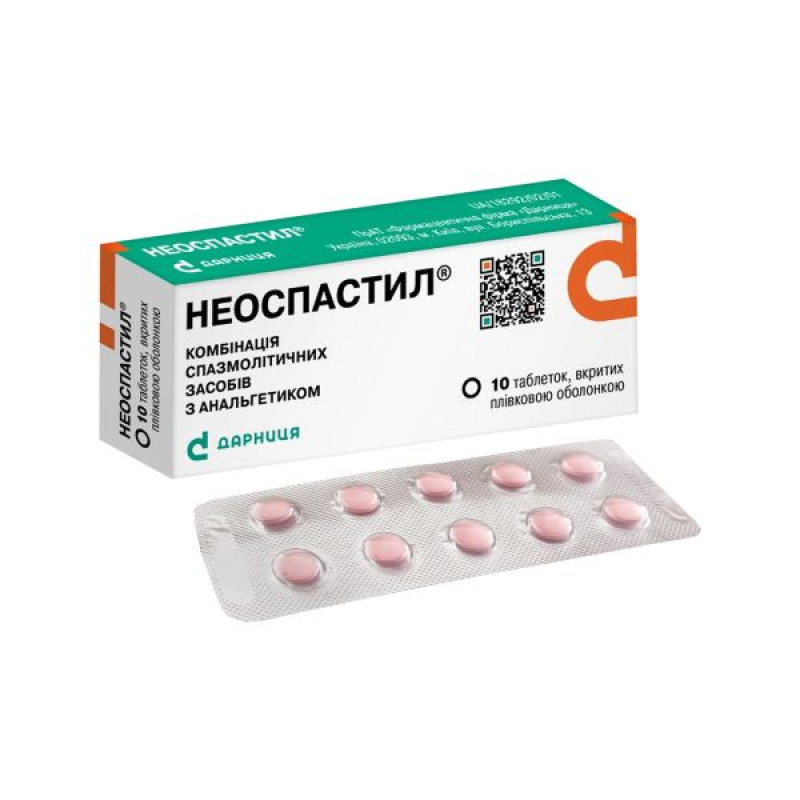
Instructions for Neospastil-Darnitsa film-coated tablets No. 10
Composition
active ingredients: ketorolac tromethamine, pitofenone hydrochloride, fenpiverinium bromide;
1 tablet contains: ketorolac tromethamine 10 mg, pitofenone hydrochloride 10 mg, fenpiverinium bromide 0.1 mg;
excipients: microcrystalline cellulose, pregelatinized starch, crospovidone, magnesium stearate, Opadry II 85F pink.
Dosage form
Film-coated tablets.
Main physicochemical properties: round tablets with a biconvex surface, coated with a pink film coating.
Pharmacotherapeutic group
Antispasmodics in combination with analgesics.
ATX code A03D A02.
Pharmacological properties
Pharmacodynamics.
Ketorolac tromethamine is a non-narcotic analgesic. It is a non-steroidal anti-inflammatory drug (NSAID) that exhibits potent analgesic, anti-inflammatory, and weak antipyretic activity. Ketorolac tromethamine inhibits prostaglandin synthesis and is considered a peripherally acting analgesic. It has no known effects on opiate receptors. No evidence of respiratory depression has been observed in controlled clinical trials with ketorolac tromethamine. Ketorolac tromethamine does not cause mydriasis.
Fenpiverinium has a moderate ganglioblocking and parasympathetic effect, reduces the tone and motility of the smooth muscles of the stomach, intestines, biliary and urinary tracts.
Pitofenone has a papaverine-like effect on vascular and extravascular smooth muscle with a pronounced antispasmodic character.
Clinical trials
A pivotal prospective multicenter randomized comparative clinical trial of the II/III phase in parallel groups, KPF07-T, was conducted for the drug Neospastil®. The aim of this study was to evaluate the efficacy and safety of the drug Neospastil® in comparison with the drug Ketanov in patients with pain syndrome after abdominal and pelvic surgery. The study randomized 424 patients. Patients were prescribed the study drug for oral administration if, in particular, the level of pain during movement was 4–6 points on an 11-point numerical rating scale [NRS] or 7 points, if at rest the pain level did not exceed 6 points on an 11-point numerical rating scale. The drug was prescribed 1 tablet 4 times a day for 24 hours, with a transition to taking it as needed from the next day. The total duration of study treatment in the KPF07-T trial did not exceed 5 days.
The superior efficacy of the drug Neospastil®, film-coated tablets, compared to that of the drug Ketanov, film-coated tablets, has been proven, both in terms of the main efficacy indicator (primary endpoint) and in terms of additional efficacy indicators (secondary endpoints), in particular:
The proportion of study subjects who achieved a response to treatment within the first 24 hours of oral administration of the drug in the main group (Neospastil®) was 76.6%, and in the control group (Ketanov) - 38.6% (p < 0.001).
The median area under the pain intensity curve according to the 11-point CRS at rest at time points within 24 hours after oral administration of the first dose of the drug is statistically significantly lower in the main group (Neospastil® drug) and is 46.0 compared to the control group (Ketanov) - 53.75 (p < 0.001). During movements, this indicator was 60.38 and 70.75, respectively (p < 0.001).
The median sum of differences in pain intensity at rest compared to baseline during the first 6 hours after oral administration of the drug was statistically significantly lower in the main group (Neospastil®) and was -12.0 compared to the control group (Ketanov) - -9.5 (p < 0.001). During movement, this indicator was -14.0 and -12.0, respectively (p < 0.001).
The proportion of study subjects who achieved a response to treatment based on the patient's overall assessment of pain control (rated the effectiveness as "excellent" or "very good" and did not receive another analgesic) during the first 24 hours of oral administration of the drug was 76.6% in the main group (Neospastil® drug) and 17.1% in the control group (Ketanov drug) (p < 0.001).
The proportion of study subjects who achieved a response to treatment based on the patient's overall assessment of pain control (rated the effectiveness as "excellent" or "very good" and did not receive another analgesic) during the next 3 days of oral medication was 79.3% in the main group (Neospastil®) and 16.0% in the control group (Ketanov), (p < 0.001).
Pharmacokinetics.
Neospastil®
In healthy volunteers, after a single oral administration of Neospastil®, maximum concentrations of ketorolac and pitofenone were reached within 0.50 hours, and for fenpiverinium - within 4.00 hours (median).
Cmax and AUC0–t in healthy volunteers after a single dose of Neospastil®, film-coated tablets, on an empty stomach (mean ± SD)
| Active ingredient | Cmax, ng/ml | AUC0–t, ng h/mL |
|---|
| Ketorolac | 1102.4 ± 236.6 | 3490.3 ± 884.0 |
| Pitofenone | 0.236 ± 0.084 | 0.633 ± 0.242 |
| Fenpiverinium | 0.017 ± 0.008 | 0.192 ± 0.060 |
AUC0–t — area under the pharmacokinetic concentration–time curve (from zero to the last blood sample);
Cmax is the maximum concentration in blood plasma;
SD is the standard deviation.
In healthy volunteers, after a single oral administration of Neospastil®, the elimination half-life of ketorolac, pitofenone, and fenpiverinium was (mean ± standard deviation) 5.98 ± 0.92 h, 3.75 ± 1.90 h, and 11.34 ± 4.91 h, respectively.
Ketorolac tromethamine is rapidly and completely absorbed after oral administration with a peak plasma concentration of 0.87 mg/kg 45 minutes after a single 10 mg dose. In healthy volunteers, the terminal plasma half-life is 4–6 hours (mean 5.4 hours). In elderly subjects (mean age 72 years), it is 6.2 hours. More than 99% of ketorolac in plasma is protein bound. Ketorolac does not cross the blood-brain barrier well. A small amount of it can be detected in breast milk. In healthy humans, less than 50% of the administered dose is metabolized. The important metabolites are the glucuronide conjugate and 4-hydroxy-ketorolac, the metabolites of which are pharmacologically inactive. In humans, the pharmacokinetics of ketorolac are linear after single or multiple doses. Steady-state plasma levels are reached after 1 day when administered 4 times a day. No changes were observed with prolonged use. The plasma half-life is increased in patients with renal insufficiency and in elderly patients. After a single intravenous dose, the volume of distribution is 0.25 l/kg, the half-life is 5 hours, and the clearance is 0.55 ml/min/kg. The main route of excretion of ketorolac and its metabolites (conjugates and p-hydroxymetabolites) is urine (90%), with the remainder excreted in feces. A high-fat, poorly digestible meal reduces the rate of absorption but not the extent, while antacids do not affect the absorption of ketorolac.
Pitofenone and fenpiverinium are metabolized in the liver, mainly by oxidation, with about 90% of the substance excreted in the urine as metabolites and about 10% in the feces as unchanged compound. There is evidence that their half-life from blood plasma is 10 hours. Individual components are excreted in breast milk.
Indication
For short-term symptomatic treatment of moderate pain syndrome:
for spasms of the smooth muscles of internal organs: renal colic, spasms of the bladder and urinary tract, dysmenorrhea, hepatic colic, spasms of the stomach and intestines, spastic dyskinesia of the biliary tract;
after surgical interventions and diagnostic procedures on the visceral organs of the abdominal cavity and pelvis.
Contraindication
Hypersensitivity to ketorolac, fenpiverinium, pitofenone or any other component of the drug;
active peptic ulcer, recent gastrointestinal bleeding or perforation, peptic ulcer disease or history of gastrointestinal bleeding;
bronchial asthma, rhinitis, angioedema or urticaria caused by the use of acetylsalicylic acid or other NSAIDs (due to the possibility of severe anaphylactic reactions);
history of bronchial asthma;
complete or partial nasal polyps syndrome, angioedema or bronchospasm;
use as an analgesic before and during surgery, during manipulations on the coronary vessels;
use in patients who have had surgery with a high risk of hemorrhage or incomplete cessation of bleeding;
severe heart failure;
severe liver failure;
moderate/severe renal failure (serum creatinine concentration more than 160 μmol/l);
suspected or confirmed cerebrovascular bleeding, hemorrhagic diathesis, including blood clotting disorders, high risk of bleeding;
simultaneous treatment with acetylsalicylic acid or NSAIDs (including selective cyclooxygenase-2 inhibitors), pentoxifylline, probenecid or lithium salts, anticoagulants, including warfarin or heparin in low doses (2500‒5000 units every 12 hours);
hypovolemia, dehydration with risk of renal failure due to decreased fluid volume;
pregnancy, labor and delivery;
breastfeeding period;
prostate adenoma of II and III degree;
atony of the gallbladder and urinary bladder;
tachyarrhythmia;
collaptoid state;
closed-angle glaucoma;
gastrointestinal obstruction and megacolon.
Interaction with other medicinal products and other types of interactions
The interaction of Neospastil® with other drugs is due to the content of ketorolac tromethamine.
Ketorolac tromethamine does not affect the binding of digoxin to plasma proteins. In vitro studies show that at therapeutic concentrations of salicylates (300 mcg/mL), ketorolac binding was reduced from approximately 99.2% to 97.5%, indicating a potential two-fold increase in unbound ketorolac plasma levels. Digoxin, warfarin, ibuprofen, naproxen, piroxicam, acetaminophen, phenytoin, and tolbutamide at therapeutic concentrations do not alter the binding of ketorolac tromethamine to plasma proteins.
Since ketorolac is a potent drug and its plasma levels are low, it is unlikely that it can significantly displace other drugs from plasma protein binding.
Medicines that should not be used together with Neospastil®
Acetylsalicylic acid and other NSAIDs: Ketorolac should not be used with other NSAIDs, including selective cyclooxygenase-2 inhibitors, particularly in patients receiving acetylsalicylic acid, due to the risk of severe adverse reactions.
Ketorolac inhibits platelet aggregation, reduces thromboxane concentration, and prolongs bleeding time. In contrast to the long-term effects of acetylsalicylic acid, platelet function is restored within 24–48 hours after discontinuation of ketorolac.
Anticoagulants. Concomitant use with anticoagulants may increase bleeding. Concomitant use with anticoagulants (such as warfarin) is contraindicated.
Lithium. The simultaneous use of NSAIDs and lithium preparations is contraindicated.
Probenecid: Concomitant administration of ketorolac tromethamine and probenecid resulted in decreased clearance of ketorolac, significantly increased plasma levels, and prolonged elimination half-life. Therefore, concomitant use of ketorolac tromethamine and probenecid is contraindicated.
Mifepristone: NSAIDs should not be used for 8–12 days after mifepristone administration, as they may weaken the effects of mifepristone.
Pentoxifylline: Concomitant use of ketorolac tromethamine and pentoxifylline increases the risk of bleeding.
Medicines that should be used with caution in combination with Neospastil®
Corticosteroids: As with all NSAIDs, caution should be exercised when corticosteroids are administered concomitantly due to the increased risk of gastrointestinal bleeding.
Selective serotonin reuptake inhibitors (SSRIs). There is an increased risk of gastrointestinal bleeding with concomitant use of SSRIs and NSAIDs. Caution should be exercised when using them concomitantly.
Methotrexate: Since NSAIDs may reduce the clearance of methotrexate, the toxicity of the latter may be increased.
Diuretics: Ketorolac may reduce the natriuretic effect of furosemide and thiazides in some patients. During concomitant therapy with NSAIDs, the patient should be closely monitored for signs of renal failure and to ensure the effectiveness of the diuretic.
Antihypertensives. When used simultaneously with ketorolac, the effect of these drugs is weakened. Ketorolac and other NSAIDs may reduce the antihypertensive effect of beta-blockers, angiotensin-converting enzyme (ACE) inhibitors and angiotensin-II receptor antagonists, and may increase the risk of renal dysfunction; this is especially true in patients with reduced blood volume or elderly patients. Therefore, this combination should be prescribed with caution, especially in elderly patients. Patients should be closely monitored, and renal function should be periodically monitored after initiation and discontinuation of concomitant therapy, particularly when diuretics and ACE inhibitors are used.
Cardiac glycosides: NSAIDs may worsen heart failure, reduce glomerular filtration rate, and increase plasma levels of cardiac glycosides when used concomitantly with the latter.
Thrombolytic agents. Concomitant use with NSAIDs increases the risk of bleeding.
Cyclosporine: As with all NSAIDs, caution should be exercised when co-administering cyclosporine due to the increased risk of nephrotoxicity.
Tacrolimus: NSAIDs may increase the risk of nephrotoxicity.
Opioid analgesics. The effect of opioid analgesics is enhanced, which allows for a reduction in the dose of the latter for pain relief.
Quinolones: Patients taking quinolines may be at increased risk of seizures.
Zidovudine: Concomitant use of NSAIDs with zidovudine increases the risk of hematological toxicity. There is an increased risk of hemarthrosis and hematoma in HIV-infected patients with hemophilia treated concomitantly with zidovudine and NSAIDs.
Anticonvulsants: Isolated cases of seizures have been reported during concomitant use of ketorolac tromethamine and anticonvulsants (phenytoin, carbamazepine).
Psychotropic drugs: Hallucinations have been reported with the concomitant use of ketorolac and psychotropic drugs (fluoxetine, thiotexene, alprazolam).
Non-depolarizing muscle relaxants: No studies have been conducted on the concomitant use of ketorolac tromethamine and muscle relaxants. Cases of a possible interaction between ketorolac and non-depolarizing muscle relaxants resulting in apnea have been reported.
Preparations containing garlic, onion, and ginkgo biloba may enhance the effect of ketorolac and increase the risk of hemorrhagic complications.
When using Neospastil® simultaneously with quinine preparations, the anticholinergic effect may be enhanced.
Application features
Epidemiological data suggest that ketorolac may be associated with a higher risk of gastrointestinal toxicity compared with other NSAIDs, especially when used off-label and/or for prolonged periods of time.
To reduce the risk of adverse effects, treatment with ketorolac should be for the shortest duration and at the lowest dose necessary to control pain. The maximum duration of treatment should not exceed 5 days.
When treating patients with cardiac, renal or hepatic insufficiency who are taking diuretics, or patients with hypovolemia after surgery, careful monitoring of diuresis and renal function is necessary.
Use in elderly patients
In elderly patients (over 65 years of age), the use of NSAIDs is more likely to cause undesirable side effects, especially gastrointestinal bleeding and perforation, including fatal outcomes (see section "Method of administration and dosage").
This increased risk with age is common to all NSAIDs. Compared with younger patients, these patients have a longer plasma half-life and a lower plasma clearance. Therefore, elderly patients are not recommended to take Neospastil® at a daily dose exceeding 60 mg in terms of ketorolac tromethamine (see section 4.2).
Gastrointestinal effects. Gastrointestinal bleeding, ulceration or perforation, which can be fatal, has been reported with NSAIDs at any time during treatment, with or without warning symptoms or a history of serious gastrointestinal events. The risk of serious gastrointestinal bleeding is dose-dependent. However, adverse events may occur even with short-term therapy. In addition to a history of peptic ulcer disease, concomitant use of oral corticosteroids, anticoagulants, long-term NSAID therapy, smoking, alcohol consumption, advanced age and poor general health are predisposing factors. Most spontaneous reports of gastrointestinal adverse events have occurred in elderly or debilitated patients, and caution should be exercised in these patients, and the drug should be discontinued if adverse reactions are suspected. Patients at risk should be prescribed an alternative type of therapy that does not include NSAIDs.
NSAIDs should be used with caution in patients with a history of Crohn's disease and ulcerative colitis due to the possibility of worsening of the disease.
The drug should be used with caution in patients with obstructive diseases of the gastrointestinal tract (achalasia, pyloroduodenal stenosis). Repeated use of the drug Neospastil® in these cases may cause a delay in the removal of gastrointestinal contents. The use of Neospastil® in patients with gastroesophageal reflux disease, intestinal atony, inflammatory bowel diseases, including nonspecific ulcerative colitis and Crohn's disease, requires special caution and supervision by a doctor.
Hematological effects. Concomitant use of ketorolac tromethamine in patients receiving anticoagulant therapy may increase the risk of bleeding. Although detailed studies of the concomitant use of ketorolac and heparin in prophylactic low doses (2500–5000 IU every 12 hours) have not been conducted, an increased risk of bleeding with this regimen cannot be excluded. Patients already receiving anticoagulants or who require low-dose heparin should not receive ketorolac tromethamine. Patients receiving ketorolac tromethamine should be closely monitored when receiving other agents that adversely affect hemostasis. Ketorolac inhibits platelet aggregation and prolongs bleeding time. In patients with normal hemostasis, bleeding time is increased but does not exceed the normal range of 2 to 11 minutes. Unlike the prolonged effect of acetylsalicylic acid, platelet function returns to normal within 24–48 hours after ketorolac discontinuation. Ketorolac tromethamine is contraindicated in patients undergoing surgery with a high risk of bleeding or incomplete hemostasis. Ketorolac tromethamine is not an anesthetic and does not have sedative or anxiolytic properties.
Use in patients with renal impairment (see section "Contraindications"). Like other NSAIDs, ketorolac inhibits prostaglandin synthesis and may be toxic to the kidneys, therefore it should be used with caution in patients with impaired renal function or a history of renal disease. Patients at risk include patients with impaired renal function, hypovolemia, heart failure, impaired liver function, patients taking diuretics, and elderly patients.
Patients with less severe renal impairment should receive lower doses of ketorolac. The renal status of such patients should be closely monitored. Patients should be well hydrated before starting treatment with the drug. In patients undergoing hemodialysis, ketorolac clearance was reduced to approximately half of normal and the terminal half-life was increased by almost threefold.
Due to the fact that elderly age (> 65 years) and impaired renal function require a reduction in the daily dose of the drug, as well as the lack of clinical data on the pharmacokinetics of the drug in this population, the drug should be used in elderly patients with impaired renal function only after careful assessment of the benefits and risks associated with such therapy.
Effects on the cardiovascular system and cerebral vessels. Patients with arterial hypertension and/or a history of mild to moderate heart failure should be closely monitored. The use of Neospastil® in patients with heart disease (arrhythmias, ischemic heart disease, congestive heart failure) requires special caution and monitoring by a physician.
To minimize the potential risk of adverse cardiovascular events in patients taking NSAIDs, the lowest effective dose should be used for the shortest possible duration. Ketorolac tromethamine should be used in patients with uncontrolled hypertension, congestive heart failure, established ischemic heart disease, peripheral arterial disease, and/or cerebrovascular disease only after careful consideration of the benefits and risks. Ketorolac should also be considered before initiating long-term treatment in patients at risk for cardiovascular disease (e.g., patients with hypertension, hyperlipidemia, diabetes mellitus, and smokers).
Clinical trials and epidemiological data suggest that the use of some NSAIDs, particularly at high doses and over long periods, may be associated with a small increased risk of arterial thromboembolic events such as myocardial infarction or stroke. Such a risk cannot be excluded for ketorolac.
Use in Patients with Hepatic Impairment. Ketorolac tromethamine should be used with caution in patients with impaired hepatic function or a history of liver disease. Significant elevations (greater than three times the upper limit of normal) in serum alanine aminotransferase and aspartate aminotransferase have been observed in less than 1% of patients. In addition, there have been isolated reports of severe hepatic reactions, including jaundice and fatal fulminant hepatitis, hepatic necrosis, and hepatic failure, some of which were fatal. Ketorolac should be discontinued if clinical signs of liver disease or systemic manifestations (such as eosinophilia, rash) develop.
Respiratory system: The patient's condition should be monitored due to the possibility of bronchospasm.
Systemic lupus erythematosus and mixed connective tissue diseases: Patients with systemic lupus erythematosus and various mixed connective tissue diseases are at increased risk of developing aseptic meningitis.
Dermatological disorders: Serious skin reactions such as exfoliative dermatitis, Stevens-Johnson syndrome, and Lyell's syndrome have been reported. The risk of these reactions is highest early in the course of treatment. Patients should discontinue treatment at the first appearance of rash, mucosal lesions, or other signs of hypersensitivity.
Fluid retention and edema: Fluid retention and edema have been reported with ketorolac, and therefore ketorolac should be used with caution in patients with cardiac decompensation, hypertension, or similar conditions.
Prostatic hyperplasia. Use with caution in prostatic hyperplasia.
Nervous system and organs of vision. The use of Neospastil® in patients with glaucoma or myasthenia gravis requires special caution and monitoring by a doctor. With prolonged use of the drug, its anticholinergic effect may lead to dizziness or accommodation disorders.
Effects on Fertility: Ketorolac tromethamine should be discontinued in women who are unable to conceive and are undergoing investigation for this. Women with reduced fertility should avoid the drug.
Use during pregnancy or breastfeeding
Due to the known effects of NSAIDs on the cardiovascular system of the fetus, ketorolac-containing drugs are contraindicated during pregnancy (especially in the third trimester). The use of ketorolac tromethamine is contraindicated during labor and delivery, as the onset of labor may be delayed and the duration prolonged due to suppression of uterine contractility. The risk of bleeding in both mother and child is increased.
Since ketorolac passes into breast milk in low amounts, it is not used during breastfeeding due to the possible negative effects of prostaglandin synthesis inhibitors on infants.
Ability to influence reaction speed when driving vehicles or other mechanisms
Some patients may experience dizziness, drowsiness, visual disturbances, headache, vertigo, insomnia, or depression when taking medicines containing ketorolac tromethamine. If a patient experiences these or other similar side effects, he should not drive or operate machinery.
Method of administration and doses
It is advisable to take the tablets during or after meals.
The lowest effective dose should be used for the shortest period necessary to control symptoms. The total duration of treatment should not exceed 5 days (even with parenteral administration of ketorolac followed by oral administration of Neospastil®).
Adults.
The recommended dose of Neospastil® is 1 tablet every 6 hours. If necessary, the drug can be used at intervals of 4 to 6 hours.
It is not recommended to use more than 4 tablets per day (corresponding to 40 mg of ketorolac tromethamine).
On the day of the change in dosage form, for patients who received parenteral ketorolac (including Neospastil®, solution for injection) and then switched to oral Neospastil®, the combined dose of ketorolac tromethamine should not exceed 90 mg (60 mg for elderly patients, patients with renal impairment, and patients weighing less than 50 kg), and the oral dose of ketorolac tromethamine as a component of Neospastil® should not exceed 40 mg. Patients should be switched to the oral form as soon as possible.
Concomitant use of opioid analgesics (morphine, pethidine, etc.) is possible. Ketorolac does not have a negative effect on opioid receptor binding and does not enhance the respiratory depression or sedative effects of opioid drugs.
Elderly patients: Patients over 64 years of age should be given the lowest dosage. The total daily dose should not exceed 60 mg (as ketorolac tromethamine).
Children.
Overdose
Symptoms: lethargy, headache, nausea, vomiting, epigastric pain, peptic ulcers, erosive gastritis, gastrointestinal bleeding; hyperventilation, hypertension, rarely - diarrhea, disorientation, agitation, respiratory depression, coma, drowsiness, dizziness, tinnitus, loss of consciousness, convulsions. In case of severe poisoning, acute renal failure and liver damage are possible. Anaphylactoid reactions have been reported.
Treatment. gastric lavage, administration of activated charcoal. Adequate diuresis should be ensured. Renal and hepatic function should be closely monitored. Patients should be observed for at least 4 hours after a potentially toxic dose. Frequent or prolonged convulsions should be treated with intravenous diazepam. Other measures may be appropriate depending on the patient's clinical condition. There is no specific antidote. Forced diuresis, urine alkalinization, hemodialysis, or blood transfusion may be ineffective due to the high binding of ketorolac to plasma proteins.
Side effects
On the part of the organs of vision: visual impairment, blurred vision, optic neuritis, conjunctivitis.
From the side of the organs of hearing and vestibular apparatus: hearing loss, tinnitus, vertigo.
From the respiratory system, chest organs and mediastinum: bronchospasm, shortness of breath, asthma, pulmonary edema.
From the gastrointestinal tract: dry mouth, feeling of discomfort in the abdomen, feeling of fullness of the stomach, nausea, dyspepsia, change in taste, anorexia, gastrointestinal pain, epigastric pain, diarrhea, less often - flatulence, belching, vomiting, constipation, erosive-ulcerative changes, including bleeding and perforation of the gastrointestinal tract, sometimes fatal (especially in elderly patients), vomiting blood, gastritis, peptic ulcer, pancreatitis, melena, rectal bleeding, ulcerative stomatitis, esophagitis, exacerbation of Crohn's disease and colitis.
Liver and biliary tract disorders: liver dysfunction, liver failure, hepatomegaly, jaundice, hepatitis, increased activity of hepatic transaminases.
On the part of the kidneys and urinary system: severe pain in the area of the projection of the kidneys, frequent urination, oliguria, polyuria, anuria, hyponatremia, hyperkalemia, hematuria, proteinuria, increased levels of urea and creatinine in the blood serum, urinary retention, acute renal failure, renal failure, interstitial nephritis, papillary necrosis, hemolytic uremic syndrome, nephrotic syndrome.
Metabolic and nutritional disorders: hyponatremia, hyperkalemia, anorexia.
Nervous system: headache, dizziness, fatigue, weakness, irritability, dry mouth, increased thirst, dysgeusia, nervousness, restlessness, confusion, paresthesia, functional disorders, unusual dreams, depression, drowsiness, sleep disorders, insomnia, impaired concentration, euphoria, hyperactivity, hallucinations, delirium, hyperkinesia, excitability, convulsions, psychotic reactions, abnormal thoughts, aseptic meningitis (with corresponding symptoms: neck stiffness, headache, nausea, vomiting, fever or disorientation), anxiety, disorientation, thinking disorders.
Cardiovascular: pallor, flushing, chest pain, palpitations, bradycardia, heart failure, hypertension or hypotension, edema. Clinical and epidemiological data suggest that the use of some NSAIDs, especially in high doses and for a long time, may be associated with an increased risk of arterial thromboembolic complications, including myocardial infarction or stroke (see section "Special warnings and precautions for use").
From the blood and lymphatic system: purpura, thrombocytopenia, neutropenia, agranulocytosis, granulocytopenia, anemia (aplastic, hemolytic), eosinophilia, possible occurrence of hemorrhages under the skin, hematomas, nosebleeds, decreased blood clotting rate, prolonged bleeding time and increased postoperative wound bleeding, swelling of the fingers, ankles and/or feet.
Immune system disorders: Anaphylactic reactions, urticaria, purpura, bronchospasm, laryngeal edema, angioedema, dyspnea, hypotension, flushing, exfoliative dermatitis, bullous dermatitis (including epidermal necrolysis and erythema multiforme). Such reactions may occur in patients with or without known hypersensitivity to ketorolac or other NSAIDs. They may also occur in individuals with a history of angioedema, bronchospastic reactivity (e.g. asthma and nasal polyps). Anaphylactoid reactions, such as anaphylaxis, may be fatal.
Skin and subcutaneous tissue disorders: pruritus, urticaria, photosensitivity reactions, Lyell's syndrome, bullous reactions, exfoliative dermatitis, erythema multiforme, Stevens-Johnson syndrome, maculopapular and weeping rashes.
Musculoskeletal and connective tissue disorders: myalgia, functional disorders