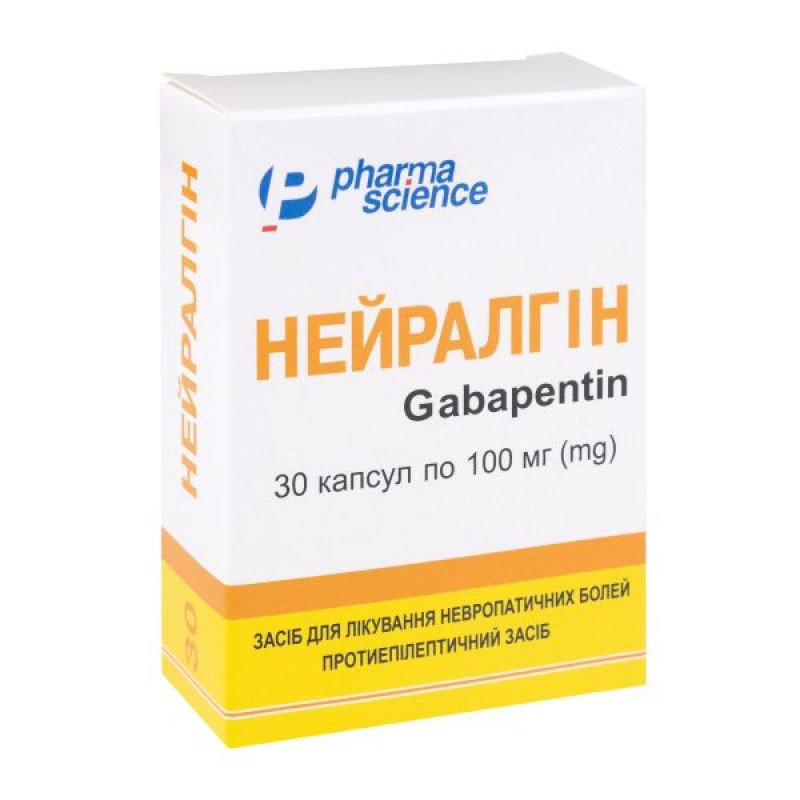
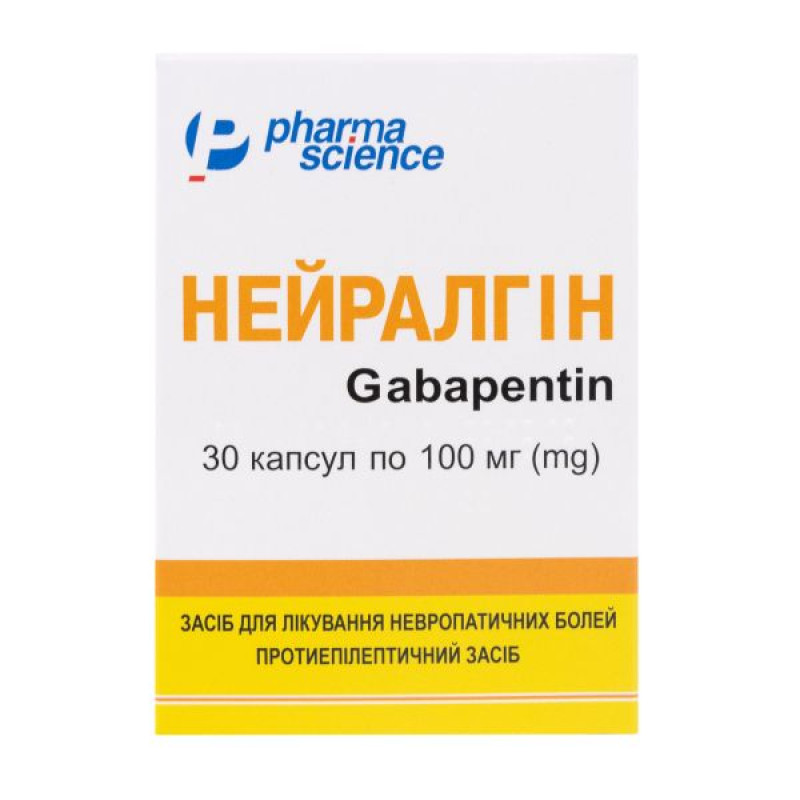
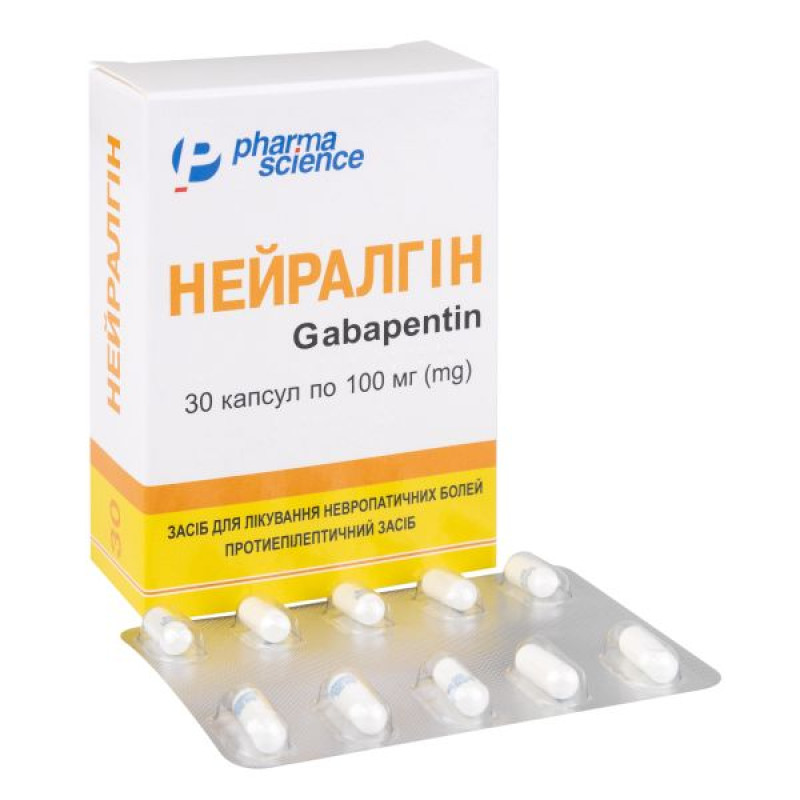
The drug "Neuralgin" is used for the following indications.
Epilepsy:
as adjunctive therapy in the treatment of partial seizures with or without secondary generalization in adults and children aged 6 years and older; as monotherapy in the treatment of partial seizures with or without secondary generalization in adults and children aged 12 years and older.
Treatment of peripheral neuropathic pain, such as painful diabetic neuropathy and postherpetic neuralgia in adults.
Composition
1 capsule contains 100 mg or 300 mg or 400 mg of gabapentin (active ingredient).
Excipients: lactose anhydrous, corn starch, talc.
Capsule shell:
100 mg capsules – gelatin, titanium dioxide (E 171); 300 mg capsules – gelatin, titanium dioxide (E 171), D&C yellow #10 dye (quinoline yellow E 104); 400 mg capsules – gelatin, titanium dioxide (E 171), D&C yellow #10 dye (quinoline yellow E 104), FD&C red #40 dye (E 129).
Contraindication
Hypersensitivity to the components of the drug.
Method of administration and doses
For oral use.
Gabapentin can be taken with or without food; the capsules should be swallowed whole with a sufficient amount of water (e.g. 1 glass of water).
For all indications, the recommended dose titration regimen for initiating therapy is described in Table 1 for adults and children aged 12 years and older.
Table 1.
Scheme-initial titration |
Day 1 300 mg once daily | Day 2 300 mg 2 times a day | Day 3 300 mg 3 times a day |
Dosage instructions for children under 12 years of age are provided in this section below.
Discontinuation of gabapentin therapy.
Clinical data suggest that if gabapentin treatment needs to be discontinued, it should be done gradually over at least 1 week, regardless of the indication.
Epilepsy.
Epilepsy usually requires long-term therapy. The dosage is determined by the doctor according to the individual tolerability of the drug and the effectiveness of the treatment.
Adults and children aged 12 and over.
The effective dose range is 900 to 3600 mg per day.
Therapy may be initiated by titrating the dose as shown in Table 1, or by administering 300 mg 3 times daily on the first day. Thereafter, based on individual patient response and tolerability, the dose may be further increased by 300 mg/day every 2-3 days to a maximum dose of 3600 mg/day.
A slower titration of gabapentin may be appropriate for individual patients. The minimum time to reach a dose of 1800 mg/day is 1 week, to reach a dose of 2400 mg/day is 2 weeks, and to reach a dose of 3600 mg/day is 3 weeks. There is evidence that doses up to 4800 mg/day have been well tolerated. The daily dose should be divided into 3 doses. The maximum interval between doses should not exceed 12 hours to prevent seizures.
Children aged 6 and over.
The initial dose should be 10 to 15 mg/kg/day, and the effective dose is achieved by titrating the dose upwards over approximately 3 days. The effective dose of gabapentin for children aged 6 years and older is 25-35 mg/kg/day. There is evidence that a dose of 50 mg/kg body weight per day has been well tolerated. The total daily dose should be divided into 3 separate doses, the maximum interval between doses should not exceed 12 hours.
There is no need to monitor plasma concentrations. Gabapentin can subsequently be used in combination with other antiepileptic drugs without regard to changes in gabapentin plasma concentrations or serum concentrations of other antiepileptic drugs.
Peripheral neuropathic pain.
Adults.
Treatment may be initiated by titrating the dose as outlined in Table 1. Alternatively, the initial dose may be 900 mg/kg/day given in 3 divided doses. The dose may then be increased by 300 mg/day every 2-3 days based on individual patient response and tolerability to a maximum dose of 3600 mg/day. Some patients may require a slower titration of gabapentin. The minimum time to reach a dose of 1800 mg/day is 1 week, to reach 2400 mg/day is 2 weeks, and to reach 3600 mg/day is 3 weeks.
In the treatment of peripheral neuropathic pain, particularly painful diabetic neuropathy and postherpetic neuralgia, efficacy and safety have not been studied for treatment periods longer than 5 months. If a patient requires dosing for a period longer than 5 months for the treatment of peripheral neuropathic pain, the physician should assess the patient's clinical status and determine the need for additional therapy.
Instructions regarding prescriptions for all indications.
For patients with weakened general health, with low body weight, after organ transplantation, the dose should be titrated more slowly, using either a dosage form with a lower dosage or increasing the intervals between dose increments.
Application features
Pregnant women
There are no adequate data on the use of gabapentin in pregnant women.
Children
Gabapentin is indicated as adjunctive therapy in the treatment of partial onset seizures with or without secondary generalization in children aged 6 years and older. Gabapentin is indicated as monotherapy in the treatment of partial onset seizures with or without secondary generalization in children aged 12 years and older.
Gabapentin acts on the central nervous system and may cause drowsiness, dizziness, or other similar symptoms. Even if mild or moderate, these undesirable effects can be potentially dangerous for patients who drive or operate machinery, especially at the beginning of treatment and after increasing the dose.
Overdose
Acute life-threatening toxicity has not been observed with gabapentin overdoses in doses up to 49 g. Symptoms of overdose are increased manifestations of side effects (dizziness, ataxia, diplopia, slurred speech, dysarthria, drowsiness, lethargy, apathy, mild diarrhea).
All patients recovered completely after treatment. The reduced absorption of gabapentin at higher doses may limit the absorption of the drug in case of overdose, and therefore, this minimizes the toxicity caused by overdose.
Overdose of gabapentin, especially in combination with other CNS depressants, may lead to coma.
Treatment: symptomatic therapy. Gabapentin can be removed from the circulation by hemodialysis. However, experience shows that this is not necessary. However, hemodialysis may be effective for patients with severe renal failure.
In animal studies, oral administration of gabapentin at a dose of 8 g/kg did not result in a lethal dose. Signs of acute toxicity in animals included ataxia, respiratory distress, ptosis, decreased activity, or agitation.
Adverse reactions
Infections and infestations: viral infections, pneumonia, respiratory infections, urinary tract infections, infections, otitis media.
From the blood system: leukopenia, thrombocytopenia, lymphadenopathy, eosinophilia.
Immune system disorders: allergic reactions, including urticaria.
Metabolic disorders: anorexia, increased appetite.
On the part of the psyche: hostility, confusion and emotional lability, depression, anxiety, increased excitability, impaired thinking, hallucinations.
Nervous system: drowsiness, dizziness, nervousness, ataxia, convulsions, hyperkinesia, dysarthria, amnesia, tremor, insomnia, headache, sensory disturbances such as paresthesia, hypoesthesia, impaired coordination of movements, nystagmus, increased/decreased or absent reflexes, hypokinesia, other movement disorders (choreoathetosis, dyskinesia, dystonia).
On the part of the organs of vision: visual disorders such as amblyopia, diplopia.
On the part of the organs of hearing: vertigo, ringing in the ears.
Cardiovascular system: arterial hypertension, vasodilation, palpitations.
From the respiratory system: shortness of breath, bronchitis, pharyngitis, cough, rhinitis.
On the part of the digestive tract: nausea, vomiting, gingivitis, changes in the condition of the teeth, diarrhea, abdominal pain, dyspeptic phenomena, constipation, dry mouth or throat, flatulence, pancreatitis.
From the hepatobiliary system: hepatitis, jaundice.
Skin: facial edema, purpura, which is most often described as bruising resulting from physical trauma, rash, itching, acne, Stevens-Johnson syndrome, angioedema, erythema multiforme, alopecia.
Musculoskeletal system: arthralgia, myalgia, back pain, muscle twitching, myoclonus.
From the urinary system: acute renal failure, urinary incontinence.
From the reproductive system: impotence, mammary gland hypertrophy, gynecomastia.
General disorders: fatigue, fever, peripheral edema, gait disturbance, asthenia, pain, malaise, flu-like syndrome, generalized edema, withdrawal reactions (mainly anxiety, insomnia, nausea, pain, increased sweating), chest pain. Sudden death has been reported, although a causal relationship to gabapentin treatment has not been established.
Laboratory indicators: decreased leukocyte levels in the blood, increased body weight, increased liver test values (AST, ALT, and bilirubin), fluctuations in blood glucose levels in patients with diabetes.
Injuries and poisoning: accidental injury, fracture, scratches.
Cases of acute pancreatitis have been reported with gabapentin treatment. A causal relationship to gabapentin has not been established.
There have been reports of myopathy with elevated creatinine levels in patients on hemodialysis with end-stage renal failure.
There is evidence that respiratory infections, middle ear infections, bronchitis, and seizures have been observed only in children, and aggressive behavior and hyperkinesia have also been frequently reported in children.
Storage conditions.
Store out of the reach of children at a temperature not exceeding 30 °C.
Shelf life - 5 years.