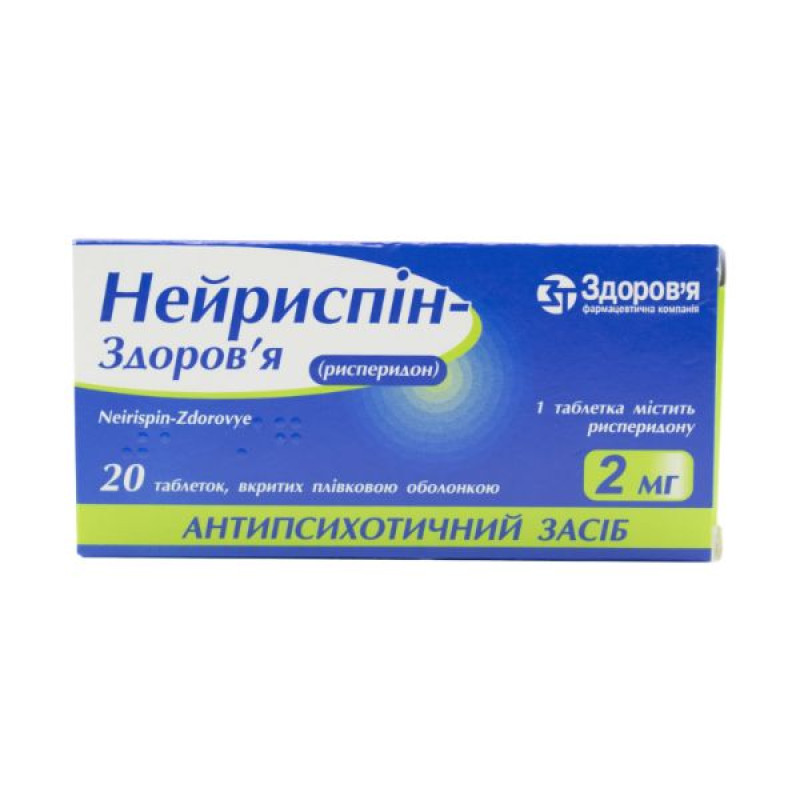
Instructions for use Neurispin-Health film-coated tablets 2 mg blister No. 20
Composition
active ingredient: risperidone;
1 tablet contains risperidone 1 mg or 2 mg or 4 mg;
excipients: lactose monohydrate, microcrystalline cellulose, croscarmellose sodium, potato starch, povidone, polyethylene glycol 4000, sodium lauryl sulfate, magnesium stearate, colloidal anhydrous silica, titanium dioxide (E 171), hypromellose; candurin (silver glitter), containing potassium aluminosilicate, titanium dioxide (E 171); dye: for 2 mg tablets – sunset yellow FCF (E 110); for 4 mg tablets – “Sepispers dry yellow R”, containing methylhydroxypropylcellulose, microcrystalline cellulose, riboflavin (E 101), and “Sepispers dry blue I”, containing methylhydroxypropylcellulose, microcrystalline cellulose, indigo carmine (E 132).
Dosage form
Film-coated tablets.
Main physicochemical properties: film-coated tablets: 1 mg tablets – white with a pearlescent tint; 2 mg tablets – yellowish-orange with a pearlescent tint; 4 mg tablets – light green with a pearlescent tint.
Pharmacotherapeutic group
Antipsychotics. ATX code N05A X08.
Pharmacological properties
Pharmacodynamics. Risperidone is a selective monoaminergic antagonist. It has high affinity for both serotonergic 5-HT2 receptors and dopaminergic D2 receptors. Risperidone also binds to α1-adrenergic receptors and (with lower affinity) to H1-histaminergic and α2-adrenergic receptors. Risperidone has no affinity for cholinergic receptors. Although risperidone is a potent D2-receptor antagonist, which reduces the severity of productive symptoms of schizophrenia, this drug is less likely to cause motor inhibition and catalepsy than classical neuroleptics. Balanced central antagonism of serotonin and dopamine may reduce the incidence of extrapyramidal side effects and extend therapeutic activity against negative and affective symptoms of schizophrenia.
Elderly patients and patients with impaired renal or hepatic function. After a single dose of the drug in elderly patients and patients with renal insufficiency, a higher plasma concentration level was observed (AUC and Cmax were 2–2.5 times higher) and a decrease in clearance of the active antipsychotic fraction by 30% in elderly patients and by 60% in patients with renal insufficiency. In patients with impaired hepatic function, a lower degree of binding of risperidone to plasma proteins was observed. In patients with hepatic insufficiency, normal plasma concentrations of risperidone were observed, but the mean value of the free fraction of risperidone in plasma was increased by 35%.
Children: The pharmacokinetics of risperidone, 9-hydroxyrisperidone and the active antipsychotic fraction in children are similar to those in adults.
Gender, race, and smoking: There was no apparent effect of gender, age, or smoking on the pharmacokinetics of risperidone or the active antipsychotic fraction.
Indication
Treatment of schizophrenia and other psychotic disorders, including maintenance therapy, in patients who have responded to therapy, in order to prevent relapse of the disease;
short-term treatment of severe aggression or severe psychiatric symptoms in patients with dementia who are at risk of harming themselves or others;
treatment of manic episodes in bipolar disorders (adjunctive therapy in combination with mood stabilizers as initial treatment or as monotherapy for a period of up to 12 weeks);
symptomatic treatment of oppositional defiant disorder or other social behavior disorders in children, adolescents and adults with below average mental development or mental retardation who have manifestations of destructive behavior (impulsivity, autoaggression);
symptomatic treatment of autistic disorders in children aged 5 years and older, in whom symptoms range from hyperactivity to irritability (including aggression, self-harm, anxiety and pathological cyclic actions).
Contraindication
Hypersensitivity to the active ingredient or to any of the excipients of the medicinal product. Dementia and symptoms of Parkinson's disease (rigidity, bradykinesia and parkinsonian postural disorders). Dementia and suspected dementia with Lewy bodies (in addition to symptoms of dementia, at least two of the following symptoms: parkinsonism, visual hallucinations, unsteadiness of gait).
Interaction with other medicinal products and other types of interactions
The breakdown of risperidone to 9-hydroxyrisperidone may be inhibited by phenothiazines, tricyclic antidepressants, and some β-blockers that bind to CYP2D6. Such inhibition may result in increased plasma concentrations of risperidone and decreased plasma concentrations of the active metabolite 9-hydroxyrisperidone. Amitriptyline does not inhibit the breakdown of risperidone to 9-hydroxyrisperidone.
Risperidone is a weak inhibitor of CYP2D6 and is not expected to significantly inhibit the elimination of drugs metabolized by these enzymes.
The metabolism of risperidone may be increased when drugs that are enzyme inducers are used concomitantly. Carbamazepine or other CYP3A4 enzyme inducers, such as rifampicin, phenytoin and phenobarbital, reduce the plasma concentration of the active antipsychotic fraction. When carbamazepine or other CYP3A4 enzyme inducers are discontinued or restarted, the dosage should be re-evaluated and adjusted if necessary. In isolated cases, toxic serum concentrations of carbamazepine have been observed when carbamazepine and risperidone were used concomitantly.
The drug may have antagonistic effects on levodopa and other dopamine antagonists. If such a combination is considered necessary, especially in the terminal stage of Parkinson's disease, the lowest effective doses of each drug should be used.
Phenothiazines, tricyclic antidepressants and some β-blockers may increase the plasma concentration of risperidone, but not the concentration of the antipsychotic fraction. Cimetidine 400 mg twice daily and ranitidine 150 mg twice daily increased the AUC of the active antipsychotic fraction (risperidone and 9-hydroxyrisperidone) by 8% and 20%, respectively, although this is not clinically significant.
Fluoxetine (20 mg/day) and paroxetine (20 mg/day) increase the plasma concentration of risperidone by 2.5-2.8 and 3-9 times, respectively. Fluoxetine does not affect the plasma concentration of 9-hydroxyrisperidone. Paroxetine reduces the plasma concentration of 9-hydroxyrisperidone by an average of 13%. Overall, the concentration of the active antipsychotic fraction increases by 50% when fluoxetine and paroxetine are co-administered. If fluoxetine and paroxetine are initiated or discontinued during treatment with the drug, the physician should review the dose. The effect of discontinuation of fluoxetine and paroxetine on the pharmacokinetics of risperidone or 9-hydroxyrisperidone has not been studied.
Erythromycin (CYP3A4 inhibitor) does not affect the pharmacokinetics of risperidone and the active antipsychotic fraction.
Caution should be exercised when prescribing risperidone with drugs that prolong the QT interval, such as class Ia antiarrhythmics (quinidine, procainamide), class III antiarrhythmics (amiodarone, sotalol), tricyclic antidepressants (amitriptyline), tetracyclic antidepressants (maprolitine), some antihistamines, other antipsychotics, some antimalarials (quinine, mefloquine), and with drugs that cause electrolyte imbalance (hypokalemia, hypomagnesemia), bradycardia, or drugs that inhibit the hepatic metabolism of risperidone.
The cholinesterase inhibitors galantamine and donepezil do not exhibit clinically significant effects on the pharmacokinetics of risperidone and the active antipsychotic fraction.
The pharmacokinetics of lithium are not significantly altered when the concomitant neuroleptic is replaced by risperidone 3 mg twice daily. The compatibility of risperidone with lithium has not been studied. Encephalopathies, extrapyramidal disorders, and neuroleptic malignant syndrome have been reported with concomitant use of neuroleptics and lithium. In clinical trials, extrapyramidal disorders and hyperkinesia were reported more frequently with lithium in combination with neuroleptics than with lithium alone.
The drug had no clinically significant effects on the pharmacokinetics of valproate and digoxin.
Topiramate significantly reduces the bioavailability of risperidone, but has little to no effect on the bioavailability of the active antipsychotic fraction. Therefore, this interaction is unlikely to be clinically significant.
Clonazepam, gabapentin, lamotrigine, methylphenidate: given the pharmacokinetics of risperidone and these active substances, interactions between them are not expected, although no relevant studies have been conducted.
The risks of concomitant use of the drug with other drugs have not been systematically studied. Interactions are theoretically possible with all active substances that act on the central nervous system. Caution should be exercised when prescribing risperidone simultaneously with other drugs.
For increased mortality when used concomitantly with furosemide in elderly patients with dementia, see section "Special warnings and precautions for use".
Risperidone should be used with caution in combination with other centrally acting substances, including alcohol, opiates, antihistamines and benzodiazepines, due to an increased risk of sedation.
Verapamil, an inhibitor of CYP3A4 and P-glycoprotein, increases the plasma concentration of risperidone.
Concomitant use of oral risperidone with paliperidone is not recommended because paliperidone is the active metabolite of risperidone and their combination may potentiate the effects of the active antipsychotic fraction.
Application features
Elderly patients with dementia treated with atypical antipsychotics had an increased mortality rate compared with patients not treated with such drugs. The median age of patients who died was 86 years (range: 67–100 years). There are insufficient data to determine the exact level of risk, and the reason for the increased risk is unknown. The causes of death were typical for this age group (65 years and older) and included: cardiovascular and cerebrovascular diseases, neoplasms, infections (e.g., pneumonia), and diabetes.
Concomitant use with furosemide. In elderly patients with dementia, furosemide was also associated with an increased mortality rate when used concomitantly with risperidone compared with patients treated with risperidone or furosemide alone. The pathophysiological mechanisms to explain this have not been established, but regardless of treatment, dehydration was a common risk factor for mortality and should be monitored closely in patients with dementia. No increased mortality was observed in patients receiving concomitant risperidone with other diuretics. Special caution should be exercised when prescribing the drug in such cases, and the risks and benefits of this combination or concomitant use with other potential diuretics should be assessed before prescribing the drug.
Children. The risk/benefit ratio should be carefully weighed before prescribing risperidone to children. The need for continued treatment should be carefully assessed regularly. Risperidone has only been studied for the symptomatic treatment of conduct disorder, oppositional defiant disorder and/or other conduct disorder and autistic disorder in children aged 5 years and older. Therefore, it should not be prescribed to children under 5 years of age for these indications.
There is no experience in children under 15 years of age for the treatment of schizophrenia and in children under 10 years of age for the treatment of manic episodes in bipolar disorder.
There is no effect on growth and development in children treated with risperidone for up to 1 year. The effect on growth and development for treatment longer than 1 year is unknown. Clinical monitoring of the endocrine system should be performed, including measurement of height and weight, monitoring of sexual development, potential prolactin-dependent effects, and investigation of extrapyramidal symptoms and other motor disorders.
Drowsiness. Drowsiness has been commonly observed in children with autism. Most cases were mild to moderate in severity. Drowsiness was predominantly observed at the start of treatment, most often within the first two weeks of treatment (mean 16 days), and resolved spontaneously. For patients with drowsiness, a change in the dosage regimen may be appropriate.
Orthostatic hypotension. Risperidone may cause orthostatic hypotension, especially at the beginning of treatment, due to its α-lytic activity. Clinically significant hypotension has been observed when used concomitantly with antihypertensive agents. Risperidone should be used with caution in patients with cardiovascular disease (e.g. heart failure, myocardial infarction, conduction disturbances), dehydration, hypovolemia or cerebrovascular disease). In these cases, the dose should be adjusted gradually. If hypotension occurs, a dose reduction should be considered.
QT prolongation: Risperidone, as with other antipsychotics, should be used with caution in patients with cardiovascular disease, electrolyte disturbances (hypokalemia, hypomagnesemia), or a family history of QT prolongation. Caution should also be exercised when co-administered with drugs known to prolong the QT interval.
Leukopenia, neutropenia, agranulocytosis. Leukopenia, neutropenia and agranulocytosis have been reported with antipsychotics, including risperidone. Patients with a history of significant leukopenia or drug-induced leukopenia/neutropenia should be closely monitored during the first few months of treatment and risperidone should be discontinued as soon as there is evidence of a significant decrease in white blood cell count and no other cause is identified. Patients with clinically significant neutropenia should be observed for fever and other signs of infection and treated appropriately if symptoms develop. In the event of severe neutropenia (< 1×10⁹/L), risperidone should be discontinued and the white blood cell count monitored until recovery.
Venous thromboembolism: Cases of venous thromboembolism have been reported with antipsychotic drugs. Since patients treated with antipsychotic drugs often have acquired risk factors for venous thromboembolism, all possible risk factors for thromboembolism should be identified before and during treatment with risperidone and appropriate preventive measures should be taken.
Tardive dyskinesia/extrapyramidal symptoms. The use of drugs with dopamine receptor antagonist properties has been associated with the development of tardive dyskinesia, characterized by rhythmic involuntary movements predominantly of the tongue and/or face. Extrapyramidal symptoms have been reported to be a risk factor for the development of tardive dyskinesia. If symptoms of tardive dyskinesia appear, consideration should be given to discontinuing all antipsychotic drugs.
Parkinson's disease and dementia with Lewy bodies. Physicians should weigh the risks and benefits when prescribing antipsychotics, including risperidone, to patients with Parkinson's disease or dementia with Lewy bodies. Risperidone may worsen Parkinson's disease. Patients with any of the above conditions may be at increased risk of neuroleptic malignant syndrome and may be more sensitive to antipsychotic drugs (e.g., confusion, pain sensitivity, and postural instability with frequent falls in addition to extrapyramidal symptoms).
Hyperglycemia and diabetes mellitus. Hyperglycemia, diabetes mellitus, or exacerbation of diabetes mellitus have been reported with risperidone. The association between the use of atypical antipsychotics and glucose abnormalities is complicated by the increased risk of diabetes mellitus in patients with schizophrenia and the increased incidence of diabetes mellitus in the general population. Therefore, the association between the use of atypical antipsychotics and adverse reactions related to hyperglycemia is not fully understood. Although there is evidence of an increased risk of adverse reactions related to hyperglycemia in patients treated with atypical neuroleptics. All patients taking atypical antipsychotics should be monitored for symptoms of hyperglycemia and diabetes mellitus.
Weight gain: Cases of significant weight gain have been reported with the use of the drug. Weight control is recommended.
Priapism: Priapism may occur during treatment with risperidone due to its α-blocking activity.
Body temperature regulation: Antipsychotic drugs may impair the ability to lower core body temperature. Appropriate care is recommended for patients prescribed risperidone if they are exposed to factors that may increase core body temperature, such as: intense physical exercise, exposure to high ambient temperatures, concomitant therapy with drugs with anticholinergic activity, or exposure to dehydration.
Antiemetic effect: Risperidone has been reported to have an antiemetic effect. This property may mask symptoms of overdose with certain drugs or conditions such as intestinal obstruction, Reye's syndrome, and brain tumors.
Convulsions: The drug should be used with caution in patients with a history of seizures or other conditions that potentially lower the seizure threshold.
Intraoperative atonic iris syndrome (IAIS). Intraoperative atonic iris syndrome has been reported in patients treated with α1-adrenergic receptor antagonists, including risperidone, during cataract surgery. ISAs may increase the risk of complications during and after ocular surgery. The ophthalmologic surgeon should be informed of any previous or current use of antipsychotic medications. The potential benefits of discontinuing α1-blocking medications prior to surgery have not been established, and the risks of discontinuing antipsychotic medications should be weighed against the risks of discontinuing antipsychotic medications.
Impaired liver and kidney function. Patients with impaired liver and kidney function are recommended to prescribe half the initial and maintenance doses.
Hyperprolactinemia: Risperidone should be used with caution in patients with hyperprolactinemia and prolactin-dependent tumors, such as pituitary prolactinoma, or suspected prolactin-dependent tumors, such as epithelial tumors of the breast.
Excipients: This medicinal product contains lactose. If you have been told by your doctor that you have an intolerance to some sugars, contact your doctor before taking this medicinal product.
The 2 mg tablets contain the dye sunset yellow FCF (E 110), which may cause allergic reactions.
Use during pregnancy or breastfeeding
There is evidence that risperidone did not show teratogenic effects in animals, but an indirect effect on prolactin levels was observed.
Newborns whose mothers have used antipsychotics (including risperidone) during the last trimester of pregnancy are at risk of developing reversible extrapyramidal symptoms and/or drug withdrawal syndrome. These symptoms include agitation, unusually high or low muscle tone, tremor, drowsiness, respiratory distress, or feeding difficulties. These complications may vary in severity. In some cases, they resolved spontaneously over time, while in others, monitoring of the infant's condition in the intensive care unit or prolonged hospitalization was required.
The drug is not recommended for use during pregnancy, except in cases of vital necessity. If it is necessary to stop treatment during pregnancy, it should not be done abruptly.
The drug may pass into breast milk in small amounts. In individual cases, 4.3% of the maternal dose was detected in breast milk as the active antipsychotic fraction of the active substance. If necessary, breastfeeding should be discontinued.
The ability to influence the reaction speed when driving or working with other mechanisms
The drug may have minor or moderate influence on the ability to drive due to effects on the nervous system and visual organs (see section "Adverse reactions"). Therefore, patients should refrain from driving or using other mechanisms until individual sensitivity to the drug is known.
Method of administration and doses
Gradual discontinuation of treatment is recommended. Acute withdrawal symptoms, including nausea, vomiting, sweating, insomnia, have been observed very rarely after abrupt discontinuation of high doses of antipsychotics. Recurrence of psychotic symptoms may also occur, and involuntary movements (e.g. akathisia, dystonia and dyskinesia) have been reported.
To obtain the prescribed doses of the drug, dosage forms of risperidone with the appropriate content of the active substance should be used.
Schizophrenia.
Adults: The medicine can be used 1 or 2 times a day.
The dose should be started at 2 mg per day, and on the second day the dose can be increased to 4 mg. After that, the dose can be maintained unchanged or, if necessary, individual dose adjustment can be continued. For most patients, the recommended dose is 4–6 mg per day. Some patients may require a gradual increase in dose or a lower initial dose.
The maximum daily dose of the drug is 10 mg. Doses exceeding 10 mg per day have not been shown to be more effective than lower doses, but they may cause extrapyramidal symptoms. Since the safety of doses exceeding 16 mg per day has not been studied, doses exceeding this level should not be used. If additional sedation is required, a benzodiazepine may be used concomitantly.
Elderly patients (65 years and older): The recommended initial dose is 0.5 mg twice daily. If necessary, the dose can be increased to 1–2 mg twice daily by increasing by 0.5 mg twice daily.
Manic episodes in bipolar disorder.
Adults. The recommended starting dose is 2 mg once daily in the evening. The dose can be individually increased by adding 1 mg/day no more frequently than every 24 hours. The recommended dose range is 2 to 6 mg/day.
With long-term use of the drug, it is necessary to periodically review the doses and adjust them throughout the course of therapy. There are no data on the effectiveness of the drug in the treatment of acute bipolar mania lasting more than 12 weeks. If the drug is used in combination with mood stabilizers, therapy can be stopped earlier, since the onset of the effect of treatment can be expected in the first weeks of therapy. Even after the first response to treatment, the possibility of recurrence of depressive symptoms should be taken into account due to the peculiarities of the course of the disease and the side effects of the drugs used for treatment, including risperidone.
Elderly patients (65 years and older). The recommended initial dose is 0.5 mg twice daily. If necessary, the dose can be increased to 1–2 mg twice daily, increasing by 0.5 mg twice daily. Since experience in elderly patients is limited, caution is recommended.
Children aged 10 years and over. The recommended starting dose is 0.5 mg once daily, morning or evening. The dose can be individually increased by adding 0.5 to 1 mg/day no more frequently than every 24 hours until the recommended dose of 2.5 mg/day is reached. The effectiveness of treatment has been demonstrated in the dose range of 0.5 to 6 mg/day; doses above 6 mg/day have not been studied.
Patients with drowsiness may be advised to divide the daily dose into 2 doses. With long-term use of the drug, it is necessary to periodically review the doses and adjust them throughout the course of therapy. There is no experience with the use of the drug for the treatment of manic episodes in bipolar disorders in children under 10 years of age.
Short-term treatment of severe aggression or severe psychiatric symptoms in patients with dementia.
The recommended initial dose is 0.25 mg twice daily. If necessary, the dose can be increased by increasing the dose by 0.25 mg twice daily no more often than every other day. The optimal dose for most patients is 0.5 mg twice daily. However, for some patients, the effective dose can be increased to 1 mg twice daily. After reaching the optimal dose, the possibility of taking the daily dose once daily can be considered. As with other types of symptomatic treatment, with long-term use of the drug, it is necessary to periodically review the dose and adjust it throughout the entire course of therapy.
Treatment with the drug should be discontinued no later than 3 months after the start of therapy; therapy can be resumed only if behavioral disorders reappear.
Symptomatic treatment of social behavior disorders or aggressive behavior.
Patients weighing ≥ 50 kg. The recommended starting dose is 0.5 mg once daily. If necessary, the dose should be adjusted by adding 0.5 mg once daily no more than every other day. The optimal dose for most patients is 1 mg once daily. However, for some patients, no more than 0.5 mg once daily is sufficient to achieve a positive effect, while others may require 1.5 mg once daily.
There is no experience with the use of the drug for the symptomatic treatment of social behavior disorders or aggressive behavior in children under 5 years of age.
Autism (children aged 5 and over).
The dose should be selected individually, depending on the patient's condition and clinical response.
Patients weighing < 50 kg. The recommended starting dose is 0.25 mg once daily. From day 4, the dose may be increased by 0.25 mg. The dose should be maintained at 0.5 mg and the clinical response assessed on day 14. Dose increases of 0.25 mg at 2-week intervals should only be considered in patients with an inadequate clinical response.
Patients weighing ≥ 50 kg. The recommended starting dose is 0.5 mg once daily. From day 4, the dose may be increased by 0.5 mg. The dose should be maintained at 1 mg and the clinical response assessed on day 14. Dose increases of 0.5 mg at 2-week intervals may be considered only in patients with an inadequate clinical response.
Table 1.
Dosages for children with autism (daily dose in mg/day)
| Body weight | Initial dose (days 1–3) | Recommended maintenance dose (days 4–14+) | Dose increase (if necessary) | Dose range |
| < 50 kg | 0.25 mg | 0.5 mg | + 0.25 mg at intervals of ≥ 2 weeks | < 20 kg: 0.5–1.25 mg ≥ 20 kg: 0.5–2.5 mg* |
| ≥ 50 kg | 0.5 mg | 1 mg | + 0.5 mg at intervals of ≥ 2 weeks | 1–2.5 mg* |
*Patients weighing more than 45 kg may require higher doses; the maximum dose studied is 3.5 mg/day.
The medicine can be used 1 or 2 times a day.
Patients who experience drowsiness after taking the drug should take the daily dose at bedtime or in 2 divided doses. Approximately 2/3 of children with autism experience weakness, which is especially noticeable during the initial phase of treatment.
Once an adequate clinical response is achieved, consideration should be given to gradually reducing the dose to achieve the optimal balance of clinical efficacy and safety.
There is insufficient data to determine the recommended duration of treatment for patients with autism, so an experienced specialist should carefully monitor the patient's condition.
If severe adverse reactions occur (e.g. extrapyramidal disorders, tardive dyskinesia or uncontrolled weight gain), the dose of the drug should be reduced or treatment discontinued.
There is no experience with the use of the drug for the symptomatic treatment of autism in children under 5 years of age.
Patients with liver and kidney disease. In patients with impaired renal function, the active antipsychotic fraction is excreted from the body more slowly than in patients with healthy kidneys. In patients with impaired hepatic function, the concentration of the free fraction of risperidone in the blood plasma increases. Regardless of the indication, these patients should be prescribed half the initial and maintenance doses, and the dose titration should be slower. The drug should be used with caution in this category of patients.
Switching from other antipsychotic drugs. If clinically appropriate, it is recommended that previous therapy with other drugs be gradually discontinued during risperidone therapy. However, if a patient is transferred from a depot antipsychotic drug, it is recommended that risperidone be initiated instead of the next scheduled injection. The need for continued current antiparkinsonian drug therapy should be periodically assessed.
Children
The drug is used to treat social behavior disorders or aggressive behavior, as well as autistic disorders in children aged 5 years and older.
Overdose
Symptoms of overdose observed are the known adverse reactions of risperidone, manifested in an intensified form: drowsiness and sedation, tachycardia and arterial hypotension, as well as extrapyramidal symptoms. QT prolongation and convulsions have been reported in overdose. Flickering has been reported in association with overdose of risperidone in combination with paroxetine.
Treatment: A patent airway should be established and maintained to ensure adequate ventilation and oxygenation. Lavage should be considered.