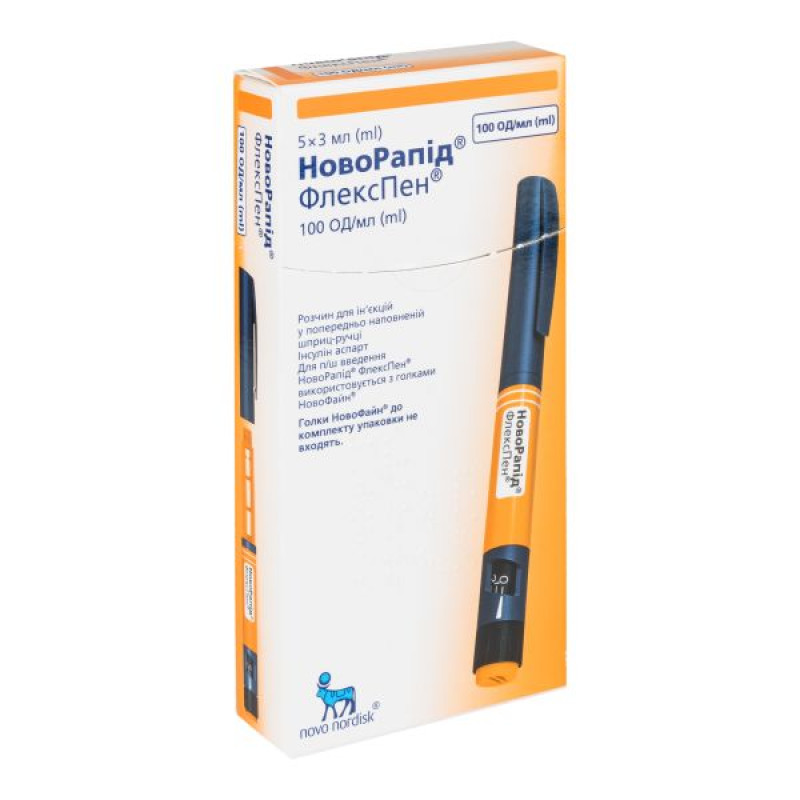
Instructions Novorapid Flexpen solution for injection 100 U/ml cartridge 3 ml inserted into syringe pen No. 5
Composition
active ingredient: insulin aspart;
1 ml of solution contains 100 U (100 U corresponds to 600 nmol) of insulin aspart (rDNA), which is equivalent to 3.5 mg;
Excipients: glycerin, phenol, metacresol, zinc chloride, sodium chloride, sodium hydrogen phosphate dihydrate, sodium hydroxide, hydrochloric acid, water for injection.
Dosage form
Solution for injection.
Main physical and chemical properties: colorless liquid without turbidity and foreign particles. During storage, traces of a very fine sediment may appear.
Pharmacotherapeutic group
Antidiabetic agents. Insulin and analogues for rapid-acting injections. ATC code A10A B05.
Pharmacological properties
Pharmacodynamics.
NovoRapid® FlexPen® is a short-acting human insulin analogue.
NovoRapid® FlexPen® has an earlier onset of action compared to soluble human insulin, with blood glucose levels being lower within the first 4 hours after a meal. When injected subcutaneously, the duration of action of NovoRapid® FlexPen® is shorter compared to soluble human insulin.
NovoRapid® FlexPen® starts working 10–20 minutes after subcutaneous injection. The maximum effect develops between 1 and 3 hours after injection. The duration of action is from 3 to 5 hours.
When calculating the dose in moles, insulin aspart is equipotent to soluble human insulin.
Adults. In clinical studies, NovoRapid® FlexPen® has been shown to lower postprandial glucose levels in patients with type 1 diabetes compared with human insulin. Two long-term, open-label studies in patients with type 1 diabetes included 1070 and 884 patients, respectively. NovoRapid® reduced glycosylated hemoglobin by 0.12% and 0.15% compared with soluble human insulin, which is of unclear clinical significance.
In clinical trials in patients with type 1 diabetes, insulin aspart was shown to reduce the risk of nocturnal hypoglycemia compared with soluble human insulin. The risk of daytime hypoglycemia was not significantly increased.
Elderly. In a study of the pharmacodynamics and pharmacokinetics of insulin aspart and soluble human insulin, the relative differences in the values of pharmacodynamic parameters in elderly people with type 2 diabetes were the same as in practically healthy individuals and younger patients.
Children and adolescents: In children, the effectiveness of long-term blood glucose control with NovoRapid® was the same as with soluble human insulin.
In a clinical study, the pharmacodynamic profile of insulin aspart in children aged 2 to 17 years and adults was similar.
The efficacy and safety of NovoRapid® FlexPen® as a bolus insulin in combination with insulin detemir or insulin degludec as basal insulin were studied in two randomised clinical trials in adults and children aged 1 to 18 years (n = 172) of over 12 months duration. The trials included 167 children aged 1–5 years, 260 children aged 6–11 years and 285 children aged 12–17 years. Improvements in HbA1c and the safety profile were comparable across age groups.
Pregnancy: Clinical studies conducted in 322 pregnant women with type 1 diabetes compared the safety and efficacy of insulin aspart and human insulin. No adverse effects of insulin aspart on the woman or the fetus/newborn were observed compared to soluble human insulin.
Additionally, a study in 27 pregnant women with diabetes showed similar safety profiles for these insulins, as well as significant improvements in postprandial glucose control in the insulin aspart group.
Pharmacokinetics.
The substitution of the amino acid proline at position B-28 of the insulin molecule with aspartic acid in NovoRapid® FlexPen® reduces the formation of hexamers that occur with the administration of soluble human insulin. Consequently, NovoRapid® FlexPen® enters the bloodstream from subcutaneous fat more quickly than soluble human insulin.
Children and adolescents. The pharmacokinetics and pharmacodynamics of NovoRapid® FlexPen® were studied in children and adolescents with type 1 diabetes. Insulin aspart was rapidly absorbed in patients of both age groups, with the time to reach maximum blood concentration being similar to that in adults. However, the level of maximum concentration was different in children of different ages, indicating the importance of individual selection of doses of NovoRapid® FlexPen®.
Elderly. In elderly patients with type 2 diabetes mellitus, the relative differences in pharmacokinetic parameters between insulin aspart and soluble human insulin were the same as in healthy subjects and in patients with diabetes mellitus of younger age. In patients of the older age group, the absorption rate was reduced, as evidenced by a longer time to reach the maximum concentration of insulin (tmax) - 82 min, while the values of its maximum concentration (Cmax) were the same as in patients with diabetes mellitus of younger age type 2 and slightly lower than in patients with diabetes mellitus of type 1.
Hepatic impairment: In patients with hepatic impairment, tmax was increased to 85 min (in subjects with normal hepatic function tmax = 50 min). AUC, Cmax and CL/F values in subjects with reduced hepatic function were the same as in subjects with normal hepatic function.
Renal impairment. The pharmacokinetics of insulin aspart after a single dose were evaluated in 18 subjects with varying degrees of renal function (ranging from normal to severe renal impairment). There were no significant differences in AUC, Cmax, and CL/F of insulin aspart across creatinine clearance levels. Limited data were available in patients with moderate to severe renal impairment. Patients with renal impairment on dialysis were not studied.
Indication
Treatment of diabetes mellitus in adults, adolescents and children aged 1 year and over.
Contraindication
Hypersensitivity to the active substance or to any of the excipients.
Interaction with other medicinal products and other types of interactions
As is known, a number of medications affect glucose metabolism, which should be taken into account when determining the dose of insulin.
Medicines that may reduce insulin requirements
Oral hypoglycemic agents (OHAs), monoamine oxidase inhibitors (MAOIs), b-blockers, angiotensin-converting enzyme (ACE) inhibitors, salicylates, anabolic steroids, and sulfonamides.
Medicines that may increase insulin requirements
Oral contraceptives, thiazides, glucocorticoids, thyroid hormones, sympathomimetics, growth hormone and danazol.
blockers may mask the symptoms of hypoglycemia.
Octreotide/lantreotide may increase or decrease insulin requirements.
Alcohol may enhance or reduce the hypoglycemic effect of insulin.
Application features
Before changing time zones, the patient should seek advice from their doctor regarding the possibility of taking insulin and meals at different times.
Hyperglycemia
Inadequate dosing or discontinuation of treatment (especially in type 1 diabetes) can lead to hyperglycemia and diabetic ketoacidosis. Usually the first symptoms of hyperglycemia develop gradually, over several hours or days. They include thirst, frequent urination, nausea, vomiting, drowsiness, redness and dryness of the skin, dry mouth, loss of appetite, and the smell of acetone on the exhaled air. In type 1 diabetes, untreated hyperglycemia leads to diabetic ketoacidosis, which is potentially fatal.
Hypoglycemia
Malnutrition or unplanned strenuous physical activity can lead to hypoglycemia.
It is necessary to monitor the adequacy of the insulin dose (primarily when using basal-bolus) to food intake, physical activity and blood glucose levels, in order to minimize the risk of hypoglycemia, especially in children.
It can occur if the dose far exceeds the patient's insulin requirement.
In patients whose blood glucose control has improved significantly with intensive insulin therapy, the usual warning symptoms of hypoglycemia may change, and patients should be warned in advance. Usually, the warning symptoms may disappear in patients who have had diabetes for a long time.
As a consequence of the pharmacodynamic characteristics of fast-acting insulin analogues, hypoglycemia may develop more rapidly compared to soluble human insulin.
NovoRapid® FlexPen® should be administered immediately before meals. Its rapid onset of action should be taken into account when treating patients with concomitant diseases or taking medications that slow down the absorption of food in the gastrointestinal tract.
Concomitant diseases, especially infections and fever, usually increase the patient's insulin requirements. The need to change the insulin dose may arise in the case of concomitant diseases of the kidneys, liver, adrenal glands, pituitary gland or thyroid gland.
When transferring patients to other types or types of insulin, early symptoms of hypoglycemia may become less pronounced compared to those when taking the previous insulin preparation.
Transferring a patient to another type or type of insulin (e.g., another strength or manufacturer) should be done under strict medical supervision. Changing insulin may require a change in insulin dose. Patients who have started using NovoRapid® FlexPen® may need to increase the number of injections or change the dose compared to the insulin they usually use.
The need for dose adjustment may arise both when a new drug is first administered and during the first few weeks or months of its use.
Injection site reactions
As with any insulin therapy, injection site reactions may occur. These include pain, redness, hives, inflammation, bruising, swelling and itching. Regularly rotating the injection site may reduce or prevent these reactions. The reactions usually disappear after a few days or weeks. Rarely, injection site reactions may require discontinuation of NovoRapid® FlexPen®.
Skin and subcutaneous tissue disorders
Patients should be instructed to rotate injection sites to reduce the risk of lipodystrophy and cutaneous amyloidosis. There is a potential risk of delayed insulin absorption and worsening glycemic control when injected into sites with these reactions. Hypoglycemia has been reported after abrupt change of injection site to an unaffected site. Blood glucose monitoring is recommended after changing injection sites from an affected to an unaffected site and dose adjustment of antidiabetic medications is recommended.
Combination of thiazolidinediones and insulin preparations
Cases of congestive heart failure have been reported with thiazolidinediones in combination with insulin, especially in patients with risk factors for the development of congestive heart failure. This should be taken into account when prescribing thiazolidinediones in combination with insulin. Patients should be monitored for signs and symptoms of congestive heart failure, weight gain and edema when these drugs are used in combination. Thiazolidinediones should be discontinued if any deterioration in cardiac function occurs.
Avoiding errors when using a medicine
The patient should be instructed to check the insulin package label before each injection to avoid confusion between NovoRapid® FlexPen® and other insulin preparations.
Insulin antibodies
Insulin administration may result in the formation of antibodies. Rarely, the presence of antibodies to insulin may necessitate a dose adjustment to prevent hyper- or hypoglycemia.
Tracking
In order to improve the traceability of a biological medicinal product, the name and batch number of the administered product should be clearly indicated on the packaging.
NovoRapid® FlexPen® should not be used
If you are allergic (hypersensitive) to insulin aspart or any of the other ingredients of this medicine.
If you suspect you are developing hypoglycemia (low blood sugar).
If the NovoRapid® FlexPen® syringe pen has been dropped, damaged or deformed.
If the NovoRapid® FlexPen® syringe pen has been stored incorrectly or has been frozen.
If the insulin does not look clear and colorless.
Insulin antibodies
Insulin administration may lead to the formation of insulin antibodies. Very rarely, the presence of such insulin antibodies may require adjustment of the insulin dose to prevent hyper- or hypoglycemia.
Use during pregnancy or breastfeeding
NovoRapid® (insulin aspart) can be used during pregnancy. According to two randomized controlled clinical trials, no adverse effects of insulin aspart on the woman or the fetus/newborn were found compared with human insulin (see section "Pharmacodynamics"). Careful control and monitoring of blood glucose levels should be carried out in pregnant women with diabetes mellitus throughout pregnancy, as well as in women planning a pregnancy. Insulin requirements usually decrease in the first trimester of pregnancy and increase significantly in the second and third trimesters. After delivery, insulin requirements quickly return to pre-pregnancy levels.
There are also no restrictions on the treatment of diabetes with NovoRapid® FlexPen® during breastfeeding. Treatment of the mother does not pose any risk to the child. However, dose adjustment may be necessary.
Fertility
Animal reproductive studies with respect to fertility have not revealed any differences between insulin aspart and human insulin.
Ability to influence reaction speed when driving vehicles or other mechanisms
The patient's reactions and ability to concentrate may be impaired during hypoglycemia. This may be a risk factor in situations where these abilities are of particular importance (e.g., when driving a car or operating machinery).
Patients should be advised to take precautions to prevent hypoglycemia before driving. This is especially important for patients who have reduced or absent warning signs of hypoglycemia or who have frequent episodes of hypoglycemia.
Method of administration and doses
Dosages. The potency of insulin analogues, including insulin aspart, is expressed in units of action, while the potency of human insulins is expressed in international units. The dosage of NovoRapid® FlexPen® is individual and determined by the doctor in accordance with the needs of the patient. NovoRapid® FlexPen® is usually used in combination with insulin preparations of intermediate or long action, which are administered at least once a day. To achieve optimal glycemic control, blood glucose monitoring and insulin dose adjustment are recommended.
The individual insulin requirement in adults and children is usually 0.5 to 1.0 U/kg/day. In a basal-bolus regimen, 50–70% of the insulin requirement is met by NovoRapid® FlexPen®, and the remainder by intermediate-acting or long-acting insulins. Dose adjustment may be necessary in patients with increased physical activity, changes in diet, or concomitant diseases.
Due to its rapid onset of action, NovoRapid® FlexPen® should be administered immediately before or immediately after a meal, if necessary. Due to the shorter duration of action, there is a lower risk of nocturnal hypoglycemia with NovoRapid® FlexPen®.
Special populations
Elderly patients (≥ 65 years)
NovoRapid® FlexPen® can be used in elderly patients. Elderly patients should be monitored for glucose levels more closely and the dose of insulin aspart should be adjusted individually.
Renal and hepatic impairment
In patients with impaired renal or hepatic function, insulin requirements may be reduced. In patients with impaired renal or hepatic function, glucose monitoring should be intensified and the insulin aspart dose adjusted individually.
Children
NovoRapid® FlexPen® has an advantage in children aged 1 year and older and adolescents compared to soluble human insulin when a rapid onset of action is required, for example, when injections are given in connection with meals. The safety and efficacy of NovoRapid® FlexPen® in children aged under 1 year have not been established. Data are not available.
Transfer from other insulin preparations
When transferring from other insulin preparations, it may be necessary to adjust the dose of NovoRapid® FlexPen® and the dose of the basal insulin. The effect of NovoRapid® FlexPen® occurs 10–20 minutes after subcutaneous injection. The maximum effect develops between 1 and 3 hours after injection. The duration of action is from 3 to 5 hours.
Close monitoring of blood glucose is recommended during the transition to NovoRapid® FlexPen® and during the first few weeks of its use.
Use of the drug
NovoRapid® FlexPen® is injected under the skin of the anterior abdominal wall, thigh, deltoid muscle of the shoulder or buttocks. Injection sites should be changed even within the same area of the body to reduce the risk of lipodystrophy and skin amyloidosis. As with all insulins, subcutaneous injection into the anterior abdominal wall provides faster absorption than when injected into other sites. As with all insulins, the duration of action varies depending on the dose, injection site, blood flow intensity, temperature and level of physical activity. However, the faster onset of action compared to soluble human insulin is maintained regardless of the injection site.
NovoRapid® FlexPen® pre-filled pens are designed to be used with NovoFine® or NovoTwist® needles up to 8 mm in length. NovoRapid® FlexPen® is for subcutaneous use only. The vial should be used if administration by syringe or intravenous system is required. If administration by insulin pump is required, the vial or NovoRapid® PumpCart should be used.
NovoRapid® FlexPen® pens have different cartridge colors and come with an in-box instruction sheet with detailed information for use.
Application in infusion pumps
NovoRapid® FlexPen® can be used for long-term subcutaneous administration using appropriate infusion pumps. Long-term subcutaneous administration is carried out in the anterior abdominal wall. The injection sites should be changed periodically.
When used in infusion pumps, NovoRapid® FlexPen® should not be mixed with any other insulin preparations. Patients using pump systems should be thoroughly instructed in the use of these systems and use appropriate containers and tubing. The infusion set (tubing and cannula) should be replaced in accordance with the instructions provided. Patients using NovoRapid® FlexPen® in a pump system should have another insulin delivery device available in case the system fails.
If necessary, NovoRapid® FlexPen® can be administered intravenously, these injections can be performed by a doctor or other appropriate medical personnel. NovoRapid® FlexPen® 100 U/ml with insulin aspart concentrations from 0.05 U/ml to 1.0 U/ml in infusion solutions of 0.9% sodium chloride, 5% glucose (dextrose) or 10% glucose (dextrose) containing 40 mmol/l potassium chloride, in infusion systems for intravenous use (polyethylene infusion bags) is stable at room temperature for 24 hours. Despite stability for a certain time, some insulin may initially be adsorbed by the infusion bag. During insulin infusion, blood glucose monitoring is necessary.
Precautions for handling and disposal
Needles and NovoRapid® FlexPen® should be used individually.
Do not refill the cartridge.
Do not use NovoRapid® FlexPen® if the solution is not clear or colorless or if the pen has been frozen.
The patient should be informed about the need to dispose of the needle after each injection.
The drug can be used in infusion pumps as described in the section "Method of administration and dosage". Tubing with internal parts made of polyethylene or polyolefin should be evaluated for suitability for use with pumps.
In case of an emergency in patients using NovoRapid® (hospitalization or malfunction of the syringe pen), NovoRapid® can be drawn from the FlexPen® syringe pen using a 100 U insulin syringe.
Instructions for using the NovoRapid® FlexPen® pre-filled syringe.
Please read these instructions carefully before using your NovoRapid® FlexPen®.
If you do not follow the instructions, you may inject too little or too much insulin, which can cause your blood glucose levels to rise or fall too quickly.
NovoRapid® FlexPen® is a unique pre-filled insulin pen with a dose selector. It allows you to set a dose from 1 to 60 units of insulin in steps of 1 unit. NovoRapid® FlexPen® is used with NovoFine® or NovoTwist® needles of 8 mm or shorter. Always carry a spare pen in case your FlexPen® is damaged or lost. Caring for your pen
The FlexPen® should be handled with care. If it is dropped, damaged or deformed, there is a risk of insulin leakage. This may cause incorrect dosing, which may lead to high or low blood sugar levels.
The surface of the NovoRapid® FlexPen® can be cleaned by wiping it with a cotton swab moistened with ethyl alcohol. Do not immerse the pen in alcohol, wash or lubricate it. This may damage the pen mechanism.
NovoRapid® FlexPen® should not be refilled.
Preparing the NovoRapid® FlexPen® syringe pen for injection
Check the name and color on the label to make sure the pen contains the right type of insulin. This is especially important if you use more than one type of insulin. If you inject the wrong type of insulin, your blood sugar level may go too high or too low.
Remove the cap from the pen.
Remove the protective label from the new disposable needle.
Screw the needle tightly onto the NovoRapid® FlexPen® syringe pen.
Remove the large outer needle cap. Do not throw it away.
Remove the inner needle cap and throw it away.
Never try to put the removed inner needle cap back on, as you may get injured by the needle.
Always use a new needle for each injection. This will reduce the risk of contamination, infection, insulin leakage, blocked needles, and inaccurate dosing.
Do not bend or damage the needle before use.
Checking insulin flow
When using the pen, a small amount of air may accumulate in the needle and cartridge. To prevent air injection and ensure that you get the correct dose, do the following:
Set the dose selector to 2 units.
Holding NovoRapid® FlexPen® vertically with the needle pointing upwards, gently tap the cartridge with your finger several times to collect any air bubbles at the top of the cartridge.
Holding the pen vertically with the needle pointing upwards, press the start button. The dose selector will return to the zero mark.
A drop of insulin should appear at the tip of the needle. If this does not happen, change the needle and repeat this procedure up to 6 times.
If a drop of insulin still does not appear, this indicates that the pen is damaged and should not be used.
Before injecting, always check that a drop appears at the tip of the needle. This confirms that insulin is coming through the needle. If a drop does not appear, you will not be able to inject insulin, even if the dose selector moves. This indicates that the needle is blocked or damaged.
Always check the needle for insulin before injecting. If you don't, you may inject too little or no insulin at all. This can cause your blood sugar to rise.
Dose setting
Make sure the dose selector is set to “0”.
The set dose can be adjusted up or down by turning the dose selector in the appropriate direction until the required dose is aligned with the dose pointer. When turning the selector in the direction of decreasing the dose, be careful not to accidentally press the release button, as this will cause insulin to leak out.
It is not possible to dial a dose that exceeds the number of units remaining in the cartridge.
Always use the dose selector and pointer to see how many units you have dialed before injecting insulin.
Do not count the clicks of the pen to select your insulin dose. If you select and inject the wrong dose of insulin, your blood sugar level may increase or decrease. Do not use the remaining insulin scale, as it only shows approximately how much insulin is left in your pen.
Insulin administration
Insert the needle under your skin. Follow the injection technique your doctor or nurse has taught you.
Inject the dose by pressing the injection button all the way in until the “0” lines up with the mark. Press only the injection button while injecting.
Turning the dose selector will not deliver insulin.
The trigger button should be kept fully depressed and the needle should be kept under the skin for at least 6 seconds. This ensures that the full dose of the drug is administered.
Pull the needle out of the skin and release the trigger button.
Always make sure that the dose indicator has returned to “0” after the injection. If the dose indicator has not returned to “0”, the full dose has not been injected, which may cause your blood sugar to rise.
Cover the needle with the large outer needle cap without touching it. Carefully dispose of the needle and put the cap back on the pen.
Remove the needle after each injection and store FlexPen® without the needle attached. This will reduce the risk of contamination, infection, insulin leakage, blocked needle and inaccurate dosing.
Additional important information
Healthcare professionals, relatives, and other caregivers must be very careful with used needles to prevent accidental needlesticks and cross-infection.
Dispose of the used syringe pen without the needle.
Never share your pen or needle with other people. This can lead to cross-infection.
Never share your pen with other people. Your medicine may be dangerous to their health.
Keep your pen and needles out of the reach of others, especially children.
Children.
NovoRapid® FlexPen® is used in children aged 1 year and over.
Overdose
Although a specific concept of overdose has not been formulated for insulin, successive stages of hypoglycemia may develop after administration of doses exceeding the patient's insulin requirement.
Mild hypoglycemia can be treated by taking glucose or sugary foods. Therefore, diabetics are advised to always carry sugary foods with them.
In the event of severe hypoglycemia when the patient is unconscious, trained personnel should administer glucagon subcutaneously or intramuscularly (0.5 to 1 mg). A healthcare professional may administer glucose intravenously. Glucose should also be administered intravenously if the patient does not respond to glucagon within 10–15 minutes. After the patient regains consciousness, oral carbohydrates should be given to prevent recurrence.
Side effects
Adverse reactions observed in patients receiving NovoRapid® FlexPen® are mostly manifestations of the pharmacological action of insulin. The most common adverse reaction in insulin therapy is hypoglycemia. The incidence of hypoglycemia varies in different patient groups, with different dosing regimens and levels of glycemic control, as described below.
At the beginning of insulin therapy, refractive errors, edema and injection site reactions (pain, redness, urticaria, inflammation, bruising, swelling and itching at the injection site) may occur; these reactions are usually transient. Rapid improvement in blood glucose control may cause acute painful neuropathy, which is usually reversible. A sharp improvement in glycemic control due to intensification of insulin therapy may be accompanied by a temporary exacerbation of diabetic retinopathy, while long-term good glycemic control reduces the risk of progression of diabetic retinopathy.
The following list of adverse reactions is based on clinical trial data; the events are classified by MedDRA system organ class. The frequency of reactions is divided into those that occur very often (≥ 1/10); often (≥ 1/100, < 1/10); infrequently (≥ 1/1000, < 1/100); rarely (≥ 1/10000, < 1/1000); very rarely (< 1/10000); frequency unknown (frequency cannot be estimated from the available data).
Immune system disorders
Urticaria, rash, erythema - uncommon.
Anaphylactic reactions* are very rare.
Nutritional and metabolic disorders
Hypoglycemia* – very common.
Nervous system disorders
Peripheral neuropathies (painful neuropathies) are rare.
Visual impairment
Refractive errors are uncommon.
Diabetic retinopathy is uncommon.
Skin and subcutaneous tissue disorders
Lipodystrophy* – uncommon.
Cutaneous amyloidosis*† - frequency unknown.
Injection site reactions are uncommon.
Swelling is uncommon.
*See section “Description of selected adverse reactions”.
†See post-marketing surveillance information.
Description of selected adverse reactions
Anaphylactic reactions
Generalized hypersensitivity reactions (including generalized skin rash, itching, sweating, gastrointestinal disorders, angioedema, difficulty breathing, rapid heartbeat and decreased blood pressure) occur very rarely but can be life-threatening.
Hypoglycemia
Hypoglycemia is the most common adverse event; it may occur if the dose is much higher than the patient's insulin requirement. Severe hypoglycemia may lead to loss of consciousness and/or seizures, followed by temporary or permanent impairment of brain function, up to and including death. Symptoms of hypoglycemia usually occur suddenly. They may include cold sweat, pale and cool skin, fatigue, nervousness or tremor, anxiety, unusual tiredness or weakness, disorientation, difficulty concentrating, drowsiness, increased hunger, visual disturbances, headache, nausea and rapid heartbeat.
In clinical studies, the incidence of hypoglycemia varies among patient groups, dosing regimens, and levels of glycemic control. In clinical studies, the incidence of severe hypoglycemia in patients treated with insulin aspart was similar to that in patients treated with human insulin.
Skin and subcutaneous tissue disorders
Lipodystrophy is an uncommon event. Lipodystrophy (including lipohypertrophy, lipoatrophy) and cutaneous amyloidosis may develop at injection sites and delay insulin absorption from the injection site. Constant rotation of injection sites within a given area may reduce or prevent this reaction.
Children
According to post-marketing surveillance and clinical studies, adverse reactions in children do not differ in frequency, type and severity from those observed in the general population.
Other special patient groups
According to post-marketing surveillance and clinical studies, adverse reactions in elderly patients and those with renal or hepatic impairment do not differ in frequency, type and severity from those observed in the general population.
Expiration date
2.5 years.
After first opening, the product can be used (if stored at a temperature not exceeding 30°C) for 4 weeks.
Storage conditions
Before use: Store in a refrigerator (2–8°C), not too close to the freezer. Do not freeze.
When in use or when carrying a spare pen: use within 4 weeks. Do not store above 30°C. Can be stored in a refrigerator (2–8°C). Do not freeze.
Keep the pen cap on to protect from light. Keep out of the reach of children.
Incompatibility
Medications added to insulin can cause it to break down.
This medicine should not be diluted or mixed with other medicinal products, except for the infusion fluids mentioned in the section “Method of administration and dosage”.
Packaging
3 ml cartridges made of type 1 glass, closed on one side with a bromobutyl rubber plunger and on the other side with a bromobutyl/polyisopropene rubber stopper. The cartridge is placed in a multidose disposable plastic syringe pen. 1 or 5 syringe pens in a cardboard box.
Vacation category
According to the recipe.
Producer
A/T Novo Nordisk (Denmark).
Novo Nordisk Production SAS (France).
Address
Novo Alle, 2880, Bagsvaerd, Denmark.
45, Avenue d'Orleans, 28000, Chartres, France.