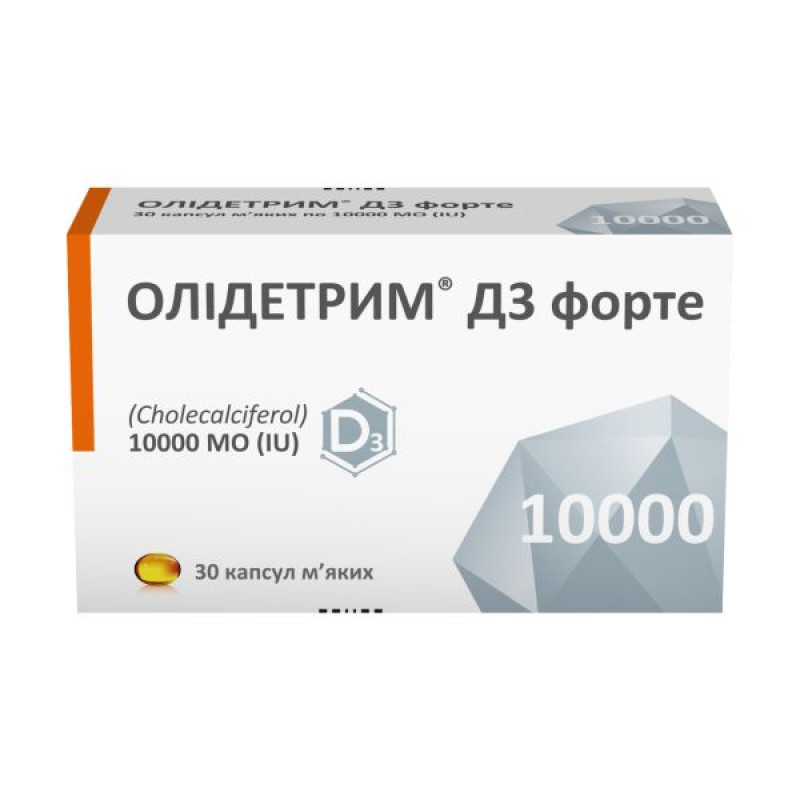
Instructions for Olidetrim D3 Forte 10,000 IU capsules No. 30
Composition
active ingredient: cholecalciferol;
1 soft capsule contains 0.25 mg of cholecalciferol, which corresponds to 10,000 IU of vitamin D3;
Excipients: capsule contents: purified safrole oil; capsule body: gelatin, glycerin, purified water, medium chain triglycerides (traces).
Dosage form
Soft capsules.
Main physicochemical properties: light yellow, oval, soft capsules, with a seam line in the middle, filled with light yellow liquid.
Pharmacotherapeutic group
Vitamins. Vitamin D and analogues. Cholecalciferol.
ATX code A11C C05.
Pharmacological properties
Pharmacodynamics.
Cholecalciferol (vitamin D3) is synthesized in the skin under the influence of ultraviolet radiation, including sunlight. In its biologically active form, vitamin D3 stimulates the absorption of calcium in the intestine, the penetration of calcium into osteoid and the release of calcium from bone tissue. In the small intestine, it promotes rapid and delayed absorption of calcium. In addition, passive and active phosphate transport is stimulated. In the kidneys, it inhibits the excretion of calcium and phosphates by stimulating tubular resorption. The biologically active form of cholecalciferol directly inhibits the production of parathyroid hormone in the parathyroid glands. The secretion of parathyroid hormone is further inhibited due to the increase in calcium absorption in the small intestine under the influence of biologically active vitamin D3.
Pharmacokinetics.
Absorption
Vitamin D in the amounts found in food is almost completely absorbed from food. It is absorbed together with dietary lipids and bile acids, and therefore administration of vitamin D with the main meal of the day may contribute to its better absorption.
Distribution
Cholecalciferol accumulates in fat cells, its biological half-life is approximately 50 days.
After a single oral dose of cholecalciferol, the maximum serum concentration of 25(OH)D3 as the main storage form is reached after approximately 7 days.
Biotransformation
Metabolic conversion of cholecalciferol occurs in the liver by microsomal hydroxylase to form 25-hydroxycholecalciferol (25(OH)D3). It is then converted in the kidneys to 1,25-dihydroxycholecalciferol, which is the biologically active form. The metabolites circulating in the blood bind to specific α-globin.
Breeding
25(OH)D3 is eliminated slowly, with an apparent serum half-life of approximately 50 days. Cholecalciferol and its metabolites are excreted primarily in the bile and feces. After high doses of vitamin D, the concentration of
Serum 25-hydroxycholecalciferol levels may increase over several months. Hypercalcemia caused by overdose may persist for several weeks (see section 4.8).
Indication
Treatment of vitamin D deficiency and conditions associated with vitamin D deficiency in adults.
Vitamin D deficiency is defined as a 25-hydroxycholecalciferol (25(OH)D) level <20 ng/mL (<50 nmol/L); the target concentration for optimal vitamin D effect is defined as 30–50 ng/mL (75–125 nmol/L).
Contraindication
Hypersensitivity to the active substance or any other excipients contained in the medicinal product.
Hypercalcemia and/or hypercalciuria.
Nephrolithiasis and/or nephrocalcinosis.
Severe renal dysfunction.
Hypervitaminosis D.
Pseudohypoparathyroidism (vitamin D requirements may be lower than during periods of normal vitamin sensitivity, there is a risk of prolonged overdose).
Sarcoidosis.
Tuberculosis.
Supplemental vitamin D (may lead to overdose).
Children's age (up to 18 years).
Interaction with other medicinal products and other types of interactions
Concomitant use of anticonvulsants (e.g. phenytoin) or barbiturates (and possibly other drugs that induce liver enzymes) may lead to a reduction in the effect of vitamin D3 due to metabolic inactivation.
In the case of treatment with thiazide diuretics, due to a decrease in calcium excretion by the kidneys, it is necessary to monitor the level of calcium in the blood plasma.
Glucocorticoids increase vitamin D metabolism, which may lead to decreased vitamin D effectiveness.
Oral vitamin D intake with concomitant use of cardiac glycosides may enhance the efficacy and toxicity of digitalis due to increased calcium levels (risk of cardiac arrhythmias). In such patients, regular ECG monitoring and monitoring of plasma and urinary calcium levels, as well as determination of digoxin or digitoxin concentrations, if possible, should be performed.
Concomitant administration of ion exchange resins such as cholestyramine, colestipol hydrochloride, orlistat or laxatives such as petrolatum may reduce the absorption of vitamin D in the gastrointestinal tract.
Rifampicin may reduce the effectiveness of cholecalciferol due to induction of liver enzymes.
Isoniazid may reduce the effectiveness of cholecalciferol due to inhibition of the metabolic activation of cholecalciferol.
Concomitant administration of benzothiadiazine derivatives (thiazide diuretics) increases the risk of hypercalcemia due to decreased renal calcium excretion. Therefore, it is necessary to monitor the level of calcium in the blood plasma and urine.
Ketoconazole may reduce the biosynthesis and catabolism of 1,25(OH)2-cholecalciferol.
Concomitant use with drugs containing high doses of calcium and phosphorus increases the risk of hyperphosphatemia.
Vitamin D may antagonize drugs prescribed for hypercalcemia, such as calcitonin, etidronate, pamidronate.
Concomitant use of the drug with antacids containing aluminum or magnesium may provoke aluminum toxicity on bones and hypermagnesemia in patients with renal failure.
The combination of cholecalciferol with metabolites or analogues of vitamin D should be avoided. The simultaneous administration of vitamin D3 with metabolites or analogues of vitamin D is possible only as an exception and only under the condition of monitoring the level of calcium in the blood serum, as this increases the risk of toxic effects.
Application features
The drug should be used with extreme caution in patients with impaired renal function. In such patients, calcium and phosphate levels should be monitored.
There is no evidence of a direct cause-and-effect relationship between vitamin D intake and kidney stone formation, but such a risk is quite likely, especially in the case of concomitant calcium intake.
Cholecalciferol is not recommended for people who are prone to the formation of calcium-containing kidney stones.
The drug should be used with special caution in patients with impaired renal function during treatment with benzothiadiazine derivatives, as well as in immobilized patients (due to the risk of hypercalcemia, hypercalciuria). In such patients, it is necessary to monitor the level of calcium and phosphates. The risk of soft tissue calcification should be taken into account. In patients with severe renal failure, the normal metabolic transformation of cholecalciferol is disrupted, and therefore other forms of vitamin D should be used (see section "Contraindications").
If treatment is prolonged and the daily dose of vitamin D exceeds 1000 IU, it is necessary to monitor the level of calcium in the blood serum, as well as monitor renal function by determining the level of serum creatinine. Such monitoring is of particular importance for elderly patients receiving concomitant therapy with cardiac glycosides or diuretics (see section "Interaction with other medicinal products and other types of interactions"), as well as for patients with a high risk of stone formation. In the event of hypercalciuria (calcium index exceeds 300 mg (7.5 mmol) / 24 hours) or signs of impaired renal function, the dose of the drug should be reduced or therapy should be discontinued.
Medical supervision is necessary to prevent hypercalcemia during treatment.
Caution should be exercised in patients receiving therapy for cardiovascular disease (see section "Interaction with other medicinal products and other types of interactions").
Cholecalciferol should not be used in patients with sarcoidosis due to the risk of accelerated conversion of vitamin D to its active metabolites. In such patients, plasma and urinary calcium levels should be monitored.
Before starting vitamin D treatment, a careful assessment of the patient's condition by the doctor is required, taking into account the additional amount of vitamin D the patient consumes with certain foods, as well as the patient's time in the sun.
The need for additional calcium intake should be determined individually for each patient. Additional calcium intake should be carried out under strict medical supervision.
Elderly people
Aged > 65 years
A recent study in elderly people with a history of falls showed an increased risk of falls with monthly use of 60,000 IU of vitamin D. Therefore, the use of cholecalciferol in elderly people is recommended only after a careful benefit-risk analysis and only if there are clear indications. In this case, the dose should not exceed 24,000 IU per month. For elderly patients with a history of falls, it is recommended to consider the possibility of daily use of vitamin D.
Aged > 70 years
When treating with vitamin D in a loading dose protocol, serum 25(OH)D3 levels should also be monitored regularly. Treatment should be discontinued at levels ≥ 50 ng/mL.
Use during pregnancy or breastfeeding
Pregnancy
Vitamin D supplementation during pregnancy is associated with a reduced risk of low-for-gestational-age birth weight and accelerated growth in newborns without an increased risk of intrauterine and neonatal death or congenital anomalies. Vitamin D supplementation during pregnancy at a dose of 2000 IU/day may reduce the risk of intrauterine and neonatal death.
The drug should not be used during pregnancy, except in cases where the clinical condition of the woman requires treatment with cholecalciferol in a dose necessary to eliminate vitamin D deficiency.
Breast-feeding.
Vitamin D and its metabolites are excreted in breast milk. No cases of overdose in breastfed infants have been observed. The recommended dose for breastfeeding women is 2000 IU per day. Breastfeeding women should not take high doses of vitamin D. Breastfeeding women are not recommended to use vitamin D as a supplement for their child.
Fertility
In studies of the effects of cholecalciferol on reproductive function and fertility, no effects were observed when it was used in therapeutic doses.
Ability to influence reaction speed when driving vehicles or other mechanisms
Studies on the effect of the drug on the ability to drive and use machines have not been conducted. Side effects of cholecalciferol that could affect the ability to drive and use machines are unknown.
Method of administration and doses
Dosage
The dosage regimen and application schedule should be selected individually, depending on the clinical manifestations of each patient.
Treatment of vitamin D deficiency and conditions associated with vitamin D deficiency in adults
Treatment of vitamin D deficiency and related conditions should be carried out for 3 months or until the concentration of 25(OH)D ≥ 30–50 ng/ml is achieved. Then it is recommended to continuously use the maintenance (prophylactic) dose recommended for healthy individuals, taking into account the patient's age and body weight.
Adults with laboratory-confirmed vitamin D deficiency
For adults with laboratory-confirmed vitamin D deficiency, the dose is 10,000 IU/day for 1–3 months, followed by a maintenance dose of 2,000 IU/day or 10,000 IU/week, depending on the patient's age and body weight.
Treatment is carried out under the supervision of a physician. Adult obese patients (with a BMI of 30 kg/m2 and above) may require a higher maintenance dose, for example 4000 IU/day, depending on the degree of obesity.
To ensure that the target 25(OH)D concentration is achieved, a follow-up 25(OH)D measurement should be performed approximately 3–4 months after the start of maintenance therapy.
Patients with hepatic impairment
No dose adjustment is required.
Patients with renal impairment
The drug should not be prescribed to patients with severe renal impairment without monitoring of renal function by a physician (see section "Contraindications").
OLIDETRIM® D3 forte with other medicines, food and drinks
Other medicines, food supplements and food or drinks containing vitamin D (cholecalciferol), calcitriol or other metabolites and analogues of vitamin D should not be used without medical supervision.
Method of application
For oral use.
The capsule should be swallowed whole with sufficient water, preferably during the main meal.
Children.
OLIDETRIM® D3 forte, capsules of 10,000 IU, should not be used in children (under 18 years of age).
Overdose
Symptoms
Acute and chronic overdose of vitamin D3 can cause hypercalcemia, an increase in the concentration of calcium in the blood plasma and urine. Symptoms can be nonspecific and manifest as nausea, vomiting, diarrhea in the initial stage, and in the late stage - constipation, anorexia, increased fatigue, headache, muscle and joint pain, muscular weakness, polydipsia, polyuria, kidney stone formation, nephrocalcinosis, renal failure, calcium deposition in tissues, ECG changes, arrhythmias and pancreatitis. There have been isolated reports of hypercalcemia with fatal outcome.
Treatment
As a primary measure, vitamin D should be discontinued; normalization of calcium levels in hypercalcemia resulting from vitamin D intoxication takes several weeks.
Depending on the degree of hypercalcemia, a calcium-free or low-calcium diet can be used, and it is also recommended to drink plenty of fluids, perform forced diuresis with furosemide, and administer glucocorticoids and calcitonin.
To reduce the severity of hypercalcemia in hypervitaminosis D, phosphate infusions should not be used due to the risk of metastatic calcification.
Adverse reactions
The frequency is defined as follows: uncommon (≥ 1/1,000 to < 1/100); rare (≥ 1/10,000 to < 1/1,000); or unknown (cannot be estimated from the available data)
Organ class (according to the MedDRA classification system): Frequency of side effects - Adverse reactions:
Cardiovascular system: Frequency unknown - Arrhythmia, arterial hypertension
Immune system disorders: Frequency not known - Hypersensitivity reactions such as angioedema or laryngeal oedema
Metabolic: Uncommon - Hypercalcemia, hypercalciuria; Frequency unknown - Hypercholesterolemia, weight loss, polydipsia, increased sweating, pancreatitis
Skin and subcutaneous tissue disorders: Rare - Hypersensitivity reactions, including urticaria, rash, pruritus
Nervous system disorders: Frequency unknown - Headache, drowsiness, mental disorders, depression
From the urinary system: Unknown frequency - Increased calcium levels in the blood and/or urine, urolithiasis and tissue calcification, uremia, polyuria
Musculoskeletal system: Frequency unknown - Myalgia, arthralgia, muscular weakness
On the part of the organs of vision: Unknown frequency - Conjunctivitis, photosensitivity
Hepatobiliary system: Frequency unknown - Increased aminotransferase activity
Psychiatric: Frequency unknown - Decreased libido
There have been isolated reports of fatal outcomes (see Overdose section).
Reporting of suspected adverse reactions
Reporting adverse reactions after the registration of a medicinal product is important. This allows monitoring of the benefit/risk ratio of the medicinal product. Medical and pharmaceutical professionals, as well as patients or their legal representatives, should report all cases of suspected adverse reactions and lack of efficacy of the medicinal product via the Automated Information System for Pharmacovigilance at the link: https://aisf.dec.gov.ua.
Expiration date
2 years.
Storage conditions
Store at a temperature not exceeding 30 °C. Store in the original package in order to protect from light. Keep out of the reach of children.
Packaging
15 capsules in a blister. 2, 4, or 6 blisters in a cardboard box.
Vacation category
According to the recipe.
Producer
Pharmaceutical Plant "POLPHARMA" S.A., Medan Branch in Sieradz
Pharmaceutical Works POLPHARMA SA, Medana Branch in Sieradz
Location of the manufacturer and address of its place of business.
57 Polish Military Organization Street, 98-200 Sieradz, Poland
57, Polskiej Organizacji Wojskowej Str., 98-200 Sieradz, Poland.