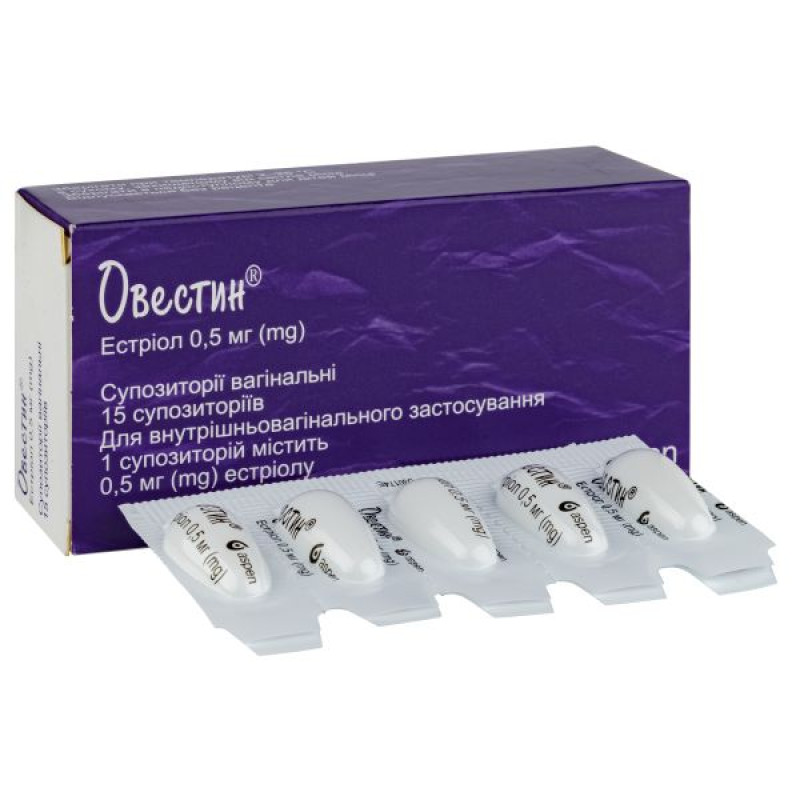
Instructions for use Ovestin vaginal suppositories 0.5 mg No. 15
Composition
active ingredient: estriol;
1 suppository contains 0.5 mg of estriol;
excipient: solid fat.
Dosage form
Vaginal suppositories.
Main physicochemical properties: white suppositories in the shape of a torpedo; the outer surface and the surface on the cut along the longitudinal axis are smooth.
Pharmacotherapeutic group
Natural and semi-synthetic estrogens. ATX code G03C A04.
Pharmacological properties
Pharmacodynamics
Mechanism of action
The active substance of the drug Ovestin, suppositories, is estriol. In terms of its chemical and biological properties, estriol is identical to the natural female hormone estriol. Unlike other estrogens, estriol is short-acting.
During menopause, a woman's body stops producing estrogen. This can lead to atrophic changes in the vaginal mucosa. As a result, urogenital complaints such as atrophic vaginitis are possible. Estriol can reduce these complaints.
Information obtained during clinical trials
A decrease in the severity of climacteric disorders was determined during the first weeks of treatment.
Vaginal bleeding after treatment with Ovestin has occurred only in rare cases. In case of vaginal bleeding while taking Ovestin suppositories, the patient should consult a doctor. The cause of vaginal bleeding while taking the drug should always be determined (see section "Special instructions").
Pharmacokinetics
Absorption
Intravaginal administration of estriol provides optimal bioavailability at the site of action. Estriol is also absorbed into the systemic circulation, as evidenced by a rapid increase in the concentration of unconjugated estriol in the blood plasma.
Distribution
The maximum plasma concentration (Cmax) develops 1-2 hours after administration. After vaginal administration of 0.5 mg estriol, the Cmax value was approximately 100 pg/ml, Cmin – approximately 25 pg/ml, and the average concentration – approximately 70 pg/ml. After 3 weeks of daily vaginal administration of 0.5 mg estriol, the average concentration decreased to 40 pg/ml.
Biotransformation
Almost all (90%) of estriol in plasma is bound to albumin and, unlike other estrogens, almost none is bound to sex hormone binding globulin. The metabolic breakdown of estriol occurs mainly by conjugation and deconjugation during enterohepatic circulation.
Breeding
Since estriol is the end product of metabolism, it is mainly excreted in the urine in conjugated form. Only a small part (±2%) is excreted in the feces, mainly as unconjugated estriol. The half-life after intravaginal administration is approximately 6-9 hours.
Indication
Hormone replacement therapy (HRT) for the treatment of atrophy of the mucous membrane of the lower genitourinary tract associated with estrogen deficiency in postmenopausal women. Pre- and postoperative treatment of postmenopausal women during vaginal surgery. As an aid in diagnosis in doubtful cases of atrophic cervical smear (class IIIa according to the Papanicolaou test) in postmenopausal women in case of detection of pathological cells indicating epithelial atrophy.
Contraindication
Known, past or suspected breast cancer. Known or suspected estrogen-dependent malignancies (e.g. endometrial cancer). Unexplained vaginal bleeding. Untreated endometrial hyperplasia. Previous or current venous thromboembolism (VTE) (deep vein thrombosis, pulmonary embolism).
Known thromboembolic disorders (e.g. protein C, protein S or antithrombin deficiency, see section "Special warnings and precautions for use").
Active or recent thromboembolic arterial disease (e.g. angina pectoris, myocardial infarction). Active liver disease or a history of liver disease after which liver function tests have not returned to normal. Hypersensitivity to the active substance or to any of the excipients. Porphyria.
Interaction with other medicinal products and other types of interactions
The metabolism of estrogens (and progestogens) may be enhanced when used concomitantly with drugs that can induce enzymes involved in drug metabolism, especially cytochrome P450 enzymes, for example, anticonvulsants (including phenobarbital, phenytoin, carbamazepine), antibacterial/anti-infectives (including rifampicin, rifabutin, nevirapine and efavirenz), and herbal preparations containing St. John's wort (Hypericum perforatum).
Ritonavir and nelfinavir are known potent inhibitors, but they, on the contrary, exhibit inducing properties when used together with steroid hormones.
A clinically significant increase in the metabolism of estrogens and progestogens may lead to a decrease in the effectiveness of Ovestin and a change in the bleeding pattern.
Application features
For the treatment of symptoms of estrogen deficiency in postmenopausal women, HRT should be initiated only if symptoms are present and have a negative impact on quality of life. A careful assessment should be performed at least annually to accurately determine the risks and benefits, and HRT should only be continued as long as the benefits of treatment outweigh the risks.
There is limited information on the risks associated with HRT in the treatment of premature menopause. However, due to the lower absolute risk in the younger group of women, the benefit-risk ratio is better for them than for older women.
Medical examination/follow-up by a doctor
Before starting or resuming HRT, a complete personal and family history should be taken. The medical examination (including pelvic and breast examination) should take into account the patient's history and the contraindications and precautions for use of the drug (see section "Contraindications"). Periodic medical examinations of the patient are recommended during the course of treatment, the frequency and nature of which depend on individual characteristics.
Women should be informed about what changes in their breasts they should report to their doctor or nurse (see section “Breast cancer” below). Screening, including imaging techniques such as mammography, is recommended in accordance with current screening practices, adjusted to the needs of the individual woman.
Conditions that require medical attention
If any of the following conditions are present, or have existed in the past and/or have been aggravated during pregnancy or other hormonal treatment, the patient should be monitored closely. It should be borne in mind that these conditions may recur or be aggravated during treatment with Ovestin. These conditions include:
leiomyoma (uterine fibroids) or endometriosis; presence of risk factors for thromboembolic disorders (see "Venous thromboembolism"); presence of risk factors for estrogen-dependent tumors, for example, 1st degree of heredity for breast cancer; increased blood pressure; liver disease (for example, hepatoadenoma); diabetes mellitus with or without vascular disorders; cholelithiasis; migraine or severe headache; systemic lupus erythematosus; history of endometrial hyperplasia (see "Endometrial hyperplasia"); epilepsy; asthma; otosclerosis.
Reasons for immediate discontinuation of treatment:
HRT should be discontinued immediately if a contraindication is identified or the following situations occur:
jaundice or worsening liver function; significant increase in blood pressure; new onset of migraine-type headache; pregnancy.
Endometrial hyperplasia
To prevent endometrial stimulation, the daily dose should not exceed 1 suppository (0.5 mg estriol). This maximum dose should not be used for more than a few weeks. An epidemiological study has shown that long-term treatment with low doses of oral estriol (but not vaginal estriol) may increase the risk of developing endometrial carcinoma. This risk increases in proportion to the duration of the treatment period and disappears within a year after its cessation. The increased risk primarily concerns less invasive and well-differentiated tumors. During the course of taking the drug, vaginal bleeding should always be monitored. The patient should be informed that in the event of vaginal bleeding, she should consult a doctor.
Breast cancer
All available evidence suggests an increased risk of breast cancer in women using combined estrogen-progestogen HRT, and possibly estrogen-only HRT; this depends on the duration of HRT.
Combined estrogen-progestogen therapy:
Both a randomised, placebo-controlled trial (the Women's Health Initiative (WHI) study) and epidemiological studies have consistently shown an increased risk of breast cancer in women taking combined oestrogen-progestagen HRT, which becomes apparent after approximately 3 years (see section 4.8).
Estrogen-only treatment:
The WHI trial did not find an increased risk of breast cancer in women who had undergone hysterectomy and were taking oestrogen-only HRT. In most cases, there was a small increased risk of breast cancer being diagnosed, which was, however, significantly lower than in women taking oestrogen-progestagen combinations (see section 4.8).
The increased risk becomes noticeable after several years of using the drug, but returns to its original values within several (no more than 5) years after stopping treatment.
With HRT, particularly with combined estrogen-progestogen therapy, the density of mammographic images increases, which may interfere with the radiological detection of breast cancer.
The limited data available do not indicate that Ovestin suppositories increase the likelihood of developing breast cancer.
Ovarian cancer is much less common than breast cancer. Long-term (at least 5-10 years) estrogen monotherapy (as HRT) has been associated with a small increased risk of ovarian cancer (see section 4.8). Some studies, including the WHI study, suggest that long-term use of combined HRT is associated with an equivalent or slightly lower risk (see section 4.8). It is not known whether long-term use of weak estrogens (such as estriol) is associated with any different risk compared with estrogen-only products.
Venous thromboembolism (VTE)
Hormone replacement therapy (HRT) is associated with a 1.3- to 3-fold increased risk of developing VTE, i.e. deep vein thrombosis or pulmonary embolism. This risk is highest during the first year of HRT use and then decreases (see section 4.8).
Patients with established diseases accompanied by thrombophilic disorders are at increased risk of developing VTE, and HRT may increase this risk. Therefore, HRT is contraindicated in such patients (see section "Contraindications"). General risk factors for VTE: use of estrogens, old age, major surgery, prolonged immobilization, obesity (body mass index >30 kg/m2), pregnancy, the postpartum period, systemic lupus erythematosus and cancer. There is no clear opinion on the role of varicose veins in the development of VTE.
As with all patients undergoing surgery, precautions should be taken to avoid the development of VTE after surgery. If prolonged immobilization is unavoidable after elective surgery, it is recommended that hormone replacement therapy be temporarily discontinued 4-6 weeks prior to surgery. Such therapy should not be resumed until the woman has regained full mobility.
Women with no history of VTE but a first-degree relative who has had thrombosis at a young age should be offered screening after careful explanation of its limitations (only a subset of thrombophilic disorders are detected by such screening). If hereditary thrombophilic disorders are found in the family that are associated with thrombosis or are “serious” (e.g., antithrombin, protein S, or protein C deficiency, or a combination of these disorders), HRT is contraindicated.
In women who are already on continuous anticoagulation therapy, the benefit-risk ratio of treatment should be carefully weighed.
If VTE occurs after initiation of treatment with Ovestin, treatment with this drug should be discontinued. Patients should be advised to seek immediate medical attention if they experience symptoms of possible thromboembolism (e.g. painful swelling of a leg, sudden chest pain, shortness of breath).
Coronary heart disease (CHD)
Randomized controlled trials have not shown that combined estrogen-progestin or estrogen-only HRT provides protection against myocardial infarction in women with or without coronary artery disease.
Combined estrogen-progestogen therapy
The relative risk of CHD is slightly increased with combined estrogen-progestogen HRT. Since the underlying absolute risk of CHD is largely age-dependent, the number of additional cases of CHD due to estrogen-progestogen use is very small in healthy women approaching menopause, but increases with age.
Estrogen only
Based on these randomized controlled trials, no increased risk of CHD was found in women with a uterus removed who used estrogen-only HRT.
Ischemic stroke
With combined estrogen-progestogen or estrogen-only therapy, the risk of ischemic stroke increases by 1.5 times. The relative risk does not change depending on age and time after menopause. Since the absolute risk of ischemic stroke is significantly dependent on age, the overall risk of ischemic stroke in women undergoing HRT increases with age (see section "Adverse reactions").
Other states
Estrogens can cause fluid retention in the body, so patients with impaired cardiac or renal function should be carefully monitored.
Women with a history of hypertriglyceridemia require special monitoring, as in rare cases, isolated cases of a significant increase in plasma triglyceride levels, leading to the development of pancreatitis, have been reported with estrogen therapy in the presence of this condition.
Estrogens increase thyroxine-binding globulin levels, leading to an increase in circulating total thyroid hormone, as measured by protein-bound iodine, T4 levels (chromatographic separation or radioimmunoassay) or T3 levels (radioimmunoassay). T3 uptake by the resin is reduced, reflecting the increase in thyroxine-binding globulin (TBG). Free T4 and T3 concentrations remain unchanged.
There is no evidence that HRT improves cognitive function. However, some evidence suggests an increased risk of possible dementia in women who start continuous combined HRT or estrogen monotherapy at the age of 65 years and older.
When used in recommended doses, Ovestin suppositories do not affect the results of hormonal laboratory tests.
Ability to influence reaction speed when driving vehicles or other mechanisms
According to available data, the drug Ovestin does not affect the ability to drive vehicles and work with mechanisms.
Use during pregnancy or breastfeeding
Pregnancy
Ovestin is not used during pregnancy. If a woman becomes pregnant during treatment with Ovestin, the drug should be discontinued immediately. The results of most epidemiological studies conducted to date, relevant for assessing the consequences of accidental exposure to estrogens on the fetus, do not indicate the presence of teratogenic or fetotoxic effects.
Breastfeeding period
Ovestin is not used during breastfeeding, as estriol passes into breast milk and may reduce milk production.
Fertility
Ovestin is only intended for the treatment of women in the postmenopausal period (natural and surgically induced).
Method of administration and doses
Ovestin contains only estrogen, so it can be administered vaginally to women with and without a uterus.
Doses
When initiating or continuing treatment of estrogen deficiency symptoms in postmenopausal women, the lowest effective dose should be used for the shortest duration possible (see section 4.4).
For atrophy of the lower genitourinary tract: 1 suppository per day for the first weeks (no more than 4 weeks) with subsequent gradual reduction of the dose to a maintenance dose (no more than 1 suppository 2 times a week) depending on the degree of symptom reduction. For pre- and postoperative treatment of postmenopausal women during vaginal surgery: 1 suppository per day for 2 weeks before surgery; 1 suppository 2 times a week for 2 weeks after surgery. As an aid to diagnosis when obtaining an atrophic picture of a cervical smear: 1 suppository every other day for a week before taking the next smear.
If you miss a dose, take it as soon as you remember, unless it is the day your next dose is due. In the latter case, skip the missed dose and continue treatment as usual. Do not take two doses on the same day.
Method of application
Ovestin vaginal suppositories should be inserted into the vagina in the evening before going to bed. The patient should insert the suppository as deeply as possible into the vagina while lying down.
For women not taking HRT or who are switching from a continuous combined HRT product, treatment with Ovestin can be started on any day. Women switching from a cyclic or continuous sequential HRT regimen should start treatment with Ovestin on the day immediately following the completion of the previous cycle.
Children
The drug is not used in children.
Overdose
In case of administration of a large amount of the drug in women and girls, nausea, vomiting and bleeding may occur as a withdrawal syndrome. A specific antidote is unknown. If necessary, symptomatic treatment should be carried out.
Adverse reactions
Adverse reactions occur mainly in 3-10% of patients undergoing treatment. They may indicate an overdose. In most cases, adverse reactions disappear after the first weeks of treatment. The frequency of adverse reactions may vary depending on the indications, the dose administered, and when the drug is used in combination with other drugs.
The following frequency indicators are used to assess adverse reactions: very common (> 1/10), common (> 1/100 - < 1/10), uncommon (> 1/1000 - < 1/100), rare (< 1/10000), frequency unknown (frequency cannot be estimated from the available data).
Based on literature data and post-marketing safety surveillance, the following adverse reactions have been documented with the use of Ovestin:
| Organ classes/systems | Frequency unknown |
| General disorders and administration site conditions | Irritation and itching at the injection site Flu-like symptoms |
| Genital and mammary glands | Discomfort and pain in the mammary glands Postmenopausal bleeding Vaginal discharge |
| Gastrointestinal tract | Nausea |
| Metabolic and eating disorders | Swelling |
Other adverse reactions have also occurred with estrogen/progestogen treatment.
Gallbladder disease. Skin and subcutaneous tissue disorders: chloasma, erythema multiforme, erythema nodosum, purpura haemorrhagic. Dementia may occur after the age of 65. Risk of breast cancer It has been reported that women who take combined estrogen-progestogen HRT for more than 5 years have an almost 2-fold increased risk of breast cancer. In patients receiving estrogen monotherapy, the degree of increased risk is somewhat lower than in patients taking combined estrogen-progestogen HRT.
The degree of risk depends on the duration of use (see section "Special precautions for use").
The results of the largest randomized placebo-controlled trial, the WHI, and the largest epidemiological study, the Million Women Study (MWS), are presented below. The Million Women Study (MWS) estimated the additional risk of developing breast cancer after 5 years of use.
| Age group (years) | Additional cases per 1000 women who have not used HRT for 5 years* | Relative risk # | Additional cases per 1000 women using HRT for 5 years (95% CI) |
| Estrogen monotherapy HRT | - | - | - |
| 50-65 | 9-12 | 1.2 | 1-2 (0-3) |
| Combined estrogen-progestogen HRT therapy | - | - | - |
| 50-65 | 9-12 | 1.7 | 6 (5-7) |
# Relative risk overall. The relative risk is not a constant value, it increases with increasing duration of use. * As baseline breast cancer incidence rates may vary across EU countries, the number of additional breast cancer cases varies accordingly. |
WHI study in the US - additional risk of breast cancer after 5 years of use
| Age group (years) | Incidence per 1000 women in the placebo group over 5 years | Relative risk (95% CI) | Additional cases per 1000 women using HRT for 5 years (95% CI) |
| Estrogen monotherapy HRT (KEE) | - | - | - |
| 50-79 | 21 | 0.8 (0.7 - 1.0) | -4 (-6-0)* |
| Combined estrogen-progestogen HRT (CEE + MPA) ¹ | - | - | - |
| 50-79 | 14 | 1.2 (1.0 - 1.5) | +4 (0-9) |
CEE: conjugated equine estrogen; MPA: medroxyprogesterone acetate ¹ When the analysis was restricted to women who had not used HRT at baseline, no clear risk was observed during the first 5 years of treatment; after 5 years the risk was higher than in those who had not used HRT. * The WHI study in women with a removed uterus showed no increase in the risk of developing breast cancer. | - | - | - |
Ovarian cancer
Long-term use of estrogen-only and combined estrogen-progestogen HRT has been associated with a slightly increased risk of ovarian cancer. In the MWS, 5 years of HRT resulted in 1 additional case per 2500 women treated.
Risk of developing VTE
The risk of developing VTE, i.e. deep vein thrombosis or pulmonary embolism, increases with HRT by 1.3-3 times. The development of VTE is most likely during the 1st year of HRT than in subsequent years (see section "Special instructions"). The relevant results of the WHI studies are presented below.
WHI study - additional risk of VTE after 5 years of use
Age group (years) | Incidence per 1000 women in the placebo group over 5 years | Relative risk (95% CI) | Additional cases per 1000 women using HRT for 5 years (95% CI) |
| Oral estrogen monotherapy HRT* | - | - | - |
| 50-59 | 7 | 1.2 (0.6-2.4) | 1 (-3-10) |
| Combined oral estrogen-progestogen HRT | - | - | - |
| 50-59 | 4 | 2.3 (1.2-4.3) | 5 (1-13) |
| *Study involving women with a removed uterus | - | - | - |
Risk of developing coronary heart disease
The risk of developing coronary heart disease is slightly increased in women taking combined estrogen-progestogen HRT over the age of 60 (see section "Special warnings and precautions for use").
Risk of developing ischemic stroke
Estrogen monotherapy and combined estrogen-progestogen therapy are associated with a 1.5-fold increased risk of ischemic stroke. The risk of hemorrhagic stroke is not increased with HRT.
The relative risk does not depend on age or duration of use, but since the baseline risk is largely age-dependent, the overall risk of stroke in women taking HRT will increase with age (see section 4.4).
Pooled WHI data - additional risk of ischemic stroke* after 5 years of use
Age group (years) | Incidence per 1000 women in the placebo group over 5 years | Relative risk (95% CI) | Additional cases per 1000 women using HRT for 5 years (95% CI) |
| 50-59 | 8 | 1.3 (1.1-1.6) | 3 (1-5) |
* No difference was found between ischemic and hemorrhagic stroke. | - | - | - |
Reporting of suspected adverse reactions
Reporting suspected adverse reactions after the registration of a medicine is of great importance. This allows for long-term monitoring of the benefit/risk balance of the medicine. Healthcare professionals are asked to report all suspected adverse reactions via the national reporting system.
Expiration date
3 years.
Storage conditions
Store at a temperature of 2-25 °C in a dry place, protected from light.
Keep out of reach of children.
Packaging
5 suppositories in a blister; 3 blisters in a cardboard box.
Vacation category
Without a prescription.
Producer
Uniter Industries.
Location of the manufacturer and its business address
Le Malcourlet Industrial Area 03800 Annecy, France.