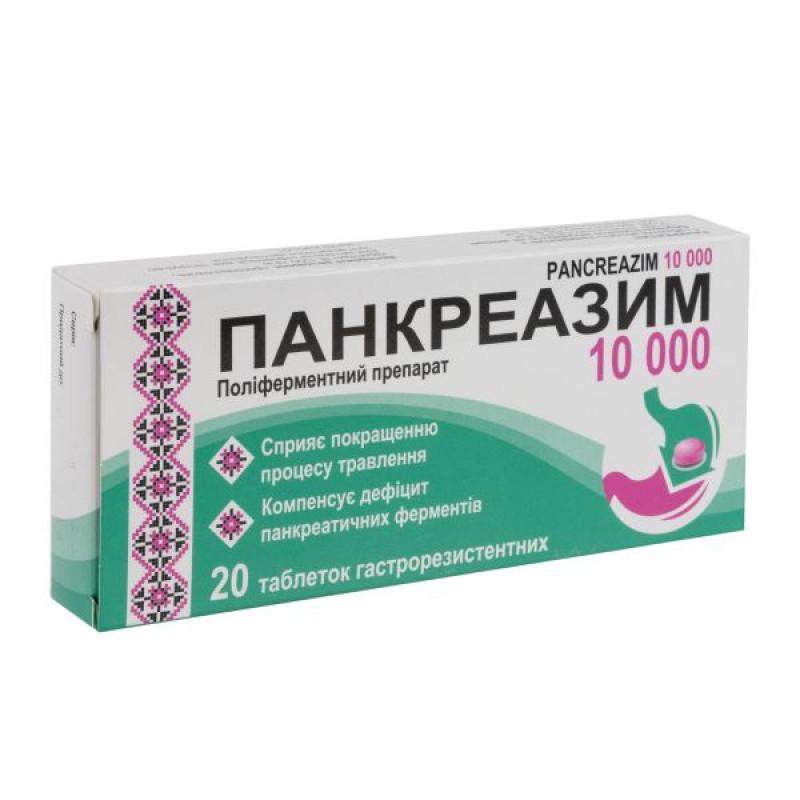
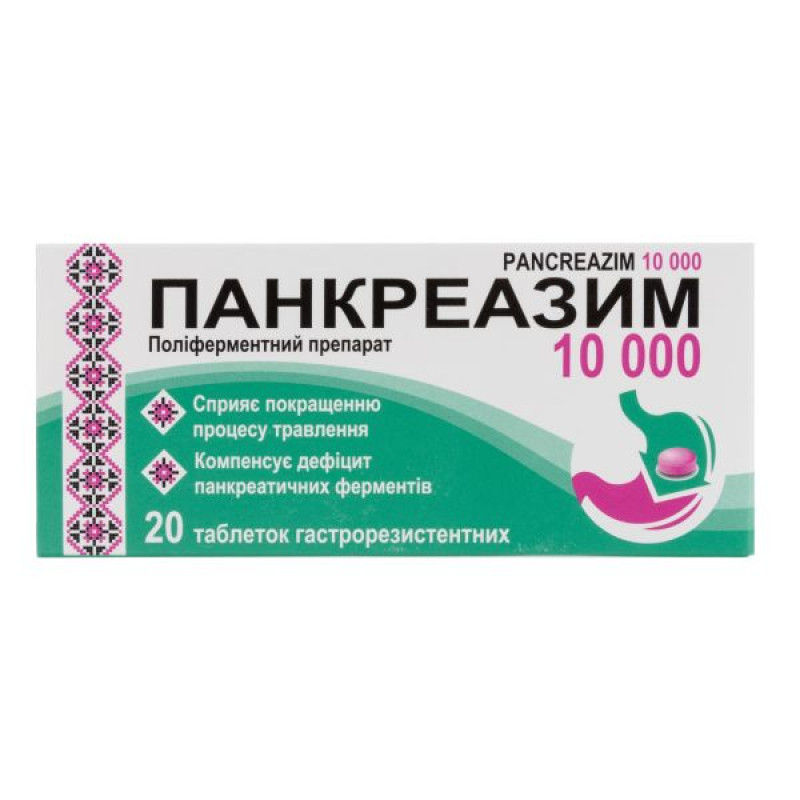
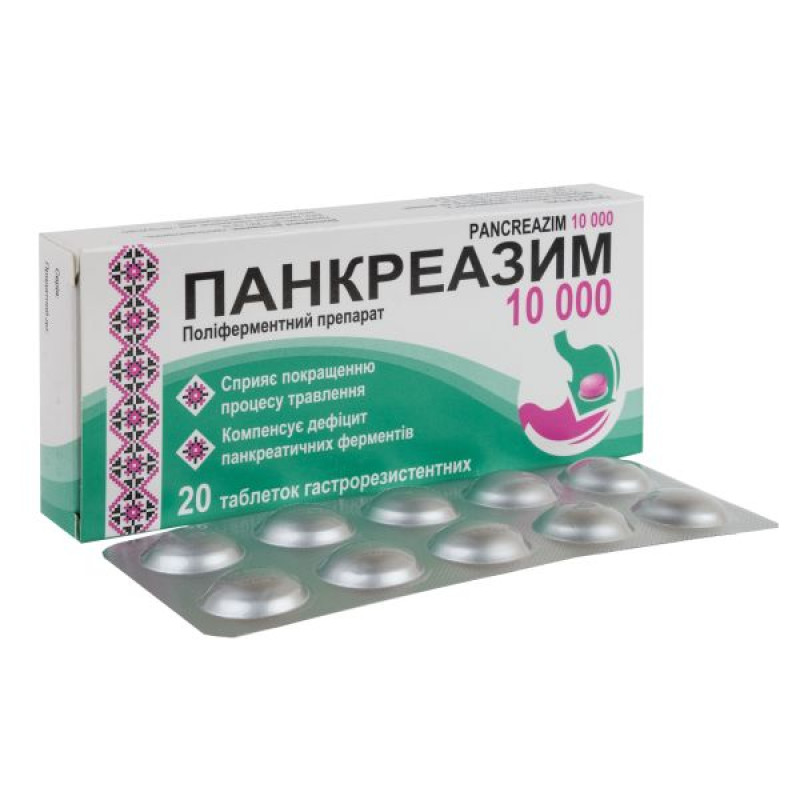
Instructions Pancreazim 10000 gastro-resistant tablets blister No. 20
Composition
active ingredient: pancreatin;
1 gastro-resistant tablet contains pancreatin with enzymatic activity of at least 10,000 lipolytic U Ph. Eur., 7,500 amylolytic U Ph. Eur., 400 proteolytic U Ph. Eur.;
excipients: sodium chloride, colloidal anhydrous silicon dioxide, microcrystalline cellulose, crospovidone, croscarmellose sodium, povidone 25, magnesium stearate, methacrylate copolymer dispersion, talc, propylene glycol, titanium dioxide (E 171), carmoisine (E 122).
Dosage form
Gastro-resistant tablets.
Main physicochemical properties: round, film-coated tablets with convex upper and lower surfaces, pink in color, with a faint specific odor. When broken, a core surrounded by one continuous layer is visible under a magnifying glass.
Pharmacotherapeutic group
Drugs that affect the digestive system and metabolism. Drugs that improve digestion, including enzymes. Polyenzyme drugs (lipase, protease, etc.).
ATX code A09A A02.
Pharmacological properties
Pharmacodynamics
A multi-enzyme preparation. Pancreatic enzymes (lipase, amylase and protease) that are part of it facilitate the digestion of fats, carbohydrates, proteins, which contributes to their complete absorption in the small intestine. In diseases of the pancreas, the preparation compensates for the insufficiency of its exocrine function and helps improve the digestive process.
Pharmacokinetics
The shell covering the tablet does not dissolve under the action of gastric juice and protects the enzymes from their inactivation by gastric juice. Only under the action of the neutral or slightly alkaline environment of the small intestine does the shell dissolve and the enzymes are released.
Indication
Diseases that are accompanied by a violation of the process of food digestion due to insufficient secretion of digestive enzymes by the pancreas, such as chronic pancreatitis.
Conditions after simultaneous resection of the stomach and small intestine, functional acceleration of food passage through the intestines, intestinal disorders, simultaneous consumption of difficult-to-digest vegetable, fatty and unusual foods.
Intestinal distension and preparation for X-ray or ultrasound diagnostic examinations.
Contraindication
Hypersensitivity to the active substance or other components of the drug. Acute pancreatitis, exacerbation of chronic pancreatitis, intestinal obstruction.
Interaction with other medicinal products and other types of interactions
The drug reduces iron absorption with prolonged use, therefore, if necessary, iron preparations should be prescribed simultaneously. Simultaneous use of antacids containing calcium carbonate and/or magnesium hydroxide may lead to a decrease in the effectiveness of pancreatin.
Simultaneous use with tannin and alcohol-containing products may lead to a decrease in the effectiveness of pancreatin.
Pancreatic enzymes inhibit folic acid absorption. When bicarbonates and cimetidine are taken concomitantly with large doses of pancreatic enzymes, it is recommended to periodically measure serum folic acid levels and provide additional folic acid if necessary.
Pancreatic enzymes may reduce the effectiveness of acarbose and miglitol.
Application features
In the presence of symptoms similar to intestinal obstruction, it is necessary to remember the possibility of intestinal strictures. It is recommended to monitor all unusual symptoms, especially when taking more than 10,000 Ph. Eur. lipase units/kg/day.
The drug contains active enzymes that can damage the oral mucosa, so the tablets should be swallowed whole, without chewing.
Ability to influence reaction speed when driving vehicles or other mechanisms
No effect on the ability to drive or use machines was observed.
Use during pregnancy or breastfeeding
There is no data on the safety of lipase, amylase, and protease during pregnancy.
Animal studies did not indicate direct or indirect harmful effects with respect to pregnancy, embryonic development, parturition or postnatal development.
It should be prescribed with caution to pregnant women. Enzymes are not absorbed from the gastrointestinal tract, but the risk cannot be excluded. The drug should be used in pregnant and breastfeeding women only if the expected benefit to the mother outweighs the potential risk to the child.
Method of administration and doses
If there are no other recommendations, as well as in the case of eating hard-to-digest plant foods, fatty or unusual foods, take 1-2 tablets. In other cases mentioned above, if digestive disorders occur, the recommended dose is 2-4 tablets. If necessary, the dose of the drug can be increased. Increasing the dose to reduce the symptoms of the disease, such as steatorrhea or abdominal pain, should be carried out only under the supervision of a doctor. The daily dose of lipase should not exceed 15,000-20,000 Ph. Eur. units per 1 kg of body weight.
Take the tablets during meals, swallowing them whole and drinking plenty of liquid, such as 1 glass of water.
The duration of treatment depends on the course of the disease and is determined by the doctor on an individual basis.
The dosage and duration of treatment for children is decided by the doctor.
The drug should be prescribed in a daily dose necessary to normalize bowel movements, but not more than 1,500 Ph. Eur. lipase units per 1 kg of body weight of a child under 12 years of age. For children over 12 years of age, the daily dose of enzymes should not exceed 15,000 - 20,000 Ph. Eur. lipase units per 1 kg of body weight.
Children
Use for children aged 3 years and over.
Overdose
Symptoms. Possible enhancement of side effects. Hyperuricemia and hyperuricosuria have been observed when taking extremely high doses of other pancreatic powder preparations, and constipation in children.
Treatment: Discontinuation of the drug, adequate hydration, and symptomatic therapy.
Adverse reactions
The following classification is used to estimate the frequency of adverse reactions: very common: ≥ 1/10; common: ≥ 1/100 and < 1/10; uncommon: ≥ 1/1000 and < 1/100; rare: ≥ 1/10000 and < 1/1000; very rare: < 1/10000, frequency unknown (cannot be estimated from the available data).
Cardiovascular system: frequency unknown: tachycardia.
Immune system disorders: very rare: immediate allergic reactions (skin rash, itching, sneezing, lacrimation, bronchospasm), anaphylactic reactions. Frequency unknown: the dye carmoisine (E 122) may cause allergic reactions.
Gastrointestinal: very rare: when using high doses of pancreatin (more than 10,000 Ph. Eur. lipase units/kg body weight/day), strictures may form in the ileocecal region and in the ascending part of the colon; diarrhea, abdominal pain, nausea, vomiting, change in the nature of stools; possible development of intestinal obstruction, constipation.
Skin and subcutaneous tissue disorders: frequency unknown: urticaria, hyperemia, itching, angioedema.
On the part of the genitourinary system: frequency unknown: increased excretion of uric acid in the urine is possible, especially when using high doses of pancreatin. To avoid the formation of uric acid stones in such patients, its content in the urine should be monitored.
General disorders: frequency unknown: feeling hot, general weakness.
Expiration date
2 years.
Storage conditions
Store in original packaging at a temperature not exceeding 25 ° C. Keep out of the reach of children.
Packaging
10 tablets in a blister. 2 blisters in a cardboard pack.
Vacation category
Without a prescription.
Producer
Technolog PJSC.
Location of the manufacturer and its business address
Ukraine, 20300, Cherkasy region, Uman city, Stara Prorizna Street, building 8.