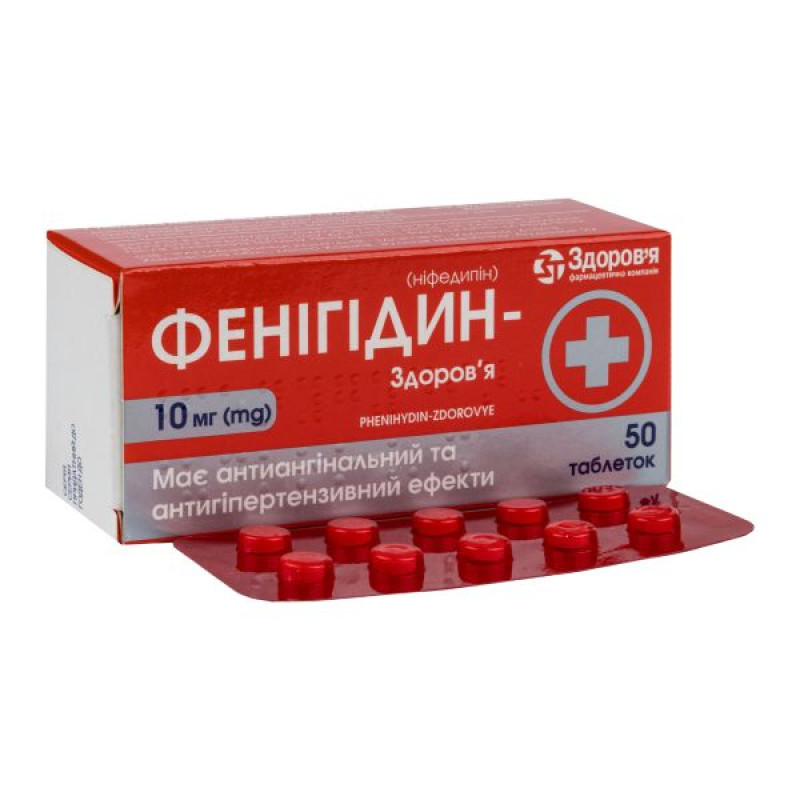
Instructions for use Phenigidine-Health tablets 10 mg blister No. 50
Composition
active ingredient: nifedipine;
1 tablet contains nifedipine 10 mg;
excipients: potato starch, lactose monohydrate, refined sugar, calcium stearate, polysorbate-80.
Dosage form
Pills.
Main physicochemical properties: tablets of yellow or greenish-yellow color, flat-cylindrical shape with a bevel.
Pharmacotherapeutic group
Selective calcium channel blockers with a predominant effect on blood vessels. Dihydropyridine derivatives. ATC code C08C A05.
Pharmacological properties
Pharmacodynamics.
Nifedipine – the active ingredient of the drug – a selective calcium channel blocker, a dihydropyridine derivative. It exhibits antianginal and antihypertensive effects. It inhibits the influx of calcium into cardiomyocytes and vascular smooth muscle cells. It reduces the tone of vascular smooth muscle. It dilates coronary and peripheral arteries, reduces total peripheral vascular resistance, blood pressure and, to a lesser extent, myocardial contractility, reduces afterload and myocardial oxygen demand. It improves coronary blood flow. It does not inhibit myocardial conductivity. With prolonged use, nifedipine can prevent the formation of new atherosclerotic plaques in the coronary vessels. At the beginning of treatment with nifedipine, transient reflex tachycardia and an increase in cardiac output may occur, which do not compensate for the vasodilation caused by the use of the drug. Nifedipine increases the excretion of sodium and fluid from the body. In Raynaud's syndrome, the drug can prevent or reduce spasm of the blood vessels in the extremities.
Pharmacokinetics.
After oral administration, nifedipine is rapidly and almost completely absorbed. Bioavailability due to first-pass metabolism in the liver is 50%. Maximum plasma concentration (Tmax) is reached 1–3 hours after administration.
Nifedipine is metabolized in the intestinal wall and in the liver via the cytochrome P450 3A4 system. Metabolites do not exhibit pharmacological activity. It is excreted from the body as metabolites mainly by the kidneys and about 5–15% - through the intestines with bile. Trace amounts of unchanged substance (less than 0.1%) were detected in the urine.
The half-life (T1/2) of nifedipine from blood plasma is 2–5 hours.
Indication
Arterial hypertension; ischemic heart disease: chronic stable angina, vasospastic angina (Prinzmetal's angina).
Contraindication
Hypersensitivity to nifedipine, to other dihydropyridine derivatives or to other components of the drug; cardiogenic shock; severe aortic stenosis; unstable angina; acute myocardial infarction (within the first 4 weeks); ileostomy; colostomy; use in combination with rifampicin (due to the inability to achieve effective concentrations of nifedipine in the blood plasma).
Interaction with other medicinal products and other types of interactions
Nifedipine is metabolized by the cytochrome P450 3A4 system, which is located in the intestinal mucosa and liver. Therefore, drugs that inhibit or induce this enzyme system may alter the "first pass" (after oral administration) or clearance of nifedipine.
When using the drug simultaneously with other medicines, the following interactions are possible:
with quinupristin/dalfopristin, cimetidine, cisapride - due to inhibition of cytochrome P450 ZA4, the concentration of nifedipine in the blood plasma increases; with simultaneous use of drugs, it is recommended to monitor blood pressure and, if necessary, reduce the dose of nifedipine;
with the following inhibitors of the cytochrome P450 3A4 system: macrolide antibiotics, HIV protease inhibitors, azole antifungals, fluoxetine, nefazodone, valproic acid - clinical studies of the interaction of these drugs and nifedipine have not been conducted. It is known that drugs of this class inhibit the cytochrome P450 3A4-mediated metabolism of nifedipine, therefore, with simultaneous use, an increase in the concentration of the latter in the blood plasma cannot be excluded; it is recommended to monitor blood pressure and, if necessary, reduce the dose of nifedipine;
with rifampicin – due to induction of cytochrome P450 ZA4, the bioavailability and efficacy of nifedipine are significantly reduced; simultaneous use of the drugs is contraindicated;
with the following inducers of the cytochrome P450 3A4 system: carbamazepine, phenobarbital - clinical studies of the interaction of the above-mentioned drugs and nifedipine have not been conducted. It is known that both drugs, due to the induction of cytochrome P450 3A4, reduce the concentration in the blood plasma of the structurally similar calcium channel blocker nimodipine, therefore, when used simultaneously with nifedipine, an increase in its concentration in the blood plasma cannot be excluded;
with antihypertensive agents (diuretics, α- and β-adrenoblockers, ACE inhibitors, calcium receptor antagonists, AT-1 receptor antagonists, PDE-5 inhibitors, methyldopa, magnesium sulfate) - possible enhancement of the hypotensive effect; with simultaneous use of nifedipine with β-adrenoblockers, careful monitoring of the patient is required, since isolated cases of exacerbation of heart failure are known;
with digoxin - possible decrease in digoxin clearance and increase in its concentration in blood plasma; it is recommended to monitor the patient for symptoms of digoxin overdose and, if necessary, adjust the dose;
with quinidine - a decrease in quinidine concentration has been reported, and when nifedipine is discontinued - a sharp increase in quinidine concentration in blood plasma; it is recommended to monitor quinidine concentration in blood plasma and, if necessary, adjust its dose; also, some authors have reported an increase in nifedipine concentration in blood plasma with their simultaneous use;
with tacrolimus - increased tacrolimus plasma concentrations have been reported; it is recommended to monitor tacrolimus plasma concentrations and, if necessary, adjust its dose.
Grapefruit juice inhibits the cytochrome P450 3A4 system. The use of grapefruit juice during the use of nifedipine leads to an increase in the concentration of the drug in the blood plasma and an increase in the duration of action of nifedipine due to a decrease in first-pass metabolism or a decrease in clearance. As a result, the antihypertensive effect of the drug may be enhanced. After regular consumption of grapefruit juice, this effect may persist for at least 3 days after the last consumption of the juice. Therefore, grapefruit/grapefruit juice should be avoided during nifedipine therapy.
The use of the drug may lead to falsely elevated results in the spectrophotometric determination of the concentration of vanillylmandelic acid in urine (however, this effect is not observed when using the high-performance liquid chromatography method).
The use of the drug may lead to false-positive results in X-ray examinations using barium contrast media (for example, filling defects are interpreted as a polyp).
Application features
The drug can be used in combination with other antihypertensive agents. However, the possibility of developing postural hypotension should be taken into account.
When using the drug and β-blockers simultaneously, it is recommended to monitor the patient's condition, as this may lead to a more pronounced decrease in blood pressure and weakening of cardiac activity.
The drug should not be used in patients with an acute attack of stable angina.
The drug should not be used if there is a possible connection between previous use of nifedipine and ischemic pain. In patients with angina pectoris, attacks may occur more frequently, and their duration and intensity may increase, especially at the beginning of treatment.
The drug should be used with caution in patients with severe arterial hypotension (systolic blood pressure below 90 mm Hg), severe heart failure, severe cerebral circulation disorders, diabetes mellitus, impaired liver function. It is recommended to monitor the patient's condition and, if necessary, adjust the dose of nifedipine.
The drug should be used with extreme caution in patients undergoing hemodialysis, in conditions of malignant arterial hypertension or hypovolemia, since dilation of blood vessels may cause a significant decrease in blood pressure in them.
The drug should be used with caution in patients who are simultaneously taking inhibitors of the cytochrome P450 3A4 system. It is recommended to monitor blood pressure and, if necessary, adjust the dose of nifedipine.
The drug should be used with caution in patients with severe gastrointestinal narrowing due to the possibility of obstructive symptoms. Obstructive symptoms have been described in the absence of a history of gastrointestinal disorders. Bezoars may occur, which may require surgical intervention.
Some in vitro experiments have shown an association between the use of calcium antagonists, such as nifedipine, and reversible biochemical changes in spermatozoa that impair their ability to fertilize. If in vitro fertilization attempts are unsuccessful, in the absence of other explanations, calcium antagonists, such as nifedipine, may be considered as a possible cause of this phenomenon.
The medicine contains lactose and refined sugar, therefore, if the patient has been diagnosed with an intolerance to some sugars, you should consult your doctor before taking this medicine.
Use during pregnancy or breastfeeding
Animal studies have shown embryotoxicity, fetotoxicity, and teratogenicity of the drug.
There are no adequate and well-controlled studies in pregnant women. An increased incidence of perinatal asphyxia, cesarean section, preterm birth, and intrauterine growth retardation has been reported. It is not yet clear whether these reports are due to the presence of hypertension, its treatment, or a specific effect of the drug. The available information is insufficient to exclude serious adverse effects on the fetus or newborn.
The use of nifedipine is contraindicated in pregnancy up to the 20th week. The use of nifedipine in pregnancy after the 20th week requires a careful assessment of the risk/benefit ratio. The issue of therapy with the drug should be considered only in the absence of alternative treatment options. When using nifedipine simultaneously with intravenous magnesium sulfate, careful monitoring of blood pressure is required because of the possibility of a significant decrease in blood pressure, which may harm the mother and fetus.
Nifedipine passes into breast milk. Breastfeeding should be discontinued during the period of use of the drug.
Ability to influence reaction speed when driving vehicles or other mechanisms
When using the drug, adverse reactions may occur that affect the speed of reaction when driving or using other mechanisms, especially at the beginning of treatment or when switching to another drug.
Method of administration and doses
The drug is intended for adults orally. The tablets should be taken at the same time, regardless of food intake, without chewing and with sufficient liquid (except grapefruit juice). The recommended interval between doses is 12 hours (but not less than 6 hours).
The dose of the drug and the duration of the course of treatment are determined individually, taking into account the severity of the disease and the patient's response to treatment.
Arterial hypertension.
The drug should be used at a dose of 20 mg 2 times a day.
Ischemic heart disease.
The drug should be used at a dose of 20 mg 2 times a day. If necessary, the dose of nifedipine may be increased to 60 mg/day. The dose should be increased gradually.
Patients concomitantly using inhibitors or inducers of cytochrome CYP 3A4. Dose adjustment or discontinuation of the drug may be required when used concomitantly with inhibitors or inducers of cytochrome CYP 3A4.
The drug should be discontinued gradually, especially when using high doses.
Children. The drug should not be used in children.
Overdose
Symptoms of acute intoxication: impaired consciousness up to the development of coma, decreased blood pressure, tachycardia/bradycardia, hyperglycemia, metabolic acidosis, hypoxia, cardiogenic shock accompanied by pulmonary edema.
Treatment. Emergency measures should be aimed primarily at removing the drug from the body and restoring stable hemodynamics. After oral administration, it is recommended to completely empty the stomach, if necessary in combination with gastric and small intestinal lavage. In case of bradycardia, it is recommended to use β-sympathomimetics. In case of life-threatening slowing of the heart rate, the use of an artificial pacemaker is recommended. Arterial hypotension resulting from cardiogenic shock and vasodilation can be eliminated with calcium preparations (10–20 ml of a 10% solution of calcium chloride or gluconate should be administered intravenously slowly, then repeated if necessary). As a result, serum calcium levels may reach the upper limit of normal or be slightly elevated. If calcium administration is not effective enough, it is advisable to use sympathomimetics such as dopamine or noradrenaline. The doses of these drugs should be selected taking into account the achieved therapeutic effect. Additional fluid administration should be approached with great caution, as this increases the risk of cardiac overload. Since nifedipine is characterized by a high degree of binding to plasma proteins and a relatively small volume of distribution, hemodialysis is ineffective, but plasmapheresis is recommended.
Side effects
From the blood and lymphatic system: anemia, leukopenia, thrombocytopenia (sometimes with purpura), agranulocytosis.
Nervous system and psyche: headache, migraine, dizziness/vertigo, tremor, paresthesia/dysaesthesia/hypoesthesia, sleep disorders, drowsiness, feeling of anxiety.
On the part of the organs of vision: visual impairment, feeling of pain in the eyes.
Cardiovascular system: tachycardia, palpitations, hypotension, edema, vasodilation, hyperemia, collapse, chest pain (including typical angina attacks), loss of consciousness.
Respiratory, thoracic and mediastinal disorders: epistaxis, nasal congestion, dyspnea.
On the part of the hepatobiliary system: transient increase in liver enzyme activity, jaundice, cholestasis.
Metabolism and metabolism: hyperglycemia.
From the urinary system: polyuria, dysuria, in patients with renal failure - deterioration of renal function.
Musculoskeletal and connective tissue disorders: myalgia, arthralgia, muscle cramps, joint swelling.
From the reproductive system and mammary glands: erectile dysfunction, gynecomastia (in elderly men).
Immune system, skin and subcutaneous tissue disorders: hypersensitivity reactions, including rash, pruritus, urticaria, allergic edema/angioedema, including laryngeal edema; anaphylactic/anaphylactoid reactions; erythema, photosensitivity, purpura, exfoliative dermatitis, toxic epidermal necrolysis (Lyell's syndrome).
Others: malaise, increased fatigue, chills, nonspecific pain, with prolonged use, fever is possible.
Patients with malignant hypertension and hypovolemia undergoing hemodialysis may experience a significant decrease in blood pressure due to vasodilation.
Expiration date
3 years.
Storage conditions
Store in the original packaging at a temperature not exceeding 25 °C.
Keep out of reach of children.
Packaging
Tablets No. 10x5 in blisters in a box.
Vacation category
According to the recipe.
Producer
Limited Liability Company "Pharmaceutical Company "Zdorovya".
Address
Ukraine, 61013, Kharkiv region, Kharkiv city, Shevchenko street, building 22.