Instructions for use PK-Merz solution for infusion 0.4 mg/ml bottle 500 ml No. 2
Composition
active ingredient: amantadine sulfate;
1 bottle (500 ml) contains amantadine sulfate 200 mg;
excipients: water for injection, sodium chloride.
Dosage form
Solution for infusion.
Main physicochemical properties: colorless, transparent, odorless solution.
Pharmacotherapeutic group
Antiparkinsonian drugs. ATX code N04B B01.
Pharmacological properties
Pharmacodynamics.
Amantadine has various pharmacological properties. It has indirect striatal dopamine receptor agonist properties. Animal studies have shown that amantadine increases extracellular dopamine concentrations both by increasing dopamine release and by blocking reuptake in presynaptic nerve cells. At therapeutic concentrations, amantadine inhibits NMDA receptor-mediated acetylcholine release and may thus exert anticholinergic effects. Amantadine has a synergistic effect with L-dopa.
Pharmacokinetics.
The maximum concentration in blood plasma is reached 2-8 hours (tmax) after taking a single dose of the drug.
The readily soluble amantadine hydrochloride gives higher plasma concentrations than the less soluble amantadine sulfate, for which the peak plasma concentration (Cmax) occurs later than for the hydrochloride. A Cmax of 0.5 μg/ml is achieved after a single oral dose of 250 mg amantadine hydrochloride.
When taking the drug at a dose of 200 mg/day, the equilibrium concentration is reached after 4-7 days with a plasma concentration of 400-900 ng/ml. After taking 100 mg of amantadine sulfate, Cmax is 0.15 μg/ml.
The total amount of active substance absorbed (AUC) is the same for the two salts
amantadine.
Plasma clearance is determined to be identical to renal clearance and is 17.7 ±
10 l/hour in healthy adult volunteers.
The apparent volume of distribution (4.2 ± 1.9 l/kg) depends on age, in adults it is 6 l/kg.
The elimination half-life is 10-30 hours, with an average of 15 hours, and is largely dependent on the patient's age. In elderly men (62-72 years), the elimination half-life is 30 hours. In patients with renal insufficiency, the terminal plasma half-life may be significantly prolonged (up to 68 ± 10 hours).
After an infusion of 200 mg of amantadine sulfate, the Cmax after 3 hours is 0.54 μg/ml. After treatment with a dose of 200 mg/day, a mean plasma concentration of 0.76 μg/ml is reached at the end of the infusion on day 6. The mean total clearance was calculated to be 3.6 l/h; the plasma half-life is between 7 and 23 hours with a mean value of approximately 10 hours.
Amantadine is approximately 67% bound to plasma proteins (in vitro); approximately 33% is found in plasma in an unbound form. It crosses the blood-brain barrier via saturable transport systems.
It is excreted in the urine almost unchanged (90% of a single dose), a small amount is excreted in the feces.
The dialyzability of amantadine is low - almost 5% per dialysis.
Amantadine is not metabolized in the human body.
Indication
Intensive therapy and initial treatment of akinetic crisis in cases of acute exacerbations of parkinsonism symptoms.
To increase the ability to concentrate (vigilance) in post-comatose states of various etiologies in hospital settings.
Contraindication
Hypersensitivity to amantadine or to any other components of the drug;
decompensated heart failure (NYHA stage IV);
cardiomyopathy and myocarditis;
atrioventricular block II or III degree;
bradycardia (less than 55 beats/min);
prolonged QT interval (Bazett QTc >420 ms) with either prominent U-waves or a family history of congenital QT syndrome;
severe ventricular arrhythmia, including chaotic polymorphic ventricular tachycardia;
simultaneous treatment with budipine or other drugs that prolong the QT interval (see section "Interaction with other medicinal products and other types of interactions");
low levels of potassium or magnesium in the blood;
epilepsy and other seizures;
severe renal failure;
peptic ulcer.
Special safety precautions
Patients who are simultaneously taking neuroleptics and the drug PK-Merz are at risk of developing neuroleptic malignant syndrome in the event of sudden discontinuation of the drug PK-Merz.
Intoxication may occur in patients with kidney damage.
Particular caution should be exercised when prescribing the drug to patients with organic brain syndrome or patients with epileptic seizures, as an increase in individual symptoms may occur.
Patients with known cardiovascular disorders should remain under constant medical supervision during treatment with PK-Merz.
An ophthalmologist should be consulted as soon as symptoms of visual loss or blurred vision appear to rule out possible causes of corneal edema. If corneal edema is diagnosed, PC-Merz should be discontinued. Corneal edema caused by PC-Merz usually resolves within a month after discontinuation of treatment.
Patients should inform their doctor if they experience difficulty urinating.
A 500 ml infusion bag contains 77 mmol sodium (1770 mg sodium). This should be taken into account by patients on a low-salt diet.
Interaction with other medicinal products and other types of interactions
Concomitant use of amantadine with other drugs that cause QT prolongation is contraindicated. These include:
certain class IA (e.g., quinidine, disopyramide, procainamide) and class III (e.g., amiodarone, sotalol) antiarrhythmics;
certain neuroleptics (e.g. thioridazine, chlorpromazine, haloperidol, pimozide);
certain tricyclic and tetracyclic antidepressants (e.g., amitriptyline);
certain antihistamines (e.g., astemizole, terfenadine);
certain macrolide antibiotics (e.g., erythromycin, clarithromycin);
certain gyrase inhibitors (e.g., sparfloxacin);
azole antifungals and other drugs such as budipine, halofantrine, co-trimoxazole, pentamidine, cisapride, and bepridil.
Before starting to take other medicines together with PK-Merz, it is necessary to carefully read the instructions for use for the possible interaction, due to prolongation of the QT interval, between the medicine and amantadine. To avoid side effects (such as psychotic reactions), the dose of other medicines or their combinations should be reduced.
No specific interaction studies have been conducted after concomitant administration of PK-Merz with other antiparkinsonian agents (e.g. levodopa, bromocriptine, trihexylphenidyl) or memantine (see section "Adverse reactions").
Simultaneous administration of PK-Merz and any other groups of medicines or active ingredients listed below may lead to the following types of interactions:
Anticholinergics
Increased side effects (confusion and hallucinations) of anticholinergic agents (e.g., trihexylphenidyl, benztropine, scopolamine, biperiden, orphenadrine).
Sympathomimetics with direct action on the CNS
Enhancement of the main action of amantadine.
Alcohol
Reduced alcohol tolerance.
Levodopa (anti-Parkinsonian drug)
Mutual enhancement of therapeutic effects. Therefore, levodopa can be prescribed simultaneously with the drug PK-Merz.
Memantine (dementia drug)
Memantine may enhance the effects and side effects of the drug PK-Merz (it is important to pay attention to the section "Special instructions for use").
Other medicines
Concomitant use of diuretics such as triamterene/hydrochlorothiazide may result in decreased plasma clearance of amantadine, leading to toxic plasma concentrations of amantadine. Therefore, concomitant use of this combination should be avoided.
Application features
Special caution should be exercised when administering the drug to patients with:
liver dysfunction;
thyrotoxicosis;
recurrent eczema;
prostatic hypertrophy;
narrow-angle glaucoma;
renal failure (of varying severity; there is a risk of accumulation of amantadine due to impaired renal filtration (see also the section "Method of administration and dosage");
agitation or confusion;
delirium syndrome or exogenous psychosis in history;
with simultaneous treatment with memantine (see section "Interaction with other medicinal products and other types of interactions").
when used simultaneously with drugs that affect the CNS (see section "Interaction with other medicinal products and other types of interactions").
An ECG (50 mm/s) and a manually determined Bazett-corrected QT interval (QTc) should be performed before the start of treatment and after 1 and 3 weeks. This ECG should be performed before any subsequent dose increase and 2 weeks after. Thereafter, an ECG should be performed at least once a year. Treatment should not be initiated or discontinued if the initial QTc value is greater than 420 ms, if the QT increases by more than 60 ms during treatment with the drug or if the QTc value is greater than 480 ms during treatment with PK-Merz, solution for infusion, and in patients with visible U-waves. By observing the above precautions and taking into account the contraindications, life-threatening side effects can be prevented.
Patients at risk of electrolyte imbalance due to, for example, diuretic treatment, frequent vomiting and/or diarrhea, patients taking insulin in crisis situations, or patients with renal or anorexic disorders should undergo examination and monitoring of laboratory parameters and appropriate replenishment of electrolytes, especially potassium and magnesium.
In patients with pacemakers, accurate determination of the QT interval is not possible, therefore the decision to use PK-Merz should be made individually after consultation with a cardiologist.
Some patients may develop peripheral edema with prolonged use of the drug. This should be taken into account in patients with chronic heart failure.
Amantadine treatment should not be discontinued abruptly as this may lead to worsening of Parkinson's disease, the appearance of symptoms characteristic of neuroleptic malignant syndrome, as well as the development of cognitive disorders such as: catatonia, confusion, disorientation, deterioration of mental status, delirium. Amantadine should not be abruptly discontinued in patients who are simultaneously using neuroleptics due to the possible risk of developing neuroleptic-induced catatonia.
Suicide attempts and suicidal thoughts have been reported in patients receiving amantadine. In order to prevent the emergence of suicidal thoughts and intentions, the drug should be prescribed in the minimum effective dose.
Additional administration of amantadine for the prevention and treatment of influenza A virus is inappropriate and should be avoided due to the risk of overdose.
Use during pregnancy or breastfeeding
If amantadine is prescribed to a woman of childbearing potential, the patient should be instructed to consult a physician immediately if pregnancy is suspected or anticipated.
There are no data on the penetration of the drug through the placenta. There are no data on the use of amantadine in pregnant women. There have been reports of isolated cases of healthy births, but there have also been complications during pregnancy and five cases of congenital defects (cardiovascular defects, limb anomalies). In animal studies, amantadine has shown its embryotoxic and teratogenic effects. The potential risk for humans is unknown. Therefore, amantadine can be used during pregnancy only in cases of extreme necessity. If therapy is carried out in the first trimester, an ultrasound scan is necessary.
PK-Merz passes into breast milk. If amantadine therapy is absolutely necessary during breastfeeding, the infant should be observed for possible symptoms associated with the use of the drug (skin rash, urinary retention, vomiting), and breastfeeding should be discontinued.
Amantadine is contraindicated in pregnant women and women planning to become pregnant.
The drug is contraindicated during breastfeeding, as it passes into breast milk. If necessary, use of the drug should be discontinued.
Ability to influence reaction speed when driving vehicles or other mechanisms
An effect on the ability to concentrate and adapt is not excluded, especially in combination with the effect of other drugs used in the treatment of Parkinson's syndrome. At the beginning of treatment, the ability to drive a car or operate other mechanisms may be impaired due to the condition itself. This impairment is further exacerbated in combination with alcohol.
Method of administration and doses
Administer intravenously.
Treatment of patients with Parkinson's syndrome
In case of a sharp exacerbation of parkinsonism symptoms during an akinetic crisis, an intravenous dose of 200 mg of amantadine sulfate is administered 1-3 times a day. The rate of administration should not exceed 55 drops per minute, which is equal to an infusion time of approximately 3 hours.
Vigilance.
To improve alertness in post-comatose states of various etiologies, therapy with a daily dose of 200 mg of amantadine sulfate, administered as a slow infusion (> 3 hours), can be carried out in an initial period of 3-5 days. Depending on the clinical picture, treatment can be continued, if possible, in oral form - up to 4 weeks at a dose of 200 mg of amantadine sulfate per day.
Dosage for patients with renal insufficiency.
Doses for patients with renal impairment should be adapted according to glomerular filtration rate (GFR) as shown in Table 1.
Table 1
| GFR, ml/min | Dose of amantadine sulfate, mg | Dose interval |
| 80-60 | 100 | Every 12 hours |
| 60-50 | 200 and 100 | Every next day* |
| 50-30 | 100 | 1 time per day |
| 30-20 | 200 | 2 times a week |
| 20-10 | 100 | 3 times a week |
| < 10 and patients on hemodialysis | 200 and 100 | 1 time per week or 1 time every two weeks |
* achieved by alternately administering 100 mg and 200 mg of amantadine sulfate once.
GFR can be approximately calculated using the following equation:
Clcr = (140 - age) x body weight,
72 x creatinine
where:
Clcr = creatinine clearance in ml/min and
Creatinine = serum creatinine in mg/100 ml.
Creatinine clearance calculated according to this expression applies exclusively to men (the corresponding value for women is 85% of this value) and can be equated to insulin clearance for determining GFR (120 ml/min for adults).
Amantadine is poorly dialyzed (about 5%).
Abrupt discontinuation of treatment should be avoided, as this may result in an increase in extrapyramidal symptoms, sometimes including akinetic crises, in patients with Parkinson's disease, and the withdrawal effect may sometimes manifest as delirium.
Patients with reduced alertness who have continued treatment with tablets should not take the drug for longer than 4 weeks.
Children.
There are no data on the use of the drug in children, so the drug should not be used in this age category.
Overdose
The possibility of multiple intoxication, such as taking more than one drug for the purpose of suicide, must always be considered.
Symptoms of overdose
Acute intoxication is characterized by nausea, vomiting, hyperexcitability, tremor, ataxia, blurred vision, lethargy, depression, dysarthria and convulsions; one case of cardiac arrhythmia has been reported. Neuromuscular disorders, hyperreflexia, restlessness, extrapyramidal phenomena, torsion spasms, mydriasis, dysphagia, disorientation, dry mouth, hyperventilation, pulmonary edema, respiratory failure, respiratory distress syndrome, hypertension, tachycardia, angina pectoris, cardiac arrest.
Renal dysfunction, including increased urea nitrogen and decreased creatinine clearance, and urinary retention, is possible.
Acute toxic psychosis in the form of confusion with visual hallucinations, sometimes including coma and myoclonus, has been observed after concomitant administration of amantadine and other antiparkinsonian drugs.
Treatment
Specific drug treatment for overdose or antidote is unknown. In case of intoxication with PK-Merz, additional intensive care is required. Therapeutic measures should be taken, which include fluid administration and acidification of the urine for faster excretion of the substance, possible sedation, anticonvulsant and antiarrhythmic measures (lidocaine intravenously).
For the treatment of neurotoxic symptoms (such as those described above), intravenous physostigmine can be tried at a dose of 1-2 mg every 2 hours in adults and 2 x 0.5 mg at 5-10 minute intervals up to a maximum dose of 2 mg in children.
Due to the low dialysability of amantadine (almost 5%), hemodialysis is not recommended.
It is recommended to monitor patients with a predisposition to possible prolongation of the QT interval and factors that contribute to the occurrence of chaotic polymorphic ventricular tachycardia, such as electrolyte imbalance (in particular hypokalemia and hypomagnesemia) or bradycardia.
Side effects
The assessment of side effects is based on the following frequency indicators:
| Very often | (>1/10) |
| Often | (>1/100, <1/10) |
| Infrequently | (>1/1000, <1/100) |
| Rarely | (>1/10000, <1/1000) |
| Very rare | (<1/10,000), including isolated reports |
| Unknown: | frequency cannot be estimated from the available data |
From the nervous system
Common: dizziness, movement disorders.
Very rare: epileptic seizures, usually after treatment with doses exceeding the recommended ones, symptoms of myoclonus and peripheral neuropathy, anxiety, headache, drowsiness, insomnia, weakness, fever, ataxia, slurred speech, impaired concentration, irritability, depression, myalgia, paresthesia, confusion, disorientation, tremor, dyskinesia, stupor, suicidal thoughts and intentions, neuroleptic malignant syndrome, delirium, hypomania and mania, hallucinations, nightmares.
Mental disorders
Common: sleep disturbances and mental agitation.
In patients (especially elderly) prone to mental disorders, paranoid exogenous psychoses may develop, accompanied by visual hallucinations. Side effects of this type may be more common when the drug is taken in combination with other antiparkinsonian drugs (e.g. levodopa, bromocriptine) or memantine.
Renal and urinary disorders
Common: urinary retention in patients with prostatic hypertrophy, urinary incontinence, change in libido.
Skin and subcutaneous tissue disorders
Common: "marbled skin" accompanied by swelling of the lower leg and ankle.
Very rare: increased photosensitivity, skin rashes, itching, increased sweating, eczematous dermatitis.
Gastrointestinal tract
Uncommon: nausea, dry mouth, anorexia, vomiting, constipation, diarrhoea, reversible increase in liver enzymes.
From the heart
Very rare: cardiac arrhythmia (ventricular tachycardia, ventricular fibrillation, chaotic polymorphic ventricular tachycardia and QT prolongation), peripheral oedema, heart failure. The majority of these cases were caused by overdose, concomitant use of certain medicinal products or other risk factors (see sections “Contraindications” and “Interaction with other medicinal products and other types of interactions”). Cardiac arrhythmias with tachycardia.
From the vascular side
Common: orthostatic dysregulation.
Visual impairment
Rare: blurred vision*.
Not known: corneal edema, disappears after discontinuation of treatment.
*An ophthalmologist should be consulted as soon as symptoms of visual acuity loss or blurred vision appear, in order to rule out possible causes of corneal edema (see section "Special precautions").
Blood and lymphatic system disorders
Very rare: hematological side effects such as leukopenia and thrombocytopenia.
After infusion therapy, the above undesirable effects were reported less frequently.
On the part of the immune system
Very rare: anaphylactic reactions following infusion therapy.
Other: hypersensitivity reactions.
Expiration date
5 years.
Storage conditions
Store at a temperature not exceeding 25 °C.
Keep out of reach of children.
Packaging
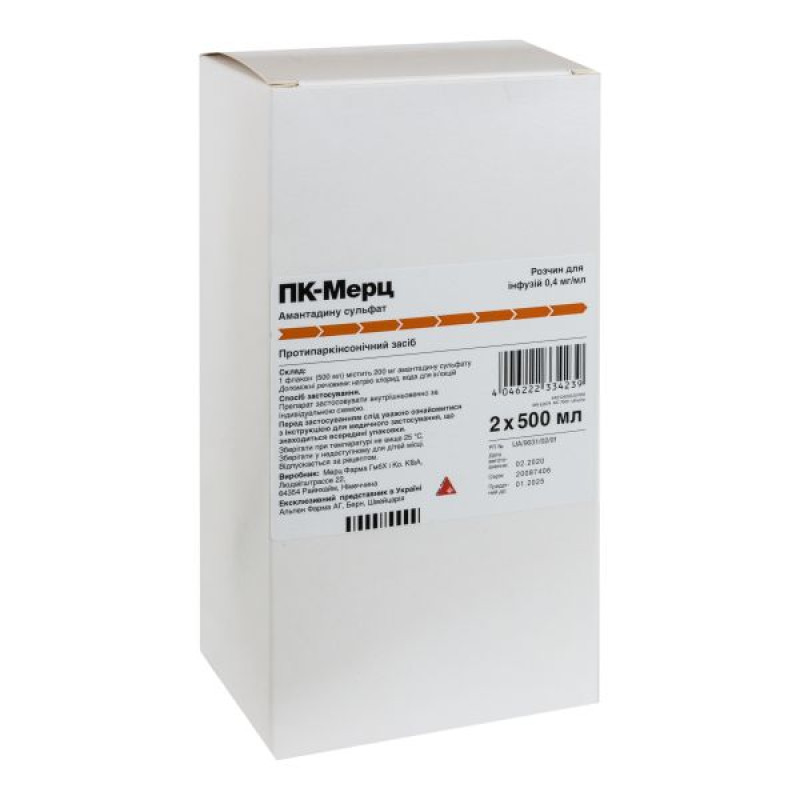
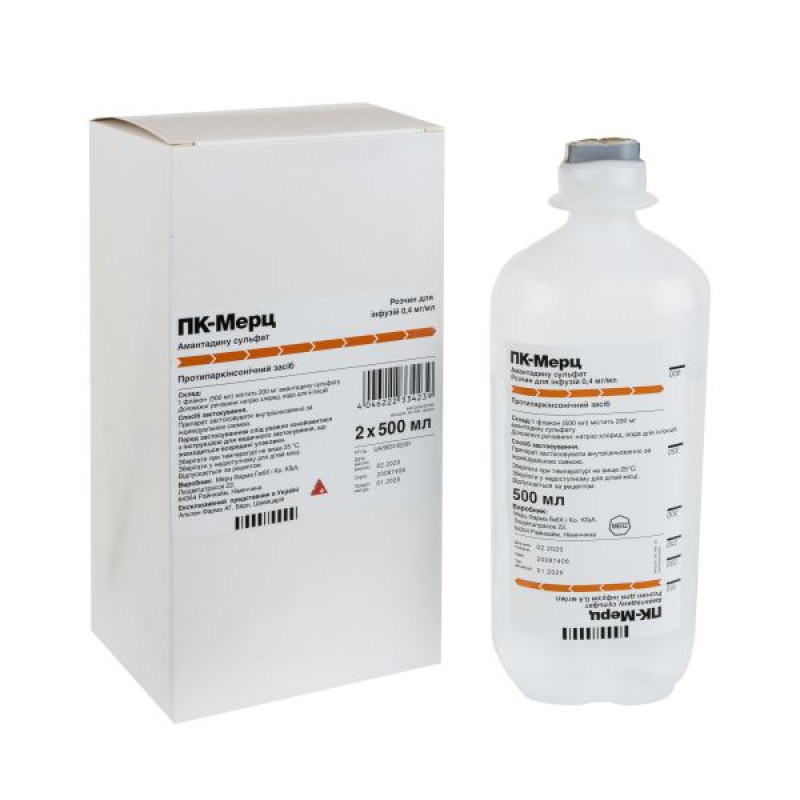
500 ml of solution in a bottle; 2 bottles in a cardboard box.
Vacation category
According to the recipe.
Producer
Merz Pharma GmbH and Co. KGaA/Merz Pharma GmbH & Co. KGaA.
Address
Ludwigstrasse 22, 64354 Reinheim, Germany.