Plazmoven®
(Plasmoven)
Composition:
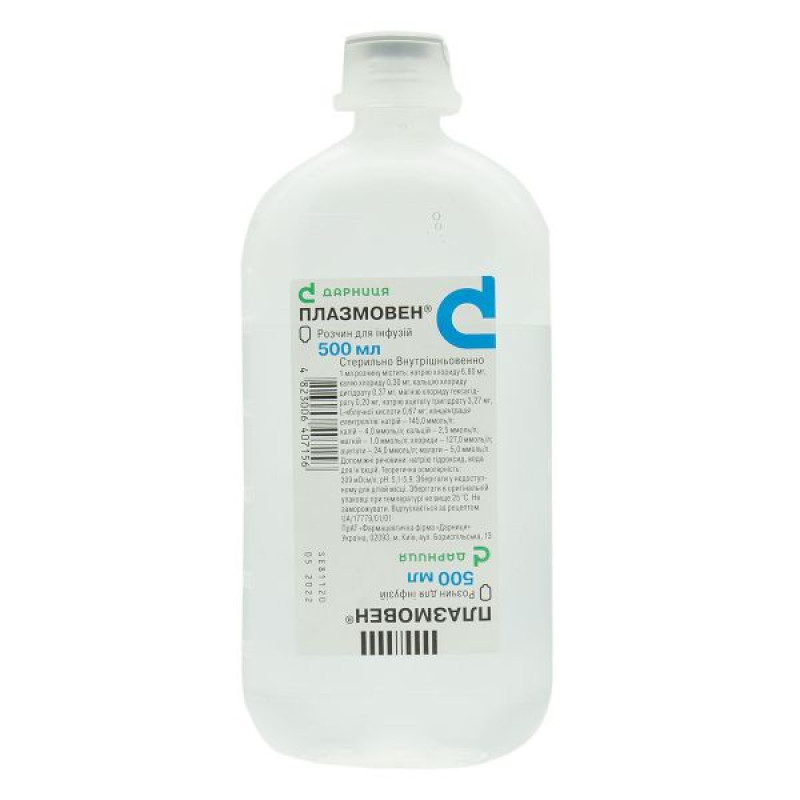
active ingredients: sodium chloride; potassium chloride; calcium chloride dihydrate; magnesium chloride hexahydrate; sodium acetate trihydrate; L-malic acid;
1 ml of solution contains sodium chloride 6.80 mg, potassium chloride 0.30 mg, calcium chloride dihydrate 0.37 mg, magnesium chloride hexahydrate 0.20 mg, sodium acetate trihydrate 3.27 mg, L-malic acid 0.67 mg;
electrolyte concentration: sodium – 145.0 mmol/l; potassium – 4.0 mmol/l; calcium – 2.5 mmol/l; magnesium – 1.0 mmol/l; chlorides – 127.0 mmol/l; acetates – 24.0 mmol/l; malates – 5.0 mmol/l;
Excipients: sodium hydroxide, water for injections.
Dosage form.
Solution for infusion.
Main physical and chemical properties: clear, colorless liquid. Theoretical osmolarity: 309 mOsm/l; pH: 5.1–5.9.
Pharmacotherapeutic group.
Blood substitutes and perfusion solutions. Solutions for intravenous administration. Solutions used to correct electrolyte imbalances. Electrolytes. ATX code B05B B01.
Pharmacological properties.
Pharmacodynamics.
This medicinal product is an isotonic electrolyte solution in which the electrolyte concentrations correspond to their plasma concentrations. It is used to correct extracellular fluid losses (i.e. loss of water and electrolytes in proportional amounts). The purpose of the solution is to restore and maintain normal osmotic conditions in the extracellular and intracellular spaces.
The anionic composition of the drug is a balanced combination of chlorides, acetates and malates, which prevents the occurrence of metabolic acidosis.
Pharmacokinetics.
Since Plasmoven® is administered intravenously, its bioavailability is 100%.
Sodium and chloride are distributed primarily in the extracellular space, while potassium, magnesium, and calcium are distributed primarily intracellularly. The kidneys are the primary route of excretion for sodium, potassium, magnesium, and chloride, although minor amounts of electrolytes are lost through the skin and digestive tract. Calcium is excreted in approximately equal amounts in urine and by intestinal secretion.
During infusion of acetates and malates, their plasma levels increase until steady-state levels are reached. After cessation of infusion, anion concentrations decrease rapidly. Urinary excretion of acetates and malates increases during infusion, but their metabolism in body tissues is so rapid that only minor fractions are detected in the urine.
Clinical characteristics.
Indication.
Replacement of intercellular fluid losses in case of isotonic dehydration in the presence or threat of acidosis.
Contraindication.
Hypersensitivity to any active substance or excipient included in the medicinal product.
Hyperhydration.
Severe congestive heart failure.
Renal failure with oliguria or anuria.
Severe general swelling.
Severe hyperkalemia.
Hypercalcemia.
Metabolic alkalosis.
Severe metabolic acidosis.
Interaction with other drugs and other types of interactions.
Sodium, potassium, calcium and magnesium are contained in Plazmoven® in the same concentrations as in blood plasma. Therefore, the use of the drug according to the recommended indications and contraindications does not lead to an increase in plasma concentrations of these electrolytes. In the event of an increase in the concentration of any electrolyte for other reasons, the following interactions should be considered.
Medications that cause sodium retention.
The use of nonsteroidal anti-inflammatory drugs (NSAIDs), corticosteroids/steroids, and carbenoxolone may lead to sodium and water retention (with edema and hypertension).
Drugs that interact with potassium.
Suxamethonium, ACE inhibitors, NSAIDs, potassium-sparing diuretics (amiloride, spironolactone, triamterene, alone or in combination), tacrolimus, cyclosporine may increase plasma potassium concentrations and lead to potentially fatal hyperkalemia, especially in the presence of renal failure, which enhances the hyperkalemic effect and may lead to cardiac arrhythmias.
Potassium administration may reduce the therapeutic effect of cardiac glycosides. ACTH, corticosteroids, and loop diuretics may increase renal elimination of potassium.
Drugs that interact with calcium.
The effect of digitalis glycosides (digitalis cardiotonics) in hypercalcemia may be enhanced and lead to serious or fatal cardiac arrhythmia.
Thiazide diuretics and vitamin D can cause hypercalcemia. Calcium complexes render tetracycline antibiotics inactive.
Drugs that interact with malate.
Alkalization of urine after administration of bicarbonate or bicarbonate precursor results in increased renal clearance of acid-containing drugs.
The half-life of major drugs, especially sympathomimetics (e.g., ephedrine, pseudoephedrine) and stimulants (e.g., dexamphetamine sulfate, fenfluramine hydrochloride), is prolonged when malate-containing solutions are administered simultaneously.
Application features.
Plazmoven® should be prescribed with extreme caution and with constant monitoring to patients with conditions such as:
- hypernatremia;
- hyperchloremia;
- renal failure;
- coma of unknown origin;
- simultaneous treatment with digitalis preparations;
- hyperkalemia or conditions that may lead to hyperkalemia, including Addison's disease, sickle cell anemia;
- hypertensive dehydration, arterial hypertension, impaired renal function, existing or threatened eclampsia, aldosteronism or other conditions or with concomitant treatment with drugs (e.g. corticosteroids/steroids) associated with sodium retention and drugs that increase serum potassium levels (see also section "Interaction with other medicinal products and other types of interactions");
- disorders where sodium restriction is indicated, such as mild to moderate heart failure, peripheral edema, generalized edema, pulmonary edema, preeclampsia or extracellular hyperhydration (for more severe conditions, see section "Contraindications");
- disorders where calcium intake restriction is indicated, such as sarcoidosis.
Patients receiving cardiac glycosides should use potassium- and calcium-containing solutions with caution (see section “Interaction with other medicinal products and other types of interactions”).
Solutions containing potassium salts should be administered with caution to patients with heart disease or conditions that may lead to hyperkalemia, such as renal or adrenocorticoid insufficiency, acute dehydration, or extensive tissue destruction in severe burns.
Due to the presence of calcium:
- caution should be exercised during intravenous administration to avoid extravasation and local irritation by calcium salts;
- in case of simultaneous blood transfusion, this solution should not be administered through the same infusion system as the blood components.
Use as a solvent.
Please note! When using a medicinal product as a solvent, the safety information of the added substance, approved by the relevant manufacturer, should be taken into account.
Solutions containing metabolizable anions should be administered with caution to patients with respiratory impairment.
Clinical monitoring should include serum electrolytes, fluid balance, and pH.
With long-term parenteral treatment, the patient should be prescribed appropriate nutrition.
Elderly patients.
Elderly patients, who are more likely to suffer from heart failure and impaired renal function, should be closely monitored for treatment and the dose should be adjusted to avoid cardiac and renal complications caused by fluid overload.
Children.
Intravenous therapy should be carefully monitored in children, as the ability to regulate fluids and electrolytes may be impaired. Adequate urine output should be ensured. Fluid balance, plasma and urine electrolyte concentrations should be carefully monitored.
When providing short-term volume replacement in the event of bleeding or trauma, volume overload due to overdose should always be avoided.
For intravenous administration only.
For single use only. Any unused solution should be discarded.
Only a clear, practically particle-free solution should be used.
The solution should be administered using a sterile system using aseptic technique. The system should be filled with solution to prevent air from entering.
When using the solution in plastic bags, the protective bag should be removed immediately before use.
Important information about excipients.
This medicinal product contains sodium. This should be taken into consideration by patients on a controlled sodium diet.
Use during pregnancy or breastfeeding.
There are no data on the use of Plasmoven® in pregnant and lactating women. Within the recommended indications, no risk should be expected if the volume of solution administered, electrolyte levels and acid-base parameters are carefully monitored.
Plasmoven® should be used with caution in toxicosis in pregnant women.
The ability to influence the reaction speed when driving vehicles or other mechanisms.
Plazmoven® has no or negligible influence on the ability to drive or operate machinery.
Method of administration and doses.
The dose should be determined depending on the actual need to replenish water and electrolyte levels.
Adults.
Maximum daily dose.
The volume of the administered solution should not exceed 40 ml/kg body weight per day (corresponding to 5.8 mmol sodium per 1 kg body weight and 0.16 mmol potassium per 1 kg body weight).
Additional fluid losses (e.g. due to fever, diarrhoea, vomiting) should be compensated depending on the volume and composition of the lost fluid. In case of dehydration, the dose of 40 ml/kg body weight per day may be exceeded.
The dose should be calculated taking into account the severity of dehydration and the clinical condition of the patient.
In the treatment of acute fluid deficit, namely severe or life-threatening hypovolemic shock, higher doses may be used, for example by rapid infusion (under pressure).
Maximum infusion rate.
When treating dehydration, the maximum infusion rate is 5 ml/kg body weight per hour, which corresponds to 0.7 mmol sodium per kg body weight per hour and 20 µmol potassium per kg body weight per hour.
For short-term intravascular volume replacement, the maximum infusion rate depends on the patient's clinical situation.
In life-threatening situations, 500 ml of the drug can be rapidly administered using manual pressure.
Solvent.
When using Plasmoven® as a diluent, the dosage and infusion rate are determined primarily based on the characteristics and dosing regimen of the diluent.
Pediatric population.
The dose is prescribed by a doctor. The dose depends on the patient's age, body weight, laboratory parameters, clinical condition and concomitant therapy.
Maximum daily dose.
The following daily doses should not be exceeded:
Age Doses (ml/kg body weight per day)
from 28 days of life 160
from 2 months 150
1–2 years 120
3–5 years 100
6–12 years 80
13–18 years 70
Additional fluid losses (e.g. due to fever, diarrhea, vomiting) should be compensated depending on the volume and composition of the lost fluid.
In case of dehydration or short-term intravascular volume replenishment, these doses may be increased.
The dose should be calculated taking into account the severity of dehydration and the clinical condition of the patient.
Infusion rate.
Maximum infusion rate:
Body weight, kg ml/h
0–10 4 ml/kg body weight/hour
10–20 40 ml/h + 2 ml/kg body weight/h > 10 kg
> 20 60 ml/h + 1 ml/kg body weight/h > 20 kg
When treating dehydration, the maximum infusion rate is 5 ml/kg body weight per hour, which corresponds to 0.7 mmol sodium per kg body weight per hour and 20 µmol potassium per kg body weight per hour.
Elderly patients.
In general, the same doses as for adults are used, but attention should be paid to patients with diseases such as heart or kidney failure, which may be associated with old age (see section "Special instructions").
Patients with chronic hyponatremia.
To prevent the development of osmotic demyelinating syndrome, the increase in serum sodium should not exceed 9 mmol/L/day. As a general recommendation, dose adjustment should be between 4 and 6 mmol/L/day for most cases, depending on the patient's condition and associated risk factors.
Method of administration.
For intravenous infusion only.
Plazmoven® can be administered into peripheral veins (for pH and theoretical osmolarity, see the section “Basic physicochemical properties”).
When administered by rapid infusion under pressure, all air must be removed from the plastic container and administration set before infusion, as otherwise there is a risk of air embolism during infusion.
During administration, fluid balance, plasma electrolyte concentration, and pH should be monitored.
Plazmoven® can be administered as long as there are indications for fluid replacement.
Children.
The medicine can be used in children from 28 days of age according to indications.
Overdose.
Excessive or too rapid administration of the solution may lead to water or sodium overload with increased skin turgor, venous stasis and the development of edema, especially in cases of impaired renal sodium excretion. In this case, additional hemodialysis may be required.
Excessive potassium intake can lead to hyperkalemia, especially in patients with renal insufficiency. Its symptoms include paresthesia of the extremities, muscle weakness, paralysis, cardiac arrhythmia, heart block, cardiac arrest, and confusion. Treatment of hyperkalemia includes the use of calcium, insulin (with glucose), sodium bicarbonate, exchange resins, or dialysis.
Excessive parenteral administration of magnesium salts leads to the development of hypermagnesemia, the important signs of which are the loss of deep tendon reflexes and respiratory depression, both manifestations resulting from neuromuscular blockade. Other symptoms of hypermagnesemia may include nausea, vomiting, flushing, thirst, hypotension due to peripheral vasodilation, dizziness, confusion, muscle weakness, bradycardia, coma, and cardiac arrest.
Excessive administration of chlorides can cause loss of bicarbonate with the manifestation of acidosis.
Excessive administration of calcium salts may lead to hypercalcemia. Symptoms of hypercalcemia may include anorexia, nausea, vomiting, constipation, abdominal pain, muscle weakness, mental disorders, polydipsia, polyuria, nephrocalcinosis, kidney stones, and in severe cases, cardiac arrhythmias and coma. Very rapid intravenous administration of calcium salts may also cause numerous symptoms of hypercalcemia, including a chalky taste in the mouth, flushing and peripheral vasodilation. Mild, asymptomatic hypercalcemia usually resolves after discontinuation of calcium and other drugs that cause its development, such as vitamin D. In case of severe hypercalcemia, urgent treatment is required (e.g., loop diuretics, hemodialysis, calcitonin, bisphosphonates, edetate trisodium).
If overdose is due to medicinal products added to the solution, the signs and symptoms of their excessive administration will also be related to the nature of the added substances. In the event of accidental overdose, treatment should be discontinued and the patient should be examined for relevant signs and symptoms related to the medicinal product. Appropriate symptomatic and supportive measures should be taken as necessary.
Treatment.
Stop the infusion immediately. Further treatment depends on the nature and severity of symptoms and may include the administration of diuretics with frequent monitoring of electrolyte balance, correction of electrolyte and acid-base imbalances.
Treatment of hyperkalemia includes the use of calcium, insulin (with glucose), sodium bicarbonate, exchange resins, or dialysis.
Adverse reactions.
Signs of overdose may occur (see section "Overdose").
Hypersensitivity reactions, including urticaria.
Hyperhydration, pulmonary edema, and electrolyte disturbances are possible.
Although oral administration of magnesium salts stimulates peristalsis, paralytic ileus has been reported in rare cases following intravenous administration of magnesium sulfate.
Adverse reactions may be related to the injection technique, including febrile response, infection at the injection site, local pain or local reactions, vein irritation, venous thrombosis or phlebitis extending from the injection site, and extravasation.
Adverse reactions may also be related to drugs added to the solution, the nature of the added substances will determine the type of any other undesirable effects.
Reporting of suspected adverse reactions.
Reporting suspected adverse reactions after the marketing authorisation of a medicinal product is an important procedure. It allows for continued monitoring of the benefit-risk balance of the medicinal product in question. Healthcare professionals should report any suspected adverse reactions via the national reporting system.
Expiration date.
3 years.
Storage conditions.
Store in the original packaging at a temperature not exceeding 25 ° C. Do not freeze.
Keep out of reach of children.
Incompatibility.
Mixing this medicine with medicines containing carbonates, phosphates, sulphates or tartrates may result in the formation of a precipitate.
Packaging.
500 ml in a bottle.
Vacation category.
According to the recipe.
Producer.
PrJSC "Pharmaceutical Company "Darnitsa".
Location of the manufacturer and address of its place of business.
Ukraine, 02093, Kyiv, Boryspilska St., 13.