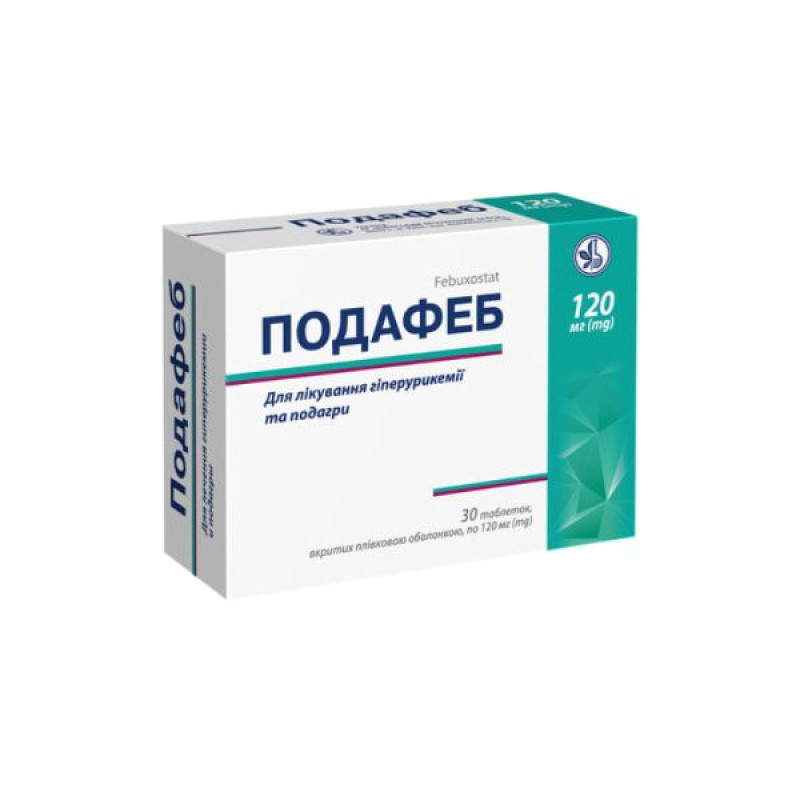
Instructions Podafeb tablets 120 mg No. 30
Composition
active ingredient: febuxostat;
1 tablet contains febuxostat 80 mg or 120 mg;
excipients: lactose, monohydrate; microcrystalline cellulose; hydroxypropyl cellulose; croscarmellose sodium; colloidal anhydrous silica; magnesium stearate; shell: Opadry II Yellow (85F42129) film-coating mixture: polyvinyl alcohol; titanium dioxide (E 171); polyethylene glycol (macrogol); talc; iron oxide yellow (E 172).
Dosage form
Film-coated tablets.
Main physicochemical properties:
80 mg tablets: round tablets with a biconvex surface, film-coated from light yellow to yellow;
120 mg tablets: oblong tablets with a biconvex surface, film-coated from light yellow to yellow.
Pharmacotherapeutic group
Medicinal products for the treatment of gout. Medicinal products that inhibit the formation of uric acid. ATC code M04A A03.
Pharmacological properties
Pharmacodynamics.
Mechanism of action.
Uric acid is the end product of purine metabolism in humans and is formed during the following reaction: hypoxanthine → xanthine → uric acid. Xanthine oxidase catalyzes both steps of this reaction. Febuxostat is a 2-arylthiazole derivative, the therapeutic effect of which is associated with a decrease in serum uric acid concentration by selective inhibition of xanthine oxidase. Febuxostat is a potent and selective non-purine inhibitor of xanthine oxidase (NP-SIXO), with an in vitro Ki (inhibition constant) of less than 1 nanomolar. Febuxostat has been shown to significantly inhibit the activity of both the oxidized and reduced forms of xanthine oxidase. At therapeutic concentrations, febuxostat does not inhibit other enzymes involved in purine or pyrimidine metabolism, such as guanine deaminase, hypoxanthine-guanine phosphoribosyltransferase, orotate phosphoribosyltransferase, orotidine monophosphate decarboxylase, or purine nucleoside phosphorylase.
Clinical efficacy and safety.
Gout
The efficacy of febuxostat was confirmed in phase 3 of three pivotal studies (two pivotal studies, APEX and FACT, and an additional study, CONFIRMS, described below), which included 4101 patients with hyperuricemia and gout. In each of these pivotal phase 3 studies, febuxostat was more effective in reducing and maintaining serum uric acid levels compared to allopurinol. The primary efficacy endpoint in the APEX and FACT studies was the proportion of patients whose serum uric acid concentration did not exceed 6.0 mg/dL (357 μmol/L) during the previous three months. In the additional phase 3 study, CONFIRMS, the primary efficacy endpoint was the proportion of patients whose serum uric acid concentration did not exceed 6.0 mg/dL at the time of the last visit. Patients who had undergone organ transplantation were excluded from these studies (see section 4.4).
The APEX study: The Phase 3 Allopurinol and Placebo-Controlled Efficacy Study of Febuxostat (APEX) was a randomized, double-blind, multicenter, 28-week study. A total of 1072 patients were randomized to receive placebo (n=134), febuxostat 80 mg once daily (n=267), febuxostat 120 mg once daily (n=269), febuxostat 240 mg once daily (n=134), or allopurinol (300 mg once daily (n=258) for patients with baseline serum creatinine ≤ 1.5 mg/dL or 100 mg once daily (n=10) for patients with baseline serum creatinine > 1.5 mg/dL and ≤ 2.0 mg/dL). For safety assessment, febuxostat was administered at a dose of 240 mg (2 times the maximum recommended dose).
The APEX study demonstrated a statistically significant superiority of both treatment regimens: febuxostat 80 mg once daily and febuxostat 120 mg once daily compared to allopurinol at the usual dose of 300 mg (n = 258)/100 mg (n = 10) in reducing serum uric acid concentrations below 6 mg/dL (357 μmol/L) (see Table 1).
FACT Study: The Febuxostat Allopurinol Controlled Trial (FACT) was a phase 3, randomized, double-blind, multicenter, 52-week study. A total of 760 patients were randomized to: febuxostat 80 mg once daily (n = 256), febuxostat 120 mg once daily (n = 251), and allopurinol 300 mg once daily (n = 253).
The FACT study demonstrated statistically significant superiority of both regimens – febuxostat 80 mg once daily and febuxostat 120 mg once daily – compared to allopurinol at the usual dose of 300 mg in reducing and maintaining serum uric acid concentrations below 6 mg/dL (357 μmol/L).
Table 1 presents the results of the assessment of the primary efficacy endpoint.
Proportion of patients with serum uric acid concentration < 6.0 mg/dL (357 μmol/L) during the last three monthly visits
Table 1
| Research | febuxostat 80 mg 1 time per day | febuxostat 120 mg once daily | Allopurinol 300/100 mg once daily 1 |
APEX (28 weeks) | 48% * (n=262) | 65% *, # (n=269) | 22% (n=268) |
FACT (52 weeks) | 53%* (n=255) | 62%* | 21% (n=251) |
| Combined results | 51%* (n=517) | 63%*, # (n=519) | 22% (n=519) |
1 Results among patients receiving 100 mg once daily (n = 10: patients with baseline serum creatinine > 1.5 mg/dL and ≤ 2.0 mg/dL) or 300 mg once daily (n=509) were combined in the analysis. * p < 0.001 compared to allopurinol, # p < 0.001 compared to 80 mg dose | | | |
Febuxostat's ability to rapidly reduce serum uric acid was rapid and long-lasting. Reductions in serum uric acid to <6.0 mg/dL (357 μmol/L) were observed as early as the second week of the study and were maintained throughout treatment.
CONFIRMS Study: The CONFIRMS study was a 26-week, randomized, controlled, phase 3 study conducted to evaluate the safety and efficacy of febuxostat 40 mg and 80 mg compared with allopurinol 300 mg and 200 mg in patients with gout and hyperuricemia. A total of 2269 patients were randomized to receive febuxostat 40 mg once daily (n=757), febuxostat 80 mg once daily (n=756), and allopurinol 300/200 mg once daily (n=756). At least 65% of patients had mild to moderate renal impairment (creatinine clearance 30–89 mL/min). Gout prophylaxis was mandatory for 26 weeks.
The proportion of patients with serum uric acid concentrations < 6.0 mg/dL (357 μmol/L) at the last visit was 45% for febuxostat 40 mg, 67% for febuxostat 80 mg, and 42% for allopurinol 300/200 mg, respectively.
Primary endpoint in the subgroup of patients with renal impairment
The APEX study evaluated the efficacy of the drug in 40 patients with renal impairment (i.e., baseline serum creatinine > 1.5 mg/dL and ≤ 2.0 mg/dL). These patients, randomized to allopurinol, had their dose reduced to 100 mg once daily. The primary efficacy endpoint was achieved in 44% of patients in the febuxostat group (80 mg once daily), 45% (120 mg once daily), and 60% (240 mg once daily) compared with 0% in the allopurinol 100 mg once daily and placebo groups.
At the same time, no clinically significant differences in the percentage reduction in serum uric acid concentration were observed in healthy volunteers, regardless of the functional state of the kidneys (58% in the group with normal kidney function and 55% in the group with severe renal impairment).
A prospective analysis of patients with gout and renal impairment in the CONFIRMS study showed that febuxostat was significantly more effective, reducing serum uric acid levels to < 6.0 mg/dL compared with allopurinol 300 mg/200 mg in patients with gout and mild to moderate renal impairment (65% of subjects).
Primary endpoint in the subgroup of patients with serum uric acid concentration ≥ 10 mg/dL
Baseline serum uric acid concentration ≥ 10 mg/dL was observed in approximately 40% of patients (combined APEX and FACT studies). Among these patients, the primary efficacy endpoint (serum uric acid concentration < 6.0 mg/dL at the last
3 visits) was achieved in the febuxostat subgroups in 41% of patients (80 mg once daily), 48% of patients (120 mg once daily) and 66% of patients (240 mg once daily) compared to 9% in the allopurinol 300 mg/100 mg once daily group and 0% in the placebo group.
In the CONFIRMS study, the proportion of patients who achieved the primary efficacy endpoint (serum uric acid concentration < 6.0 mg/dL at the last visit) in the group of patients with baseline serum uric acid concentration ≥ 10 mg/dL who received febuxostat 40 mg once daily was 27% (66/249), febuxostat 80 mg once daily 49% (125/254) and allopurinol 300 mg/200 mg once daily 31% (72/230), respectively.
Clinical outcomes: percentage of patients requiring treatment for gout attacks
APEX study: During the 8-week prophylaxis period, patients in the febuxostat 120 mg treatment group (36%) who required treatment for gout attacks were compared with patients receiving febuxostat 80 mg (28%), allopurinol 300 mg (23%), and placebo (20%). The frequency of attacks was higher after the prophylaxis period and gradually decreased over time. Between 46% and 55% of patients received treatment for gout attacks from week 8 and from week 28. Gout attacks occurring during the last 4 weeks of the trial (weeks 24–28) were observed in 15% of patients (febuxostat 80, 120 mg), 14% of patients (allopurinol 300 mg), and 20% of patients (placebo).
The proportion of patients requiring treatment for gout flares (APEX and FACT studies) was lower in groups where the mean serum uric acid concentration after treatment decreased to < 6.0 mg/dL, < 5.0 mg/dL, or < 4.0 mg/dL compared with groups in which the mean uric acid level was ≥ 6.0 mg/dL in the last 32 weeks of treatment (weeks 20–24 to weeks 49–52).
In the CONFIRMS study, the proportion of patients requiring treatment for gout attacks (1 day every 6 months) was 31% and 25% in the febuxostat 80 mg and allopurinol groups, respectively. There was no difference in the proportion of patients requiring treatment for gout attacks between the febuxostat 80 mg and 40 mg groups.
Long-term extended open-label studies
EXCEL Study (C02-021): The EXCEL study was a 3-year, open-label, multicenter, randomized, allopurinol-controlled, Phase 3 safety study conducted to evaluate the safety of patients who completed the pivotal Phase 3 studies (APEX or FACT). A total of 1086 patients were enrolled in the study, receiving: febuxostat 80 mg once daily (n=649), febuxostat 120 mg once daily (n=292), and allopurinol 300/100 mg once daily (n=145). Approximately 69% of patients did not require therapy adjustment to achieve final stable treatment. Patients with serum uric acid levels > 6.0 mg/dL on three consecutive measurements were excluded from the study.
Serum uric acid levels did not change over time (e.g., 91% and 93% of patients initially treated with febuxostat at doses of 80 mg and 120 mg, respectively, had serum uric acid levels < 6.0 mg/dL at month 36).
According to three-year follow-up data, less than 4% of patients who required treatment for attacks showed a reduction in the frequency of gout attacks at 16–24 months and 30–36 months (i.e., more than 96% of patients did not require treatment for attacks).
In 46% and 38% of patients receiving final stable treatment with febuxostat 80 or 120 mg once daily, respectively, complete resolution of the primary palpable tophus was observed from baseline to the last visit.
The FOCUS study (TMX-01-005) was a 5-year, open-label, multicenter, Phase 2 safety extension study conducted in patients who completed the 4-week double-blind febuxostat dosing in study TMX-00-004. The study included 116 patients who initially received febuxostat 80 mg once daily. 62% of patients did not require dose adjustment to maintain serum uric acid levels below 6.0 mg/dL, and 38% of patients required dose adjustment to achieve final steady-state levels.
The proportion of patients with serum uric acid levels less than 6.0 mg/dL (357 μmol/L) at the last visit was greater than 80% (81–100%) for each febuxostat dose group.
In phase 3 clinical trials, minor changes in liver function tests were observed in patients treated with febuxostat (5.0%). The incidence of these changes was similar to that observed with allopurinol (4.2%) (see section 4.4). In long-term open-label extension studies, elevations in TSH (> 5.5 μIU/mL) were observed in patients treated with febuxostat (5.5%) or allopurinol (5.8%) for extended periods (see section 4.4).
Post-registration long-term studies
The CARES study was a multicenter, randomized, double-blind, non-inferiority trial that compared cardiovascular outcomes with febuxostat and allopurinol in patients with gout and a history of major cardiovascular disease, including myocardial infarction, hospitalization for unstable angina, coronary or cerebral revascularization procedure, stroke, hospitalization for transient ischemic attack, peripheral vascular disease, or diabetes mellitus with evidence of microangiopathy or macroangiopathy. To achieve sUA levels of less than 6 mg/dL, the febuxostat dose was titrated from 40 mg to 80 mg (regardless of renal function), and the allopurinol dose was titrated in 100 mg increments from 300 to 600 mg for patients with normal renal function and mild renal impairment and from 200 to 400 mg for patients with moderate renal impairment.
The primary endpoint in the CARES study was the time to first occurrence of MACE (major adverse cardiovascular events), a composite of non-fatal myocardial infarction, non-fatal stroke, fatal cardiovascular outcome, and unstable angina with urgent coronary revascularization.
Endpoints (primary and secondary) were analyzed according to the intention-to-treat (ITT) analysis, including all subjects who were randomized and received at least one dose of the drug during the double-blind study.
Overall, 56.6% of patients discontinued trial treatment prematurely, and 45% of patients did not complete all study visits.
The primary endpoint of MACE was observed with similar rates in the febuxostat and allopurinol treatment groups (10.8% vs. 10.4% of patients, respectively; hazard ratio [HR] 1.03; two-sided repeated 95% confidence interval [CI] 0.89–1.21).
When analyzing the individual components of MACE, the incidence of cardiovascular mortality was higher in the febuxostat group than in the allopurinol group (4.3% vs. 3.2% of patients; HR 1.34; 95% CI 1.03–1.73). The incidence of other MACE events was similar in the febuxostat and allopurinol groups, i.e. nonfatal myocardial infarction (3.6% vs. 3.8% of patients; HR 0.93; 95% CI 0.72–1.21), nonfatal stroke (2.3% vs. 2.3% of patients; HR 1.01; 95% CI 0.73–1.41), and urgent revascularization for unstable angina (1.6% vs. 1.8% of patients; HR 0.86; 95% CI 0.59–1.26).
All-cause mortality was also higher in the febuxostat group than in the allopurinol group (7.8% vs. 6.4% of patients; HR 1.22; 95% CI 1.01–1.47), mainly due to the higher cardiovascular mortality rate in this group (see section 4.4).
Rates of readmission for heart failure, hospitalization for arrhythmias not related to ischemia, venous thromboembolic events, and hospitalization for transient ischemic attacks were comparable for febuxostat and allopurinol.
Tumor lysis syndrome (TLS)
The efficacy and safety of febuxostat for the prevention and treatment of SLE were evaluated in the FLORENCE (FLO-01) study. Febuxostat demonstrated superior and more rapid urate-lowering efficacy compared with allopurinol.
FLORENCE was a randomized (1:1), double-blind, pivotal phase III study comparing febuxostat 120 mg once daily with allopurinol 200–600 mg daily (mean daily allopurinol dose ± SD: 349.7 ± 112.90 mg) in a controlled setting for serum uric acid. Eligible patients were candidates for allopurinol or had no access to rasburicase. The primary endpoints were the area under the serum uric acid concentration curve (AUC sUA1-8) and the change in serum creatinine (sC), each from day 1 to day 8.
The study included 346 patients with hematological malignancies receiving chemotherapy and at intermediate/high risk of developing SLE. The mean AUC sUA1-8 (mg × h/dL) was significantly lower with febuxostat (514.0 ± 225.71 vs. 708.0 ± 234.42; LS mean difference: -196.794 [95% CI: -238.600, -154.988]; p < .0001). In addition, the mean serum uric acid level was significantly lower with febuxostat, starting from the first 24 hours of treatment and at any time point thereafter. There were no statistically significant differences in mean serum creatinine (%) between febuxostat and allopurinol (-0.83 ± 26.98 vs. -4.92 ± 16.70, respectively; LS mean difference: 4.0970 [95% CI: -0.6467, 8.8406]; p=0.0903). Regarding secondary endpoints, there were no statistically significant differences in the incidence of laboratory-confirmed SLE (8.1% and 9.2% for febuxostat and allopurinol, respectively; relative risk: 0.875 [95% confidence interval: 0.4408, 1.7369]; p=0.8488) and no clinical tumor lysis syndrome (1.7% and 1.2% for febuxostat and allopurinol, respectively; relative risk: 0.994 [95% confidence interval: 0.9691, 1.0199]; p=1.0000). The incidence of all treatment-emergent signs and symptoms and adverse reactions was 67.6% versus 64.7% and 6.4% versus 6.4% for febuxostat and allopurinol, respectively. In the FLORENCE study, febuxostat demonstrated superior and more rapid serum uric acid-lowering activity compared with allopurinol. Data comparing febuxostat and rasburicase are currently unavailable. The efficacy and safety of febuxostat have not been established in patients with acute severe GSD, i.e., patients in whom other urate-lowering therapies have failed.
Pharmacokinetics.
In healthy volunteers, the maximum plasma concentration (Cmax) and area under the curve (AUC) increased in a dose-proportional manner after single and multiple doses of febuxostat in the range of 10 mg to 120 mg. At doses of 120 mg to 300 mg, the increase in AUC was greater than dose-proportional. There was no accumulation of febuxostat when doses of 10–240 mg were administered every 24 hours. The estimated mean terminal elimination half-life (t1/2) of febuxostat was approximately 5–8 hours. A population pharmacokinetic/pharmacodynamic analysis was performed on data obtained in patients with hyperuricemia and gout who received febuxostat in doses of 40–240 mg once daily. In general, the obtained values of pharmacokinetic parameters correspond to those in healthy volunteers, who therefore represent a good model for assessing the pharmacokinetics/pharmacodynamics of the drug in patients with gout.
Febuxostat is rapidly (tmax (time to maximum concentration) 1.0–1.5 hours) and well (at least 84%) absorbed. After single and multiple oral doses of 80 mg or 120 mg once daily, Cmax is 2.8–3.2 μg/ml and 5.0–5.3 μg/ml, respectively. The absolute bioavailability of febuxostat tablets has not been studied. After multiple doses of 80 mg once daily or a single dose of 120 mg in combination with a fatty meal, Cmax was reduced by 49% and 38%, and AUC was reduced by 18% and 16%, respectively. However, this was not accompanied by clinically significant changes in the degree of reduction in serum uric acid levels (with multiple doses of 80 mg). Thus, the drug can be used regardless of food intake.
Distribution
The estimated steady-state volume of distribution (Vss/F) for febuxostat ranges from 29 to 75 L after oral administration at a dose of 10–300 mg. The degree of binding of febuxostat to plasma proteins (mainly albumin) is 99.2% and does not change with increasing dose from 80 mg to 120 mg. For the active metabolites of febuxostat, the degree of binding to plasma proteins ranges from 82 to 91%.
Metabolism
Febuxostat is extensively metabolized by conjugation involving uridine diphosphate glucuronyl transferase (UDP-glucuronyl transferase) and oxidation involving cytochrome P450 (CYP) enzymes. A total of 4 pharmacologically active hydroxyl metabolites of febuxostat have been identified; 3 of these have been detected in human plasma. In vitro studies in human liver microsomes have shown that these oxidized metabolites are formed primarily by CYP1A1, CYP1A2, CYP2C8 or CYP2C9, while febuxostat glucuronide is formed primarily by UDP-glucuronyl transferases 1A1, 1A8 and 1A9.
Breeding
Febuxostat is eliminated from the body via the liver and kidneys. Following oral administration of 80 mg 14C-febuxostat, approximately 49% was excreted in the urine as unchanged febuxostat (3%), acylglucuronide of the active substance (30%), known oxidized metabolites and their conjugates (13%), and other unknown metabolites (3%). In addition to renal excretion, approximately 45% of the dose was excreted in the feces as unchanged febuxostat (12%), acylglucuronide of the active substance (1%), known oxidized metabolites and their conjugates (25%), and other unknown metabolites (7%).
Special patient groups
Renal impairment. Multiple dosing of febuxostat at a dose of 80 mg did not show any changes in febuxostat Cmax in patients with mild, moderate, or severe renal impairment compared to patients with normal renal function. The mean total AUC of febuxostat increased approximately 1.8-fold from 7.5 μg × hour/mL in patients with normal renal function to 13.2 μg × hour/mL in patients with severe renal impairment. The Cmax and AUC of the active metabolites increased 2- and 4-fold, respectively. However, no dose adjustment is required in patients with mild or moderate renal impairment.
Hepatic impairment: Multiple dosing of febuxostat at a dose of 80 mg did not result in significant changes in Cmax and AUC of febuxostat and its metabolites in patients with mild (Child-Pugh Class A) and moderate (Child-Pugh Class B) hepatic impairment compared to patients with normal hepatic function. The drug has not been studied in patients with severe hepatic impairment (Child-Pugh Class C).
Age: After multiple oral doses of febuxostat, there were no significant changes in AUC of febuxostat and its metabolites in elderly patients compared to young healthy volunteers.
Gender: Following multiple oral doses of febuxostat, febuxostat Cmax and AUC were 24% and 12% higher, respectively, in females than in males. However, weight-adjusted Cmax and AUC were similar in both groups, and no dose adjustment for febuxostat is necessary based on gender.
Indication
For 80 mg and 120 mg dosages
Treatment of chronic hyperuricemia in diseases accompanied by the deposition of urate crystals, including the presence of tophi and/or gouty arthritis at present or in history.
For 120 mg dosage
Treatment and prevention of hyperuricemia in adult patients undergoing chemotherapy for hematological malignancies at moderate or high risk of tumor lysis syndrome (TLS).
The medicine is indicated for adult patients.
Contraindication
Hypersensitivity to the active substance or to any other excipient of the medicinal product.
Interaction with other medicinal products and other types of interactions
Mercaptopurine/azathioprine
According to its mechanism of action, febuxostat inhibits xanthine oxidase, therefore concomitant use is not recommended. Inhibition of xanthine oxidase may lead to increased plasma concentrations of both drugs, which may cause a toxic reaction. Interaction studies of febuxostat with drugs (except theophylline) metabolized by xanthine oxidase have not been conducted in humans.
No interaction studies have been conducted with febuxostat during other cytotoxic chemotherapy. In the study, patients with SLE receiving multiple chemotherapy regimens, including monoclonal antibodies, were administered febuxostat at a dose of 120 mg. However, drug-drug and drug-disease interactions were not investigated in this study. Therefore, the possibility of interactions with any concomitantly administered cytotoxic drugs cannot be excluded.
Rosiglitazone/CYP2C8 substrates
Febuxostat is a weak inhibitor of CYP2C8 in vitro. In a study in healthy volunteers, coadministration of 120 mg of febuxostat once daily with a single oral dose of 4 mg of rosiglitazone had no effect on the pharmacokinetics of rosiglitazone and its metabolite N-desmethylrosiglitazone, indicating that febuxostat does not inhibit CYP2C8 in vivo. Therefore, concomitant administration of febuxostat and rosiglitazone or other CYP2C8 substrates does not require dose adjustments for these drugs.
Theophylline
An interaction study of febuxostat was conducted in healthy volunteers to assess the effect of xanthine oxidase inhibition on the increase in circulating theophylline levels observed with other xanthine oxidase inhibitors. The results of the study showed that there was no pharmacokinetic interaction or effect on the safety of theophylline when febuxostat 80 mg was co-administered with theophylline 400 mg. Therefore, febuxostat 80 mg can be co-administered with theophylline without any special precautions. There are no data available for the 120 mg dose of febuxostat.
Naproxen and other glucuronidation inhibitors
Febuxostat metabolism is dependent on the activity of the enzyme UDP-glucuronyltransferase. Drugs that inhibit glucuronidation, such as NSAIDs and probenecid, could theoretically affect the elimination of febuxostat. In healthy volunteers, concomitant administration of febuxostat and naproxen 250 mg twice daily resulted in an increase in febuxostat exposure (Cmax 28%, AUC 41%, t1/2 26%). In studies, the use of naproxen and other NSAIDs/COX-2 inhibitors was not associated with a clinically significant increase in adverse reactions.
Febuxostat can be used concomitantly with naproxen without changing their doses.
Glucuronidation inducers
Strong inducers of the enzyme UDP-glucuronyltransferase may increase the metabolism and reduce the efficacy of febuxostat. In patients receiving strong inducers of glucuronidation, it is recommended to monitor plasma uric acid levels after 1-2 weeks of concomitant therapy. When the inducer of glucuronidation is discontinued, an increase in febuxostat plasma levels may occur.
Colchicine/indomethacin/hydrochlorothiazide/warfarin
Febuxostat can be used concomitantly with colchicine or indomethacin without changing the dose of the drugs.
There is also no need to change the dose of febuxostat when used simultaneously with hydrochlorothiazide.
Concomitant use of febuxostat with warfarin does not require a change in the dose of warfarin. Co-administration of febuxostat (80 mg or 120 mg once daily) with warfarin does not affect the pharmacokinetics of warfarin. Co-administration with febuxostat also does not affect the international normalized ratio (INR) and factor VII activity.
Desipramine/CYP2D6 substrates
In vitro data indicate that febuxostat is a weak inhibitor of CYP2D6. In a study in healthy volunteers receiving 120 mg of febuxostat once daily, a 22% increase in the AUC of desipramine (a CYP2D6 substrate) was observed, indicating that febuxostat is a weak inhibitor of the CYP2D6 enzyme in vivo.
Therefore, there is no need to adjust the doses of febuxostat and CYP2D6 substrates when co-administered.
Antacids
When used simultaneously with antacids containing magnesium hydroxide and aluminum hydroxide, a delay in the absorption of febuxostat (approximately 1 hour) and a decrease in Cmax by 32% are noted, however, the AUC of febuxostat does not change significantly, therefore febuxostat can be used with antacids.
Application features
Cardiovascular diseases
Treatment of chronic hyperuricemia
In the APEX and FACT studies, an increased number of cardiovascular events (Anti-Platelet Trialists' Collaboration (APTC)) (endpoints defined in the antiplatelet therapy (APTC) analysis group, including cardiovascular death, non-fatal myocardial infarction, non-fatal stroke) were reported in the overall febuxostat group compared to the allopurinol group (1.3 versus 0.3 events per 100 patient-years), in contrast to the CONFIRMS study. The rate of cardiovascular events (APTC) reported in the combined phase 3 studies (APEX, FACT, and CONFIRMS studies) was 0.7 versus 0.6 events per 100 patient-years. In long-term large-scale studies, the incidence of cardiovascular events was 1.2 and 0.6 cases per 100 patient-years for febuxostat and allopurinol, respectively. The differences were not statistically significant, and a causal relationship between these events and febuxostat was not established. Identified risk factors in these patients included diseases resulting from atherosclerosis and/or myocardial infarction or congestive heart failure in history.
In the post-marketing CARES study, the incidence of MACE was similar in the febuxostat and allopurinol groups (HR 1.03; 95% CI 0.89–1.21), but there was a higher incidence of cardiovascular death (4.3% vs. 3.2% of patients; HR 1.34; 95% CI 1.03–1.73).
Prevention and treatment of hyperuricemia in patients at risk of developing Gout
Patients undergoing chemotherapy for hematological malignancies with moderate or high risk of SLE and using febuxostat should be monitored by a cardiologist if clinically indicated.
Allergy/hypersensitivity to medications
There have been rare reports of serious allergic/hypersensitivity reactions, including life-threatening Stevens-Johnson syndrome, toxic epidermal necrolysis, and acute anaphylactic reactions/shock, during post-marketing surveillance. Most of these reactions occurred within the first month of febuxostat use. Several, but not all, patients had a history of renal impairment and/or hypersensitivity to allopurinol. Severe hypersensitivity reactions, including drug rash with eosinophilia and systemic symptoms (DRESS), have been associated with fever, haematological, renal or hepatic failure in some cases.
Patients should be informed of the signs and symptoms of hypersensitivity/allergy and monitored for the development of such reactions. Febuxostat should be discontinued immediately if serious allergic/hypersensitivity reactions, including Stevens-Johnson syndrome, occur, as early discontinuation improves the prognosis. If a patient develops an allergic/hypersensitivity reaction, including Stevens-Johnson syndrome and acute anaphylactic reactions/shock, then re-administration of febuxostat is contraindicated.
Gout flare-up (attack)
Febuxostat treatment should only be initiated after an exacerbation of the disease. Febuxostat may precipitate a gout attack at the start of treatment by altering serum uric acid levels due to the release of urate from the depot. At the start of treatment with febuxostat, it is recommended to prescribe nonsteroidal anti-inflammatory drugs (NSAIDs) or colchicine for at least 6 months to prevent gout attacks.
If a gout attack develops while taking febuxostat, treatment should be continued. At the same time, appropriate individual therapy for gout exacerbations should be carried out. With prolonged use of febuxostat, the frequency and severity of gout attacks are reduced.
Xanthine deposition
In patients with accelerated urate formation (e.g., against the background of malignant neoplasms and their treatment or in Lesch-Nyhan syndrome), a significant increase in the absolute concentration of xanthines in the urine is possible, which in rare cases is accompanied by their deposition in the urinary tract. This was not observed in the pivotal clinical study of febuxostat in SLP. Due to limited experience, febuxostat is not indicated in patients with Lesch-Nyhan syndrome.
Mercaptopurine/azathioprine
Febuxostat is not recommended for use in patients receiving concomitant mercaptopurine/azathioprine, as inhibition of xanthine oxidase by febuxostat may result in increased plasma concentrations of mercaptopurine/azathioprine, which may lead to severe toxicity. No interaction studies have been performed in patients. I