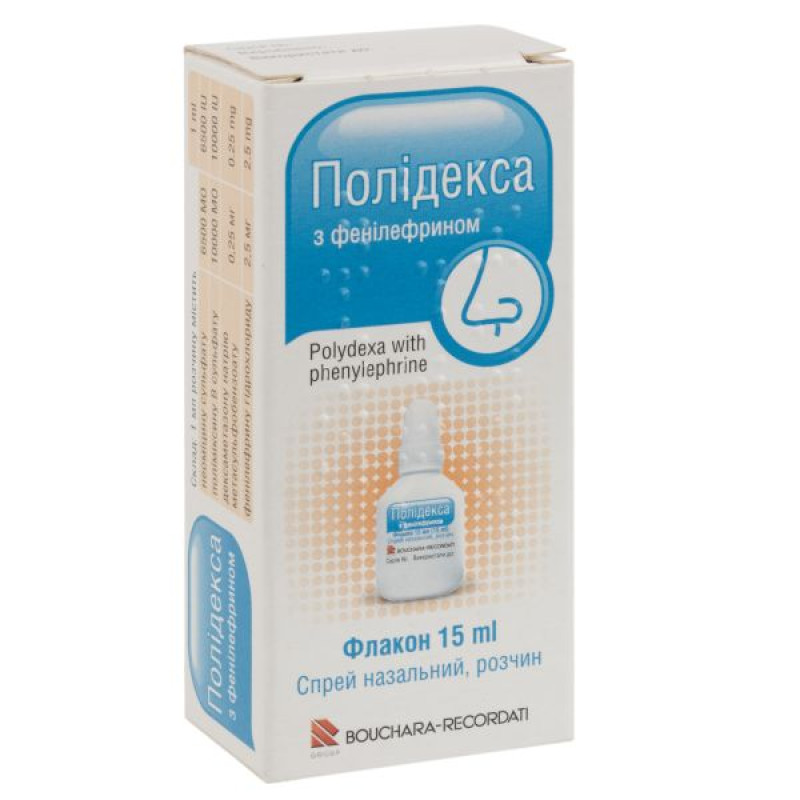
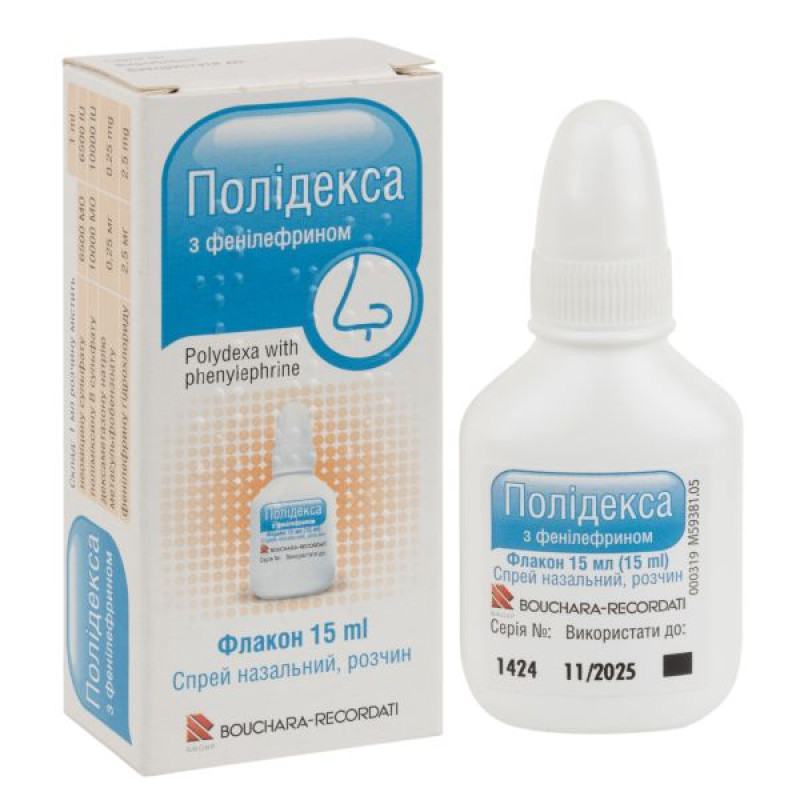
Instructions for Polydex with phenylephrine spray nasal solution bottle with sprayer 15 ml
Composition
active ingredients: 1 ml of solution contains neomycin sulfate 6500 IU, polymyxin B sulfate 10000 IU, dexamethasone sodium metasulfobenzoate 0.25 mg, phenylephrine hydrochloride 2.5 mg;
Excipients: methyl parahydroxybenzoate (E 218), lithium chloride, citric acid monohydrate, lithium hydroxide, macrogol 4000, polysorbate 80, purified water.
Dosage form
Nasal spray, solution.
Main physicochemical properties: clear liquid.
Pharmacotherapeutic group
Drugs used in diseases of the nasal cavity. Dexamethasone, combinations. ATX code R01A D53.
Pharmacological properties
Pharmacodynamics
The therapeutic effect of the drug is due to the anti-inflammatory effect of dexamethasone on the nasal mucosa, the vasoconstrictor effect of phenylephrine and the antimicrobial effect of neomycin and polymyxin B. The combination of these antibiotics expands the spectrum of antimicrobial action against most gram-positive and gram-negative microorganisms that cause infectious and inflammatory diseases of the nasal cavity and paranasal sinuses. Due to the vasoconstrictor effect of phenylephrine, the feeling of nasal congestion decreases.
Polymyxin B is active against Acinetobacter, Aeromonas, Alcaligenes, Citrobacter, Enterobacter, E.coli, Klebsiella, Moraxella, P.aeruginosa, Salmonella, Shigella, S.maltophilia.
Cocci and bacilli resistant to Polymyxin B, B.catarrhalis, Brucella, B.cepacia, B.pseudomallei, Campylobacter, C.meningosepticum, Legionella, Morganella, Neisseria, Proteus, Providencia, Serratia, V.cholerae El Tor, Mycobacteria.
Neomycin is active against Corynebacterium, Listeria monocytogenes, Met-S Staphylococcus, Acinetobacter, B.catarrhalis, Campylobacter, Citrobacter, Enterobacter, E.coli, H.influenzae, Klebsiella, Morganella, Proteus, Providencia, Salmonella, Serratia, Shigella, Yersinia, Pasteurella.
Enterococci, N.asteroides, Met-R Staphylococcus, Streptococcus, A.denitrificans, Burkholderia, Flavobacterium sp., P.stuartii, P.aeruginosa, S.maltophilia, Chlamidia, Mycoplasma, Rickettsiae, and resistant anaerobes are resistant to Neomycin.
Pharmacokinetics
Pharmacokinetic studies of the drug were not conducted due to low systemic absorption.
Indication
Inflammatory and infectious diseases of the nasal cavity, including acute rhinitis, acute sinusitis.
Contraindication
children under 15 years of age; hypersensitivity to any of the components of the drug, in particular to parabens and aminoglycosides; history of stroke or risk factors that may contribute to stroke due to the alpha-sympathomimetic activity of vasoconstrictors; severe or difficult-to-treat hypertension; severe coronary insufficiency; suspected angle-closure glaucoma; suspected urinary retention during urethro-prostatic disorders; presence of nasal infections caused by herpes simplex or herpes zoster viruses, chickenpox; history of convulsions;
simultaneous use with non-selective MAO inhibitors due to the risk of paroxysmal hypertension and hyperthermia (see section "Interaction with other medicinal products and other types of interactions");
simultaneous use with other indirect sympathomimetics or alpha-sympathomimetics, regardless of the route of administration, oral or nasal, due to the risk of vasoconstriction or hypertensive crisis (see section "Interaction with other medicinal products and other types of interactions").
Interaction with other medicinal products and other types of interactions
Below are the features of drug interactions that occur with the systemic distribution of the drug's active ingredients.
Interactions related to phenylephrine
Invalid combinations:
with non-selective irreversible MAO inhibitors: risk of paroxysmal hypertension, hyperthermia, which can be fatal. Due to the long-term effect of MAO inhibitors, interaction is possible for 2 weeks after discontinuation of MAO inhibitors. with other indirect sympathomimetics and alpha-sympathomimetics (oral and/or nasal): risk of vasoconstriction and/or hypertensive crisis.
Undesirable combinations:
with dopaminergic ergot alkaloids and vasoconstrictor ergot alkaloids: risk of vasoconstriction and/or hypertensive crisis; with selective and reversible MAO inhibitors, including linezolid and methylene blue: risk of vasoconstriction and/or hypertensive crisis.
Combinations that require careful use:
with volatile halogenated anesthetics: perioperative hypertensive crisis. In the case of planned intervention, it is advisable to interrupt treatment a few days before surgery.
Interactions related to dexamethasone
Undesirable combinations:
with acetylsalicylic acid: increased risk of bleeding when used simultaneously with anti-inflammatory doses of acetylsalicylic acid (≥ 1 g per dose or ≥ 3 g per day).
with aminoglutethimide: increased activity of dexamethasone (due to increased metabolism in the liver). Dexamethasone dose adjustment is necessary; with drugs that cause torsades de pointes: increased risk of ventricular arrhythmias, including torsades de pointes. Before treatment with the drug, assess for hypokalemia and perform serum potassium determination and electrocardiography; with other drugs that reduce blood potassium levels (hypokalemic diuretics alone or in combination, laxatives, intravenous amphotericin B, glucocorticoids and tetracosactides): increased risk of hypokalemia due to additive effect. Hypokalemia is a factor contributing to the occurrence of cardiac arrhythmias (especially torsades de pointes) and increases the toxicity of some drugs. Serum potassium should be monitored and adjusted if necessary; with digitalis preparations: hypokalemia exacerbates the toxic effects of digitalis preparations. Before treatment with the drug, assess for hypokalemia and perform serum potassium determination and electrocardiography; with anticonvulsants, enzyme inducers: decreased plasma concentration and efficacy of corticosteroids by increasing their metabolism in the liver. The consequences of this are particularly severe (or important) for patients with Addison's disease treated with hydrocortisone and in the case of organ transplantation. Clinical and laboratory monitoring is necessary, as well as corticosteroid dose adjustment during combination therapy and after discontinuation of enzyme inducers; with praziquantel: decreased plasma concentration of praziquantel, with subsequent risk of treatment failure, by increasing its metabolism in the liver. Separate the administration of these drugs by at least one week.
Combinations that require attention:
with antihypertensive agents: possible weakening of the hypotensive effect (salt and water retention in the body due to the effect of corticosteroids); with clarithromycin, erythromycin, ritonavir-stimulated protease inhibitor, itraconazole, ketoconazole, nelfinavir, posaconazole, telithromycin, voriconazole: increased plasma concentration of dexamethasone by reducing its metabolism in the liver due to enzyme inhibition, with the risk of Cushingoid syndrome; with acetylsalicylic acid: increased risk of bleeding with antipyretic or analgesic doses ≥ 500 mg per dose or < 3 g per day; with non-steroidal anti-inflammatory drugs: increased risk of peptic ulcer and gastrointestinal bleeding; with fluoroquinolones: possible increased risk of tendinitis or even tendon rupture (rarely), particularly in patients who have been treated with corticosteroids for a long time.
Application features
The drug should not be swallowed.
The drug should not be used beyond the prescribed period. Long-term use of the drug is not recommended due to the risk of withdrawal syndrome and iatrogenic rhinitis. Repeated and/or prolonged inhalation may cause systemic absorption of the active substances.
The presence of a corticosteroid in the drug does not prevent local allergy symptoms, but may change their course.
If necessary, simultaneous use with systemic antibiotics is possible.
Due to the presence of a sympathomimetic in the composition, it is necessary to strictly adhere to the recommended dosages and duration of treatment, and to familiarize yourself with the contraindications. If arterial hypertension, tachycardia, palpitations or heart rhythm disturbances, nausea, or any neurological symptoms (for example, the appearance or exacerbation of headache) occur, the drug should be discontinued.
Use with caution in patients with arterial hypertension, coronary heart disease, hyperthyroidism, psychosis, or diabetes due to the presence of a sympathomimetic in the composition.
There is a possible risk of overdose when used simultaneously with other vasoconstrictors (see "Interaction with other medicinal products and other types of interactions").
Do not prescribe treatment in combination with drugs that lower the seizure threshold, namely terpene derivatives, clobutinol, atropine-containing substances, local anesthetics, or in case of a history of seizures.
Attention athletes: the drug contains a substance (dexamethasone) that may give a positive result in doping control.
After opening the bottle and starting from the first day of using the drug, there is a possibility of microbial contamination of the drug.
Ability to influence reaction speed when driving vehicles or other mechanisms
No cases of impact on reaction speed when driving vehicles were identified.
Use during pregnancy or breastfeeding
It is not recommended for women to use the drug during pregnancy or breastfeeding.
Method of administration and doses
Adults should be prescribed 1 injection 3-5 times a day in each nasal passage, children over 15 years of age - 1 injection 3 times a day in each nasal passage.
The injection is performed by pressing the bottle. When using the drug, the bottle should be held vertically and the head should be slightly tilted forward to inject the solution into the nasal passage in the form of a spray, rather than a jet of liquid.
Children
The drug should not be used in children under 15 years of age.
Overdose
With prolonged treatment (beyond the prescribed period) or when using a dose significantly exceeding the recommended one, this medicine may cause systemic effects: hypothermia, sedation, loss of consciousness, coma, and respiratory depression.
Adverse reactions
Associated with the presence of antibiotics:
Systemic or local allergic reactions (redness, swelling) and sensitization to antibiotics included in the preparation are possible, which may complicate subsequent administration of such or related antibiotics.
Associated with the presence of phenylephrine:
Cardiovascular disorders:
increased heartbeat, tachycardia, myocardial infarction.
On the part of the organs of vision:
angle-closure glaucoma crisis.
From the gastrointestinal tract:
dry mouth, nausea, vomiting.
From the nervous system:
hemorrhagic stroke, particularly in patients using pseudoephedrine hydrochloride products; this cerebrovascular event occurred during treatment with an overdose or with incorrect use in a patient who had vascular risk factors; ischemic stroke, headache, seizures.
Mental disorders:
anxiety, agitation, behavioral abnormalities, hallucinations, insomnia.
Fever, which may be caused by overdose or combined use of drugs that are known to interact, or overdose.
From the genitourinary system:
dysuria (in case of existing urethral or prostate diseases), urinary retention (in particular in case of urethral or prostate diseases).
On the skin:
sweating, rash, itching, hives.
From the vascular side:
arterial hypertension (hypertensive crisis).
Injection site disorders: dry nose, rare allergic reactions.
Expiration date
3 years.
Storage conditions
Store out of the reach of children at a temperature not exceeding 25 °C.
Packaging
15 ml in a bottle with a sprayer in a cardboard box.
Vacation category
According to the recipe.
Producer
Sofartex.
Location of the manufacturer and its business address
Rue Pressoir 21, 28500 Vernouillet, France.